
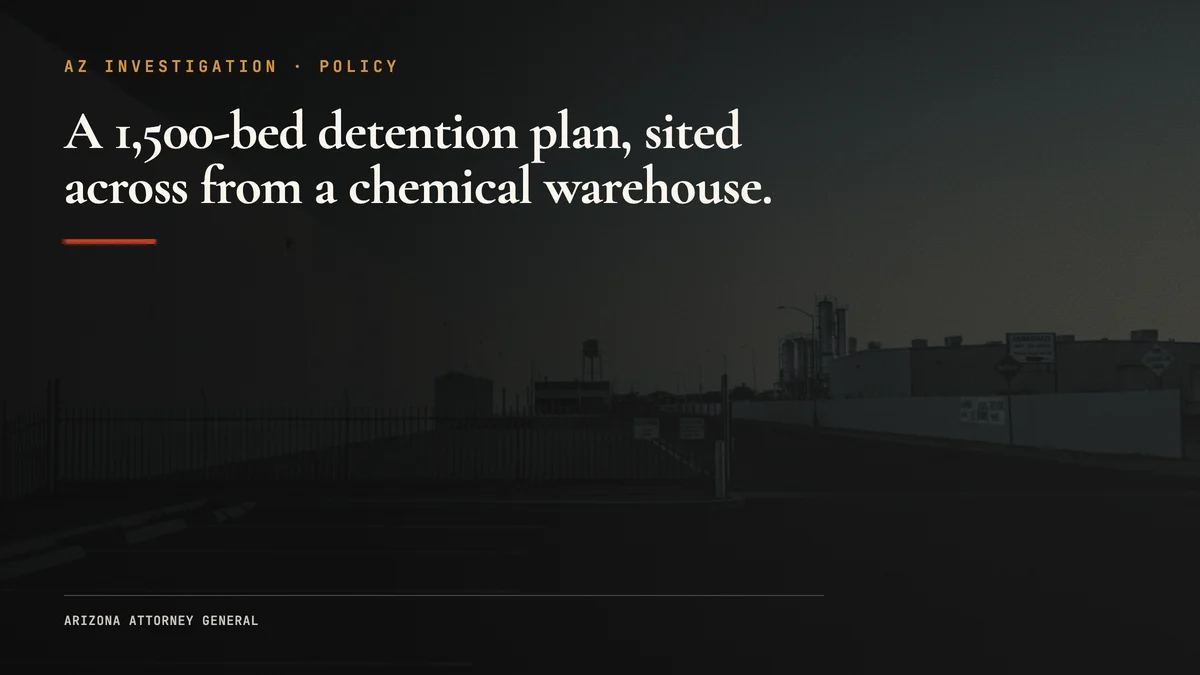
On Friday, April 24, 2026, Arizona Attorney General Kris Mayes filed State of Arizona v. Mullin et al. in the U.S. District Court for the District of Arizona.
The defendants are U.S. Department of Homeland Security Secretary Markwayne Mullin and U.S. Immigration and Customs Enforcement Acting Director Todd Lyons in their official capacities, plus DHS and ICE as agencies.
The complaint pleads violations of the National Environmental Policy Act, the Immigration and Nationality Act, and the Clean Air Act Risk Management Plan provisions.
The single fact that makes this lawsuit different from a partisan press release is the address across the street.
What the AG’s Complaint Actually Says
Mayes’ filing pleads three statutory claims.
The first is the National Environmental Policy Act, 42 USC 4321 et seq. NEPA requires federal agencies to evaluate the environmental impacts of major federal actions before committing resources.
The federal purchase of a 418,400-square-foot warehouse for $70 million, the $313 million in renovation and operations contracts that follow, and the use of the facility as a federal detention site is a major federal action under traditional NEPA case law.
The complaint argues DHS prepared no Environmental Assessment, no Environmental Impact Statement, and no valid claim of a categorical exclusion before committing funds.
The second is the Immigration and Nationality Act. The pleadings on the INA claim were not retrieved from the federal docket within the research window for this piece. The AG’s press release lists INA among the statutory claims but the specific theory needs the complaint itself for verification.
Direct retrieval of the Mullin docket should be done before quoting INA pleadings.
The third is the Clean Air Act, Risk Management Plan provisions, 42 USC 7412(r). The RMP regime requires facilities that store specific quantities of regulated substances to register the substances with EPA, run worst-case and alternative-case release modeling, and file a public Risk Management Plan that contemplates the surrounding land use.
The Rinchem RMP filed January 1, 2026, the AG quotes, did not contemplate a 1,500-bed locked federal detention facility across the street.
Mayes’ verbatim quote in the press release is direct: “The Trump administration has run roughshod over federal law in its rush to expand detention capacity.”
The Hazardous-Chemical Neighbor
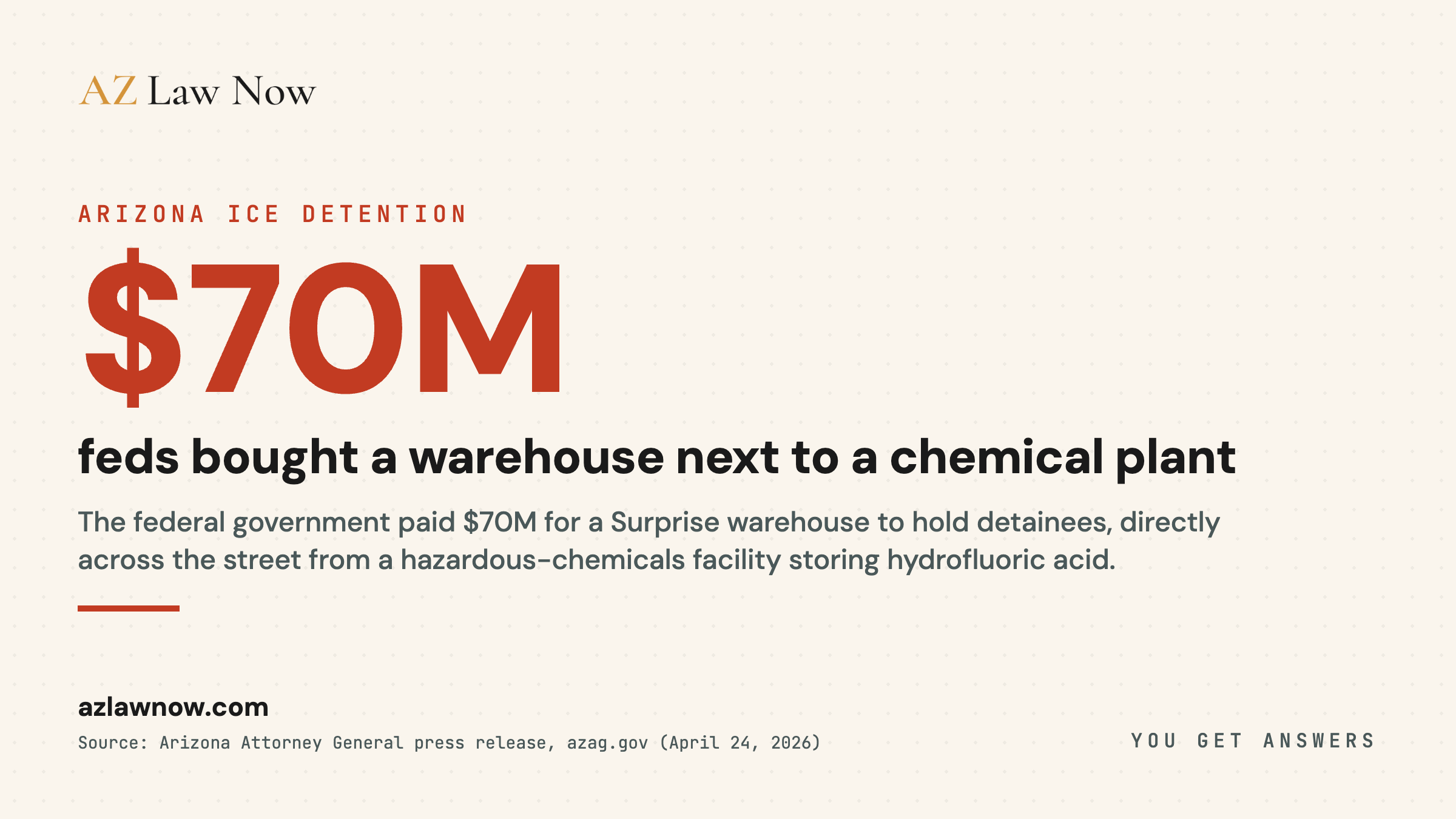
Rinchem Company, LLC operates a hazardous-materials warehouse at 13255 W Sweetwater Avenue. The AG’s complaint describes the site as storing chemicals typical of semiconductor production, and the one substance the complaint names that the article relies on is hydrofluoric acid (hydrogen fluoride).
This isn’t an abstract regulatory concern. Hydrofluoric acid is acutely toxic by inhalation and absorbs through skin. A facility holding regulated substances above threshold quantities has to file a Risk Management Plan under the Clean Air Act precisely because a release can carry real off-site consequences.
A worst-case release modeling scenario filed under 40 CFR Part 68 yields a downwind hazard distance specific to each facility and substance. Direct retrieval of the Rinchem RMP’s specific worst-case distance from the EPA eRMP public reading room was not completed in the research window for this piece.
The exact pound-quantities and the modeled hazard zone need EPA confirmation before publication of any specific evacuation distance.
The AG complaint’s procedural argument doesn’t depend on the exact distance.
It depends on the fact that the federal agency that bought the building next door did not apparently consult the publicly-filed RMP, did not engage Rinchem on the change in adjacent land use, and did not produce a NEPA analysis that addressed any of it.
A locked federal detention facility doesn’t have the option of a community evacuation siren and a 30-minute walk-out window. NEPA’s logic in this case isn’t political.
It’s that federal agencies committing federal funds to facility decisions have to face the consequences in writing, before commitment, when the people affected can’t move. The Rinchem chemicals were across the street first.
What the Federal Government Actually Bought
The site is a 418,400-square-foot vacant industrial warehouse near Dysart Road and Waddell Road in Surprise. The federal government purchased the warehouse for approximately $70 million on January 23, 2026. The complaint shows a renovation and operations contract of $313,357,612.46 awarded to GardaWorld Federal Services LLC.
Initial federal plans referenced up to 1,500 detainees at any given time. Operator plans later in 2026 referenced approximately 550 beds. KJZZ has reported that internal DHS planning documents released by U.S. Representative Paul Gosar in February 2026 pointed to broader scenarios, though those figures aren’t confirmable in a primary DHS document.
The mismatch between the federal-purchase scale and the operator’s lower stated capacity is part of the AG’s transparency concern.
Three Sister-State Suits Already on File
Arizona isn’t freelancing. Three sister-state attorneys general filed materially similar suits against DHS and ICE in 2026 before Arizona, all on warehouse-conversion fact patterns.
Maryland v. DHS/ICE was filed February 23, 2026, in the U.S. District Court for the District of Maryland, on a Williamsport warehouse the federal government purchased for $102 million for a detention facility. The court issued a Temporary Restraining Order on March 11, 2026, and extended limits through April 16.
The Maryland TRO is the precedent that says this argument has already worked in 2026.
New Jersey v. DHS/ICE was filed March 20, 2026, in the District of New Jersey, by AG Jennifer Davenport and Roxbury Township, on a 1,500-bed warehouse conversion. The pleadings include NEPA violations and zoning incompatibility.
Michigan v. DHS/ICE was filed March 24, 2026, by AG Dana Nessel and the City of Romulus. The Michigan complaint alleges DHS failed to assess environmental impacts and failed to provide public notice or consult state and local officials.
Arizona’s filing on April 24 makes this a four-state procedural challenge to DHS warehouse-conversion practice in 2026.
The Eleventh Circuit’s Florida Decision
The legal pivot for the Surprise case is the Eleventh Circuit’s April 21, 2026 decision in Friends of the Everglades, Inc. v. Secretary, U.S. Department of Homeland Security.
The Eleventh Circuit vacated a preliminary injunction in the Florida “Alligator Alcatraz” case on a theory that turns on whether a facility involves both federal funding and federal control. There, the state had built and was operating the facility itself, with federal funds flowing through indirectly.
That holding is the test. Arizona meets it cleanly. The federal government bought the warehouse directly, holds the federal contract for renovation, and contracts for operations. Federal commitment is approximately $70 million in purchase plus $313 million in renovation and operations.
That is the kind of federal funding and federal control that the Eleventh Circuit’s decision puts at the center of the NEPA review question.
The Maryland TRO came on the same fact pattern. Arizona’s case sits in the post-Eleventh-Circuit world with cleaner facts than Florida’s.
What Surprise Knew, and When
Surprise Mayor Kevin Sartor’s public position is that the city wasn’t consulted before the federal purchase on January 23, 2026, and learned of the project only through public reporting. The Mayor sent transparency-demand letters to DHS leadership. The city has stated it lacks legal authority to block the facility itself.
A Surprise City Council meeting in early 2026 drew substantial public comment opposing the facility. Cali Overs, Dysart High School student body president, spoke at City Council against the facility on the record.
Three Surprise City Council seats are confirmed by name in this period: District 2 Councilmember Aly Cline (newly elected), District 3 Councilmember Patrick Duffy (re-elected), and District 4 Councilmember Ken Remley (re-elected). Districts 1, 5, and 6 are open in the 2026 primary.
Confirming the District 1, 5, 6 incumbents requires direct retrieval from surpriseaz.gov before any direct outreach.
Two Arizona state senators have spoken on the record opposing the facility: Sen. Catherine Miranda (D-Laveen) and Sen. Analise Ortiz (D-Phoenix). Two Arizona U.S. senators (Sen. Mark Kelly and Sen. Ruben Gallego) sent transparency letters to DHS earlier in 2026.
This case isn’t asking the federal court to block immigration enforcement. It’s asking the court to require the federal agency to follow the public-process law that has applied to every federal facility decision since 1969.
NEPA is a procedural statute. Mayes’ theory of the case stands on the procedural failure, not on the politics of immigration enforcement. The Maryland TRO landed on the same procedural argument under the same statute in March 2026.
What’s Missing From This Account, and Why
A few things in this report are flagged for follow-up before they’re reported as fact. The PACER docket for State of Arizona v. Mullin was not retrieved in the research window for this piece.
The complaint pleadings, including the specific INA theory and the exact NEPA prayer-for-relief, should be pulled directly from the docket before any in-quotes reporting on them.
The exact regulated substances and pound-quantities on file in Rinchem’s EPA RMP, and the modeled worst-case-release downwind hazard distance, were not pulled from the EPA eRMP public reading room within the budget. Those numbers are the kind of detail that makes the chemical-zone concern concrete in court filings and in subsequent reporting.
The specific DHS NEPA categorical-exclusion claim, if any, is in the agency record DHS will produce in litigation.
For each of these items, the dossier path is documented in the underlying research. For each, the public source of truth exists and is retrievable.
What Comes Next
Three near-term events shape the case.
The first is whether the federal court issues a preliminary injunction or temporary restraining order on the Maryland template. Maryland’s TRO came in March under similar pleadings. Arizona’s request will land before a judge in the District of Arizona who has both the Eleventh Circuit’s federal-funding-and-control framing and the Maryland TRO available as guidance.
The second is the EPA eRMP public reading room data on the Rinchem facility. The hazard distance and the worst-case modeling are part of the public Tier II and RMP record. Coverage that pulls those numbers and maps them against the warehouse footprint advances the public-process argument the AG is making.
The third is whether DHS files an Environmental Assessment, an Environmental Impact Statement, or a categorical-exclusion claim while the case is pending. The administrative record DHS produces will determine the next phase of litigation.
For now, the lawsuit is filed. The complaint places a hazardous-materials warehouse directly across the street. The sister-state TROs are documented. The procedural argument has worked in March 2026, and the Eleventh Circuit’s April decision didn’t close it for Arizona.
This investigation was built from the AG’s April 24, 2026 press release and complaint, the National Environmental Policy Act and Clean Air Act statutory text, and the public dockets for Maryland v. DHS, New Jersey v. DHS, and Michigan v. DHS.
If you have the full State of Arizona v. Mullin complaint pleadings, the EPA eRMP record for Rinchem at 13255 W Sweetwater Avenue, or the DHS NEPA documentation, contact AZ Law Now.
We report from primary sources.
We protect the identity of community members and detainees who share information.
Frequently asked questions
What is State of Arizona v. Mullin and when was it filed?
What is the Rinchem chemical issue and why does it matter?
What is NEPA and why is it the legal pivot here?
Have other states filed similar lawsuits?
What capacity is the Surprise facility planned to hold?
What did the City of Surprise know and when?
What does this lawsuit ask the court to do?
Sources & references
- Arizona Attorney General. (2026, April 24). Attorney General Mayes Sues to Block Proposed ICE Detention Facility in Surprise. Retrieved April 27, 2026, from https://www.azag.gov/press-release/attorney-general-mayes-sues-block-proposed-ice-detention-facility-surprise
- Rinchem Company, LLC. Surprise Arizona Warehouse Location. Retrieved April 27, 2026, from https://www.rinchem.com/locations/arizona-surprise-warehouse/
- National Environmental Policy Act of 1969, 42 USC 4321 et seq.
- Clean Air Act, Risk Management Plan provisions, 42 USC 7412(r). Retrieved from https://www.epa.gov/rmp
- Immigration and Nationality Act, 8 USC 1101 et seq.
- Arizona Revised Statutes Title 41, Chapter 1, Article 4 (Powers of the Attorney General). Retrieved from https://www.azleg.gov/ars/41/00193.htm
- Eleventh Circuit Court of Appeals. (2026, April 21). Friends of the Everglades, Inc. v. Secretary, U.S. Department of Homeland Security (vacating preliminary injunction in Florida 'Alligator Alcatraz' case).
- State of Maryland v. Department of Homeland Security et al., No. 26-733, D. Md. (filed February 23, 2026). Temporary Restraining Order issued March 11, 2026.
- State of New Jersey et al. v. Department of Homeland Security, D.N.J. (filed March 20, 2026).
- State of Michigan and City of Romulus v. Department of Homeland Security, E.D. Mich. (filed March 24, 2026).
- KJZZ. (2026, April 27). Reporting by Camryn Sanchez and Howard Fischer (Capitol Media Services) on the AG complaint.
- KJZZ. The Show. (2026, February 18). Reporting on DHS internal planning documents released by U.S. Rep. Paul Gosar.
- City of Surprise, Arizona. Mayor's Office. Retrieved from https://www.surpriseaz.gov/738/Office-of-the-Mayor---Kevin-Sartor
- U.S. Department of Homeland Security. Directive 023-01 and Instruction Manual 023-01-001-01 (NEPA Implementing Procedures).
- Tucson Sentinel and Arizona Mirror reporting on the April 24, 2026 filing.
- Phoenix New Times. (2026). Coverage of the State of Arizona v. Mullin filing. Retrieved from https://www.phoenixnewtimes.com/news/
Tell Google to show our reporting more often in Search and AI answers.