
The data on every Medicare-certified nursing home in Maricopa County is public. CMS publishes it. It’s free. Anyone can look it up on Care Compare. Most families don’t know it exists.
The federal government inspects nursing homes, logs the violations, tracks the penalties, and publishes the results in a searchable database. Staffing levels, health deficiency citations, abuse complaints, fire safety violations. It’s all there. And the picture it paints for some Arizona facilities isn’t good.
How the Star Rating System Works
CMS assigns every certified nursing home a rating from one to five stars. One star means “much below average.” Five stars means “much above average.” The overall rating combines three separate component scores.
The Three Component Scores
Health inspections
Based on the most recent three years of standard surveys and any complaint investigations. Facilities are inspected by state surveyors working under contract with CMS. In Arizona, that’s the Arizona Department of Health Services.
Staffing
Based on the number of registered nurse (RN) hours and total nursing staff hours per resident per day. CMS calculates these from Payroll-Based Journal data, which facilities are required to submit quarterly.
Quality measures
Based on clinical outcomes: falls with major injury, pressure ulcers, urinary tract infections, emergency department visits, antipsychotic medication use, and other metrics drawn from resident assessment data.
The overall star rating isn’t a simple average of the three. CMS uses a weighted formula that starts with the health inspection score and adjusts upward or downward based on staffing and quality measures. A facility can’t get five stars overall if its health inspection rating is one star.
The rating updates monthly. A facility that had four stars last year might have two stars today. Families should check the current rating, not rely on what the facility told them during the tour.
Reading a Health Deficiency Citation
When a state surveyor finds a problem during an inspection, they issue a deficiency citation. Each citation gets classified on two dimensions: scope and severity.
Scope describes how widespread the problem is.
- Isolated: Affected one or a small number of residents
- Pattern: Affected multiple residents
- Widespread: Affected a large number of residents or represented a systemic failure
Severity describes how serious the harm was.
- No actual harm with potential for minimal harm (Level 1)
- No actual harm with potential for more than minimal harm (Level 2)
- Actual harm that isn’t immediate jeopardy (Level 3)
- Immediate jeopardy to resident health or safety (Level 4)
The combination of scope and severity determines the citation’s letter grade, from A (isolated, minimal harm potential) to L (widespread, immediate jeopardy). Citations at level G and above indicate actual harm or immediate jeopardy. Those are the ones that trigger enforcement actions.
An immediate jeopardy citation means CMS found a situation that has caused or is likely to cause serious injury, harm, impairment, or death to a resident.
Facilities cited at this level face accelerated enforcement timelines, including potential termination from Medicare. If a facility your family member lives in receives an immediate jeopardy citation, take it seriously.
The Penalty Dataset
CMS tracks every penalty imposed on every certified nursing home. The data is public. Penalties come in two forms.
Civil monetary penalties (CMPs). Fines levied against the facility. These can be per-instance (a one-time fine for a specific violation) or per-day (an ongoing fine that accrues daily until the facility corrects the deficiency). Per-day fines range from approximately $129 to $25,847 depending on severity. Per-instance fines reach up to $25,847.
Payment denials. CMS can deny Medicare reimbursement for new admissions. This is the financial equivalent of shutting off the revenue pipeline. Facilities under a denial of payment for new admissions can still bill for existing residents, but they can’t admit new Medicare patients until the deficiency is corrected and verified.
In severe cases, CMS can terminate a facility’s Medicare and Medicaid certification entirely. Termination is rare but not unheard of. It essentially forces the facility to relocate every resident.
Arizona facilities have collectively paid millions in federal penalties over the past decade. The fines are public record and available through CMS’s penalty dataset.
Staffing: The Numbers Behind the Problem
Staffing is the single best predictor of care quality in nursing homes. Every major study on nursing home outcomes reaches the same conclusion: more nursing hours per resident means fewer falls, fewer infections, fewer pressure ulcers, fewer emergency room transfers, and fewer deaths.
CMS collects staffing data through the Payroll-Based Journal system. Every Medicare-certified facility must submit quarterly payroll data showing exactly how many RN hours, LPN/LVN hours, and CNA hours were worked per resident per day. This isn’t self-reported survey data. It’s payroll data. It’s harder to manipulate.
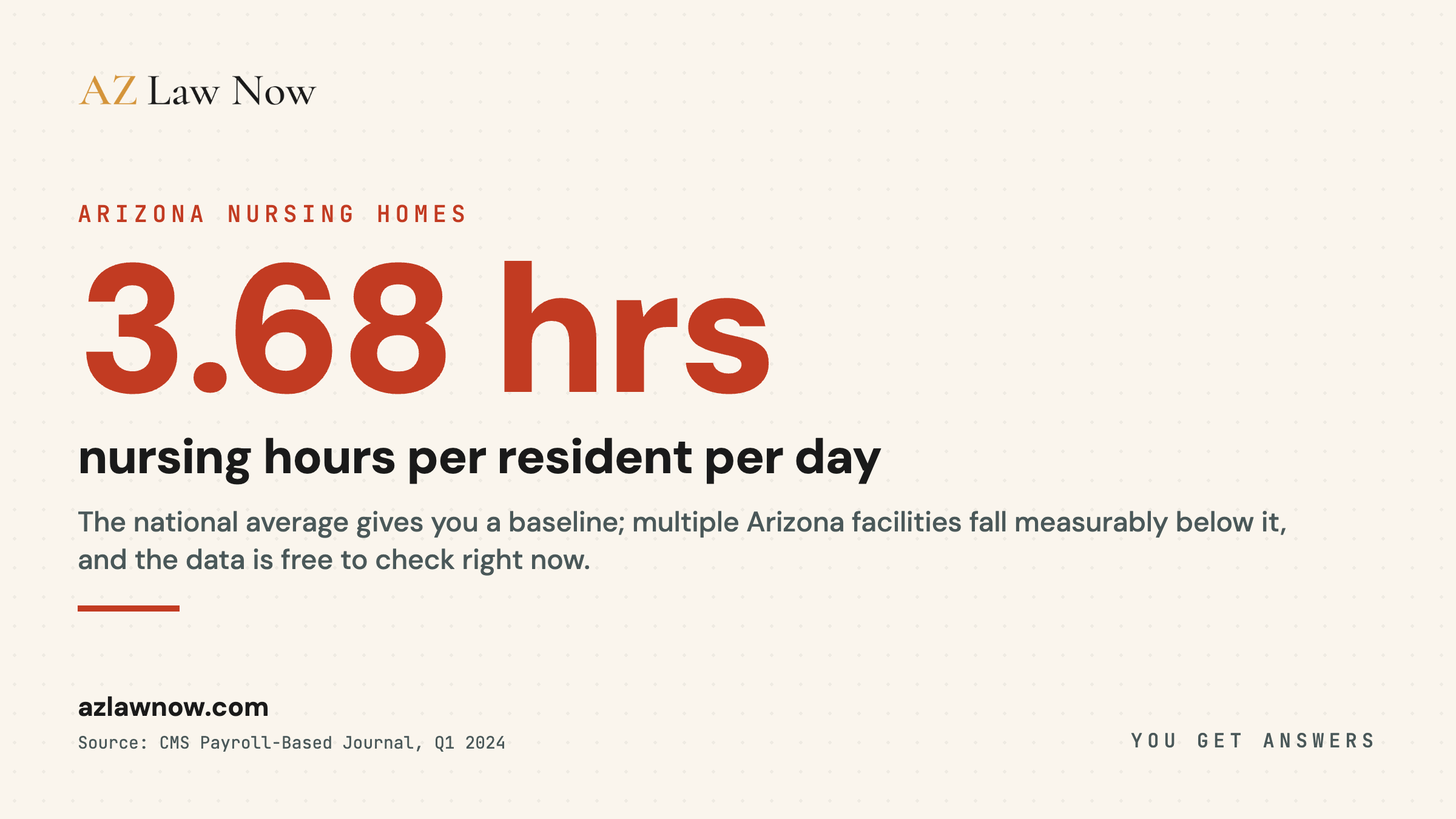
The national average for total nursing staff hours was 3.68 hours per resident per day as of Q1 2024, per CMS Payroll-Based Journal data. That includes RNs, LPNs, and CNAs combined.
Note that CMS published minimum staffing thresholds of 3.48 total HPRD and 0.55 RN HPRD in its 2024 final rule, but Congress repealed that rule in December 2025. There’s currently no federal numeric minimum in effect. Adequacy benchmarks come from the clinical literature and CMS’s star-rating methodology.
Multiple Arizona facilities fall below these thresholds. Some significantly below. The Payroll-Based Journal data is available on the CMS provider data website, broken down by facility, by quarter, by staff type.
Here’s what to look for when you pull the data on a specific facility.
Start with RN hours per resident day. That’s the most important single number on the page. Registered nurses handle assessments, care planning, medication management, and clinical decision-making. When RN hours run low, the residents who need the most attention get the least of it.
A facility at 0.4 RN hours per resident day is functionally running with assessments skipped and medications handed off to LPNs or CNAs operating outside their scope.
Next, look at weekend staffing. CMS breaks out weekday versus weekend numbers, and the gap is where the problems live. Many facilities drop staff levels sharply on weekends. A facility with 0.8 RN hours per resident day on weekdays and 0.3 on weekends is a facility where most incidents will happen Saturday night.
Finish with staff turnover. CMS publishes turnover rates for RNs and total nursing staff. High turnover means new staff who don’t know the residents, higher medication error rates, missed symptoms, and less continuity of care. A turnover rate above 60% annually is a red flag regardless of what the star rating says.
West Valley Facilities
If you’re in the West Valley, Buckeye, Goodyear, Avondale, Litchfield Park, Surprise, Sun City, or Sun City West, the same public records cover your local facilities.
The West Valley has an aging population that’s growing fast. Sun City and Sun City West are retirement communities by design. Buckeye and Goodyear are adding residents in every age bracket. The demand for skilled nursing care is increasing while staffing challenges persist statewide.
Not every facility in the West Valley has a poor record. Some maintain four and five-star ratings consistently. But several have bounced between one and two stars, drawn repeated deficiency citations, and paid federal penalties.
This isn’t a ranked list of the worst facilities. The data changes monthly, so a static ranking would be outdated within weeks. What matters more is showing you how to look it up yourself.
How to Check a Facility
CMS Care Compare is the tool. It’s at medicare.gov/care-compare. Here’s how to use it.
Go to the site and select “Nursing homes” as the provider type. Enter the city, zip code, or facility name. The search returns every certified nursing home in the area with its current overall star rating, health inspection rating, staffing rating, and quality measure rating.
Click on a facility name to see the full profile. The profile pulls together five data sets in one place.
Ownership changes are the line most people skip, and it’s the line that matters most. Some companies acquire one and two-star facilities, rebrand them under a new name, and continue running the same staffing pattern that generated the low rating in the first place. The star rating resets on the surface. The underlying operation doesn’t.
A one-star facility can reopen under a new name the next year, with a blank slate on Google but the same ownership group, the same director of nursing, and the same nurse-to-resident ratio. The CMS ownership history is how you catch that.
Three things to check first: (1) the health inspection star rating, especially if it’s one or two stars, (2) whether the facility has any immediate jeopardy citations in the last three years, and (3) weekend RN staffing hours. If all three look concerning, dig deeper into the deficiency details.
What the Arizona Department of Health Services Does
ADHS is the state agency that conducts nursing home inspections in Arizona on behalf of CMS. State surveyors visit facilities for annual standard surveys, complaint investigations, and revisit surveys to verify that previously cited deficiencies have been corrected.
ADHS also licenses nursing homes under Arizona state law. The state licensing process is separate from the federal certification process, though the same inspectors often handle both. State licensing can impose additional requirements beyond the federal minimum.
Complaint investigations are triggered by reports from residents, families, staff, or the ombudsman program. If ADHS receives a complaint alleging abuse, neglect, or a serious safety concern, they’re required to investigate. The timeline depends on the severity. Immediate jeopardy complaints trigger an on-site investigation within two days. Other complaints may take longer.
Families can file a complaint with ADHS by calling their health facility complaint line or submitting one online through the ADHS website. The complaint triggers an investigation, but the results aren’t always shared directly with the complainant. The deficiency citations that result from complaint investigations are, however, published on CMS Care Compare.
Adult Protective Services Data
Separate from the CMS inspection data, Arizona Adult Protective Services (APS) tracks reports of abuse, neglect, and exploitation of vulnerable adults. APS is part of the Arizona Department of Economic Security.
APS data isn’t published at the facility level the way CMS data is. But APS publishes annual reports with statewide statistics on the number of reports received, the types of maltreatment alleged, and the outcomes of investigations. These reports show that neglect is the most commonly substantiated allegation, followed by exploitation and physical abuse.
Families who suspect abuse or neglect at a nursing home should report to both CMS/ADHS (for the federal track) and APS (for the state track). They’re separate systems with separate investigators and separate enforcement powers. Reporting to one doesn’t automatically trigger the other.
Financial Exploitation: The Hidden Problem
The CMS data captures clinical care failures. Staffing shortages, medication errors, fall prevention failures. But it doesn’t capture financial exploitation well.
Financial exploitation of elderly residents is a growing problem nationally and in Arizona. It includes theft of personal property, unauthorized use of bank accounts or credit cards, undue influence over financial decisions, and fraudulent changes to wills or powers of attorney.
In nursing home settings, financial exploitation can come from staff, from other residents, or from outside actors who target vulnerable people. Arizona defines financial exploitation under ARS 46-451 and makes it a reportable offense. But detection is difficult when the resident has cognitive impairment and can’t identify or report the theft.
Families should monitor their loved one’s financial accounts regularly. Unexpected charges, missing cash, new “friends” who offer to help with banking. These are warning signs. APS investigates financial exploitation complaints, and law enforcement can pursue criminal charges.
What This Data Means for Families
The CMS data isn’t perfect. Inspections happen once a year for standard surveys. Conditions can change between inspections. Staffing data is quarterly. A facility that had good staffing six months ago might be short-staffed today.
But it’s the best publicly available data on nursing home quality in the United States. No other industry gets this level of federal scrutiny with this level of public transparency. Families should use it.
Before placing a loved one in a nursing home, check Care Compare. After placement, check it regularly. Monthly. The ratings change, and a decline in star ratings is an early warning sign.
If you see a pattern of deficiency citations, low staffing, or federal penalties at a facility where your family member lives, it’s time to act. Visit more often. Document what you see. Talk to the staff. And if you see signs of abuse or neglect, report it to ADHS and APS immediately.
Nobody else is going to monitor this for you. The data is there. Use it.
Related Coverage
For the legal and process context, see Ron DeBrigida’s guide to Arizona elder abuse law, Stephanie Ramirez’s nursing home abuse signs reporting, the nursing home abuse practice overview.
Frequently asked questions
Where can I look up a nursing home's inspection results?
What does a one-star rating mean?
How often are nursing homes inspected in Arizona?
What's the difference between CMS complaints and APS reports?
Can a nursing home lose its Medicare certification?
What should I do if I find problems in a facility's data?
Sources & references
- Centers for Medicare & Medicaid Services. (2026). Care Compare: Find a Nursing Home. Retrieved April 9, 2026, from https://www.medicare.gov/care-compare/?providerType=NursingHome
- Centers for Medicare & Medicaid Services. (2026). Health Deficiency Citations Dataset. Retrieved from https://data.cms.gov/provider-data/dataset/r5ix-sfxw
- Centers for Medicare & Medicaid Services. (2026). Nursing Home Penalties Dataset. Retrieved from https://data.cms.gov/provider-data/dataset/g6vv-u9sr
- Centers for Medicare & Medicaid Services. (2026). Payroll-Based Journal: Daily Nurse Staffing. Retrieved from https://data.cms.gov/quality-of-care/payroll-based-journal-daily-nurse-staffing
- Arizona Department of Health Services. (2026). AZ CareCheck: Search Licensed Facilities. Retrieved April 9, 2026, from https://azcarecheck.azdhs.gov/s/
- Arizona Department of Economic Security. (2024). Adult Protective Services Year in Review. Retrieved from https://des.az.gov/sites/default/files/dl/APS-1038A.pdf
- Centers for Medicare & Medicaid Services. Quality, Safety & Oversight https://www.cms.gov/medicare/health-safety-standards/certification-compliance
- Arizona Department of Health Services. Healthcare Institutions Licensing https://www.azdhs.gov/licensing/healthcare-institutions/index.php
- Arizona Department of Economic Security. Adult Protective Services https://des.az.gov/services/aging/adult-protective-services
- Arizona Legislature. ARS 46-451: Definitions (Vulnerable Adults) https://www.azleg.gov/ars/46/00451.htm
Tell Google to show our reporting more often in Search and AI answers.