
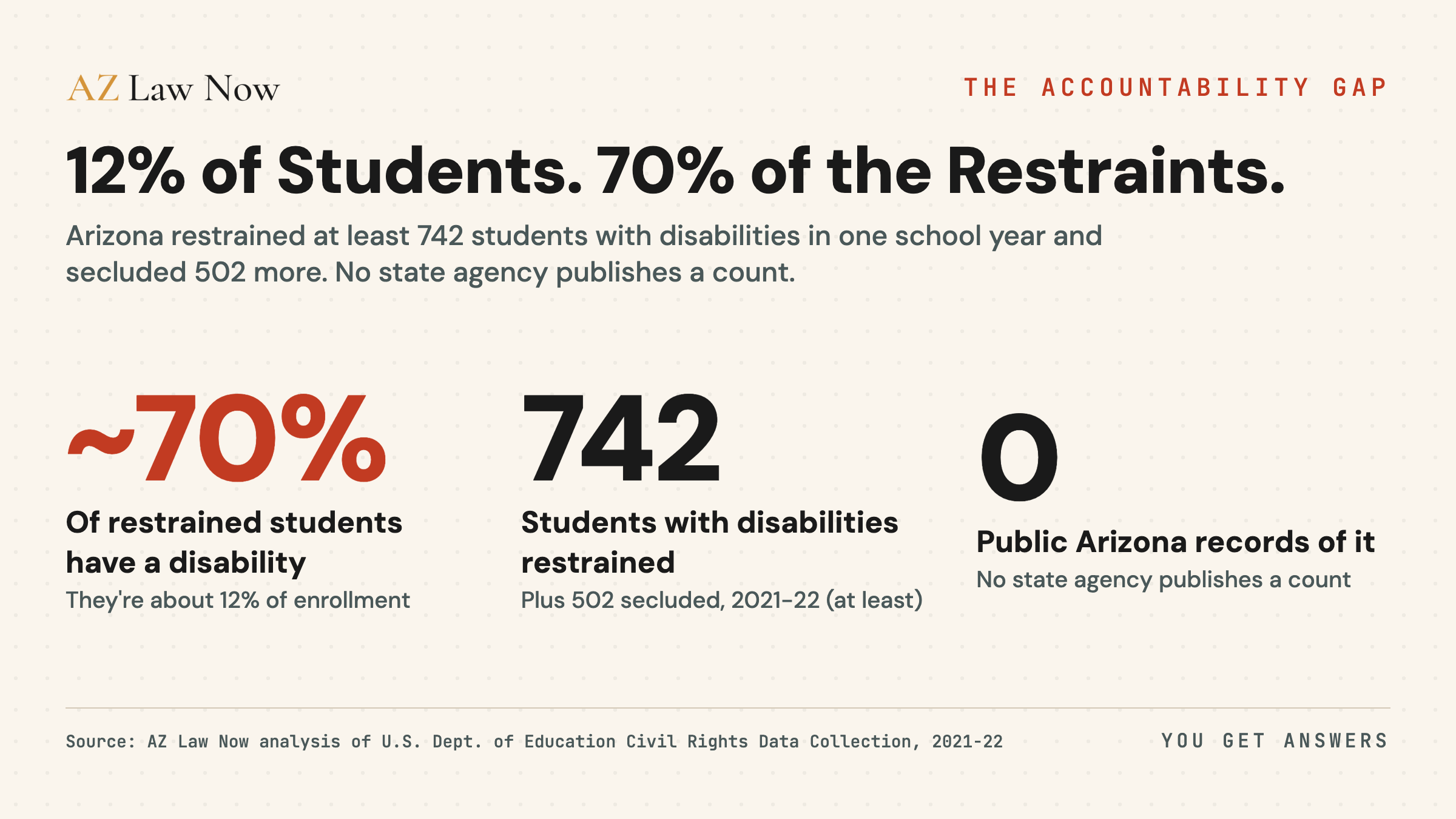
In the 2021-22 school year, Arizona schools physically restrained at least 742 students with disabilities and secluded at least 502 more. Those students are about 12% of the state’s enrollment, and they were roughly 70% of everyone physically restrained.
We didn’t get those numbers from Arizona. The state doesn’t publish them. We computed them from the federal Civil Rights Data Collection, summing every Arizona school in the file ourselves, because there’s no Arizona source that holds this count in one place.
That absence is the story. Arizona regulates restraint, requires a parent be told, and then keeps no public record of how often it happens or to whom. The gap between what the law documents and what the public can see is where a family’s fight for accountability begins, and where it usually stalls.
The Number, and Where It Comes From
The Civil Rights Data Collection is the U.S. Department of Education’s national survey of every public school in the country. Schools self-report how many students they physically restrained, mechanically restrained, and secluded, broken out by whether the student is served under the Individuals with Disabilities Education Act.
For Arizona in 2021-22, the school-level file records 742 students with disabilities physically restrained, against 306 students with no disability and 16 served only under Section 504. It records 502 students with disabilities secluded, and 18 mechanically restrained.
Add the categories, and students with disabilities are 742 of 1,064 physically restrained, or 69.7%.
Set that against enrollment. Arizona reported 132,551 students served under IDEA out of 1,115,843 total, or 11.9%. So a group that is about one in eight students made up about seven in ten of the children a school decided to physically restrain.
We’re describing a disparity, not proving a cause. Students served under IDEA include children whose disabilities involve behavior, and a school will say that explains part of the gap. It may explain part.
But a gap this size, in a practice the law treats as a last resort, is the kind of number that’s supposed to trigger review. In Arizona, there’s no public place where anyone can see it to ask.
Why Arizona Has No Count of Its Own
Here’s the part that surprises people. Arizona has a restraint statute, and it doesn’t require schools to report a single incident to the state.
ARS 15-105 permits restraint or seclusion only when a student’s behavior presents an imminent danger of bodily harm and less restrictive steps look insufficient. It bans any restraint that impedes breathing, and it requires the technique to stop when the danger ends.
On documentation, the statute requires three things: same-day notice to the parent, written documentation to the parent, and an internal review when a student is restrained repeatedly.
Read the statute for what it doesn’t say. It names no state agency as a recipient. It builds no database. It requires no public disclosure. The record ARS 15-105 creates is a private one, between a district and one parent at a time.
ARS 15-105 requires a school to notify the parent the same day, provide written documentation of the incident, and review its practices after repeated restraints of the same student.
It doesn’t require reporting to the Arizona Department of Education, and it doesn’t create a public record. A parent who wants their district’s numbers has to ask for them.
That’s why the only statewide count is the federal one, and the federal one is imperfect by design. It arrives on a multi-year lag. It’s self-reported by the districts being measured. A 2020 review by the Government Accountability Office (GAO-20-345) found restraint and seclusion data widely underreported nationally.
Our Arizona figures carry the same floor. The public-use file suppresses small counts, and we excluded those cells rather than guess at them. Every number here is therefore a minimum. The real totals are these or higher.
The Accountability Path, and the Walls In It
Say a family sees the injury and wants an answer. The path is real, and it’s narrow. This is the legal analysis layer of this report, reviewed by Ron DeBrigida, J.D.
The path starts with the records. Under ARS 39-121, Arizona public records are open to inspection, so a parent can request the district’s aggregate restraint counts and their own child’s incident reports. This is the tool that substitutes for the public database the state never built.
Then the clock starts. A school district is a public entity. Under ARS 12-821.01, which names public schools specifically, a claim requires a notice of claim within 180 days after the cause of action accrues, and ARS 12-821 requires any lawsuit within one year.
For a student who is a minor, the 180-day notice clock is tolled under ARS 12-502 and runs 180 days after minority ends. A parent who waits, or who sues without first serving the notice of claim, can lose the claim on the deadline alone.
Last comes the immunity question. A family can bring a federal civil-rights claim under 42 U.S.C. 1983, and there they meet qualified immunity.
Under Harlow v. Fitzgerald and Pearson v. Callahan, a government official is shielded from damages unless the conduct violated a clearly established right, one defined specifically enough that a reasonable official would have known it was unlawful.
That specificity is the wall. It often turns on whether an earlier court has already held nearly identical conduct unconstitutional.
Arizona sits in the Ninth Circuit, not the Fifth. Commentary that treats one federal circuit as a total-immunity outlier is describing the Fifth Circuit, which covers Texas, Louisiana, and Mississippi.
An Arizona school restraint claim is litigated under Ninth Circuit precedent. The doctrine here should be described on its own terms, not borrowed from another circuit.
There’s a further wrinkle worth stating plainly. In Ingraham v. Wright, the Supreme Court held that the Eighth Amendment’s cruel-and-unusual-punishment clause doesn’t apply to school discipline.
So modern restraint claims generally run under the Fourth and Fourteenth Amendments. For students with disabilities, they also run under Section 504 of the Rehabilitation Act, Title II of the ADA, and the IDEA, which are analyzed on their own standards rather than the constitutional-tort test.
Title IX is a sex-discrimination statute and isn’t the vehicle for a disability restraint claim.
The Ninth Circuit has already drawn that line in one direction. In Preschooler II v. Clark County School Board of Trustees, 479 F.3d 1175 (9th Cir. 2007), the court affirmed the denial of qualified immunity to a special-education teacher accused of beating and slamming a severely disabled, nonverbal four-year-old.
The court held that a schoolchild’s right to be free from a teacher’s excessive force was already clearly established. It granted those same officials immunity on the lesser claims, the unexplained bruises and a shoeless walk from the bus.
So whether a given restraint clears the clearly-established bar stays a fact-specific question, decided case by case. But the controlling precedent in this circuit is real, and it has a name.
What the Data Would Look Like If Arizona Kept It
This is the shape of the accountability gap in one image. On one side, a private notice to a parent, filed nowhere the public can reach. On the other, a federal file that lands years late, self-reported, and suppresses its smallest and most sensitive counts.
A parent in a district with a rising restraint problem has no early signal. A reporter can’t compare two districts.
Disability Rights Arizona, the state’s federally designated protection and advocacy organization, has a statutory mandate to investigate abuse and neglect of people with disabilities. Even it has to reconstruct from records requests what a state dashboard would show at a glance.
None of that requires a change in the restraint standard. It requires a count. California, for one, publishes district-level restraint and seclusion data through its state education agency, where any parent or reporter can pull the numbers by local educational agency.
Arizona collects the underlying incidents by law and stops one step short of counting them anywhere the public can see.
What This Report Establishes
Arizona restrains and secludes students with disabilities at a rate far out of proportion to their share of enrollment, at least 742 physically restrained and 502 secluded in a single year, and those are floors.
The state requires the incident be documented to a parent, then keeps no public count of it. A family seeking accountability runs a 180-day clock and a clearly-established standard before the merits are ever reached.
That’s a data gap and a legal one, stacked. The number exists. Arizona just doesn’t publish it, so we did.
If you’re a parent, an educator, or an advocate with records or accounts of restraint practices in Arizona schools, the reporting continues, and every account helps. Families who believe a child was injured by an improper restraint can reach the editors through the contact page.
Related Coverage
Frequently asked questions
How many Arizona students are restrained or secluded at school?
Does Arizona law require schools to report restraint to the state?
How do I get my school district's restraint numbers in Arizona?
What is the deadline to bring a claim against an Arizona school?
What is qualified immunity and how does it affect a school restraint case?
Sources & references
- U.S. Department of Education. (2025). Civil Rights Data Collection (CRDC) 2021-22 public-use file. Retrieved August 21, 2026, from https://civilrightsdata.ed.gov/data
- Arizona State Legislature. (2025). ARS 15-105: Use of restraint and seclusion techniques; requirements; definitions https://www.azleg.gov/ars/15/00105.htm
- Arizona State Legislature. (2025). ARS 12-821.01: Authorization of claim against public entity or public employee https://www.azleg.gov/ars/12/00821-01.htm
- Arizona State Legislature. (2025). ARS 12-821: Limitation of actions against a public entity or employee https://www.azleg.gov/ars/12/00821.htm
- Arizona State Legislature. (2025). ARS 12-502: Effect of disability of minority or of unsound mind https://www.azleg.gov/ars/12/00502.htm
- Arizona State Legislature. (2025). ARS 39-121: Public inspection of documents https://www.azleg.gov/ars/39/00121.htm
- U.S. Government Accountability Office. (2020). Restraint and Seclusion: Education Should Better Assess Data Quality (GAO-20-345) https://www.gao.gov/products/gao-20-345
- Harlow v. Fitzgerald, 457 U.S. 800 (1982) https://supreme.justia.com/cases/federal/us/457/800/
- Pearson v. Callahan, 555 U.S. 223 (2009) https://supreme.justia.com/cases/federal/us/555/223/
- Ingraham v. Wright, 430 U.S. 651 (1977) https://supreme.justia.com/cases/federal/us/430/651/
- Preschooler II v. Clark County School Board of Trustees, 479 F.3d 1175 (9th Cir. 2007) https://www.courtlistener.com/opinion/3047809/preschooler-ii-v-clark-county-school-board-of-trustees/
- Disability Rights Arizona. What is a P&A? https://www.disabilityrightsaz.org/about/what-is-a-pa/
- California Department of Education. (2025). Restraint and Seclusion Data (reported at the LEA level: county offices of education, districts, and charter schools) https://www.cde.ca.gov/ds/ad/rsdinfo.asp