
The Arizona Department of Education runs the country’s first universal Empowerment Scholarship Account program. ESA pays an annual grant per eligible child to a parent-controlled account. Children with documented IEPs or 504 plans qualify for disability-category multipliers that materially raise the per-child payout.
Two structural numbers, both verifiable from primary sources, frame the 2026 ESA conversation.
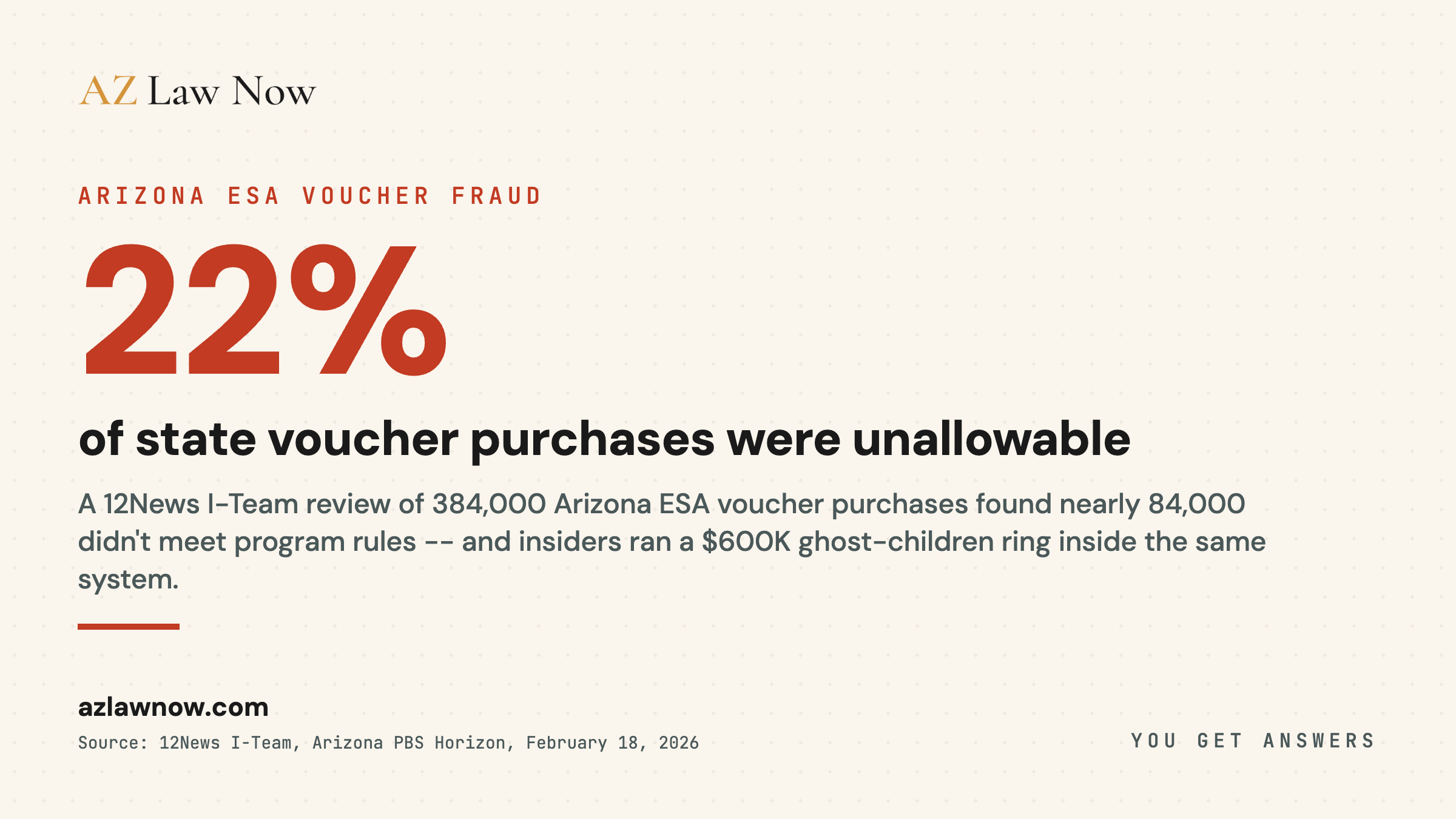
The first number is the system-level finding from the 12News I-Team investigation that reporter Craig Harris discussed on the February 18, 2026 Arizona PBS Horizon segment. The 22% rate doesn’t translate directly to fraud (some unallowable purchases are honest miscategorizations of permitted vs prohibited expenses), but it signals structural compliance gap.
The second number is the documented insider case. On February 29, 2024, the Arizona State Grand Jury indicted three former AZED ESA program specialists, Dolores Lashay Sweet, Dorrian Lamarr Jones, and Jennifer Lopez, plus two of Sweet’s adult children, Jadakah Celeste Johnson and Raymond Lamont Johnson, Jr.
The Attorney General alleged the ring drained more than $600,000 from the ESA program across October 2021 to November 2023. The case has since resolved: Sweet, Lopez, and both Johnsons pleaded guilty, and Jones was acquitted at trial on February 27, 2025.
How the Alleged Scheme Worked
Per the AG and reporting on the case, the scheme used 17 students. 5 were entirely fictitious. The record references Sweet allegedly claiming non-existent triplets, Lopez allegedly claiming non-existent twins, and all five fictitious children sharing the same birthday in the program records.
Attorney General Kris Mayes’ verbatim, on the indictment: “they created ghost children with forged birth certificates, children that didn’t exist, and gave them fake disability diagnoses that would make them eligible for larger funding amounts.”
The forged-document categories named by the AG: birth certificates and fake disability diagnoses. Disability documentation matters because of the per-child funding multiplier. A child with a documented IEP qualifies for a materially higher annual payout than the base ESA grant.
Forging the disability documentation, per the AG’s allegations, allowed the alleged ring to claim the higher amount on every fabricated child.
The indictment was the formal accusation. The case has since resolved: Sweet, Lopez, and both Johnsons pleaded guilty, and Jones was acquitted at trial on February 27, 2025.
How AZED Found Out
AZED did not catch Sweet’s branch of the alleged scheme on its own.
A credit union flagged Sweet’s banking activity to the Arizona Attorney General. That’s the trigger. The Jones and Lopez branches were separately referred to the AG by Superintendent Tom Horne’s office.
The ring ran approximately 26 months before being interrupted.
After the February 2024 indictment, Superintendent Horne’s office moved to strengthen ESA oversight and compliance staffing. The specific personnel detail isn’t in the public record retrieved for this report. The named director and the scope of the new positions require direct verification at azed.gov.
The structural question, post-indictment: are the new controls sufficient to surface the next ring before a credit union or another outsider flags it? The 22% unallowable-purchase rate suggests the answer isn’t yet yes.
The AG didn’t allege three random fraudsters discovered ESA. The AG alleged three former AZED ESA program specialists. People who, by job description, sat at the eligibility-and-payment choke point of the program.
The structural failure isn’t that ESA is generous. It’s that the same employees who approve ESA eligibility could, per the allegations, approve fictional children for full disability-multiplier payouts and then route the money to addresses they controlled.
The Statutory Frame
The State Grand Jury indictment alleged felony charges including:
- Fraudulent schemes and artifices, Arizona Revised Statutes 13-2310. Class 2 felony for an enterprise that knowingly obtains a benefit by means of false or fraudulent pretenses, representations, promises, or material omissions of fact.
- Conspiracy.
- Money laundering.
- Forgery.
The case was prosecuted by the Arizona Attorney General through the State Grand Jury process under ARS Title 21. It has since resolved: Sweet, Lopez, and both Johnsons pleaded guilty, and Jones was acquitted at trial on February 27, 2025. Sweet was ordered to pay $614,352 in restitution.
The named AG line prosecutor isn’t in the retrieved public record. The Mayes office is the named entity.
The 2026 Reform Politics
Two competing ESA reform ballot initiatives are advancing toward the 2026 Arizona ballot, per AZ Luminaria reporting on May 1, 2026.
One initiative would tighten ESA fraud controls, expand AZED audit authority, and limit the categories of allowable purchases. The structural-reform argument: the Sweet/Jones/Lopez indictment plus the Horizon 22% unallowable-purchase rate prove the program needs hard guardrails the legislature won’t impose.
The other initiative would protect or expand the universal voucher structure. The voucher-expansion argument: the indictment proves enforcement works, and the program’s value to participating families justifies continuing the universal structure.
The specific initiative numbers, signature thresholds, and projected ballot positions require direct verification at azsos.gov before publication of any specific initiative status.
The Save Our Schools Arizona organization (Beth Lewis, executive director) and the national Network for Public Education (Carol Burris, executive director) are both active on the structural-reform side. The school-choice advocacy organizations are on the protect-and-expand side. Both camps have public statements citing the indictment and the audit findings as their organizing evidence.
Specific things still flagged for follow-up:
- The Maricopa County Superior Court case number for the Sweet et al. case plus per-defendant charge counts (the AG announcement names defendants and approximate dollars but not the full court docket detail).
- Whether the charges formally alleged forged disability documentation on every one of the 17 children or on a subset (the AG language is “false, forged or fraudulent documentation” used to admit “real and fictitious” students; we haven’t confirmed the every-child claim).
- The named director Horne’s office brought in to strengthen ESA oversight plus any named full-time ESA investigator.
- Itemized “luxury purchases” sometimes referenced in coverage of the case, against charging documents rather than secondary characterization.
- The Mayes / Horne ongoing public dispute over a separate prosecution where Horne’s office characterized a defendant as “an innocent man” should not bleed into this report. The Sweet/Jones/Lopez/Johnson defendants are different people.
What Comes Next
Three near-term reporting moves on this story.
The first is the Maricopa County Superior Court docket. The case number, the per-defendant dispositions, and the sentencing detail are public. Direct retrieval is the next pull.
The second is the AZED ESA program review. The 22% unallowable-purchase rate from the 12News I-Team investigation is the headline number. The underlying methodology, the per-category breakdown, and the recovery-action timeline live in the AZED ESA Annual Report or the equivalent compliance summary at azed.gov.
The third is the 2026 ballot initiative tracking. Both the structural-reform initiative and the protect-and-expand initiative file signatures with the Arizona Secretary of State. The signature counts, the qualification deadlines, and the projected ballot positions are all at azsos.gov.
For now, the case is resolved on the public record, the 22% rate is documented, and the 2026 ballot is the political deadline.
This investigation was built from the Arizona Attorney General press release at azag.gov, the 12News I-Team investigation into ESA spending (discussed by Craig Harris on the February 18, 2026 Arizona PBS Horizon segment), and the Arizona Department of Education ESA communications page.
Additional sources include 12News, Arizona Mirror, and Arizona Capitol Times reporting on the case and its resolution, AZ Luminaria reporting on the 2026 ESA reform ballot initiatives, and Arizona Revised Statutes 13-2310.
If you have the Maricopa County Superior Court case number for the Sweet et al. case, the AZED ESA Annual Report compliance breakdown, the named director Horne’s office brought in to run ESA, or any record of additional indictments in the December 2024 follow-up cluster, contact AZ Law Now.
We report from primary sources.
Frequently asked questions
What was the alleged ESA fraud and who's indicted?
How does the ESA voucher program work and why is it vulnerable to this kind of fraud?
What did the February 18, 2026 Arizona PBS Horizon segment add?
What's the statutory frame for the indictment?
Why didn't AZED catch this internally?
What does this mean for Arizona families using ESA legitimately?
Where do the 2026 ESA reform ballot initiatives stand?
Is it worth suing for emotional distress?
Can you sue someone for emotional distress in AZ?
What is the average personal injury settlement in Arizona?
What is it called when someone can't afford an attorney?
Sources & references
- Arizona Attorney General. (2024, February 29). Attorney General Mayes Announces Indictments, ESA Program. Retrieved May 2, 2026, from https://www.azag.gov/press-release/attorney-general-mayes-announces-indictments-esa-program
- 12News I-Team. (2026). Investigation into Arizona ESA spending (Craig Harris), discussed on Arizona PBS Horizon, February 18, 2026. Retrieved from https://azpbs.org/horizon/2026/02/fraud-found-in-arizonas-empowerment-scholarship-account-program/
- Arizona Capitol Times. (2024 to 2025). Coverage of the ESA fraud case and its resolution (guilty pleas; Jones acquittal February 27, 2025; $614,352 restitution).
- Arizona Department of Education. (2024 to 2026). ESA fraud case discovered, Supt. Horne's office results in conviction. Retrieved from https://www.azed.gov/communications/esa-fraud-case-discovered-supt-horne%E2%80%99s-office-results-conviction
- 12News. (2024, February 29). Reporting on the AG ESA indictment update. Retrieved from https://www.12news.com/article/news/education/arizona-attorney-general-give-update-empowerment-scholarship-account-program-investigation/75-3f3af38a-d011-473f-a114-2a4736dcde93
- Arizona Mirror. (2024, February 29). Coverage of the State Grand Jury indictment naming five defendants in alleged ESA fraud ring.
- AZ Luminaria. (2026, May 1). Coverage of competing ESA reform ballot initiatives advancing toward the 2026 ballot.
- Arizona Revised Statutes 13-2310 (Fraudulent schemes and artifices). Retrieved from https://www.azleg.gov/ars/13/02310.htm
- Arizona Department of Education. ESA Program page. Retrieved from https://www.azed.gov/esa
- Save Our Schools Arizona. The Truth About ESA Vouchers, accountability advocacy. Retrieved from https://sosarizona.org/the-truth-about-esa-vouchers/
- Network for Public Education. (2025 to 2026). Reports on AZ ESA fraud and universal voucher accountability.
- Arizona Secretary of State. 2026 ballot measures (initiative, referendum, recall). Retrieved from https://azsos.gov/elections/ballot-measures
- Arizona State Grand Jury process under Arizona Revised Statutes Title 21.
Tell Google to show our reporting more often in Search and AI answers.