
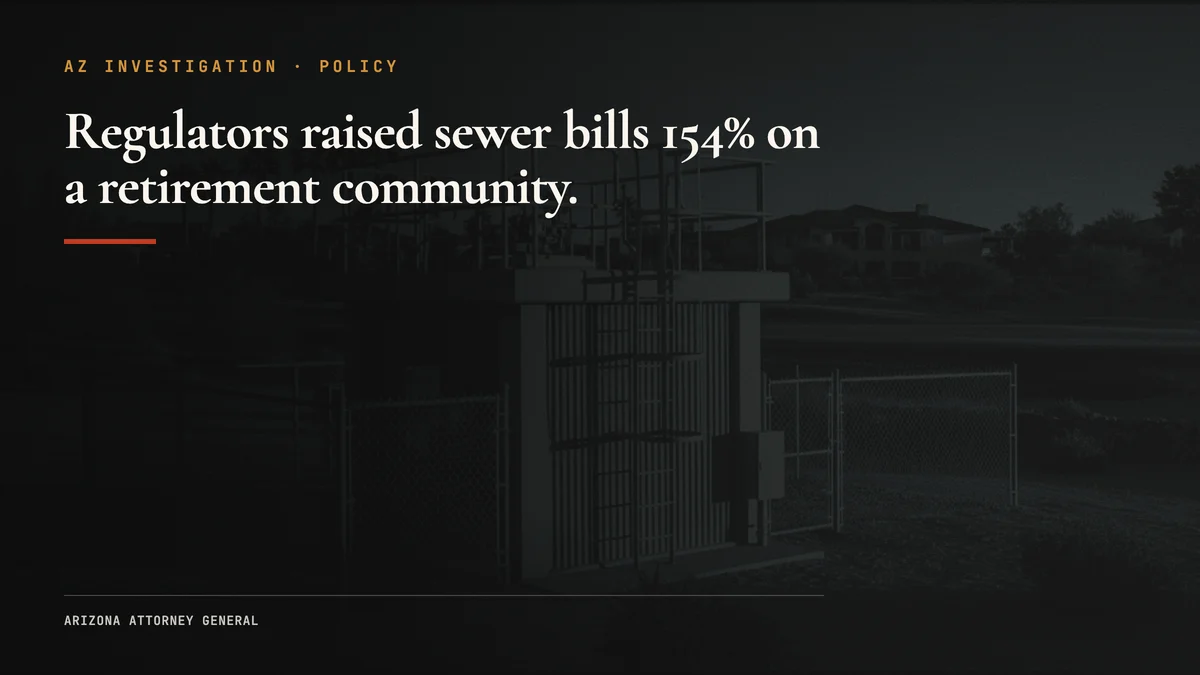
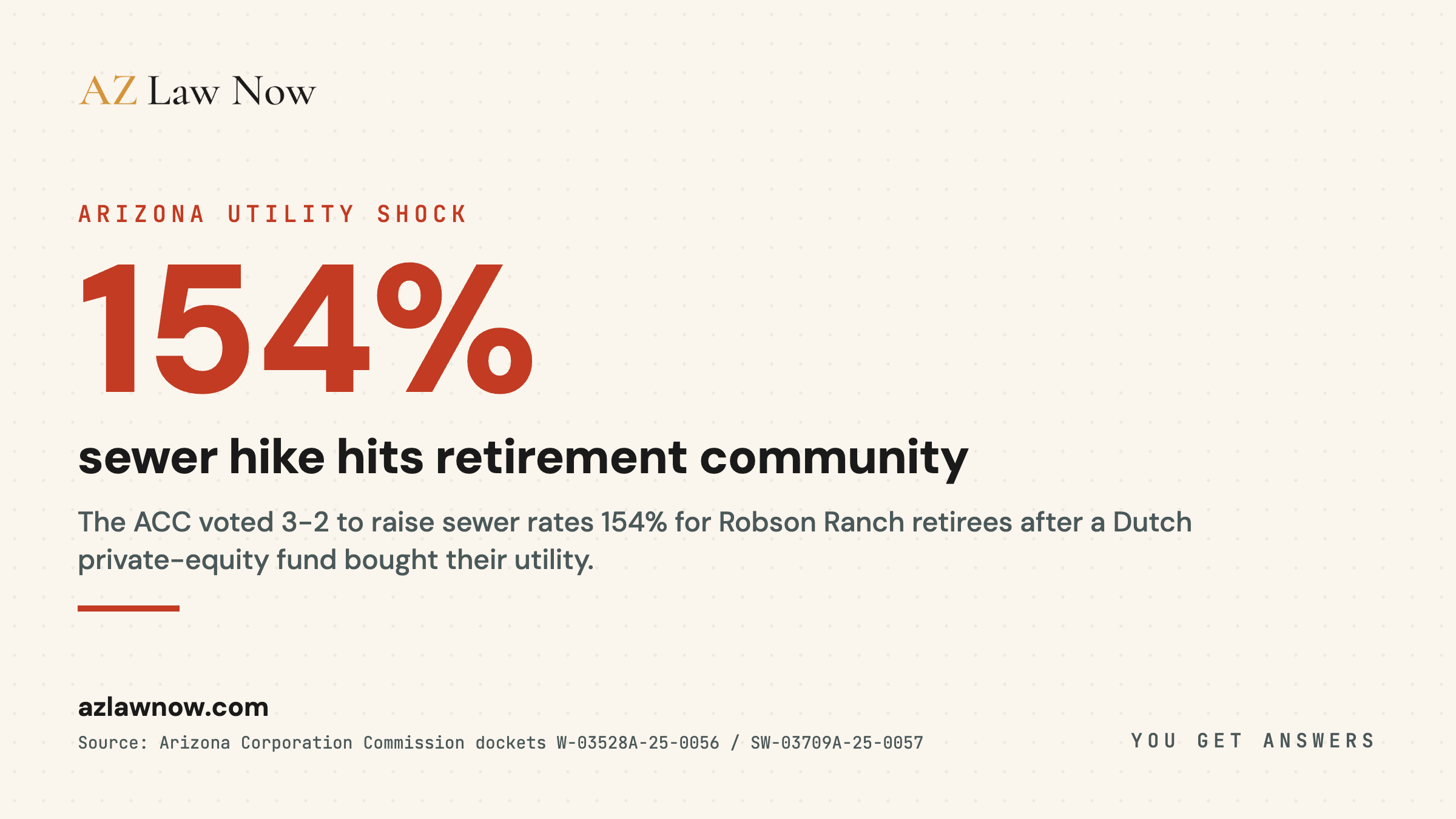
On March 4, 2026, the Arizona Corporation Commission voted 3 to 2 to approve a 22% water rate increase and a 154% wastewater rate increase for Picacho Water and Picacho Sewer. The two regulated utilities serve the Robson Ranch retirement community near Eloy.
The combined average bill jumps approximately $76.63 per month per KJZZ reporting. That’s approximately $920 per year per household.
Who Owns the Utilities
Picacho Water and Picacho Sewer were sold November 21, 2024. The seller was Robson Companies, the original Robson Ranch developer. The buyer was JW Water Holdings.
JW Water Holdings is owned by CVC DIF, formerly DIF Capital Partners. CVC DIF is an Amsterdam-based private-equity fund manager with approximately EUR 19 billion in assets under management. The Picacho utilities sit inside the DIF Infrastructure VII fund. JW Water CEO is Jason Williamson. CVC DIF Managing Partner overseeing JW Water is Gijs Voskuyl.
Through JW Water Holdings, CVC DIF owns or controls 18 regulated water and wastewater utilities in Arizona, serving approximately 50,000 connections. Picacho Water and Picacho Sewer are two of those 18. The other 16 aren’t enumerated in the public record retrieved for this report.
Direct retrieval of JW Water Holdings’ ACC entity filings would surface the full list.
What the ACC Staff Said
The single fact in this story that’s harder to defend than the rest sits in the ACC’s own staff testimony.
Per Attorney General Kris Mayes’ March 31, 2026 rehearing application, the ACC staff witness on the record stated: “Staff doesn’t set rates based on affordability.” The AG’s release also describes ACC staff testimony as having “gave no consideration to ratepayer impact.”
That’s the staff’s own framing. Pulling the full transcript from the ACC docket would attribute the direct quote to the named staff witness. The dossier sources don’t have the named witness yet.
The rehearing application is the procedural counter. AG Mayes filed for rehearing on March 31, 2026, demanding the ACC reopen the proceeding to consider ratepayer affordability, particularly the impact on fixed-income retirees.
How the Vote Broke Down
Three commissioners voted yes:
- Nick Myers (Republican), ACC Chair.
- Rachel Walden (Republican), ACC Vice Chair.
- Rene Lopez (Republican). The Lopez yes vote is by elimination from the named no votes; pre-publication action is to confirm directly from ACC meeting minutes.
Two commissioners voted no:
- Kevin Thompson (Republican).
- Lea Marquez Peterson (Republican).
This is a Republican-on-Republican vote, not a partisan split. The ACC is a five-member elected body. All five commissioners are Republicans on the current commission. The 3 to 2 split is a substantive disagreement within the majority party about ratepayer protection.
How the Rate Hike Math Works
Picacho Water and Picacho Sewer hadn’t raised rates since the late 1990s.
The new 22% water and 154% wastewater hikes are the first increases in more than 25 years.
Utility-advocate framing: the long deferral period justifies the size of the increase. Aging infrastructure, rising operating costs, EPA wastewater treatment standard upgrades, and replacement of equipment past useful life. The original JW Water ask was 125% water and 188% wastewater. The ACC reduced the ask but still approved a substantial increase.
Ratepayer-advocate framing: a 154% sewer hike on a fixed-income retirement community is the size that triggers affordability analysis under the just-and-reasonable standard. The ACC staff didn’t perform that analysis. The AG’s rehearing application is the procedural challenge.
Both framings have basis in ACC ratemaking jurisprudence. The just-and-reasonable standard at ARS 40-365 doesn’t explicitly require affordability analysis. Multiple Arizona appellate decisions have addressed the standard without resolving the affordability-consideration question.
The structural pattern matters. Picacho was a Robson-developed community served by Robson-controlled utilities until November 2024. The sale to JW Water moved the utilities into a Dutch private-equity fund’s portfolio. PE-owned regulated utilities operate on a different return profile than developer-controlled or municipal utilities.
CVC DIF’s other 16 AZ utility holdings are on their own rate-case calendars. Communities served by JW Water entities should expect rate-case filings on a similar schedule, with the same PE-owner economics underlying the ask.
Who’s Speaking on the Record
Eloy Mayor Andy Sutton, who is also a Robson Ranch resident, filed a letter opposing the hike in June 2025.
Named residents on the record opposing the hike include Deborah Dorman, Ross Dunfee, Jerry Lewis, and Raul Salmon.
Camryn Sanchez of the Arizona Capitol Times and Wayne Schutsky of KJZZ are the named bylines on the case so far.
What’s Open Before the Final Story Lands
Five things are flagged for verification before the next pull:
The formal ACC Decision number and the rate-effective date aren’t yet in the dossier sources. KJZZ and the original proposal both reference April 2026 as the effective date. The four dockets are confirmed but the formal Decision entry date governs the ARS 40-253 rehearing window calculation.
The Lopez yes vote is by elimination. AZ Free News and KJZZ both name Thompson and Marquez Peterson as the no votes and Myers and Walden as named yes votes. Lopez is the only remaining commissioner. Direct ACC meeting-minute confirmation closes the loop.
The named ACC staff witness who testified about ratepayer affordability isn’t named in the dossier sources. Pulling the staff witness transcript from the ACC docket attributes the direct quote.
The full enumeration of CVC DIF’s 18 AZ utility holdings beyond Picacho Water and Picacho Sewer requires JW Water Holdings’ ACC entity filings.
The procedural status of the Mayes rehearing application as of publication date requires direct verification at azag.gov and the ACC eDocket.
What Comes Next
Three near-term reporting moves on this story.
The first is the ACC Decision number retrieval. The four dockets are confirmed. The formal Decision entry date governs the rehearing window. The Decision itself contains the rate-effective date and the full majority + dissent rationale.
The second is the JW Water portfolio enumeration. The 18-utility AZ holding is the structural story. Each of the other 16 utilities is on its own rate-case calendar. The communities served are the next ratepayer-protection conversations.
The third is the rehearing decision. The ACC will accept or deny the AG’s March 31 rehearing application within the statutory window. If denied, AG Mayes has indicated reservation of the right to appeal to Arizona Superior Court.
For now, the vote is on the public record. The PE ownership is documented. The decades-long gap since the last rate increase is the structural backdrop.
This investigation was built from the Arizona Attorney General press release at azag.gov, AZ Capitol Times reporting (Camryn Sanchez), KJZZ reporting (Wayne Schutsky), the JW Water Picacho rate-case FAQ PDF, the Arizona Corporation Commission docket portal at azcc.gov, the Arizona Constitution Article 15, and Arizona Revised Statutes Title 40.
If you have the formal ACC Decision number for the March 4 vote, the named ACC staff witness who testified about ratepayer affordability, the full enumeration of CVC DIF’s 18 AZ utility holdings, or any record of the rehearing application’s procedural status, contact AZ Law Now.
We report from primary sources.
Frequently asked questions
What did the ACC actually approve on March 4, 2026?
Who owns Picacho Water and Picacho Sewer?
When did Picacho last raise rates and how does the new hike compare?
What did AG Mayes' rehearing application say?
Who lives at Robson Ranch and how does the rate hike hit fixed-income households?
What's the statutory frame for ACC ratemaking and ratepayer protection?
What does this mean for other Arizona communities served by JW Water?
Why is my electric bill so high in Arizona?
Is price gouging illegal in Arizona?
Who regulates utilities in AZ?
Is SRP regulated by ACC?
Sources & references
- Arizona Attorney General. (2026, March 31). Attorney General Mayes Challenges Massive Rate Hike for Robson Ranch Utility Customers. Retrieved May 2, 2026, from https://www.azag.gov/press-release/attorney-general-mayes-challenges-massive-rate-hike-robson-ranch-utility-customers
- Arizona Capitol Times. (2026, March 4). ACC Approves Hefty Water Rate Hike for Eloy Retirement Community (Camryn Sanchez reporting). Retrieved from https://azcapitoltimes.com/news/2026/03/04/acc-approves-hefty-water-rate-hike-for-eloy-retirement-community/
- KJZZ. (2026, March 5). Residents of Robson Ranch in Eloy Blame Developer, Foreign Investors for Utility Rate Shock (Wayne Schutsky reporting). Retrieved from https://www.kjzz.org/politics/2026-03-05/residents-of-robson-ranch-in-eloy-blame-developer-foreign-investors-for-utility-rate-shock
- JW Water. Picacho Sewer Rate Case FAQ PDF (2025). Retrieved from https://jwwater.com/picacho-sewer/wp-content/uploads/sites/10/2025/07/Picacho-Rate-Case-FAQs-7.1.2025.pdf
- Arizona Corporation Commission. eDocket portal. Dockets W-03528A-25-0056, W-03528A-25-0096, SW-03709A-25-0057, SW-03709A-25-0097. Retrieved from https://azcc.gov/news/home/2026/03/10/march-4--2026-open-meeting-highlights
- Arizona Constitution Article 15 (Corporation Commission).
- Arizona Revised Statutes Title 40 (Public Utilities and Carriers). ARS 40-250, 40-253, 40-365 (rate increase procedures, rehearing, just-and-reasonable standard). Retrieved from https://www.azleg.gov/arsDetail/?title=40
- CVC DIF (formerly DIF Capital Partners). Fund disclosures. DIF Infrastructure VII fund. Retrieved from https://www.cvcdif.com/news-insights/cvc-dif-acquires-a-portfolio-of-us-regulated-water-and-wastewater-utilities
- JW Water Holdings. Company website and AZ utility portfolio. Retrieved from https://jwwater.com/about-us/
- AZ Free News. (2026, March 4). ACC vote coverage with named commissioner positions.
- Robson Companies. Original Robson Ranch developer. Sale of Picacho utilities to JW Water Holdings November 21, 2024.
- Eloy City Council. Mayor Andy Sutton's June 2025 letter opposing the rate hike.
Tell Google to show our reporting more often in Search and AI answers.