
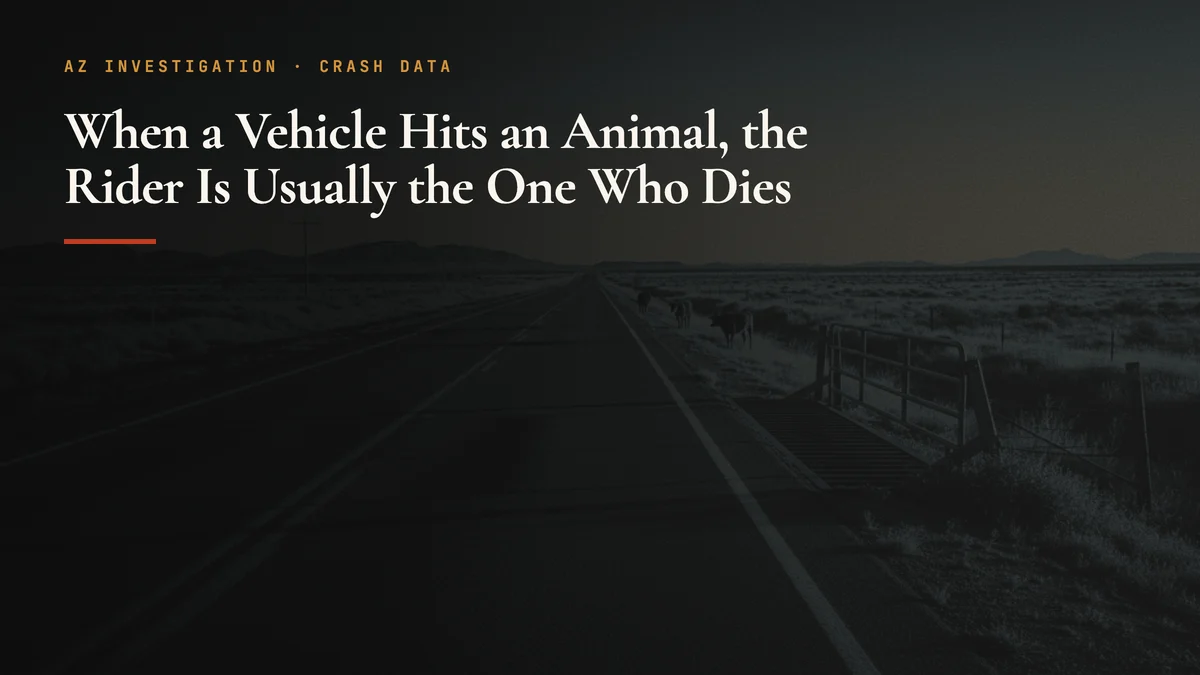
When a vehicle in the United States hits an animal and someone dies, that person was more likely riding a motorcycle than sitting in anything else on the road. From 2001 through 2024, motorcyclists were 2,437 of the 4,692 people killed in crashes whose first harmful event was striking a live animal, 51.9 percent.
That’s about four times their 12.8 percent share of all US traffic deaths over the same years.
On Saturday, July 18, 2026, a cow wandered onto Sibyl Road near milepost 9, in the open-range country outside Benson. Brent Brewer, 68, of Willcox was riding toward it. He struck the animal and died at the scene.
Six local outlets covered the crash, and the Cochise County Sheriff’s Office is still investigating. What none of that coverage carried is the number that turns a single wreck into a pattern. On the American road, the animal is the obstacle, and the motorcyclist is the one who dies.
We pulled the federal crash file to measure it. Every figure here is computed by AZ Law Now from the NHTSA Fatality Analysis Reporting System, the record of every US traffic death. An animal-strike death is a person killed in a crash the file marks with a live animal as the first harmful event.
The national count reconciles to an outside source, because the Insurance Institute for Highway Safety reports 210 US animal-strike deaths for 2024, the same figure the federal file returns.
The Person Who Dies Is on Two Wheels
Start with the lopsidedness, because it’s the whole story. Motorcyclists make up a small slice of the people on the road and a small slice of everyone who dies in traffic, 12.8 percent from 2001 through 2024. In animal-strike deaths, that slice becomes the majority.

The reason isn’t a mystery, and the record doesn’t ask us to guess at it. A car meets an animal with a steel frame, a windshield, and airbags between the impact and the people inside.
A motorcycle puts a rider on the animal at highway speed with nothing in between. A deer that dents a sedan’s hood throws a rider to the pavement. That’s a description of what the crashes are, not a claim about fault in any one of them.
The pattern is steady enough to trust. Split the record in half and motorcyclists were 47.1 percent of animal-strike deaths in the first years and 56.9 percent in the most recent, both far above the 12.8 percent baseline.
Drop the single state with the most of these deaths, Wisconsin, and motorcyclists still make up more than half of the fatal crashes. The majority holds no matter how you cut it.
Arizona: 28 Riders, and a Law That Decides Who Pays
Arizona isn’t where most of these deaths happen. States with more deer and more rural miles, Wisconsin, Texas, and Pennsylvania among them, record more animal-strike deaths than Arizona does. Counting bodies, Arizona is unremarkable.
What sets Arizona apart is what happens after the crash. From 2001 through 2024, 70 people were killed across 66 fatal animal-strike crashes in the state, and 28 of them, 40 percent, were on a motorcycle.
Over the most recent decade the state recorded 34 such deaths, the same figure the Insurance Institute for Highway Safety lists for Arizona.

Those riders didn’t die in one place. The motorcyclist animal-strike deaths of the last decade fall on named rural highways across the state: SR-82 in Cochise County, the Beeline Highway in Gila County, SR-187 in Pinal County, Stockton Hill Road in Mohave County, Madera Canyon Road south of Tucson, and SR-64 near Williams.
It’s the kind of road where a rider comes over a rise at speed and an animal is standing in the lane.
Not Every Animal Is a Cow
Before the law, one honest limit has to sit in plain view, because it changes what the rest of the piece can claim. The federal file marks that a crash struck a live animal. It doesn’t record whether that animal was a cow, a horse, an elk, or a deer.
That single gap splits the story in two. The finding that motorcyclists die in these crashes far more than their share, the number this whole piece rests on, holds for every animal strike, livestock and wildlife alike. The open-range legal rules that follow apply only to the livestock cases. The two aren’t the same map.

The county map proves the point. Arizona’s two deadliest animal-strike counties are Coconino and Navajo, the northern high country of the Mogollon Rim and the plateau, where the animal in the road is far more often an elk or a deer than a cow.
Cochise County, the open-range cattle country where the July crash near Benson happened, recorded 4 of these deaths over the whole period.
So this piece never says most of Arizona’s animal deaths are livestock. They aren’t. It says two things that are both true: motorcyclists are the ones who die, everywhere, and in the livestock cases a second Arizona rule decides who pays for it.
Open Range: The Rider Bears the Loss
Most of Arizona’s rural land is legally open range, and the open-range rule flips the instinct most drivers carry. Off the range, an animal’s owner keeps it fenced in.
On open range, the burden runs the other way: under ARS 3-1427, a landowner who wants livestock off their property has to fence the animals out, and livestock otherwise have a right to be on the road. A driver is expected to watch for them.
That rule reaches the crash itself. When a rider hits livestock on an open-range highway, Arizona law makes recovery from the animal’s owner hard. The Arizona Supreme Court set the standard in [Carrow Co. v.
Lusby](https://law.justia.com/cases/arizona/supreme-court/1990/cv-89-0328-pr-2.html), a case that began the same way this story does, with a motorcyclist who struck a rancher’s heifer on an open-range road.
The court held that a livestock owner owes drivers a duty of ordinary care, but that the mere failure to keep cattle off the highway, by fencing or otherwise, isn’t a breach of it. To win, an injured rider has to point to a specific negligent act, like someone driving cattle onto the road.
The Court of Appeals applied that rule in Brookover v. Roberts Enterprises and threw out the claim, because general knowledge that cattle sometimes reach a highway, without proof of a specific negligent act, wasn’t enough.
Put together, the cases mean that in the ordinary open-range crash, the loss falls on the rider, or on the rider’s family.
Two things can change that answer, and they’re the reason a claim is worth a hard look rather than a shrug. The first is a no-fence district, a defined area where the open-range rule is switched off and the owner must keep livestock in.
Inside one, the owner can be liable. The second is proof of that specific negligence the cases require. Neither is automatic, and neither is hopeless. The difference between them is usually the evidence gathered in the first days after the crash.
The evidence that decides an open-range case, the brand on the animal, whose land it grazed, whether a gate was left open, gets cleared or forgotten within days. Arizona gives an injured person two years to file under ARS 12-542, and a wrongful-death claim runs on the same two-year limit under ARS 12-542(2).
If a public road or a government body may be involved, a separate 180-day notice deadline under ARS 12-821.01 can apply, and it’s far shorter.
The first moves that protect a claim are in the motorcycle crash action plan, and how fault works in an Arizona motorcycle case is in Ron DeBrigida’s Arizona motorcycle law guide.
What the Count Can’t Show
The death count is the headline. It isn’t the whole harm. For every rider killed, others survive an animal strike with a brain injury, a spinal injury, or a shoulder rebuilt with hardware, and carry the cost of it for decades. The federal file counts the deaths.
It doesn’t count the survivors, and the open-range rule that decides a fatal claim decides those too.
There’s a companion piece to this one. Our Arizona motorcycle fatality report takes the same federal file and tests what the state believes about how riders die, and finds most of it wrong.
The animal-strike finding is the same lesson from a different angle: the danger to a motorcyclist rarely looks the way people picture it.
How We Counted
Every count and share on this page is computed by AZ Law Now from the NHTSA Fatality Analysis Reporting System, the federal record of every US traffic death.
An animal-strike death is a person who died in a crash the file codes with a live animal as the first harmful event. A motorcyclist death is one of those people killed on a motorcycle body type, counted at the person level.
The national analysis covers 2001 through 2024, and the Arizona figures cover the same window, with a 2015-to-2024 subset stated wherever it appears so the recent decade is never blended with the full period. County names are resolved from the federal county code.
The single honest limit is stated in place: the file marks that a crash struck a live animal but not the species, so the livestock-versus-wildlife split is inferred from geography, not read from a field.
The national and Arizona totals reconcile to the Insurance Institute for Highway Safety’s published animal-collision tables, 210 US deaths in 2024 and 34 Arizona deaths across 2015 through 2024. These are computed figures, not NHTSA-published statistics.
Related Coverage
Read the companion Arizona motorcycle fatality report for what the federal file says about how Arizona’s riders actually die. For the legal and process side, see Ron DeBrigida’s guide to Arizona motorcycle law, the motorcycle crash action plan, and the motorcycle crashes practice overview.
Frequently asked questions
Who dies most often when a vehicle hits an animal?
How many people die in animal-strike crashes in Arizona?
Is Arizona the worst state for animal-strike deaths?
If I hit a cow on an open-range road in Arizona, who is liable?
Does the data separate livestock from wildlife?
Where do animal-strike motorcycle deaths happen in Arizona?
Where is this animal-strike data from?
Sources & references
- National Highway Traffic Safety Administration. (2025). Fatality Analysis Reporting System (FARS), 2001 to 2024. U.S. Department of Transportation. Retrieved from https://www.nhtsa.gov/research-data/fatality-analysis-reporting-system-fars
- Insurance Institute for Highway Safety. (2025). Fatality Facts: Collisions with fixed objects and animals. Retrieved from https://www.iihs.org/topics/fatality-statistics/detail/collisions-with-fixed-objects-and-animals
- Arizona State Legislature. ARS 3-1421: Formation of no-fence districts. Retrieved from https://www.azleg.gov/ars/3/01421.htm
- Arizona State Legislature. ARS 3-1426: Lawful fence defined. Retrieved from https://www.azleg.gov/ars/3/01426.htm
- Arizona State Legislature. ARS 3-1427: Recovery for damage to unfenced lands; exception. Retrieved from https://www.azleg.gov/ars/3/01427.htm
- Carrow Company v. Lusby, 167 Ariz. 18, 804 P.2d 747 (1990). Retrieved from https://law.justia.com/cases/arizona/supreme-court/1990/cv-89-0328-pr-2.html
- Brookover v. Roberts Enterprises, Inc., 215 Ariz. 52, 156 P.3d 1157 (App. 2007). Retrieved from https://law.justia.com/cases/arizona/court-of-appeals-division-one-published/2007/cv05-0444.html
- KVOA News 4 Tucson. (2026, July). Willcox motorcyclist dies after striking cow on Sibyl Road, CCSO says. Retrieved from https://www.kvoa.com/news/cochisecounty/willcox-motorcyclist-dies-after-striking-cow-on-sibyl-road-ccso-says/article_34a36627-c5d4-43b5-984b-0f6236e1f603.html
- Herald/Review. (2026, July). Willcox man identified as motorcyclist who died after striking cow. Retrieved from https://www.myheraldreview.com/news/benson/willcox-man-identified-as-motorcyclist-who-died-after-striking-cow/article_4b2ecb7c-eac7-4402-a828-c957aec9a407.html