
Arizona publishes daycare inspection data. It’s online. Free. Available to anyone with an internet connection and 10 minutes to spare.
Almost nobody checks it.
The record lives on a state site called AZ CareCheck. Type in a facility name and you’ll see its licensing status, inspection dates, and any substantiated findings.
What the site won’t do is let you compare the daycares in your zip code, or surface the ones that keep getting cited for the same problem. For that, you have to know what the rules require, what the fines can reach, and what the public record leaves out.
That gap, between what the state regulates and what a parent can actually see, is where this report lives. It starts with the fine.
The Fine-Cap Problem
Arizona law caps civil penalties for daycare violations at $100 per violation per day. The statute, ARS 36-891, is explicit: “not more than one hundred dollars for each violation. Each day that a violation occurs constitutes a separate violation.”
One hundred dollars.
Compare that with what the same state charges when a licensed health care institution, a nursing home or a hospital, violates its licensing rules. ARS 36-431.01 caps those fines at $1,000 per violation per day, with the same per-day accumulation structure.
Arizona fines other licensed care facilities ten times more, per violation, than it fines a daycare.

That 10x gap isn’t a historical quirk. Both statutes are current Arizona law. Neither has an inflation adjustment or an escalator for repeat violations.
The gap compounds. Because each day is a separate violation, a deficiency documented for 30 days caps at $3,000 for a daycare. The same 30-day violation at a nursing home or hospital caps at $30,000. And the health care statute, ARS 36-431.01, lets the state assess its penalty for each patient the violation impacted.
The daycare statute has no such multiplier. One child or twelve, the daycare ceiling is the same.
What $100 Looks Like in Practice
In February 2017, a worker at Brighter Angels Learning Center in South Phoenix was captured on video beating a 21-month-old child with a broom. ADHS investigated. The total fine: $300. That is $100 multiplied by three violations. The facility kept its license.
The ADHS director, asked about the fine on the record, said the agency can impose “a maximum of $100 per violation, per day.”
That quote isn’t a complaint. It’s a description of the law.
The $300 figure corroborates the statutory cap exactly. Three documented violations at $100 each. The cap isn’t theoretical. It’s the ceiling inspectors operate against every time a facility is cited.
Arizona has no published aggregate enforcement data for daycare penalties, revocations, or suspensions from 2020 through 2025. ADHS publishes no annual enforcement summary.
The most recent dedicated performance audit of the state’s licensing division was completed in 1998, Auditor General Report 98-17, and it found the division had not taken sufficient enforcement action against facilities that repeatedly violated licensing standards.
In June 2026, the Joint Legislative Audit Committee approved a new audit, but of Arizona’s federal child care assistance program, the subsidy side run by the Department of Economic Security, not of licensing enforcement.
The public still has no systematic view of how often the $100 cap is reached, how often fines escalate across days, or how enforcement actions compare across facilities.
A Recent Revocation
License revocation is the enforcement tool ADHS reaches for when fines and corrective plans have not produced compliance. It’s rare.
In February 2026, ADHS revoked the license of Colorful Kids Preschool in Chandler, effective February 12, 2026. The revocation followed the asphyxiation death of a two-year-old. The medical examiner ruled the manner of death a homicide. ADHS surveyors found that staff had given misleading information during the investigation.
A worker was arrested on suspicion of a related offense. Prosecutors declined charges. The confirmed enforcement action is the ADHS license revocation.
The Abuse Trend
The clearest harm metric Arizona reports publicly comes from its federal child care funding obligations. Under the Child Care and Development Block Grant, states must report substantiated abuse in licensed, subsidy-eligible care each year.
Arizona’s reported figures: 14 substantiated abuse cases in FY2023, 33 in FY2024, and 24 in FY2025.
These figures come from Arizona’s mandated CCDBG posting, compiled by the state’s child care agencies and published through the Arizona Child Care Resource and Referral network. They count substantiated abuse among CCDF-eligible licensed providers only, statewide, with no city-level breakdown.
They don’t count the broader universe of licensing deficiencies, and they aren’t the same as a violation count. The FY2025 figure is preliminary, posted soon after the federal fiscal year closed.
What they show is a single-year doubling, from 14 to 33, followed by a partial pullback to 24. Against roughly 2,800 licensed and certified providers statewide, that FY2024 count works out to about 12 substantiated abuse cases per 1,000 providers, up from about 5 the year before.
Whether the jump reflects real changes in harm, changes in reporting, or changes in investigation capacity isn’t answerable from the public record alone. The trend is worth noting because it’s the only published harm aggregate the state produces for this sector.
How Daycare Licensing Works in Arizona
The Arizona Department of Health Services licenses and inspects all childcare centers and certified group homes in the state. The rules live in Arizona Administrative Code Title 9, Chapter 5 (R9-5). It’s 87 pages of regulations covering everything from staff qualifications to diaper changing procedures to the temperature of served milk.
DHS conducts two types of inspections. Routine inspections happen on a regular cycle: at least once a year for licensed centers, at least twice a year for certified in-home group homes. Complaint-based inspections happen when someone reports a concern.
DHS is supposed to investigate complaints within specific timeframes based on severity: 24 hours for imminent health and safety risks, five days for serious concerns, 30 days for lower-priority issues.
When an inspector finds a violation, they issue a notice of deficiency. The facility gets a corrective action plan and a deadline to fix the problem. If they fix it, the case closes. If they don’t, DHS can escalate to probation, enrollment suspension, or license revocation.
That’s the system on paper. In practice, it’s slower and more forgiving than most parents would expect.
The Landscape Across the West Valley
Start with how many facilities there even are. The state’s own licensing registry, the same data that feeds CareCheck, lists every active licensed facility by city. Pulled from that registry, the four fast-growing West Valley cities look like this.
That’s 131 licensed facilities across the four cities, part of 1,528 active in Maricopa County and 2,536 statewide, as of the state’s February 2026 registry extract.
The more revealing number is the trend behind it. Arizona licenses roughly 2,800 child care providers statewide today, even as the West Valley added tens of thousands of residents, many of them young families. Demand is climbing faster than the licensed supply.
That squeeze shows up where it matters most. The clearest safety signal the state does publish is the count of substantiated abuse cases in licensed, subsidy-eligible care, reported each year under federal child care rules.
Thirty-three is a small number against thousands of providers, and it counts substantiated abuse specifically, not the broader category of licensing deficiencies. But it more than doubled in a single year. That’s the kind of jump that should prompt hard questions about whether oversight is keeping pace with a system under strain.
What Arizona doesn’t publish is just as important. There’s no public, aggregated breakdown of how many facilities were cited, for what, or how often. CareCheck holds that detail one facility at a time.
To see a citywide pattern, the count of repeat-cited facilities or the share of findings that are ratio failures, you either check every facility by hand or file a public records request under ARS 39-121. This report sticks to what the public record can currently prove.
Staff Ratios: The Front-Line Safeguard
Arizona’s staff-to-child ratios are set in R9-5-404. The rule requires one staff member for every five infants under 12 months. One for every six one-year-olds. One for every eight two-year-olds. One for every 13 three-year-olds. One for every 15 four-year-olds. One for every 20 children five and older.
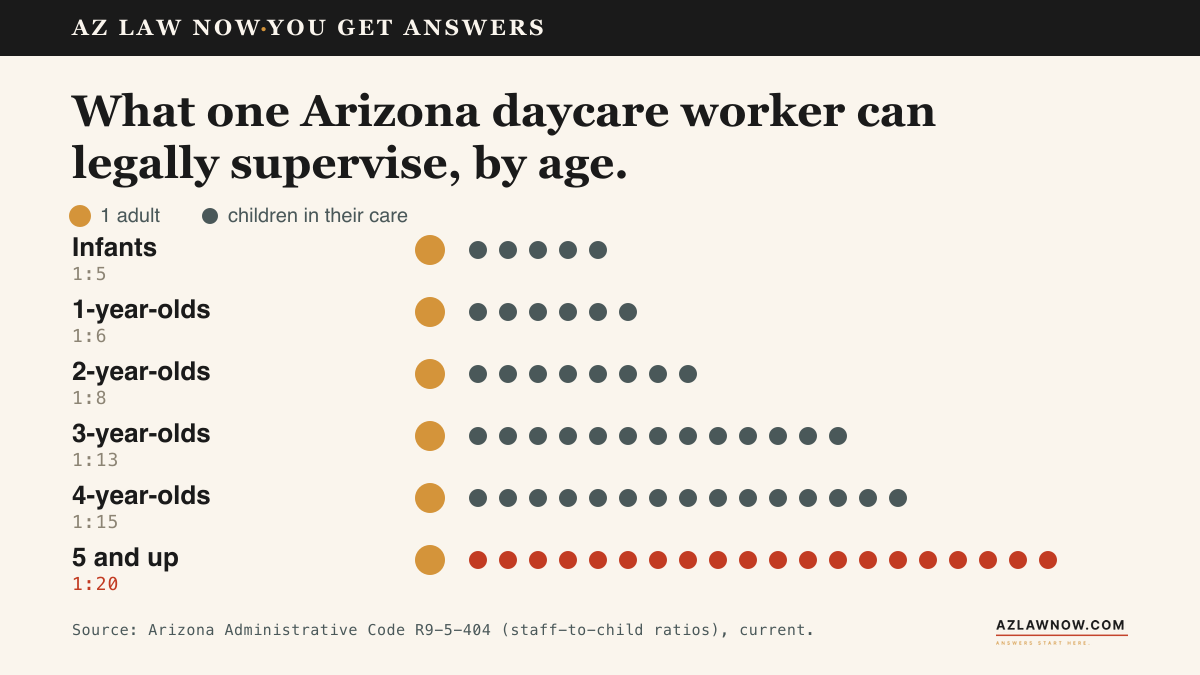
These ratios apply at all times. Not just during main activities. During naps, outdoor play, bathroom transitions, arrival, and departure. When a staff member steps out for lunch, the remaining staff must still cover the required ratio. When a teacher calls in sick, the center must have a plan to maintain ratios.
Ratio failures are among the most serious findings inspectors can cite, because ratios are the front-line safeguard for actual supervision. Arizona doesn’t publish an aggregate breakdown of deficiency types, so families can’t see a statewide count, but the pattern shows up in individual facility records across CareCheck.
That’s not a paperwork problem. That’s a supervision problem. When a room designed for one adult and eight toddlers has one adult and 12 toddlers, things get missed. A child climbing a shelf. A child choking on a small toy. A child wandering toward an unlocked door. These aren’t hypotheticals.
These are the scenarios that show up in incident reports when ratios fail.
The economics of childcare make ratio compliance hard. Childcare workers earn low wages, with the occupation’s national median around $15 an hour in 2024, and turnover runs high.
When a teacher quits on Thursday and the replacement doesn’t start until the following Monday, the center faces a choice: close the room and tell parents to find alternative care, or keep the room open short-staffed. Most keep the room open. DHS catches some of those days. Most, it doesn’t.
When a facility is cited for the same ratio failure again and again, the enforcement record is the only place a parent could ever see the pattern, and only if they check CareCheck between inspections and know what the codes mean.
Because a finding posts only after an investigation closes, a facility can carry an open complaint and a clean-looking public record at the same time.
Supervision Failures
Supervision findings are another common category. They include children left unattended, children accessing areas they shouldn’t, outdoor play without adequate adult presence, and naptime checks not conducted at required intervals.
R9-5-501(C)(1) requires a staff member to supervise each enrolled child at all times. Arizona’s rules define supervision to include the ability to see or hear the child at all times. Not through a camera. Not from the next room. Directly.
Supervision findings turn up across the age range, and they carry the most weight for the youngest children, who can’t call out when an adult’s attention lapses.
When a supervision lapse is substantiated, DHS issues a deficiency and the facility files a corrective action plan. The fix is often a procedural one, while the staffing pressure that produced the lapse stays in place. That’s the limit of a system built to document deficiencies after the fact rather than prevent them.
Background Check Gaps
Arizona requires a fingerprint clearance card from the Department of Public Safety, plus a check of the Department of Child Safety Central Registry, for every person who has contact with children at a licensed facility. That includes teachers, aides, kitchen staff, maintenance workers, and volunteers. The check must be completed before the person begins working.
R9-5-203 sets the requirements. A valid fingerprint clearance card issued by the Arizona Department of Public Safety. A check of the Department of Child Safety Central Registry for substantiated reports of abuse or neglect. Both must be on file at the facility and available for inspection.
Background-check findings generally fall into two buckets: an employee working before clearance is complete, or a facility that can’t produce the clearance paperwork during an inspection.
Most of these were documentation gaps, not confirmed cases of people with disqualifying histories working in childcare. But the point of the background check system is prevention. When a facility lets someone start work before the check clears, there’s a window where that person has unsupervised access to children without anyone having verified their history.
Even a short gap matters, because the whole point of the clearance system is to verify a person’s history before they’re alone with children, not after.
Unreported Incidents
Arizona requires facilities to report serious incidents, but the deadlines differ by type. A child’s death at the facility must be reported to DHS within 24 hours (R9-5-301(L)).
Suspected abuse or neglect must be reported immediately to the Department of Child Safety or law enforcement, with written documentation to follow within three days (R9-5-307, A.R.S. 13-3620).
Failure to report is itself a violation. And it’s one of the hardest to catch, because by definition, the state doesn’t know about incidents that aren’t reported.
The way these surface is usually through parent complaints. A parent takes their child to the ER for a head injury and later learns the daycare didn’t report the incident to DHS. Or a parent notices bruising and the daycare has no incident report on file.
The data only captures what DHS eventually found out about. The unreported incidents that never surface, the ones where no parent complained and no inspector happened to ask the right question, those aren’t in any database.
Growth Outpacing Oversight
Here’s the piece that makes all of this harder.
Buckeye, Goodyear, Avondale, and Surprise are among the fastest-growing suburbs in the country. Combined, the four added more than 75,000 residents between 2020 and 2025, with young families a large share of that growth. They need child care. Demand is outpacing the licensed supply even as the population grows.
A strained provider base is exactly the condition under which corners get cut: a new operator still learning the rules, a room kept open short-staffed because the alternative is turning families away. The economics push the same way.
With low pay and high turnover, keeping every room at ratio every single day is a standing challenge, not a solved problem.
Whether DHS oversight is keeping pace with that growth is the open question. The agency publishes no current inspector-to-facility ratio and no aggregated enforcement reporting, which leaves the public unable to judge.
That gap, between a system under visible strain and a public record that can’t be searched in aggregate, is the heart of the problem.
How to Check a Facility on AZ CareCheck
AZ CareCheck is the public-facing database run by DHS. It’s at azcarecheck.azdhs.gov. You search by facility name or address, one facility at a time. There’s no way to browse or compare all the daycares in a city.
For every licensed facility, CareCheck shows the current licensing status (regular, probationary, suspended), the license expiration date, the facility’s capacity, and a list of any substantiated findings from inspections and complaint investigations.
It’s more useful than most parents realize. But it has limits.
CareCheck doesn’t show findings that are still under investigation. If DHS is currently investigating a complaint, it won’t appear until the investigation closes. That lag means a facility could have an active investigation and a clean public record simultaneously.
CareCheck doesn’t show the full text of inspection reports. You get the finding category and date, but not the inspector’s narrative. For the detail, you need to request the full inspection file from DHS via public records request.
CareCheck doesn’t rate or rank facilities. It’s a compliance database, not a quality rating. A facility with zero findings might be excellent, or it might have simply avoided inspection. A facility with one finding might have a minor documentation issue, or the finding might signal a deeper pattern.
Here’s what I recommend if you’re evaluating a facility.
Search the facility on CareCheck. Note any findings, their dates, and the categories. A single ratio finding three years ago is different from three ratio findings in 12 months. Patterns matter more than individual events.
Request the full inspection reports from DHS for the past three years. The request is free under Arizona’s public records law. Email the DHS Office of Child Care Licensing with the facility name and license number. They’ll send you the files.
Read the inspector’s narrative sections, not just the finding codes. The narrative describes what the inspector observed, what staff said, and what documentation was available.
A finding that says “ratio violation” could mean one extra child in a room for 10 minutes during pickup, or it could mean a room routinely operating at double capacity. The narrative tells you which.
Visit the facility unannounced during operating hours. If a facility tells you that you can’t see the rooms your child would use without an appointment, treat that as a red flag. Walk through every room. Count the adults. Count the children. Check the ratios yourself.
Ask the director about staff turnover. If three teachers left the infant room in the past year, that tells you something about working conditions. Ask about the training staff receive for emergency response, behavioral management, and supervision during transitions.
What the Violation Codes Mean
DHS uses a coding system for deficiency findings that isn’t intuitive for parents. Here’s a plain-language translation of the codes that show up most often.
Not all findings are equal. A one-time finding for a cleaning supply stored in a reachable cabinet is different from a recurring R9-5-404 finding in the infant room. Context matters. Frequency matters. What the facility did after the finding matters.
What Parents Should Ask Before Enrolling
Beyond checking CareCheck and reading inspection reports, here are the questions that separate careful parents from the rest.
What’s your staff-to-child ratio right now? Not the required ratio. The actual ratio. Ask during your visit and do your own count.
What happens when a teacher calls in sick? Do they have a substitute pool? Do they combine rooms? Do they close the room? The answer tells you how the facility handles the most common ratio-failure scenario.
How do you handle incidents? Ask for their written incident reporting policy. Ask how they’ll notify you. Same-day phone call? Written report? App notification? Get specifics.
What training do your staff complete each year? Arizona requires annual continuing training for child care staff. Ask what topics it covers. If they can’t tell you, that’s information.
Can I see the infant and toddler rooms right now? Don’t accept a tour of only the rooms they want to show you. Walk through every space. Check door security, outdoor fencing, and the condition of equipment.
Have you had any DHS findings in the past two years? Ask directly. An honest director will tell you. A director who says “nothing significant” or “I’d have to check” isn’t someone you want watching your child.
Families whose child was injured at a daycare and who believe the facility failed to meet its duty of care can reach AZ Law Now at (602) 654-0202 or through the contact form. An initial review pulls the full DHS inspection file for the facility. Intake is confidential. Representation is on contingency.
What Happens Next
A public records request under ARS 39-121 to the Bureau of Child Care Licensing is the only way to surface the data this site won’t show: how many facilities have been cited, for what, and how often, by city.
When that record comes back, this report gets the citywide, facility-level findings CareCheck can’t show on its own. The West Valley’s growth guarantees demand will keep climbing. Whether oversight keeps pace is the question that data will help answer.
If you have information about conditions at a West Valley daycare, a parent’s account, a staff member’s account, reach out. Every account helps.
Your kid deserves better than a corrective action plan.
Related Coverage
For the legal and process context, see Ron DeBrigida’s guide to Arizona daycare negligence law, Stephanie Ramirez’s how to vet arizona daycare, the daycare negligence practice overview.
Frequently asked questions
How do I check a daycare's violation history in Arizona?
What are the most common daycare violations in Arizona?
What are the staff ratio requirements for Arizona daycares?
Can I sue a daycare for negligence in Arizona?
What happens when DHS finds a violation at a daycare?
Are home daycares inspected the same as daycare centers in Arizona?
What constitutes child neglect in Arizona?
What are the four elements a family must prove to win a daycare negligence case in Arizona?
How do I file a complaint against a daycare in Arizona?
Sources & references
- Arizona Department of Health Services. (2026). AZ CareCheck: Search Licensed Facilities. Retrieved April 9, 2026, from https://azcarecheck.azdhs.gov/s/
- Arizona Department of Health Services. (2026). Childcare Facility Licensing. Retrieved April 9, 2026, from https://www.azdhs.gov/licensing/childcare-facilities/index.php
- Arizona Department of Health Services. (2026). Childcare Facility Complaints. Retrieved from https://facility-licensing.azdhs.gov/s/childcare-facility-complaints
- Arizona Department of Health Services. (2026). ADHS Data Portal. Retrieved from https://data.azdhs.gov/reports-and-catalogs/home
- Arizona State Legislature. (2025). ARS 36-883: Standards of Care; Rules; Classifications. Retrieved from https://www.azleg.gov/ars/36/00883.htm
- Arizona Department of Health Services. (2026). Public Records Requests. Retrieved from https://recordsrequest.azdhs.gov/new-request.php
- Arizona Department of Health Services. (2026). Child Care Facility Licensing https://azdhs.gov/licensing/childcare-facilities/
- Arizona Secretary of State. Arizona Administrative Code Title 9, Chapter 5 (R9-5) https://www.azsos.gov/rules/arizona-administrative-code
- Arizona Department of Health Services. (2025). Child Care Licensing Reports and Data https://www.azdhs.gov/licensing/childcare-facilities/index.php#reports-data
- Arizona Department of Health Services, Division of Licensing. (2026). Licensed Child Care Facility registry (ArcGIS FeatureServer Layer 17, extract 2026-02-03) https://services1.arcgis.com/mpVYz37anSdrK4d8/arcgis/rest/services/AZLicensedFacilities/FeatureServer/17
- Arizona Department of Health Services, Bureau of Child Care Licensing. (2018). BCCL FAQ (inspection cadence; staff ratios) https://www.azdhs.gov/documents/licensing/childcare-facilities/bccl-faqs.pdf
- Arizona Department of Health Services. Interpretation and Clarification of Child Care Licensing Rules in 9 A.A.C. 5 (SP-040) https://www.azdhs.gov/documents/director/administrative-counsel-rules/rules/sps/sp-040-phl-ccl.pdf
- Arizona Joint Legislative Budget Committee. (2023). Child Care program summary (statewide provider count) https://www.azjlbc.gov/units/psdesdcschildcare.pdf
- Arizona Child Care Resource and Referral. (2026). CCDBG substantiated-abuse reporting, FY2023 to FY2025 (FY2025 preliminary). Retrieved June 9, 2026, from https://azccrr.com/family/rules-and-regulations
- Arizona Auditor General. (1998). Performance Audit, Department of Health Services Division of Assurance and Licensure Services (Report No. 98-17). Retrieved June 9, 2026, from https://www.azauditor.gov/sites/default/files/2023-11/98-17.pdf
- KJZZ. (2026, June 3). Committee approves audits of Arizona student safety practices, child care assistance funds. Retrieved June 9, 2026, from https://www.kjzz.org/education/2026-06-03/committee-approves-audits-of-arizona-student-safety-practices-child-care-assistance-funds
- US Bureau of Labor Statistics. (2025). Childcare Workers: Occupational Employment and Wages https://www.bls.gov/oes/current/oes399011.htm
- US Census Bureau. (2025). QuickFacts: Buckeye, Goodyear, Avondale, Surprise https://www.census.gov/quickfacts