
Two enforcement systems run against Arizona nursing homes. They run separately. They produce different records. They cite different statutes.
The combined frame this investigation runs: when you stack the records on top of each other, the same buildings show up under both.
The Two Systems
The first system is billing oversight. AHCCCS (Arizona’s Medicaid agency) runs the Office of Program Integrity, which audits provider billings and publishes provider suspension and termination notices at azahcccs.gov/Fraud/Providers/actions.html. The AG’s Medicaid Fraud Control Unit (MFCU) prosecutes the criminal counterparts. The AG’s Consumer Fraud section can run civil actions under ARS 44-1521 et seq.
The second system is care oversight. AZ DHS Bureau of Long-Term Care Facilities Licensing operates under ARS 36-401 et seq, with mandatory-reporter duties on long-term care providers under ARS 46-454. CMS Form 2567 surveyors document deficiencies on a scope-and-severity grid that runs from A (isolated, no actual harm) to L (widespread, immediate jeopardy).
Adult Protective Services receives reports under ARS 46-451 to 46-454.
Each system has its own enforcement architecture. Each produces its own paper trail. The two systems don’t currently publish a joint cross-reference of facilities that show up in both.
The Cross-Reference Nobody Publishes
The structural gap in this story is the absence of a public cross-reference between the AHCCCS billing-fraud actions log and the CMS Form 2567 deficiency record at the facility level.
That cross-reference can be built. The AHCCCS Provider Actions log lists individual facilities with their suspension or termination dates. The CMS Care Compare data set lists individual facilities with their deficiency citations and scope-and-severity tags. Both data sets key on facility name, address, and CMS Certification Number.
When the cross-reference is built, the same facilities appear on both sides. That’s the combined frame. A facility that bills Medicaid for nursing hours that didn’t occur is, by construction, the same facility that didn’t deliver the nursing care those hours were supposed to fund.
The billing fraud and the resident harm aren’t parallel scandals. They’re the same scandal billed twice.
The state response to nursing-home harm currently treats billing fraud as a financial enforcement problem (return the dollars to AHCCCS) and resident harm as a licensing enforcement problem (cite the facility, sometimes fine).
Treating them as two problems lets the facility settle the billing case, pay back a fraction of the recoveries, and continue to operate while accumulating more Form 2567 citations against the same residents.
The combined frame says: a facility that’s been cited for billing fraud in a given year, and cited for resident harm in the same year, is one facility with one operating problem. The enforcement record should reflect that.
What CMS Care Compare Shows for Arizona
CMS Care Compare lists 142 nursing homes registered in Arizona. 52 of those carry a 1-star or 2-star quality rating, the lowest two tiers of CMS’s five-star scale. That’s 36% of the rated population.
To confirm any single facility’s current standing, pull its record directly from CMS Care Compare: the overall star rating, the health-inspection history, the deficiency citations, and the penalty record.
A facility cited for Substandard Quality of Care carries a deficiency at scope-and-severity level F, H, I, J, K, or L, the band where the failure to meet professional care standards becomes regulatorily significant.
Pulling the live Care Compare CSV at medicare.gov/care-compare gives the up-to-the-week count of low-rated facilities and their current Form 2567 narratives. The CMS data refreshes quarterly. Confirm any fine amount or violation count against the CMS primary penalty record before relying on it, since third-party aggregators report different totals.
What HHS OIG Said in 2025
The Office of Inspector General at HHS released a report in 2025 titled CMS’s Special Focus Facility Program for Nursing Homes Has Not Yielded Lasting Improvements, covering the 2013 to 2022 review period.
The Special Focus Facility (SFF) program is CMS’s designation for the worst-performing nursing homes nationally. A facility designated as an SFF gets surveyed at twice the normal frequency and has to demonstrate sustained improvement before exiting the program. The program is capped at 88 active SFFs nationally, against a candidate pool in the hundreds.
OIG’s finding: the designation doesn’t produce lasting improvement. Even the federal government’s strongest oversight tool against the worst nursing homes doesn’t work at the level that matters to people living in those facilities.
CMS announced updates to the SFF program on January 28, 2026, citing underreporting of serious falls linked to staffing as a tightening criterion.
What MFCU Recovered
The Arizona AG’s Health Care Fraud Unit reported 91 indictments, 41 convictions, and over $74 million in recoveries in its most recent reporting year, spanning 44 provider types. The unit earned a national award for excellence in fighting fraud and abuse, announced in June 2025.
The reporting period covers a wider provider universe than nursing homes alone (drug diversion, behavioral-health, sober-living, durable medical equipment, and patient-abuse cases all run through the same unit). The aggregate figures don’t break out the nursing-home subset on the AG’s public release.
The structural backstop runs through AZCIR’s reporting on Arizona’s $2.5 billion Medicaid fraud crisis, which centered on behavioral-health and sober-living providers rather than nursing homes. AHCCCS suspended more than 322 providers across that crisis, with 90 closed by late 2025.
The two enforcement crises (behavioral-health and nursing-home) share the same enforcement architecture (AHCCCS Office of Program Integrity, AG MFCU) but different provider universes.
The nursing-home subset of MFCU activity is a public records target. Pulling it gives the actual scale of nursing-home billing-fraud enforcement against the AHCCCS payor base.
The APS Substantiation Gap
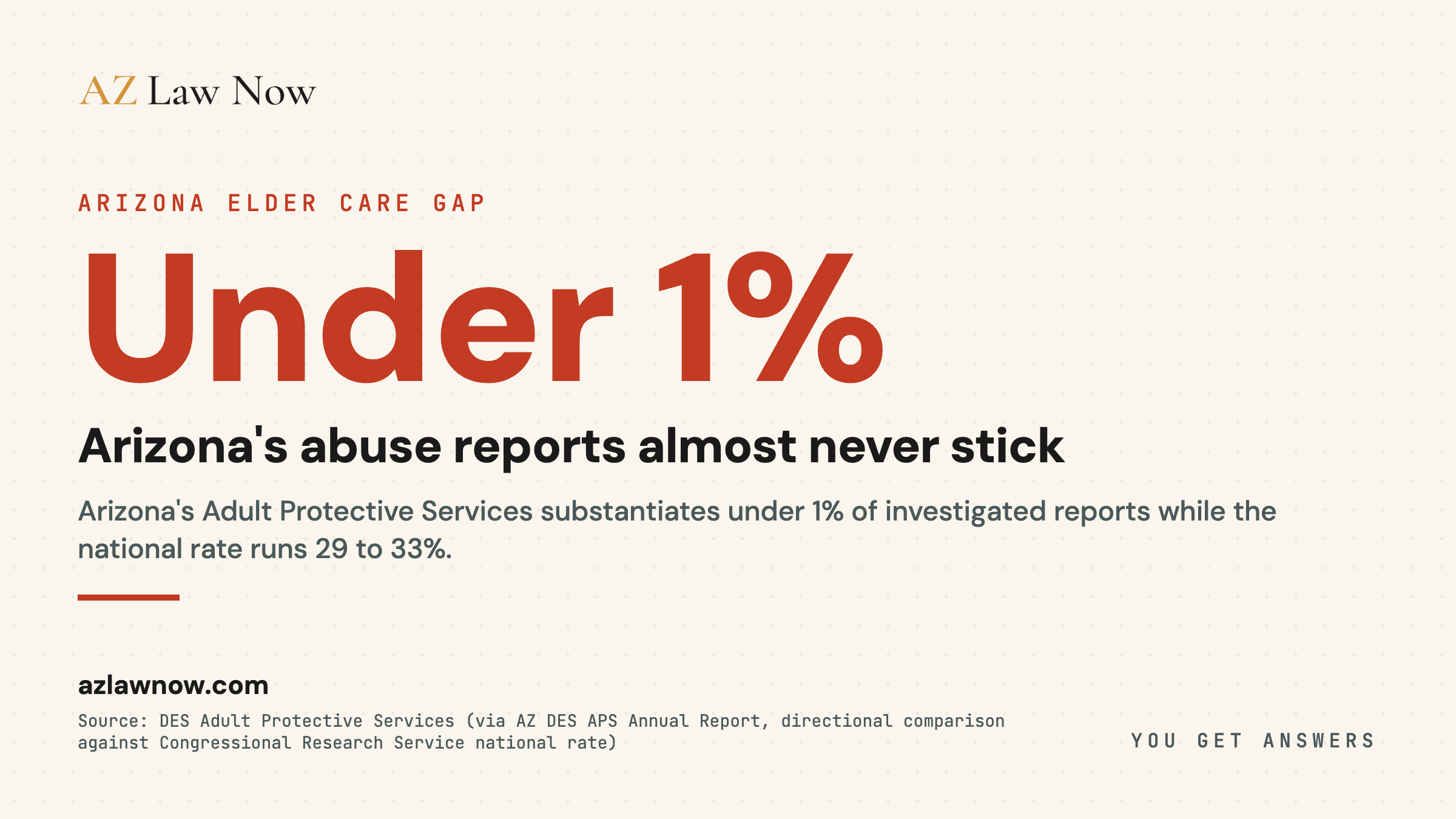
Arizona’s Adult Protective Services substantiates less than 1% of the reports it investigates.
The national substantiation rate runs 29 to 33%.
That’s a wide gap. Either Arizona is the cleanest state in the country for vulnerable-adult abuse, or the substantiation methodology produces an artificially low count, or the investigative resources can’t keep pace with report volume. The first explanation isn’t credible given CMS Care Compare data on the underlying facility population.
Pulling the primary AZ DES APS Annual Report from des.az.gov is the next reporting step. The state’s report volume, investigation counts, and substantiation rate all need to be confirmed against the underlying state document before any precise figure gets cited.
What Comes Next
Three near-term reporting moves close the gaps in this story.
The first is the public records request to AHCCCS Office of Program Integrity under ARS 39-121: aggregate billing-fraud citation count and dollar figure against nursing facilities, 2023 to 2025, broken out from the wider provider universe. That’s the Medicaid-side anchor for the combined frame.
The second is the AZ DES APS Annual Report SFY 2024 primary file: the substantiation rate, the breakdown by facility type, and the year-over-year trajectory. That’s the abuse-reporting anchor.
The third is the cross-reference build at the facility level. For each verified 1- or 2-star Arizona nursing home, pull the most recent CMS Form 2567 narrative and cross-reference the AHCCCS Provider Actions log entry during the same period. The facility-level overlap list is the combined-frame deliverable.
Several Arizona elder-law and nursing-home plaintiffs firms work cases against the named facilities. Disability Rights Arizona provides free legal services for people in long-term care. AARP Arizona’s State Director Dana Marie Kennedy has been active on long-term-care safety legislation and the 2026 nursing-home camera bill.
For now, the combined frame is documented. The two enforcement systems still run separately. The cross-reference still isn’t published.
This investigation was built from CMS Care Compare nursing-home data, the HHS OIG 2025 SFF Program report, the Arizona Attorney General Health Care Fraud Unit June 2025 release, and AHCCCS Office of Program Integrity provider actions data.
Additional sources include AZ DHS Bureau of Long-Term Care Facilities Licensing complaint architecture, ARS 36-401 et seq, ARS 46-451 to 46-454, HB2764 (signed April 8, 2024), and AZCIR / ProPublica reporting on the parallel $2.5B Medicaid fraud crisis.
If you have AHCCCS Office of Program Integrity aggregate billing-fraud data on nursing facilities, the DES APS SFY 2024 Annual Report primary file, CMS Form 2567 narratives for Arizona’s low-rated facilities, or the corporate-ownership chain on Allegiant Healthcare or Life Care Center of Tucson, contact AZ Law Now.
We report from primary sources. Person-first framing throughout: people living in long-term care, not “residents alone.” Families whose loved ones live in nursing homes, not “victim families.”
Related Coverage
For the legal and process context, see Ron DeBrigida’s guide to Arizona elder abuse law, Stephanie Ramirez’s nursing home abuse signs reporting, the nursing home abuse practice overview.
Frequently asked questions
What's the combined-frame finding here?
How many low-rated nursing homes are in Arizona?
How do you read a specific facility's record?
What's the APS substantiation gap?
What does the new HHS OIG finding say about CMS oversight?
What's the statutory framework for elder-abuse reporting in Arizona?
If a family suspects billing fraud or abuse at a relative's nursing home, what are their options?
What triggers a Medicaid fraud investigation?
Sources & references
- U.S. Centers for Medicare & Medicaid Services. Care Compare nursing-home data. Retrieved May 5, 2026, from https://www.medicare.gov/care-compare/
- U.S. Department of Health and Human Services Office of Inspector General. (2025). CMS's Special Focus Facility Program for Nursing Homes Has Not Yielded Lasting Improvements. Retrieved from https://oig.hhs.gov/reports/all/2025/cmss-special-focus-facility-program-for-nursing-homes-has-not-yielded-lasting-improvements/
- Arizona Office of the Attorney General. (2025, June). Arizona Attorney General's Office Health Care Fraud Unit Earns National Award for Excellence in Fighting Fraud and Abuse. Retrieved from https://www.azag.gov/press-release/arizona-attorney-generals-office-health-care-fraud-unit-earns-national-award
- Arizona Health Care Cost Containment System (AHCCCS). Office of Program Integrity provider actions log. Retrieved from https://www.azahcccs.gov/Fraud/Providers/actions.html
- Arizona Health Care Cost Containment System (AHCCCS). Recovery Audit Program. Retrieved from https://www.azahcccs.gov/Fraud/RecoveryAuditProgram.html
- Arizona Department of Health Services. Bureau of Long Term Care Facilities Licensing. Retrieved from https://www.azdhs.gov/licensing/ltc-facilities/index.php
- Arizona Department of Health Services. Complaint Tracker. Retrieved from https://app3.azdhs.gov/PROD-AZHSComplaint-UI
- Arizona Revised Statutes Title 36 (Public Health and Safety), Chapter 4 (Health Care Institutions), ARS 36-401 et seq. Retrieved from https://www.azleg.gov/arsDetail/?title=36
- Arizona Revised Statutes Title 46 (Welfare), Chapter 4 (Adult Protective Services), ARS 46-451 to 46-454. Retrieved from https://www.azleg.gov/arsDetail/?title=46
- Arizona Revised Statutes 46-454 (mandatory reporters of vulnerable-adult abuse). Retrieved from https://www.azleg.gov/ars/46/00454.htm
- Congressional Research Service. National Adult Protective Services substantiation rate (29-33%), used as a directional comparison against Arizona's under-1% substantiation rate. Precise Arizona SFY2024 volume figures should be confirmed against the primary AZ DES APS Annual Report before further citation.
- Arizona Legislature. HB2764, signed April 8, 2024, enhancing safety, transparency, and accountability for vulnerable adults. Retrieved from https://www.azleg.gov/legtext/56leg/2R/summary/S.2764HHS.DOCX.htm
- AZCIR / ProPublica. (2025, May 6). Arizona has recovered 5% of taxpayer dollars lost in $2.5 billion Medicaid fraud scheme. Byline Jasmine Demers. Retrieved from https://azcir.org/news/2025/05/06/most-arizona-taxpayer-funds-lost-in-2-billion-medicaid-fraud-scheme/
- Skilled Nursing News. (2026, January 28). CMS Tightens Nursing Home SFF Selection, Citing Serious Falls Linked to Staffing. Retrieved from https://skillednursingnews.com/2026/01/cms-tightens-nursing-home-sff-selection-citing-serious-falls-linked-to-staffing/
- AZ State Long-Term Care Ombudsman Program. 602-542-6454 ext 9. Retrieved from https://des.az.gov/LTCOP
Tell Google to show our reporting more often in Search and AI answers.