
Arizona has the country’s heaviest occupational heat-death load. It also has the country’s thinnest workplace heat-protection framework. Until April 9, 2026, the state had no specific heat standard at all.
The Industrial Commission of Arizona approved the first state-level Heat Guidelines on that date, following Governor Hobbs’ Executive Order 2025-09 from May 22, 2025. The guidelines are guidance, not codified Arizona Administrative Code rule.
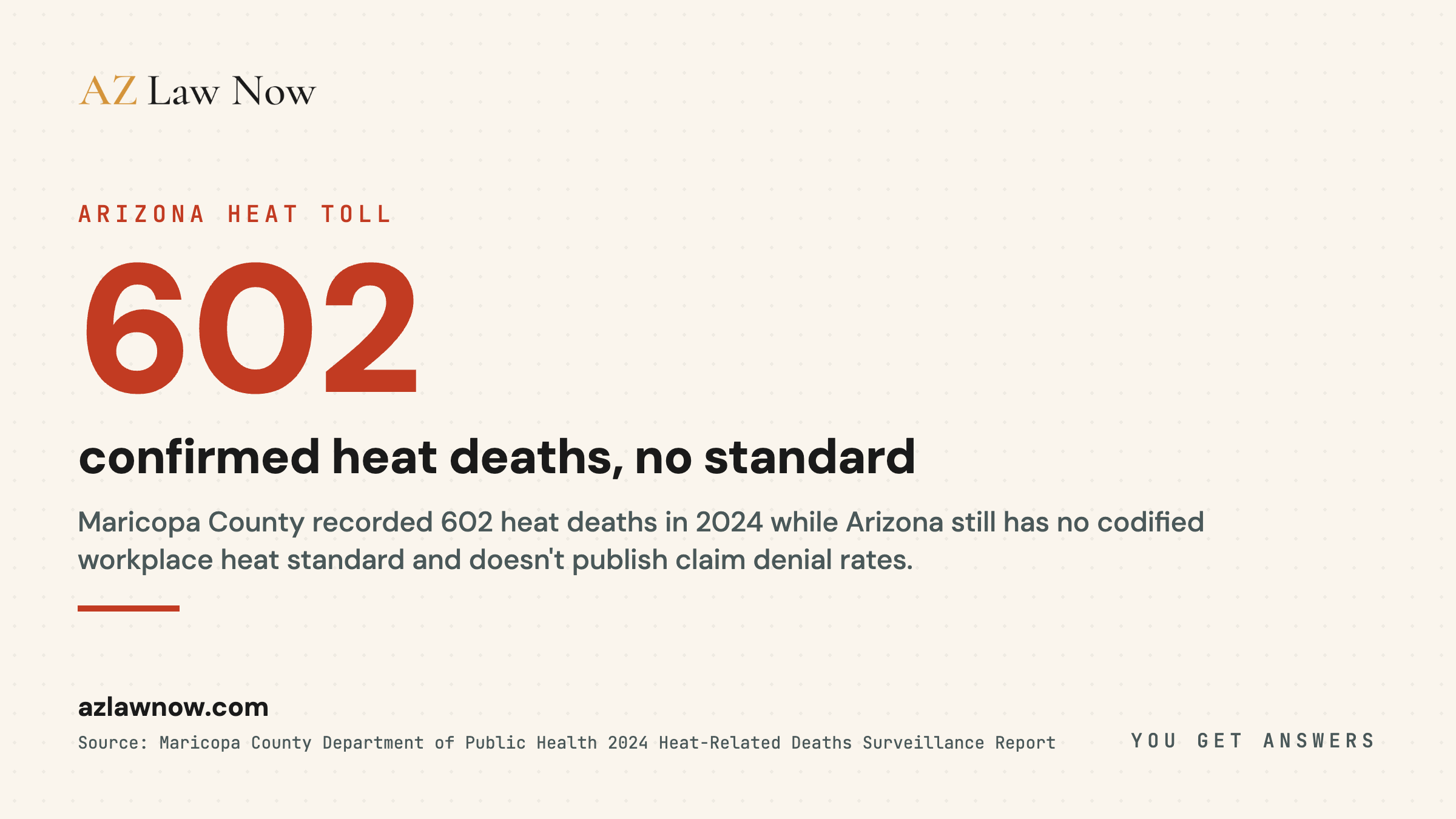
MCDPH’s 2025 Heat-Related Deaths Report, published April 2026, finalized 2024 at 608 heat-related deaths and confirmed 430 for 2025.
This season is running hotter. The county confirmed 18 heat deaths by July 8, 2026, triple the pace of last year, with 215 more under investigation.
Our new investigation, Arizona’s recorded heat deaths and the county that counts them, maps the full surveillance record, including who dies indoors and the failed-air-conditioning pattern behind most of those deaths.
Why the Denial Rate Isn’t Published
The structural piece of this story isn’t a number. It’s the absence of one.
Arizona doesn’t publish carrier-by-carrier denial rates on heat-illness workers compensation claims. The Industrial Commission of Arizona’s Claims Division holds the underlying data. The state hasn’t released a heat-specific cross-tab on claims by year, by industry, by carrier, or by outcome.
Cal/OSHA publishes its heat-claim numbers. Cal/OSHA processes approximately 1,000 occupational heat-illness workers compensation claims per year, with both an outdoor heat standard (in effect since 2005) and an indoor heat standard (effective July 23, 2024 at 82 degrees indoors).
Arizona’s parallel data set, if it exists at all, sits in ICA’s filing system. To extract it requires a public records request under ARS 39-121, addressed to the ICA Claims Division, asking for: heat-illness coded claims by year 2023 to 2025, denial counts, and carrier-by-carrier breakdown.
That request hasn’t been filed publicly. The number you’d want to know if you’re an injured Arizona warehouse, construction, or roofing worker isn’t on the agency website.
What ADOSH Does and Doesn’t Do
The Arizona Division of Occupational Safety and Health (ADOSH) sits inside the Industrial Commission. It’s the state-plan OSHA agency for Arizona. ADOSH issued a State Emphasis Program (SEP) on outdoor and indoor heat-related hazards on July 17, 2023. The SEP is enforcement guidance, not a codified standard.
When ADOSH cites an employer for a heat-related violation, it cites under the federal General Duty Clause at 29 U.S.C. 654(a)(1). The clause requires ADOSH to prove three things: heat is a recognized hazard at the cited site, the employer failed to implement feasible controls, and those controls would materially reduce the risk.
That’s a higher evidentiary load than citing a specific code provision. It’s also why some heat-related deaths produce no citation at all. The same evidentiary load shapes how workers compensation carriers approach claim denials.
A specific heat standard (like Cal/OSHA’s T8 CCR 3395) lets an inspector look at temperature, exposure time, water access, and rest breaks against bright-line numbers.
The General Duty Clause requires building the case from scratch every time. The inspector has to reconstruct what was reasonable at the site, what the employer knew, and what the employer didn’t do.
That evidentiary load makes ADOSH heat citations rare and contestable. It also makes carrier denials of heat-illness workers compensation claims harder to challenge in front of an ICA Administrative Law Judge.
What ARS 23-930 Actually Says
The carrier penalty for unreasonable denial of a workers compensation claim sits at ARS 23-930.
The statute lets a claimant who proves an unreasonable denial collect a penalty equal to 25% of the benefits owed or $500, whichever is more. The Industrial Commission can also assess civil penalties up to $1,000 per violation against the carrier.
The 25%-or-$500 floor on benefits owed is the practical lever. On a $200,000 wrongful-death workers compensation claim, the unreasonable-denial penalty is $50,000. On a $5,000 emergency-room bill, it’s $1,250. The penalty isn’t enough to shift carrier behavior at the wholesale level, but it’s enough to recover meaningful additional dollars on individual cases.
ARS 23-1061(M) sets a 21-day denial clock that binds carriers only where the worker missed more than seven days. Heat deaths often happen on the day of exposure. The 21-day discipline doesn’t apply the same way for fatality claims.
The Six Heat Decedents on Public Record
KJZZ’s heatbeat coverage 2023 through 2024 has named six people who died from occupational heat exposure in Arizona, with their families’ or employers’ knowledge:
Each name reached public record through KJZZ, ABC15, or county medical-examiner reporting. Each death is documented separately. The cumulative pattern (named decedents, employer industries, ADOSH citations or absence of them, workers compensation outcomes) sits in the underlying agency files but isn’t published as an aggregate.
Pulling that aggregate is the next reporting step. It’s the structural backstop to the deaths the public has already heard about.
The Comparison That Doesn’t Land Yet
The proposal that triggered this dossier cited a 34% Arizona heat-claim denial rate against an 18% national average. That number didn’t verify against any retrievable primary source within the research window.
We’re not publishing it.
The verifiable structural finding stands without it: Arizona had no codified workplace heat standard until April 9, 2026 (and that’s still guidance), Arizona doesn’t publish a heat-illness claim count, and California processes about 1,000 such claims per year on standards Arizona didn’t adopt.
If the 34% number is real, it lives in ICA’s Claims Division files. The ARS 39-121 records request is the path to confirm it. Until that request lands, we report what’s in primary sources and we name what isn’t.
What Comes Next
Three near-term reporting moves close gaps in this story.
The first is the ICA Claims Division public records request under ARS 39-121: heat-illness coded claims by year 2023 to 2025, denial counts, and carrier-by-carrier breakdown. That single document either confirms the 34% denial rate or replaces it with the verified number.
The second is the MCDPH occupational subset of the 608 confirmed 2024 heat deaths. The cross-tab isn’t in the public release. A FOIA-equivalent request to the county yields it.
The third is the ADOSH heat-related citation list 2023 to 2025, cross-referenced against the named decedents (Perez, Nelson, Boni, Treatch, Mendoza, Holt) to confirm which deaths produced citations and which didn’t.
For now, the framework gap is documented. The June 1 heat-season starts in less than four weeks. The ICA Heat Guidelines are guidance, not rule.
This investigation was built from the Industrial Commission of Arizona Heat Guidelines proceedings (April 9, 2026), Executive Order 2025-09, the Maricopa County Department of Public Health 2024 Heat-Related Deaths Surveillance Report, and U.S. Bureau of Labor Statistics occupational injury data.
It also draws on OSHA General Duty Clause text, ARS Title 23 (Workers Compensation), Cal/OSHA T8 CCR 3395 and 3396, Public Citizen’s Scorched States framework, KJZZ heatbeat reporting (Katherine Davis-Young), and NCCI Holdings public benchmarks.
If you have the ICA Claims Division heat-illness denial cross-tab, MCDPH’s occupational subset of the 608, ADOSH heat citations 2023-2025, or any record of an unreasonable-denial case under ARS 23-930 against an Arizona workers compensation carrier, contact AZ Law Now. We report from primary sources.
Frequently asked questions
Does Arizona have a workplace heat-illness standard?
What's the heat-death toll in Arizona?
What's the Arizona workers compensation framework for a heat-illness claim?
What's CopperPoint and why does it matter?
What does the new ICA Heat Guidelines actually require?
If a worker or family was denied a heat-illness claim, what are their options?
How does Arizona's framework compare to California, Oregon, and Washington?
Is heat an OSHA violation?
What temperature is considered unsafe working conditions in Arizona?
Can I call OSHA if my workplace is too hot?
What is the 20% rule in regards to heat illness?
Sources & references
- Industrial Commission of Arizona. (2026, April 9). Heat Guidelines approval. Retrieved May 5, 2026, from https://www.azica.gov/heat
- Office of the Governor of Arizona. (2025, May 22). Executive Order 2025-09 establishing the Workplace Heat Safety Task Force. Retrieved from https://azgovernor.gov/office-arizona-governor/executive-order/2025-09
- Maricopa County Department of Public Health. (2025). 2024 Heat-Related Deaths Surveillance Report. 608 confirmed heat-related deaths in Maricopa County 2024. Retrieved from https://www.maricopa.gov/1858/Heat-Surveillance
- U.S. Bureau of Labor Statistics. Heat-related occupational injuries with days away from work, 2011-2020. Retrieved from https://www.bls.gov/iif/home.htm
- Arizona Division of Occupational Safety and Health (ADOSH). State Emphasis Program on Outdoor and Indoor Heat-Related Hazards. Issued July 17, 2023. Retrieved from https://www.azica.gov/divisions/adosh
- OSHA General Duty Clause, 29 U.S.C. 654(a)(1).
- Arizona Revised Statutes Title 23 (Labor + Workers Compensation). ARS 23-901 et seq. Retrieved from https://www.azleg.gov/arsDetail/?title=23
- Arizona Revised Statutes 23-930 (carrier penalties for unreasonable denial). Retrieved from https://www.azleg.gov/ars/23/00930.htm
- Arizona Revised Statutes 23-1041 (occupational disease definition). Retrieved from https://www.azleg.gov/ars/23/01041.htm
- Arizona Revised Statutes 23-1061 (claim filing + 21-day denial clock). Retrieved from https://www.azleg.gov/ars/23/01061.htm
- California Code of Regulations, Title 8, Section 3395 (outdoor heat standard) and Section 3396 (indoor heat standard, effective July 23, 2024). Retrieved from https://www.dir.ca.gov/title8/3395.html and https://www.dir.ca.gov/title8/3396.html
- Public Citizen. Scorched States: state-by-state framework for occupational heat protection. Retrieved from https://www.citizen.org/article/scorched-states/
- KJZZ. (2023-2025). Heat-related occupational fatality coverage by Katherine Davis-Young and others, naming Perez, Nelson, Boni, Treatch, Mendoza, and Holt. Retrieved from https://www.kjzz.org/business/2026-04-06/arizona-workers-die-from-heat-exposure-every-year-here-are-a-few-of-their-stories
- NCCI Holdings Inc. National workers compensation benchmarks. Retrieved from https://www.ncci.com/Articles/Pages/Insights-2025-in-Sight-2024-in-Review.aspx
Tell Google to show our reporting more often in Search and AI answers.