
Phoenix spent this week under an extreme heat warning, with forecast highs of 111 to 116 degrees and overnight lows near 90.
By July 8, Maricopa County had confirmed 18 heat deaths for the season, triple the five confirmed at the same point last year, with another 215 under investigation.
The same day, the Arizona Attorney General ordered a Glendale apartment complex to fix its dead air conditioning by Friday or face Consumer Fraud Act penalties.
Behind that week sits a number we pulled from the federal government’s own storm-mortality record, and the number needs explaining before it needs repeating.
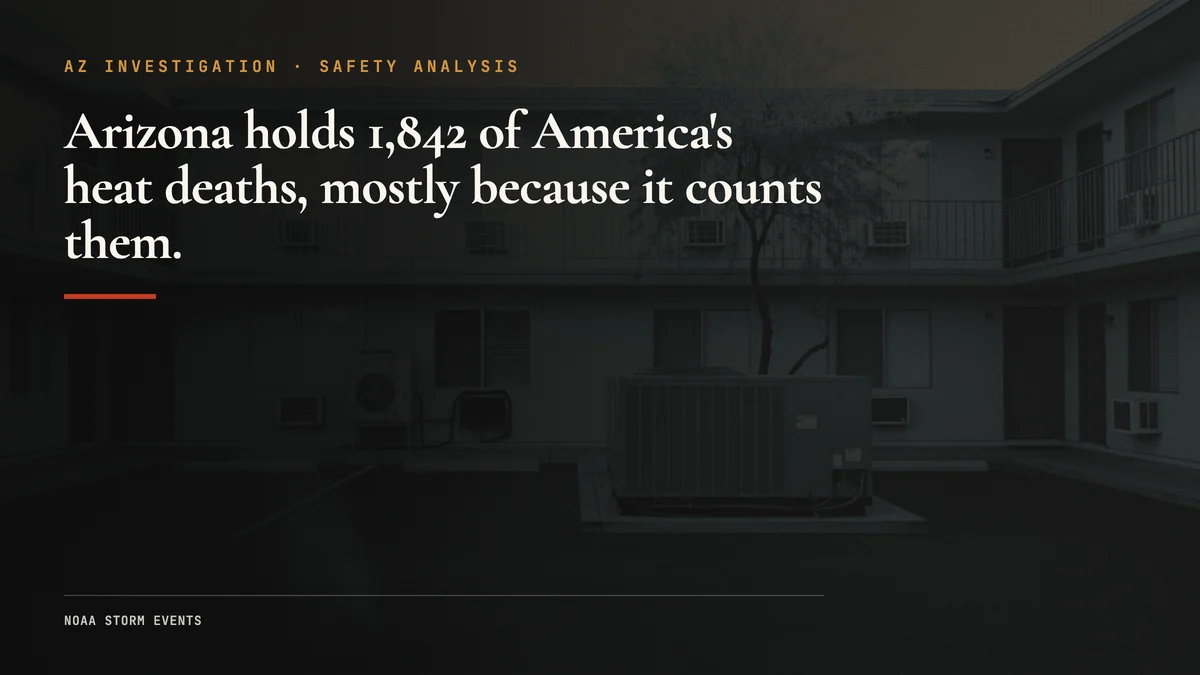
Since 2000, the NOAA Storm Events Database has recorded 4,417 direct heat deaths in the United States. Arizona holds 1,842 of them, which is 41.7%. The next state, Nevada, holds 506. On paper, one state with 2% of the country’s population owns two of every five recorded American heat deaths.
Nobody should believe that ratio at face value. What it actually shows is stranger, and closer to home: Arizona counts its heat deaths like nowhere else in America, and the count it produces is horrifying on its own terms.
What the 42% Actually Measures
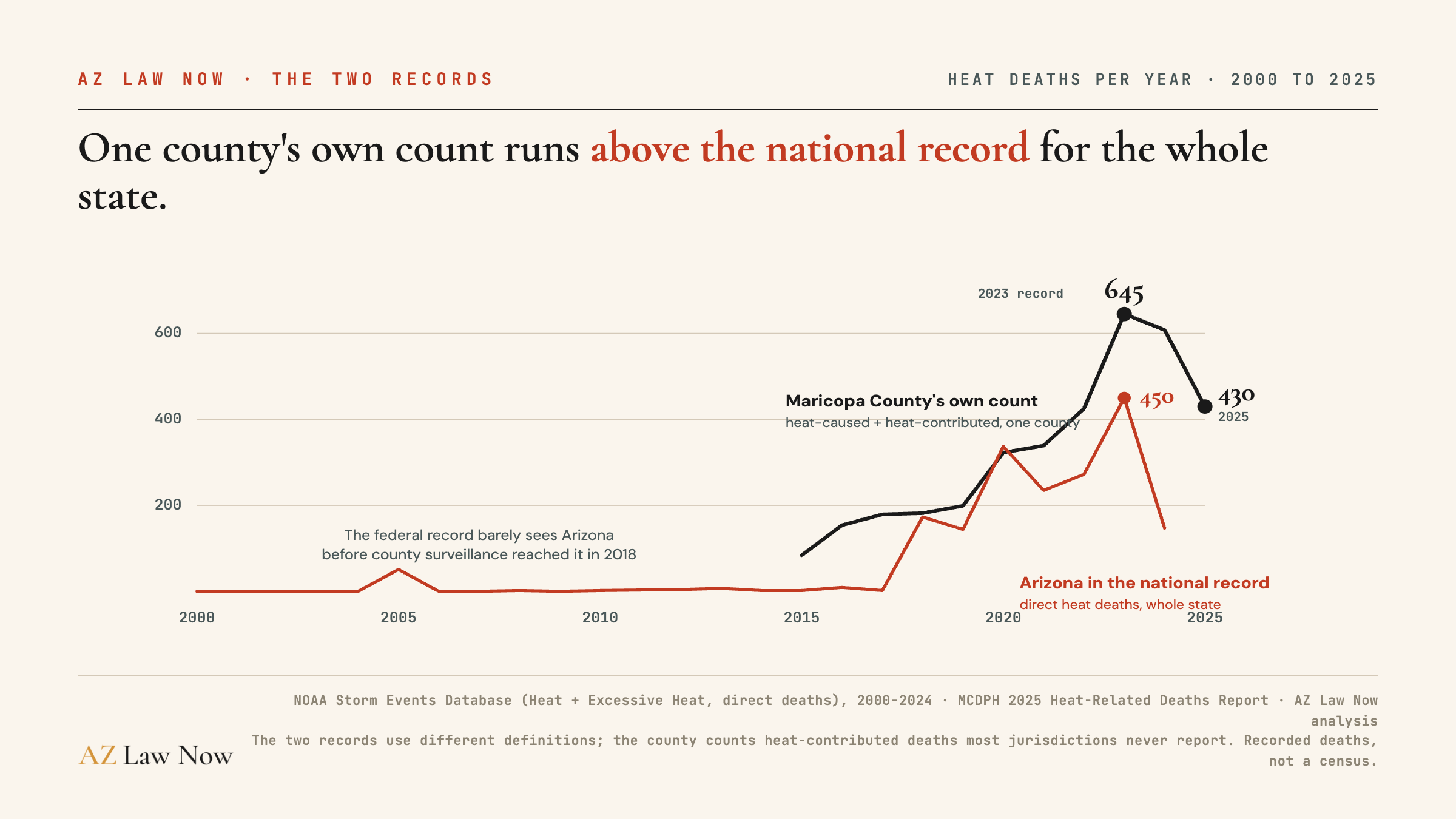
The national record’s Arizona entries barely exist before 2018. Across 2000-2017, NOAA’s database logs 84 direct heat deaths in Arizona. Across 2018-2024, it logs 1,758. 95% of Arizona’s entries landed in the last seven years of a 25-year record.
Arizonans didn’t start dying of heat twentyfold in 2018. The record changed because the counting changed.
Maricopa County’s public health department has tracked heat deaths since 2006, and it runs the process like a criminal investigation. Every suspected case goes through the county medical examiner.
Deaths are classified from death-certificate causes as either heat-caused or heat-contributed, and the results publish weekly through summer on a public dashboard, then annually in a full mortality report.
As that surveillance matured and its findings flowed into the federal record, Arizona’s share of the national count exploded.
The starkest version of the artifact: in 2023, the national record logged 557 direct heat deaths in the entire United States. Arizona’s entries account for 450 of them, four of every five recorded American heat deaths in one state.
No one thinks that’s how heat mortality distributed itself across the country that year. It’s how heat counting distributed itself.
Every figure in this piece from the national record is a count of recorded deaths, not a census of all deaths.
Maricopa County surveils heat mortality far more completely than most American jurisdictions, so Arizona’s share of the national record is inflated by reporting completeness.
We don’t rank states against each other here, because a ranking would partly measure which health departments count hardest, not where heat kills most. The full caveat sits in the methodology section below.
The county’s own numbers make the same point from the other side. MCDPH confirmed 645 heat-related deaths in 2023, a record. The federal record’s entry for the whole state that year is 450.
That means one county’s own count exceeds the national record’s count for all of Arizona, because the county counts both heat-caused and heat-contributed deaths and investigates every suspected case.
The county says this plainly in its own methodology: most jurisdictions report only heat-caused deaths, and comparisons should account for it.
So the honest headline isn’t that Arizona owns 42% of American heat deaths. It’s that when one jurisdiction actually looks, this is what it finds.
What Maricopa County’s Count Shows
The value of counting this hard is that the county knows exactly who dies. Its 2025 report, published in April 2026, confirms 430 heat-related deaths, the second straight annual decline from 2023’s record 645. The decline is real progress, and it still leaves a toll that would rank as a mass-casualty event anywhere else.
The deaths sort into two very different emergencies. About 74% of the county’s 2025 heat deaths happened outdoors, and people experiencing homelessness made up the largest share of any living situation. That’s the visible crisis, the one the Heat Relief Network’s cooling centers exist for.
The indoor deaths are the quieter one, and they’re the ones with an accountability thread. The county logged 111 indoor heat deaths in 2025, and 90% were people 50 or older.
An air-conditioning unit was present in 94% of those homes. Where a unit was present, it wasn’t functioning in 72% of cases.
These are people who died in housing that had cooling equipment which didn’t work, couldn’t run, or never turned on.
Two more county findings sharpen the picture. Nearly half of indoor deaths, 53 of 111, were found during a welfare check, when a neighbor, relative, or EMS crew finally went to look. And mobile homes and RVs, about 5% of the county’s housing stock, produced roughly 23% of indoor heat deaths.
In the national record, the seasonal shape is just as concentrated: July alone accounts for 859 of Arizona’s 1,842 recorded deaths, and June through August account for 86%. The deadliest stretch of the Arizona year is running right now.
The Accountability Thread: Dead AC as a Legal Problem
Which brings this back to the week Phoenix just had.
On July 8, Attorney General Kris Mayes sent a formal cease and desist letter to Asset Living, LLC and Spectra West Apartments in Glendale, off 59th Avenue and Bethany Home Road.
The letter cites consumer reports and local news coverage that most, if not all, units at the complex lacked functioning air conditioning, with indoor temperatures reportedly reaching 100 degrees, far above the 82-degree threshold public health authorities consider safe for indoor living.
“We are in the middle of extreme summer heat with temperatures climbing to over 110 degrees across the metro-Phoenix area,” Mayes said in the release. “It is unacceptable for residents to be without proper cooling in this dangerous weather.”
The legal theory matters for every Arizona renter. The letter alleges that advertising air conditioning and on-site maintenance while units go without working cooling may violate the Arizona Consumer Fraud Act, ARS 44-1521 et seq., alongside landlord-tenant law, with civil penalties of up to $10,000 per violation.
The demands: full repairs by a licensed technician by 5 p.m. Friday, July 10, portable units or free alternative housing for tenants in the meantime, and preservation of maintenance and marketing records back to May 2024.
Separately, Arizona’s landlord-tenant statute, ARS 33-1364, gives tenants direct remedies when a landlord fails to supply air conditioning or cooling where units are installed and offered.
This is the same statute-backed pattern we documented in the APS heat-disconnect settlement, where the Attorney General used the Consumer Fraud Act after an 82-year-old customer died following a power disconnection on a 99-degree day, and APS paid $7 million.
The county’s indoor-death data explains why these cases keep coming: the machinery of indoor heat death in Maricopa County is usually a cooling failure, a unit that’s broken, unpowered, or off.
When the failure traces to a decision by a utility, a landlord, or a property manager, it stops being weather and becomes negligence.
The gap on the workplace side runs parallel. Arizona still has no codified workplace heat standard, only guidance, and as we reported in our workers’ comp heat-denials investigation, the carrier denial rate for heat claims isn’t even public.
What This Means for an Arizona Household
The county’s data reads like a checklist of preventable circumstances, so treat it as one.
Check on people, especially older neighbors and relatives who live alone. Nearly half of indoor deaths were discovered during a welfare check that came too late to help, which makes a call or a knock during a heat warning the single intervention the data most directly endorses.
A dead AC unit is an emergency, not an inconvenience. The county found a non-functioning unit in 72% of indoor deaths where a unit was present, and 90% of indoor victims were 50 or older.
Public health’s safe-indoor threshold is 82 degrees. The Heat Relief Network runs 66 cooling centers across the Valley, and 211 provides free rides to them.
The law also sits on the tenant’s side here. ARS 33-1364 covers wrongful failure to supply air conditioning or cooling, and the Attorney General’s office accepts consumer complaints about unsafe housing conditions and deceptive advertising at azag.gov.
Kelli Donley Williams, deputy director of the Maricopa County Department of Public Health, put the stakes flatly to KTAR News this week: “Those 18 deaths are, of course, preventable.”
Families who lost someone to an indoor heat death where cooling equipment failed can read our guides on Arizona’s wrongful death statute and what a family goes through after a wrongful death.
Where a death traces to a specific cooling failure someone was responsible for fixing, that’s a premises question, not a weather question.
One deadline matters more than any other here: when a government entity is at fault, an injured person must file a formal notice of claim within 180 days under ARS 12-821.01. Failure to file is a complete defense to the claim, one the government entity must raise or it waives.
Methodology
What we counted
“Recorded direct heat deaths” are direct fatalities on Heat and Excessive Heat event entries in the NOAA Storm Events Database, 2000-2024, aggregated by state, year, and month.
Arizona’s totals: 1,842 of 4,417 nationally (41.7%), 84 across 2000-2017, 1,758 across 2018-2024, July peak of 859.
Maricopa County figures come directly from MCDPH’s published annual Heat-Related Deaths Reports (2024 and 2025 editions) and the county’s heat surveillance page, not from our own derivation.
The surveillance caveat, stated plainly
Arizona’s share of the national record partly measures reporting completeness, not just deaths.
Maricopa County runs the most thorough heat-death surveillance in the country: medical examiner investigation of every suspected case, death-certificate classification into heat-caused and heat-contributed, weekly public reporting in season, and a full annual mortality report.
Most jurisdictions report far less completely, and MCDPH’s own methodology notes that most report only heat-caused deaths.
State-to-state comparisons on this record would partly measure which health departments count hardest, so we report recorded deaths and don’t rank states as if coverage were equal.
The post-2017 explosion in Arizona’s federal entries reflects surveillance flowing into the record, not a twentyfold increase in dying.
Definitions
NOAA direct fatalities exclude deaths classified as indirect, so the federal record understates total heat mortality everywhere. MCDPH counts heat-caused deaths (heat in the direct causal chain on the death certificate) plus heat-contributed deaths (heat as a contributing factor). The two records use different definitions and are never summed or mixed in this piece.
Frequently asked questions
How many heat deaths does Arizona actually have each year?
Does Arizona really account for 42% of US heat deaths?
Who dies from heat in Maricopa County?
Is a landlord required to provide working air conditioning in Arizona?
What did Attorney General Mayes demand from Spectra West Apartments?
What should I do if I think someone is in a dangerously hot home?
Sources & references
- NOAA National Centers for Environmental Information. Storm Events Database (event types Heat and Excessive Heat, direct fatalities, 2000-2024). Retrieved July 11, 2026, from https://www.ncei.noaa.gov/stormevents/
- Maricopa County Department of Public Health. (2026, April). 2025 Heat-Related Deaths Report. Division of Epidemiology and Informatics. Retrieved July 11, 2026, from https://www.maricopa.gov/ArchiveCenter/ViewFile/Item/6510
- Maricopa County Department of Public Health. (2025, May). 2024 Heat-Related Deaths Report. Division of Epidemiology and Informatics. Retrieved July 11, 2026, from https://www.maricopa.gov/ArchiveCenter/ViewFile/Item/5934
- Maricopa County Department of Public Health. Heat Surveillance program page, data definitions, and dashboard. Retrieved July 11, 2026, from https://www.maricopa.gov/1858/Heat-Surveillance
- Maricopa County Department of Public Health. (2024, April). 2023 Heat-Related Deaths Report. Division of Epidemiology and Informatics. Confirmed 645 heat-related deaths in 2023. Retrieved from https://www.maricopa.gov/Archive.aspx?ADID=5820
- Arizona Attorney General. (2026, July 8). Attorney General Mayes Demands Spectra West Apartments in Glendale Restore Functioning Air Conditioning for Tenants. Retrieved July 11, 2026, from https://www.azag.gov/press-release/attorney-general-mayes-demands-spectra-west-apartments-glendale-restore-functioning
- KTAR News. (2026, July 8). AG Kris Mayes sends letter demanding Glendale apartment complex fix air conditioning. Kylie Werner. Retrieved July 11, 2026, from https://ktar.com/arizona-news/kris-mayes-letter-glendale-apartment-complex-air-conditioning/5887177/
- KTAR News. (2026, July 8). Maricopa County heat deaths surge past 2025's pace as officials expand cooling resources. David Iversen. Retrieved July 11, 2026, from https://ktar.com/arizona-health-news/maricopa-county-heat-deaths-surge/5887191/
- KTAR News. (2026, July 9). Extreme heat warning for metro Phoenix extended as high temperatures persist. Kevin Stone. Retrieved July 11, 2026, from https://ktar.com/arizona-weather-news/extreme-heat-phoenix-extend/5887381/
- Arizona Revised Statutes 33-1364 (wrongful failure to supply heat, air conditioning, cooling, water, hot water or essential services). Retrieved July 11, 2026, from https://www.azleg.gov/ars/33/01364.htm
- Arizona Revised Statutes 12-821.01 (notice of claim against public entities, 180 days). Retrieved July 11, 2026, from https://www.azleg.gov/ars/12/00821-01.htm