
Between November 2017 and January 2026, BNSF Railway Company filed at least five Form 6180.57 accident reports across three Phoenix Subdivision grade crossings using the same narrative phrase each time.
All three crossings sit within a 4.2-mile urban arterial corridor in west Phoenix.
The Federal Railroad Administration inventory revised July 2025 confirms that none of the three has channelizing medians, four-quadrant gates, or the supplementary safety measures specified by 49 CFR Part 222.
The Three Crossings
The phrase AUTO PRECEDED THE GATES doesn’t appear in BNSF Form 6180.57 narratives at the other 79 at-grade public crossings on the Phoenix Subdivision in Arizona. It appears at three specific crossings.
Bethany Home Road, DOT 025590V, MP 185.353
On December 29, 2023, BNSF filed Form 6180.57 recording consist R-SWE0036-29C pulling on other than main track and striking an unoccupied auto stalled on the gated crossing. The filing states the auto preceded the gates. No derailment, no hazmat released, driver’s age unknown.
Osborn Road, DOT 025428F, MP 188.878
BNSF filed twice at this crossing in eight months.
On May 1, 2025, BNSF recorded consist RSWE003301 as light power striking a trailer hooked to a pickup at the gated crossing. The filing states the auto preceded the gates and was stopped. No derailment, no hazmat release, no injuries.
On January 9, 2026, BNSF recorded consist Y-PHX3021-08A as light power striking an auto stopped in the foul of the gated crossing. The filing again states the auto preceded the gates. No derailment, no hazmat release.
Thomas Road, DOT 025617C, MP 189.580
The crossing where the phrase has the longest documentary history. BNSF filed using it on three occasions.
On November 1, 2017, more than six years before the active warning gate retrofit completed at this crossing in June 2024, BNSF recorded an eastbound auto that preceded the gates and was struck by consist VCLOPHX 1 29 A. The driver was injured.
On June 15, 2025, after the retrofit, BNSF recorded consist YPHX203115 pulling on single main track and striking an auto that preceded the gates. The driver left the scene. No derailment, no hazmat release, no injuries.
On August 7, 2025, BNSF recorded consist YPHX203107 pulling on single main track and striking an occupied auto at the gated crossing. The filing states the auto preceded gates. No derailment, no hazmat release, no injuries.
The Four-Mile Corridor
The three crossings span a 4.227-mile arterial corridor on the BNSF Phoenix Subdivision in west Phoenix:
| DOT | Crossing | Milepost | ”AUTO PRECEDED” filings |
|---|---|---|---|
| 025590V | Bethany Home Road | 185.353 | 1 |
| 025422P | Camelback Road | 186.760 | (not retrofitted, 13 pre-gate accidents) |
| 025428F | Osborn Road | 188.878 | 2 |
| 025617C | Thomas Road | 189.580 | 3 |
| 025430G | 27th Avenue (twin to Thomas Rd) | 189.615 | (50 feet south of Thomas Rd) |
The corridor carries combined annual average daily traffic above 100,000 vehicles per the most recent ADOT and Maricopa Association of Governments AADT counts referenced in the FRA inventory.
What the Federal Framework Specifies
The Federal Railroad Administration treats the failure mode BNSF documents in this phrase as a quiet-zone supplementary-safety-measure question. Under 49 CFR Part 222 Appendix A, three engineering responses address the gate-timing failure that the phrase describes:
- Channelizing medians: raised concrete or curbed barriers on the centerline of the roadway, extending back from the crossing, that physically prevent vehicles from going around lowered gate arms.
- Four-quadrant gates: gate-arm configurations that close all four corners of the crossing simultaneously rather than only the two through-traffic lanes.
- Supplementary safety measures including wayside horns, pedestrian-specific gates, and additional traffic-control signaling at the crossing approaches.
The Federal Highway Administration’s Manual on Uniform Traffic Control Devices Part 8 specifies the engineering criteria for each.
Per the Federal Railroad Administration inventory last revised July 2025, none of the three crossings on this corridor has any of these mitigations installed.
Camelback Road
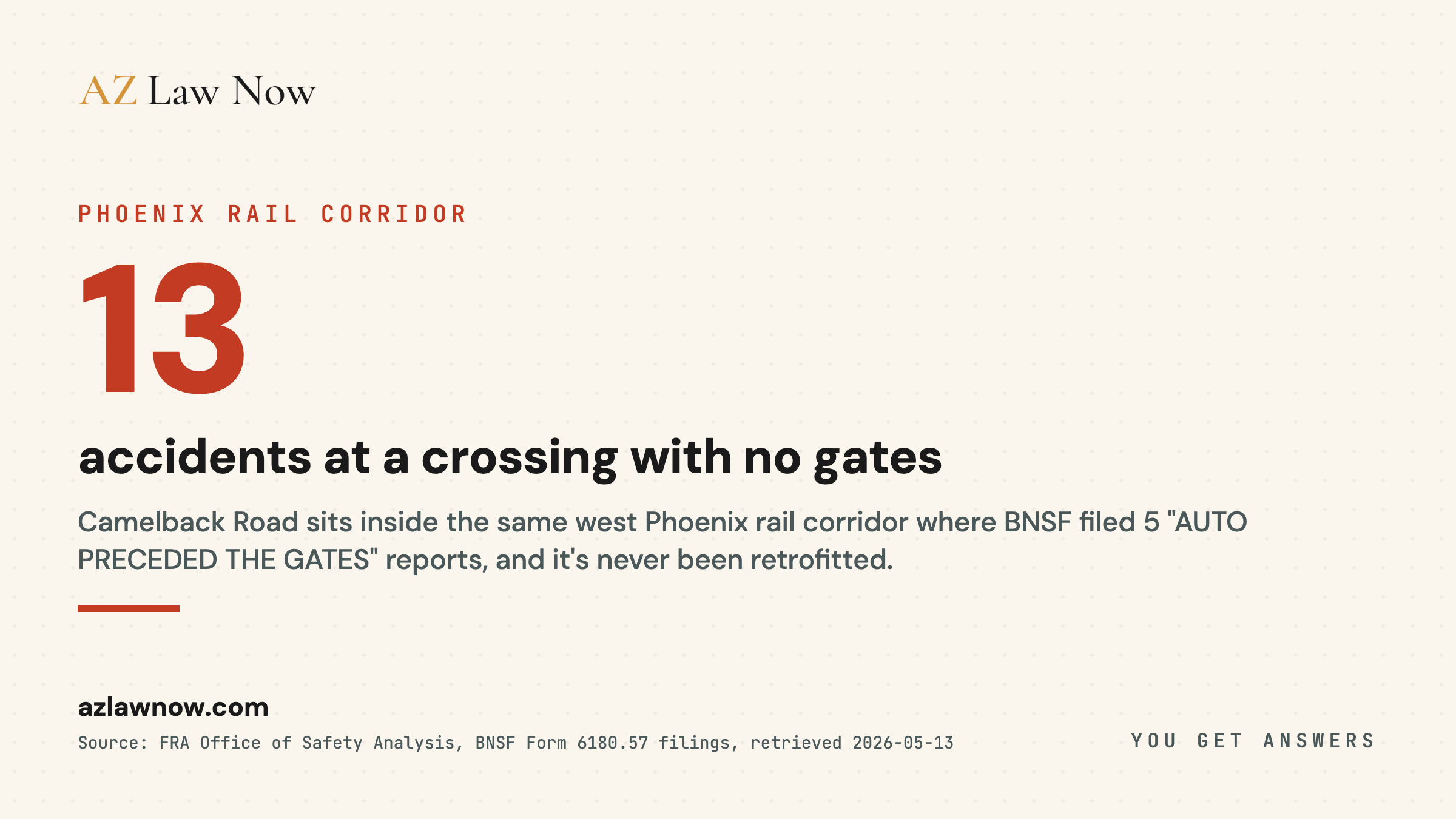
Camelback Road sits between Bethany Home and Osborn at milepost 186.760. Camelback Road has 13 reported Form 6180.57 crashes on the BNSF filing history. The crossing has not been retrofitted with active warning gates.
BNSF’s filings describe drivers stopped in the foul of the crossing, drivers who fled the scene after impact, and at least one filing in which the narrative states the driver “deliberately disregarded crossing warning devices.”
The corridor that has the three documented AUTO PRECEDED THE GATES filings has a fourth crossing inside the same span without active warning gates at all.
What Form 6180.57 Is, And What It Isn’t
Form 6180.57 is the Federal Railroad Administration’s Highway-Rail Grade Crossing Accident or Incident Report. Railroads operating on the general rail system file it after any reportable crash at a grade crossing. The records are public under the Federal Railroad Safety Act and are searchable through the FRA Office of Safety Analysis.
Federal law, 49 USC 20903, restricts the admissibility of Form 6180.57 reports in damages litigation. The form itself isn’t admissible. The underlying facts (the dates, the equipment status, the witness accounts) are admissible through other discovery channels.
For journalism, Form 6180.57 is a public record of what a railroad has written about its own accidents. The phrase AUTO PRECEDED THE GATES quoted at each of the three crossings is verbatim from the narrative field of BNSF’s own filings, retrieved from the FRA Office of Safety Analysis on 2026-05-13.
What Comes Next
Three records-request paths surface the rest of the corridor record:
- City of Phoenix Streets Transportation Department under ARS 39-121: the Capital Improvement Program line items for the BNSF Phoenix Subdivision corridor at mileposts 185.353 through 189.615, including any documented plans for channelizing medians, four-quadrant gates, or pedestrian-specific gates at the three crossings.
- ADOT Rail Section under ARS 39-121: any FHWA Section 130 program correspondence, corridor safety studies, or inter-agency memos referencing the same corridor.
- Federal Railroad Administration Office of Railroad Safety under 5 USC 552: inspector defect reports, civil-penalty cases, and Highway-Rail Grade Crossing Safety Plan correspondence between FRA and BNSF Railway Company referencing the Phoenix Subdivision.
This investigation was built from the Federal Railroad Administration Office of Safety Analysis per-crossing accident PDFs for 82 BNSF Phoenix Subdivision at-grade public crossings in Arizona (retrieved 2026-05-13, archived at data/research/fra-pulls/bnsf-phoenix-subdivision/), the NTAD Railroad Grade Crossings FeatureServer for inventory metadata, 49 CFR Part 222, and the Manual on Uniform Traffic Control Devices Part 8.
The phrase AUTO PRECEDED THE GATES quoted from each of the three crossings is verbatim from BNSF Railway Company Form 6180.57 narrative fields. The phrase appears at no other crossing on the BNSF Phoenix Subdivision in Arizona.
This report is editorial commentary on a public record. It doesn’t advance any litigation theory and doesn’t name parties to any underlying claim.
Related Coverage
For the legal and process context, see Ron DeBrigida’s guide to Arizona car crash law, Stephanie Ramirez’s car crash first 48 hours, the car crashes practice overview.
Frequently asked questions
What is the phrase AUTO PRECEDED THE GATES?
At which Phoenix Subdivision crossings does the phrase appear?
How far apart are the three crossings?
What federal mitigations would address the documented failure mode?
What about Camelback Road in the same corridor?
Has BNSF or the City of Phoenix announced corridor-wide upgrades?
Sources & references
- Federal Railroad Administration. (2026). Office of Safety Analysis: Per-crossing accident PDFs for 82 BNSF Phoenix Subdivision at-grade public crossings in Arizona. Retrieved May 13, 2026, from https://safetydata.fra.dot.gov/officeofsafety/
- Federal Railroad Administration. (2025). Highway-Rail Grade Crossing Inventory, BNSF Phoenix Subdivision (July 2025 revisions). Retrieved May 13, 2026, from https://safetydata.fra.dot.gov/officeofsafety/publicsite/crossing/crossing.aspx
- U.S. Department of Transportation, Bureau of Transportation Statistics. (n.d.). NTAD Railroad Grade Crossings FeatureServer. Retrieved May 13, 2026, from https://geodata.bts.gov/datasets/usdot::railroad-grade-crossings
- 49 C.F.R. § 222 (2024). Use of locomotive horns at highway-rail grade crossings. Retrieved from https://www.ecfr.gov/current/title-49/subtitle-B/chapter-II/part-222
- Federal Highway Administration. (2023). Manual on Uniform Traffic Control Devices for Streets and Highways, Part 8: Traffic control for railroad and light rail transit grade crossings. Retrieved from https://mutcd.fhwa.dot.gov/pdfs/11th_Edition/part8.pdf
- 49 U.S.C. § 20903 (1994). Prohibition on use of certain accident or incident reports. Retrieved from https://www.law.cornell.edu/uscode/text/49/20903
- Ariz. Rev. Stat. § 39-121 (2024). Inspection of public records; access. Retrieved from https://www.azleg.gov/ars/39/00121.htm
- 5 U.S.C. § 552 (2022). Public information; agency rules, opinions, orders, records, and proceedings (Freedom of Information Act). Retrieved from https://www.law.cornell.edu/uscode/text/5/552