
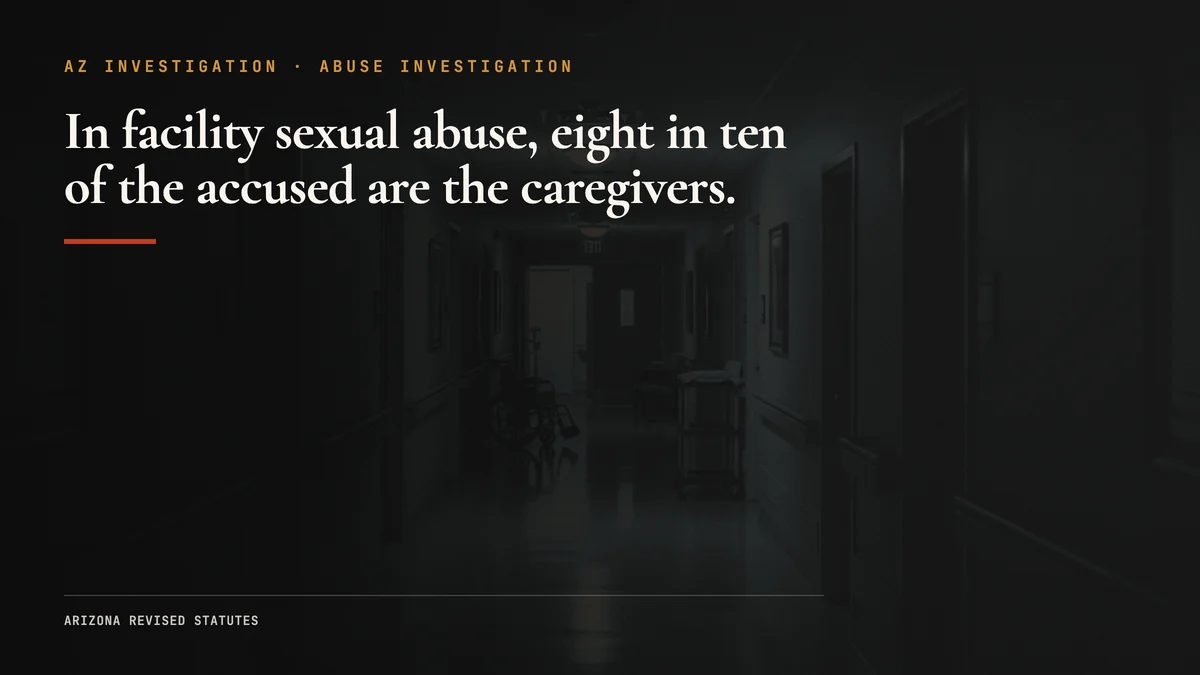
Mesa police arrested Gamacy Gilles, age 46, a staff member at Grand Court of Mesa Senior Living. The arrest came after the family of a wheelchair-bound resident with dementia reviewed video footage and reported what they saw to police.
Per local reporting, Gilles was booked on one count of felony sexual abuse, one count of felony adult abuse, and one misdemeanor count of assault. He is in jail with bond set. He is presumed innocent unless and until convicted at trial.
The case was reported by AZFamily and ABC15, with AZFamily publishing on April 21, 2026.
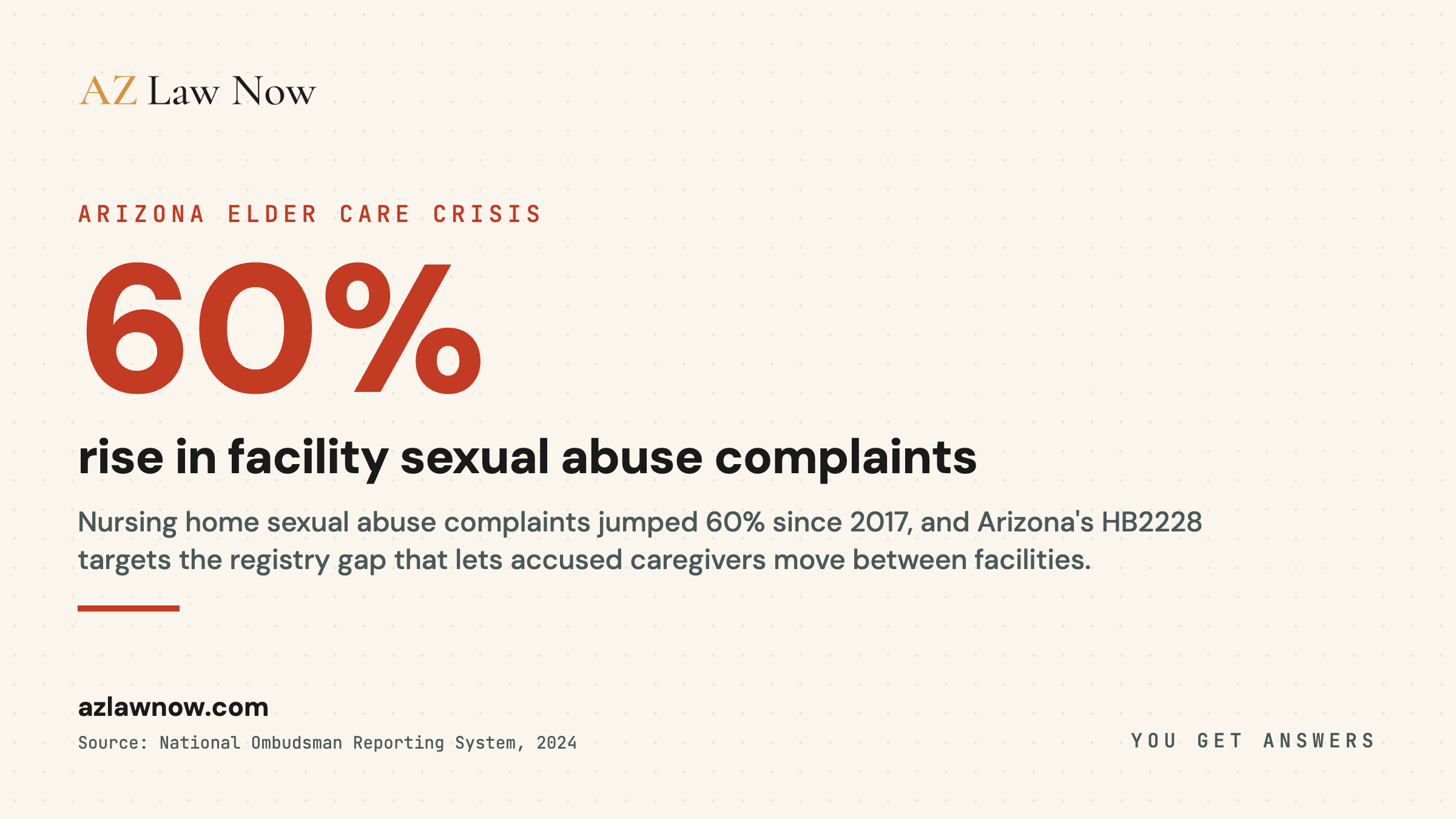
The same week, the Arizona Legislature was moving a bill specifically designed to address the conditions that produce cases like this. HB2228 (“Elder abuse central registry; mandatory reporting; release of information”) had cleared the House and was heading into the Senate process.
The two stories are connected by data that’s been sitting in plain sight for years.
What HB2228 Changes
The bill amends A.R.S. § 46-457, which governs the state’s elder abuse central registry. The registry’s job is to keep a record of caregivers and others who have substantiated findings against them so they don’t simply move to a different facility, get hired again, and reoffend.
Under HB2228, anyone filing an Adult Protective Services action must report to the Arizona Attorney General within two years. Information-release protocols get tightened. The mandatory-reporting language gets sharper. The intent is that caregivers with substantiated allegations don’t slip through the cracks between county jurisdictions, between facility licensing boards, and between criminal and civil tracks.
The bill is specifically the kind of structural reform that addresses the data points below.
The Data That Drives the Reform
The numbers on facility sexual abuse are unambiguous and they’ve been getting worse, not better.
These aren’t edge cases. They’re a documented pattern. The reported number is a fraction of the actual number, by every methodology that has tried to measure it.
The Mesa case lines up with the demographic data with painful precision. The victim is wheelchair-bound and has dementia. The accused is a caregiver. The incident was identified by family review of video, not by the facility.
The case reached law enforcement because a family member acted. Without the family’s intervention, this could easily have stayed in the large share of cases that are never reported.
What the Reform Doesn’t Fix
HB2228 is necessary. It isn’t sufficient.
The structural conditions that produce these cases include staff-to-resident ratios that are below what cognitive-impairment care requires, background-check regimes that miss prior allegations because facility incident reports don’t always reach licensing boards, and economic incentives that favor speed-of-hire over thorough vetting in a chronically understaffed sector. None of those is solved by a registry alone.
What the registry does is close one specific crack: it makes it harder for an accused caregiver to walk out of one facility and walk into another. That’s a real fix. It’s also one of several fixes the data calls for.
The bill’s path through the Senate, including which senators advance it, which amend it, and which slow it, is a public record. Anyone with a loved one in a long-term care facility in Arizona has a direct interest in that public record.
What Families Should Do Now
If you have a loved one in an Arizona long-term care facility, three things matter immediately.
Check the facility’s record
Arizona Department of Health Services maintains a public Healthcare Provider database with inspection histories and substantiated complaints. The record on any licensed assisted-living or nursing facility can be requested. Look for repeat citations, especially around staffing, supervision, and incident-reporting.
Document anything that doesn’t sit right
Behavior changes. Bruises in unusual places. Withdrawal from staff or other residents. Inconsistencies between what staff says and what you observe. Photos with timestamps. Notes with dates. Don’t wait for confirmation. The data above explains why.
Know the reporting paths
Arizona Adult Protective Services takes reports at 1-877-767-2385. APS reports trigger an investigation under A.R.S. § 46-454. If a crime is suspected, local police investigate independently. Both can run in parallel.
If you suspect abuse has already occurred, talk to a lawyer before signing any facility paperwork. Facility incident-report forms and acknowledgment-of-receipt documents can affect what you’re able to recover later.
Civil claims under A.R.S. § 46-455 (Arizona’s vulnerable-adult civil-action statute) can include negligent hiring, negligent supervision, vicarious liability, and treble damages plus attorneys’ fees in qualifying cases. Criminal prosecution is handled by the County Attorney and runs on its own track.
Evidence ages fast. Video gets overwritten on facility CCTV systems. Witnesses with dementia decline. Other residents transfer or pass away. The first 72 hours after an incident matter more than the next 72 days.
The Bigger Picture
The connection between the arrest at Grand Court of Mesa Senior Living and HB2228 is the structural pattern that produces both. A caregiver workforce hired fast, supervised thinly, monitored mostly by family review when the family is paying attention. A registry that has gaps.
A reporting regime where most incidents never reach the people empowered to do anything about them.
The bill closes one of the gaps. The case shows what the gap costs in human terms.
The Senate process for HB2228 is the next thing to watch. The data hasn’t changed. The reform has been on the table for years. The question is whether this case, and the family who caught it on video, are enough to move it across the finish line.
We’re continuing to report on Grand Court of Mesa Senior Living, including AZDHS inspection records, prior complaints, and facility ownership history.
If you have firsthand knowledge of conditions at this facility, or at any Arizona long-term care facility you’d like us to investigate, contact us. Source confidentiality is standard. We publish primary-source documents in full where the facts warrant it.
Related Coverage
For the legal and process context, see Ron DeBrigida’s guide to Arizona elder abuse law, Stephanie Ramirez’s nursing home abuse signs reporting, the elder abuse practice overview.
Frequently asked questions
What happened at Grand Court of Mesa Senior Living?
What is HB2228 and why does it matter for cases like this?
How common is sexual abuse in long-term care facilities?
Why are dementia patients especially vulnerable?
What should I do if I suspect abuse of a loved one in an Arizona facility?
What can a family do legally after an incident like this?
Has this facility had prior complaints filed with state regulators?
What qualifies as elder abuse in Arizona?
What are the three R's of elder abuse?
What is the statute of limitations for elder abuse in Arizona?
What are the four major factors of elder abuse?
Sources & references
- Arizona State Legislature. (2026). HB2228: Elder abuse central registry; mandatory reporting; release of information. Engrossed House version Feb 25, 2026. Retrieved April 22, 2026, from https://www.azleg.gov/legtext/57leg/2R/summary/H.HB2228_022526_HOUSEENGROSSED.DOCX.htm
- LegiScan. (2026). Arizona HB2228 Text and Status. Retrieved April 22, 2026, from https://legiscan.com/AZ/text/HB2228/id/3306551
- AZFamily News. (2026, April 21). Man accused of sexually abusing elderly woman at Mesa senior living facility. Retrieved April 22, 2026, from https://www.azfamily.com/video/2026/04/22/man-accused-sexually-abusing-elderly-woman/
- Administration for Community Living, National Ombudsman Reporting System. (2024). Long-term care complaint data.
- U.S. Government Accountability Office. GAO-06-326 (2006), based on 2005 data. Registered sex offenders residing in nursing homes.
- The Gerontologist. One-year mortality after sexual abuse in long-term care, as cited in Sexual Abuse in Skilled Nursing Facilities, Advocate Magazine, 2020.
- Arizona State Legislature. ARS 46-454: Reports of abuse, neglect, and exploitation. Retrieved from https://www.azleg.gov/ars/46/00454.htm
- Arizona State Legislature. ARS 46-455: Civil action for vulnerable adult abuse. Retrieved from https://www.azleg.gov/ars/46/00455.htm
- Arizona Department of Economic Security. Adult Protective Services hotline 1-877-767-2385. Retrieved from https://des.az.gov/services/aging-and-adult/adult-protective-services