
Walgreens agreed to pay $300 million, up to $350 million, to resolve federal allegations that the chain knowingly filled millions of unlawful opioid prescriptions and submitted false claims for those prescriptions to federal health programs. The U.S. Department of Justice announced the settlement in April 2025.
Walgreens owes an additional $50 million only if the company is sold, merged, or transferred before fiscal year 2032, and the amount is based on Walgreens’s ability to pay.
The covered conduct runs from August 2012 through March 1, 2023, and the underlying complaint was filed in the U.S. District Court for the Northern District of Illinois.
The Arizona connection is on the record. The DOJ release names the U.S. Attorney’s Office for the District of Arizona as one of the offices that provided substantial assistance in the investigation. That puts an Arizona federal prosecutor’s office inside the case that built this settlement.
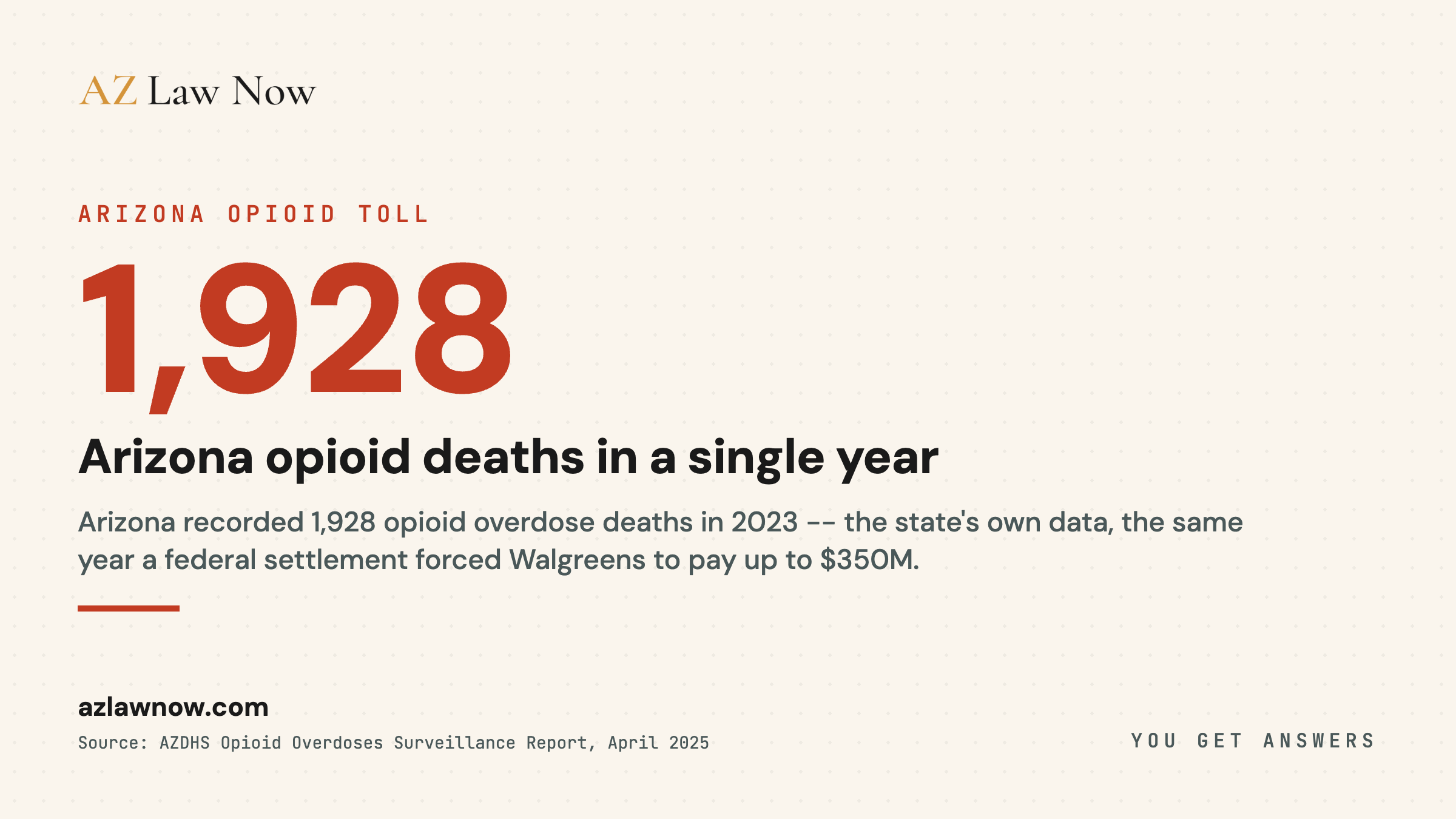
Arizona is also part of the country where the opioid death toll keeps moving. The Arizona Department of Health Services recorded 1,928 opioid overdose deaths in Arizona in 2023, a fatality rate of 25.6 per 100,000, in its Opioid Overdoses Surveillance Report published in April 2025, the most recent full-year surveillance report available.
The District of Arizona helping investigate isn’t the same as a named-store list. What the publicly retrievable records haven’t confirmed in this reporting window is which individual Arizona Walgreens stores, if any, are enumerated in the underlying settlement exhibits. The DOJ release describes the conduct as nationwide.
The store-by-store list, if it exists in the settlement, sits in the federal docket. Pulling that exhibit list is the next reporting step.
What the DOJ Said Walgreens Did
The DOJ release describes a sustained pattern of conduct. Walgreens pharmacists across the country, the United States alleges, knowingly filled millions of prescriptions for controlled substances despite clear red flags.
Those prescriptions, per the release, included prescriptions for excessive quantities of opioids, opioid prescriptions filled significantly early, and the especially dangerous three-drug “trinity” combination of an opioid, a benzodiazepine, and a muscle relaxant.
The release also alleges Walgreens pressured its pharmacists to fill prescriptions quickly and withheld internal prescriber data from those same pharmacists, which kept them from warning one another about problematic prescribers.
The Controlled Substances Act, 21 U.S.C. 801 et seq., requires DEA-registered dispensers to recognize and refuse prescriptions that fall outside the usual course of professional practice. The False Claims Act, 31 U.S.C. 3729, makes it actionable to submit false claims for federal payment.
When Walgreens billed Medicare, Medicaid, TRICARE, and other federal health programs for prescriptions that violated the CSA, those bills became false claims under the FCA. That’s the legal architecture of the case.
The settlement pays $300 million, and reaches up to $350 million only if the $50 million contingency triggers. The covered-conduct period runs more than a decade.
As part of the resolution, Walgreens entered a seven-year memorandum of agreement with the DEA and a five-year Corporate Integrity Agreement with HHS-OIG, requiring pharmacist validity checks, annual training, sufficient staffing, and prescriber-blocking systems.
What the Arizona Numbers Look Like
Arizona’s opioid death toll is on the AZDHS surveillance dashboard. The most recent full-year figure, 1,928 opioid overdose deaths in 2023 at a fatality rate of 25.6 per 100,000, comes from the AZDHS Opioid Overdoses Surveillance Report published in April 2025.
Arizona’s opioid prescribing rate, per the CDC’s U.S. dispensing rate maps, isn’t the highest in the country. The 2023 national rate was 37.5 prescriptions per 100 persons. An Arizona-specific CDC rate and a current state ranking haven’t been pulled directly in this reporting window.
Prescribing rate is one input. Pharmacy-level dispensing pattern at the store level is another, and that’s the layer where the federal CSA enforcement and the Walgreens settlement live.
What the Arizona Regulator Architecture Looks Like
Arizona has two layers of regulator with direct authority over pharmacy controlled-substance compliance.
The state layer is the Arizona State Board of Pharmacy. Its Executive Director is Kam Gandhi (Kamlesh Gandhi). The 2024-2025 Board President is Jeffrey Anderson, PharmD, whose term began January 15, 2024. Vice President is Stephanie Spark, PharmD, term began January 20, 2025.
Voting members include Lorri Walmsley, RPh, Tenille Davis, Melinda Browning, CPhT, and Christopher Hogan, RPh.
The Board’s authority extends to pharmacy permits (the license to operate a pharmacy in Arizona) and individual pharmacist licenses (the license to practice pharmacy as an individual). Disciplinary actions against pharmacy permits for controlled-substance compliance failures are documented in Board public meeting minutes, available at pharmacy.az.gov.
The federal layer is the DEA Phoenix Field Division. Special Agent in Charge Apolonio Ruiz Jr. heads the Division, which administers DEA registrations for Arizona registrants and brings DEA enforcement actions against Arizona pharmacies through Orders to Show Cause (21 U.S.C. 824(c)) and Immediate Suspension Orders (21 U.S.C. 824(d)).
DEA decisions and orders are published in the Federal Register, and the docket of Arizona-registrant DEA actions for 2023 through 2025 is filterable on federalregister.gov by registrant address.
A.R.S. 32-1901 et seq. is the Arizona Pharmacy Practice Act. The pharmacist-in-charge at each Arizona pharmacy permit is responsible to the Board for compliance with state and federal pharmacy law.
A.R.S. 36-2606 establishes the Controlled Substances Prescription Monitoring Program (CSPMP), with pharmacist query duties before dispensing certain controlled substances. A.R.S. 13-3408 makes it a felony in Arizona to knowingly transport for sale, sell, or transfer a narcotic drug, with class-2 felony classification for sale and manufacture.
The Walgreens settlement, as announced, is a national resolution. Federal dollars, federal allegations, federal court. For Arizona families and Arizona prescribing oversight, the missing layer is store-level. Which Arizona Walgreens locations were filling the prescriptions covered by the settlement?
Were Arizona stores subject to internal compliance flags? Were Arizona pharmacists individually subject to DEA Order to Show Cause filings? The settlement exhibits, if they enumerate covered stores, are the answer. The federal docket and a FOIA request are the obtainable path to that list.
What Hasn’t Been Confirmed in This Reporting Window
Several Arizona-specific layers aren’t confirmed in this report and are obtainable from public records.
The Walgreens settlement exhibit listing of covered Arizona stores wasn’t retrieved in this pass. The complaint was filed in the U.S. District Court for the Northern District of Illinois. The path is PACER docket retrieval for that filing or a FOIA request to the DOJ.
A claim that names specific Arizona stores has to be sourced to the actual exhibit.
The DEA Phoenix Field Division’s 2023-2025 docket of Federal Register Decision and Order entries against Arizona pharmacies and pharmacists wasn’t compiled in this pass. Manual filter of federalregister.gov by Arizona registrant address yields the count.
The Arizona State Board of Pharmacy public meeting minutes for 2024 and 2025 weren’t compiled for disciplinary actions against pharmacy permits where the underlying conduct involved controlled substances.
The Arizona Auditor General’s Report 25-112, the most recent available audit of the Arizona State Board of Pharmacy, is the closest secondary citation that lays a baseline for total complaint volume. The cited figure of 667 AZ State Board of Pharmacy complaints opened FY2024 comes from that report.
The Arizona Attorney General’s Mayes-era opioid settlement total (the cumulative dollar figure secured by Arizona under the One Arizona MOU and through subsequent enforcement) wasn’t pulled in this pass. The path is direct retrieval from azag.gov.
The named operator pattern at the store level requires cross-referencing three questions: which prescribers were filling at which Walgreens, which Walgreens locations had high dispensing volumes for the trinity combination, and whether any Arizona Walgreens has been the subject of a DEA Phoenix administrative action.
Answering it requires the federal Decision and Order docket plus the AZ Board public minutes plus the settlement exhibits.
What Comes Next
The District of Arizona helped build the case. Three near-term reporting moves close the store-level Arizona accountability gap that remains.
The first is the federal docket. The Walgreens settlement filed in the U.S. District Court for the Northern District of Illinois is publicly accessible through PACER. The exhibit list is the answer to the store-level question.
The second is the Federal Register filter for DEA Phoenix Field Division decisions against Arizona pharmacy registrants for the period August 2012 through March 2023, the covered-conduct window in the settlement, and the period from March 2023 forward, the post-settlement enforcement window. The federalregister.gov docket is filterable by registrant address and date range.
The third is the Arizona State Board of Pharmacy. The Board’s public meeting minutes for 2024 and 2025 document Board action against pharmacy permits (the license to operate a pharmacy) where the underlying conduct involved controlled substances. The minutes are at pharmacy.az.gov.
A summary count of permit actions that involved controlled substances during this window is the AZ-specific number that survives publication.
For now, the federal settlement is announced. The Arizona death toll is documented. The named regulators are in place. The store-level Arizona accountability gap is the public-records question, and the records exist.
This investigation was built from the U.S. Department of Justice press release announcing the Walgreens settlement (Office of Public Affairs, release no. 25-406, at justice.gov), Arizona Department of Health Services opioid surveillance materials, and the DEA’s 2024 National Drug Threat Assessment and DEA Phoenix Field Division page.
Additional sources include the CDC U.S. Dispensing Rate Maps, the Arizona State Board of Pharmacy leadership rosters at pharmacy.az.gov, and Arizona Revised Statutes Titles 12, 13, 32, 36, and 44.
If you have the Walgreens settlement exhibits with Arizona store enumeration, DEA Phoenix Field Division Decision and Order copies for Arizona registrants, Arizona State Board of Pharmacy meeting minutes citing controlled-substance permit actions, or Arizona AG opioid settlement aggregate data, contact AZ Law Now.
We report from primary sources and use person-first framing for people affected by opioid use disorder and for families who lost someone.
Frequently asked questions
What did Walgreens settle and for how much?
How is Arizona connected to the Walgreens settlement?
How many Arizona residents have died from opioid overdoses?
What does Arizona pharmacy law say about a pharmacist's duty to refuse a prescription?
Who runs the Arizona State Board of Pharmacy and the DEA Phoenix Field Division?
Can Arizona families file civil claims related to a pharmacy that filled unsafe prescriptions?
What records would close the Arizona-specific accountability gap?
Sources & references
- U.S. Department of Justice, Office of Public Affairs. (2025, April 21). Walgreens Agrees to Pay Up to $350M for Illegally Filling Unlawful Opioid Prescriptions and for Submitting False Claims to the Federal Government (Release No. 25-406). Retrieved from https://www.justice.gov/opa/pr/walgreens-agrees-pay-350m-illegally-filling-unlawful-opioid-prescriptions-and-submitting
- Arizona Department of Health Services. (2025, April). Opioid Overdoses Surveillance Report, Arizona, 2023. Retrieved from https://www.azdhs.gov/opioid/documents/opioid-report-2023.pdf
- Drug Enforcement Administration. (2024, July). 2024 National Drug Threat Assessment. Retrieved from https://www.dea.gov/sites/default/files/2024-07/2024%20NDTA-updated%207.5.2024.pdf
- Drug Enforcement Administration. Phoenix Field Division. Retrieved from https://www.dea.gov/divisions/phoenix
- Drug Enforcement Administration. Diversion Control Division pharmacy resources. Retrieved from https://www.deadiversion.usdoj.gov/pharmacy.html
- Centers for Disease Control and Prevention. U.S. Dispensing Rate Maps for opioid prescribing rates. Retrieved from https://www.cdc.gov/overdose-prevention/data-research/facts-stats/us-dispensing-rate-maps.html
- Arizona State Board of Pharmacy. Board members and leadership. Retrieved from https://pharmacy.az.gov/board-members
- Arizona State Board of Pharmacy. Public meeting minutes archive. Retrieved from https://pharmacy.az.gov/public-meetings
- Arizona Controlled Substances Prescription Monitoring Program (CSPMP). Retrieved from https://pharmacypmp.az.gov/arizona-pmp-team/about-arizona-pmp
- Arizona Revised Statutes 32-1901 et seq. (Arizona Pharmacy Practice Act). Retrieved from https://www.azleg.gov/ars/32/01901.htm
- Arizona Revised Statutes 13-3408 (narcotic drugs; possession; sale; transfer). Retrieved from https://www.azleg.gov/ars/13/03408.htm
- Arizona Revised Statutes 36-2606 (Controlled Substances Prescription Monitoring Program). Retrieved from https://www.azleg.gov/ars/36/02606.htm
- Arizona Revised Statutes 12-611 (wrongful death). Retrieved from https://www.azleg.gov/ars/12/00611.htm
- Arizona Revised Statutes 44-1521 to 44-1534 (Arizona Consumer Fraud Act). Retrieved from https://www.azleg.gov/arsDetail/?title=44
- Federal False Claims Act, 31 U.S.C. 3729.
- Controlled Substances Act, 21 U.S.C. 801 et seq.
- Federal Register. DEA Decision and Order entries. Retrieved from https://www.federalregister.gov/agencies/drug-enforcement-administration
- Arizona Auditor General. Report 25-112 (Arizona State Board of Pharmacy). Retrieved from https://www.azauditor.gov/sites/default/files/2025-09/25-112_Report.pdf
Tell Google to show our reporting more often in Search and AI answers.