Investigations
Data-Led Reporting for Arizona Families
We pull the public data. We name the patterns. We give families the information they need before they even know they need a lawyer.

Recent Investigations
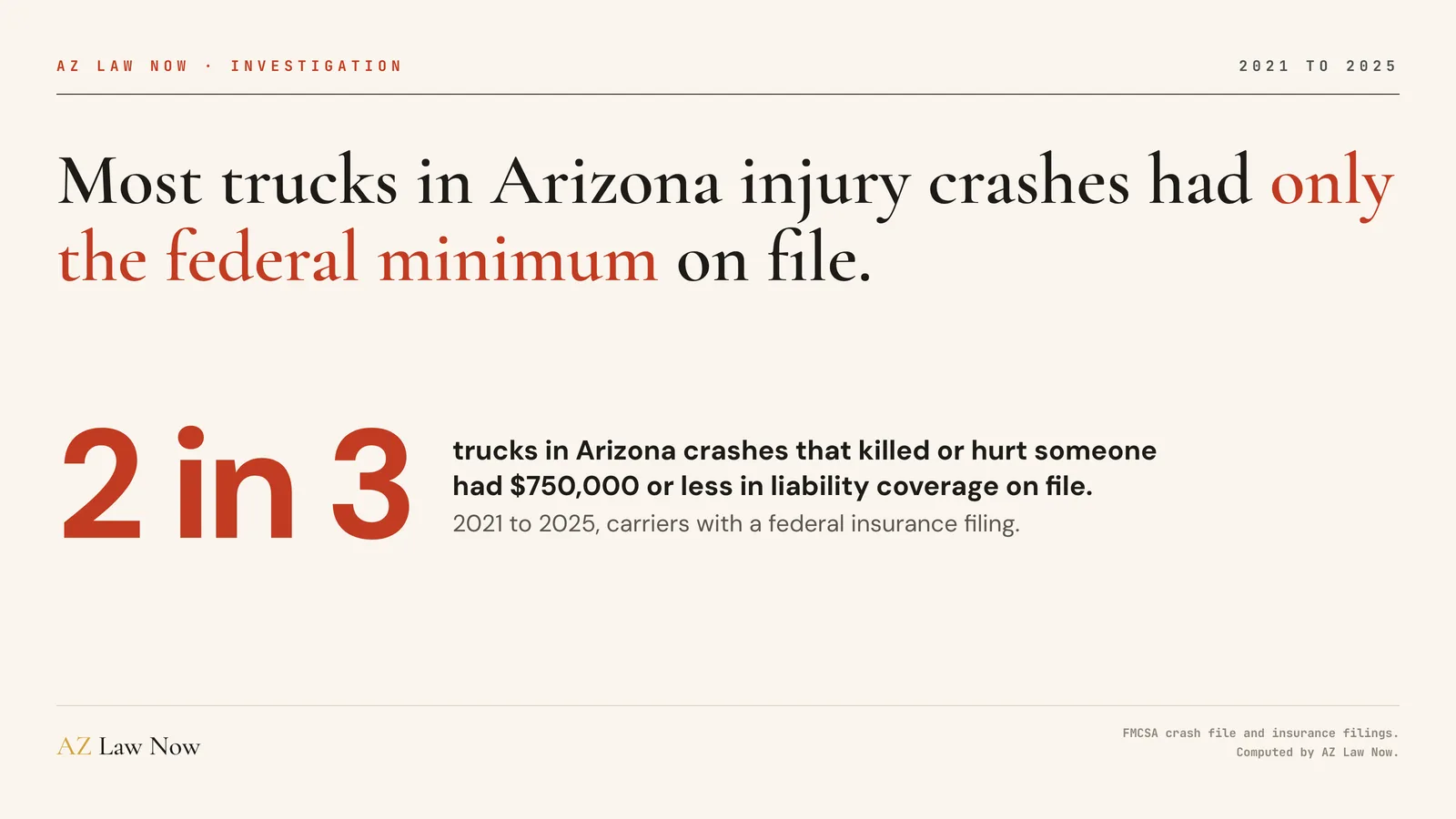
Phoenix Truck Crashes: Most Trucks Had Only the $750K Minimum
AZ Law Now matched 2,648 trucks in Arizona injury and fatal crashes to their federal insurance filings. Two in three had $750,000 or less on file.
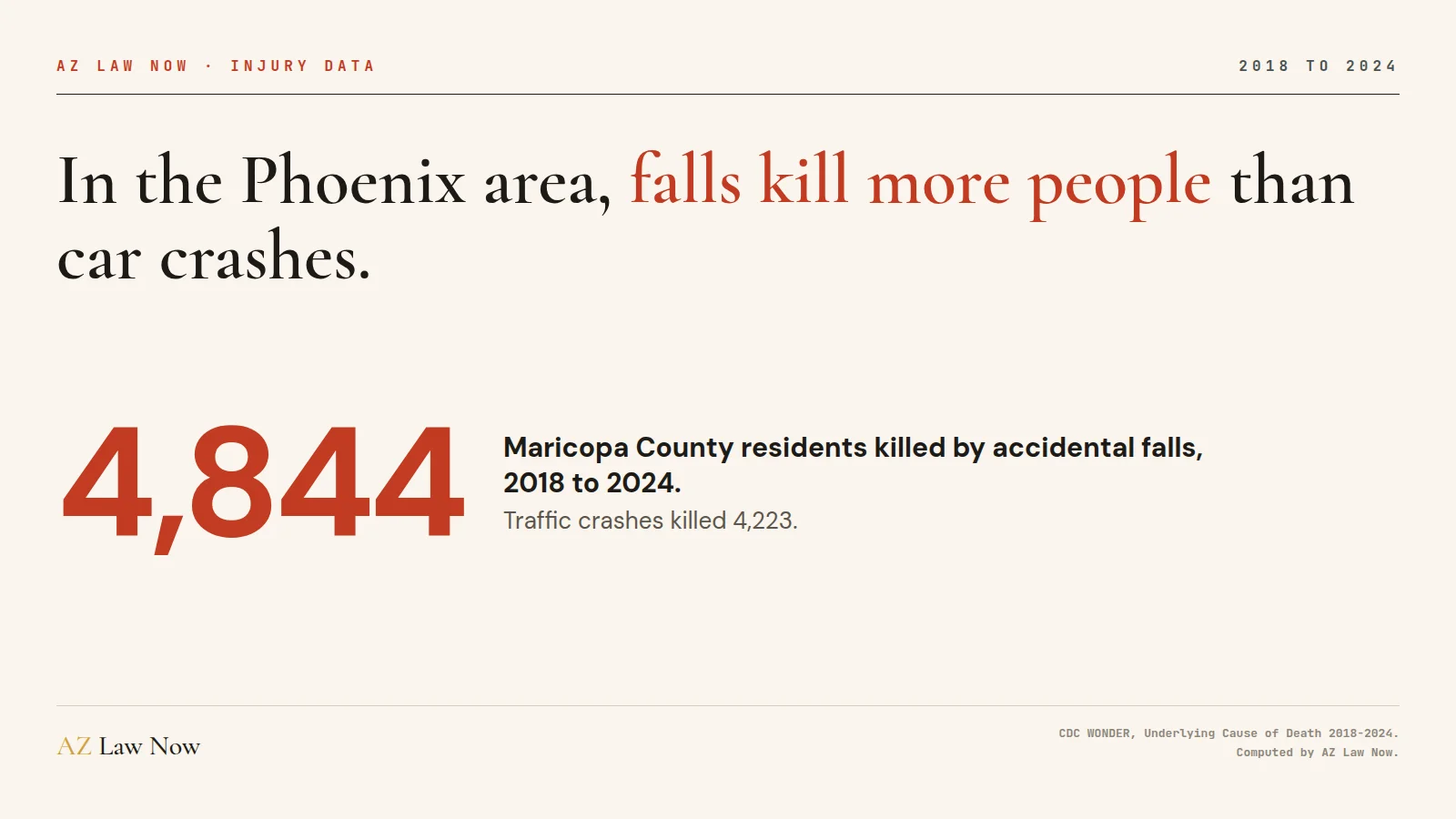
In the Phoenix Area, Falls Now Kill More People Than Car Crashes
Falls killed 4,844 Maricopa County residents from 2018 to 2024, more than car crashes killed (4,223). CDC death records, analyzed by AZ Law Now.
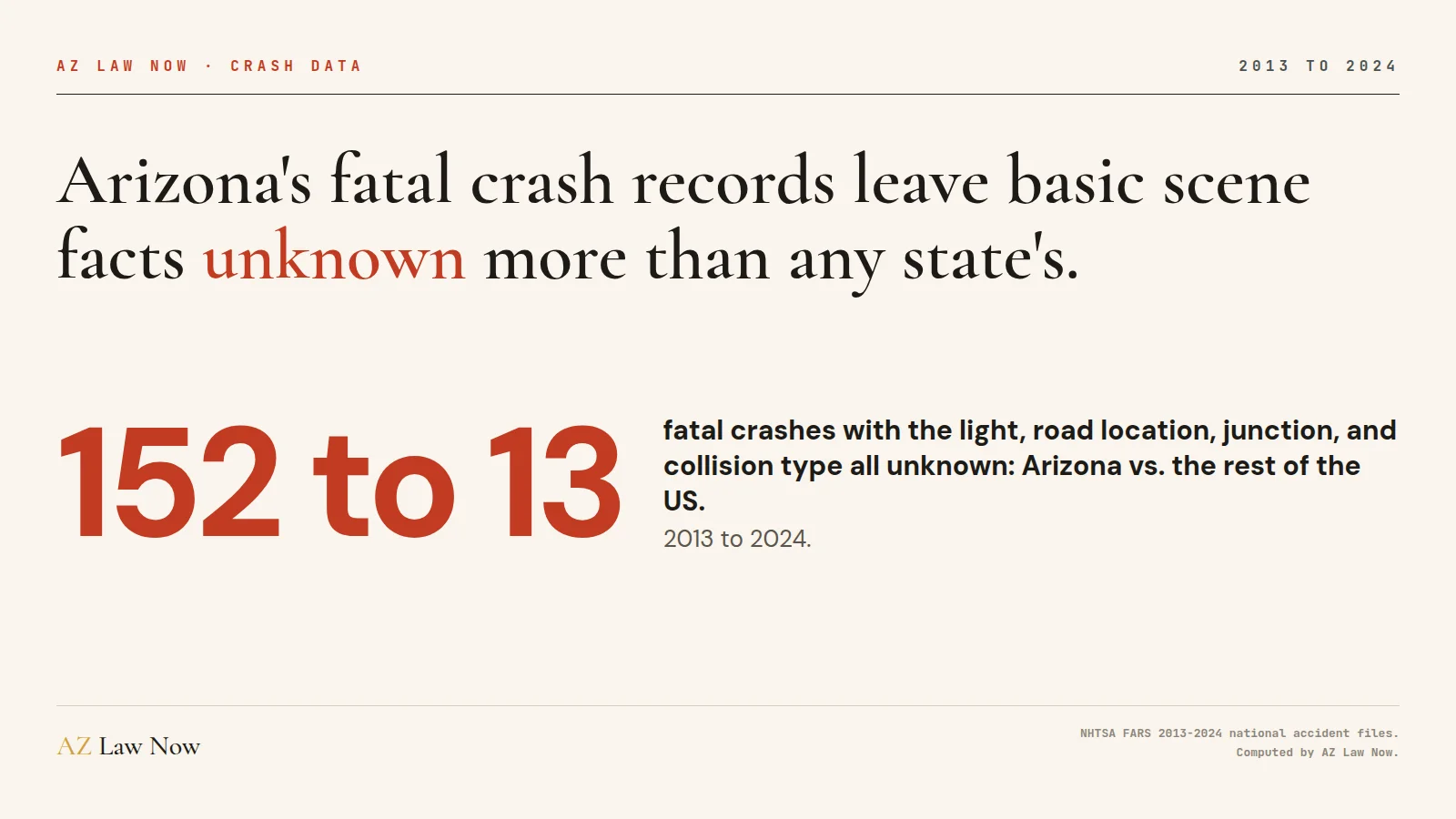
Phoenix Crash Death Records Miss Key Facts Nearly 6x the US Rate
Arizona leads the US in fatal crash records with basic scene facts marked unknown. In Phoenix it happens nearly 6 times the national rate. FARS 2013 to 2024.
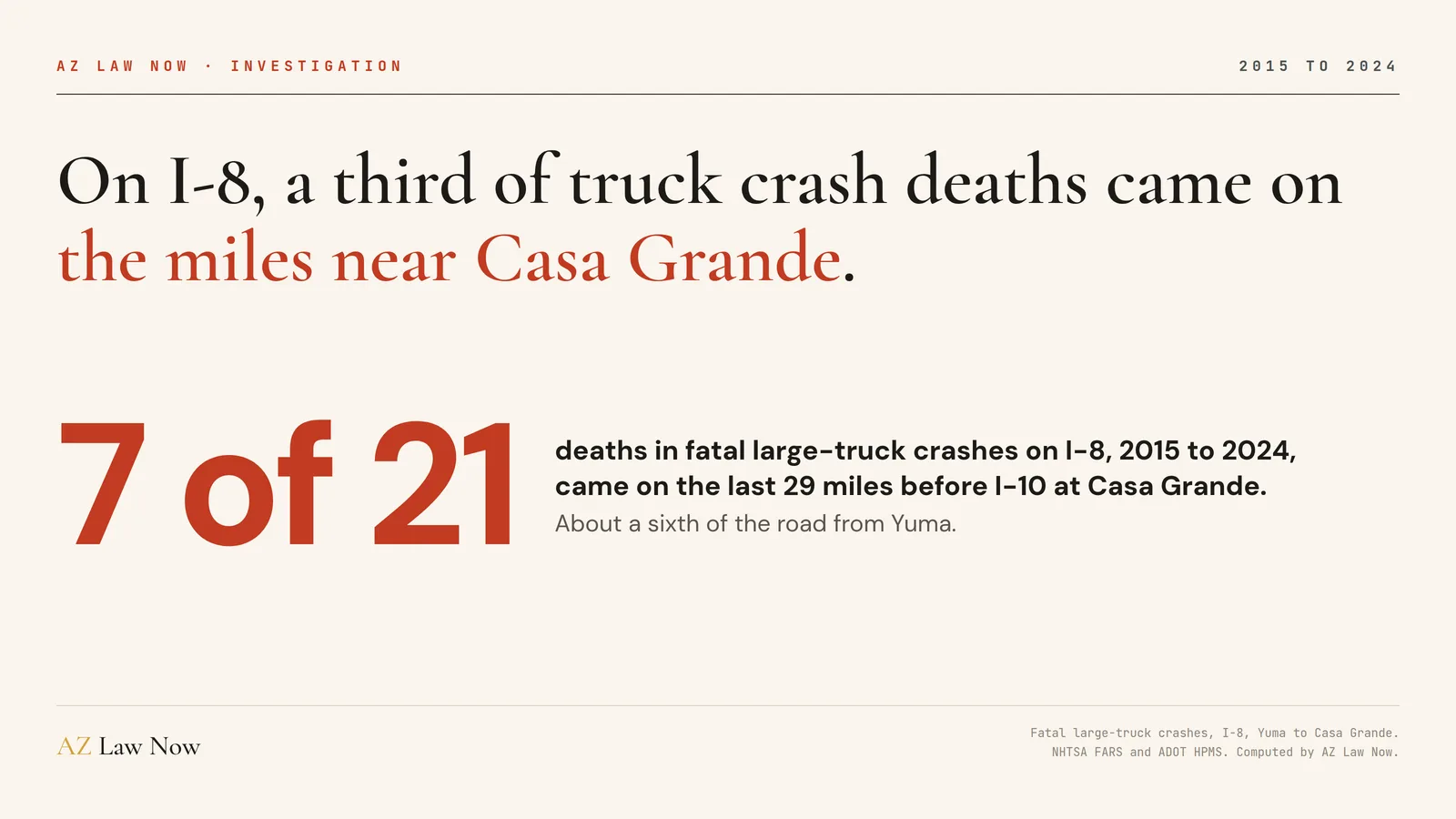
A Third of I-8's Truck Crash Deaths Came on the Miles Near Casa Grande
AZ Law Now mapped every reported truck crash on I-8 from Yuma to Casa Grande, 2015 to 2024. The last 29 miles before I-10 carried 7 of 21 deaths.
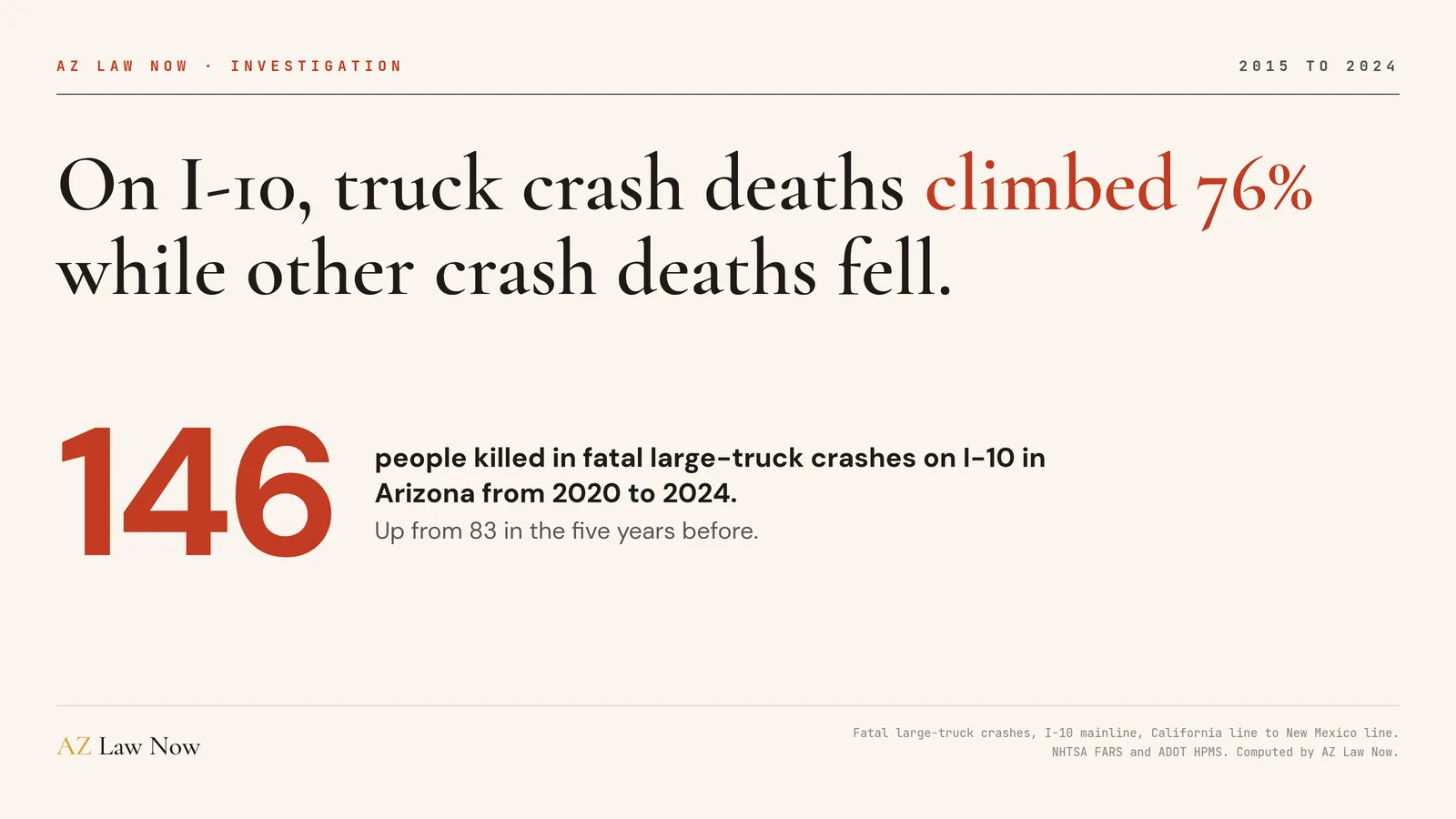
Truck Crash Deaths on Arizona's I-10 Rose 76%. Here's Where.
AZ Law Now mapped every fatal large-truck crash on Arizona's I-10, 2015 to 2024. Deaths rose from 83 to 146, while other I-10 crash deaths fell.
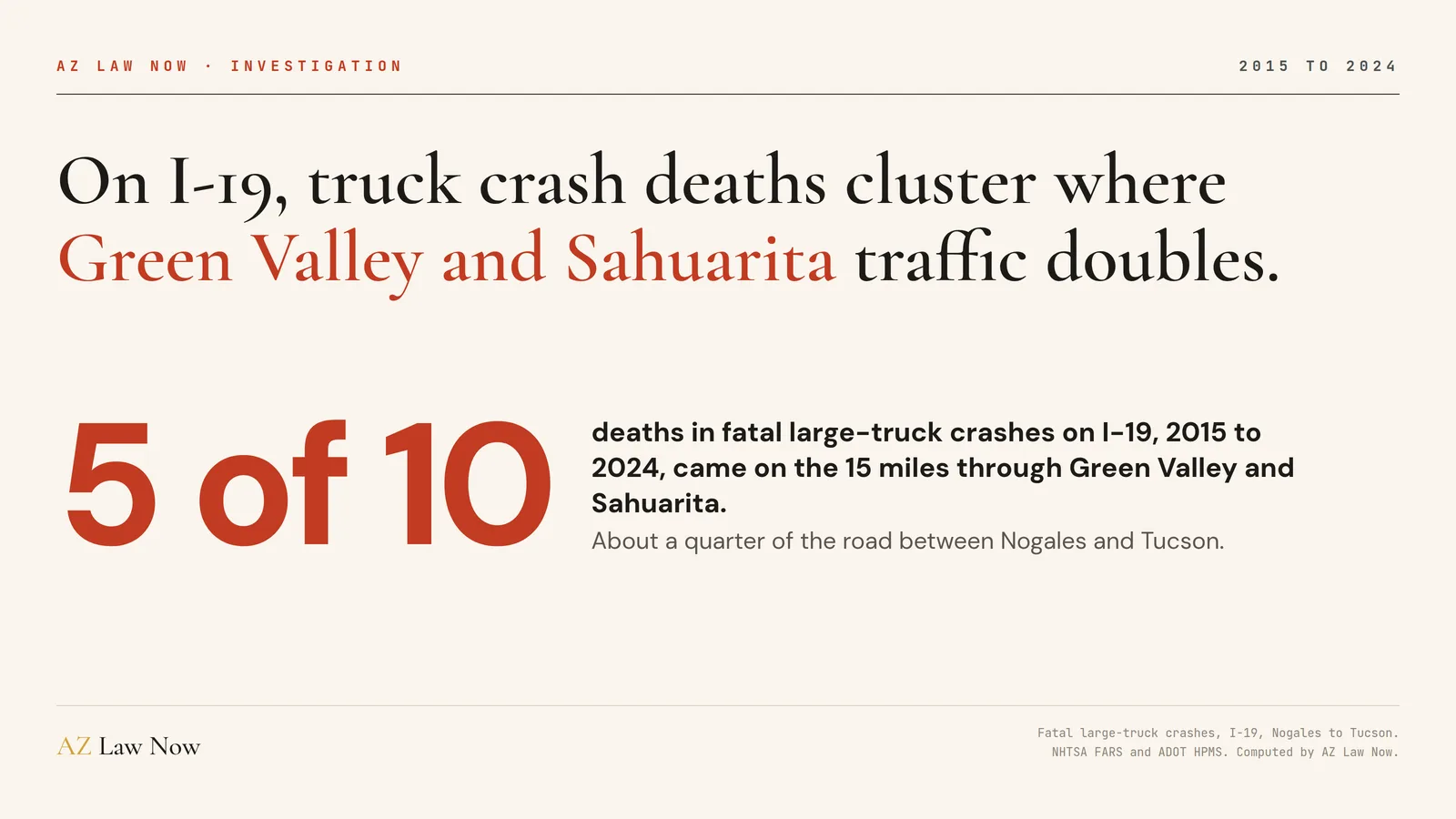
Half of I-19's Truck Crash Deaths Came Just South of Tucson
AZ Law Now mapped every reported truck crash on I-19 from Tucson to Nogales, 2015 to 2024. 15 miles through Green Valley and Sahuarita carried 5 of 10 deaths.
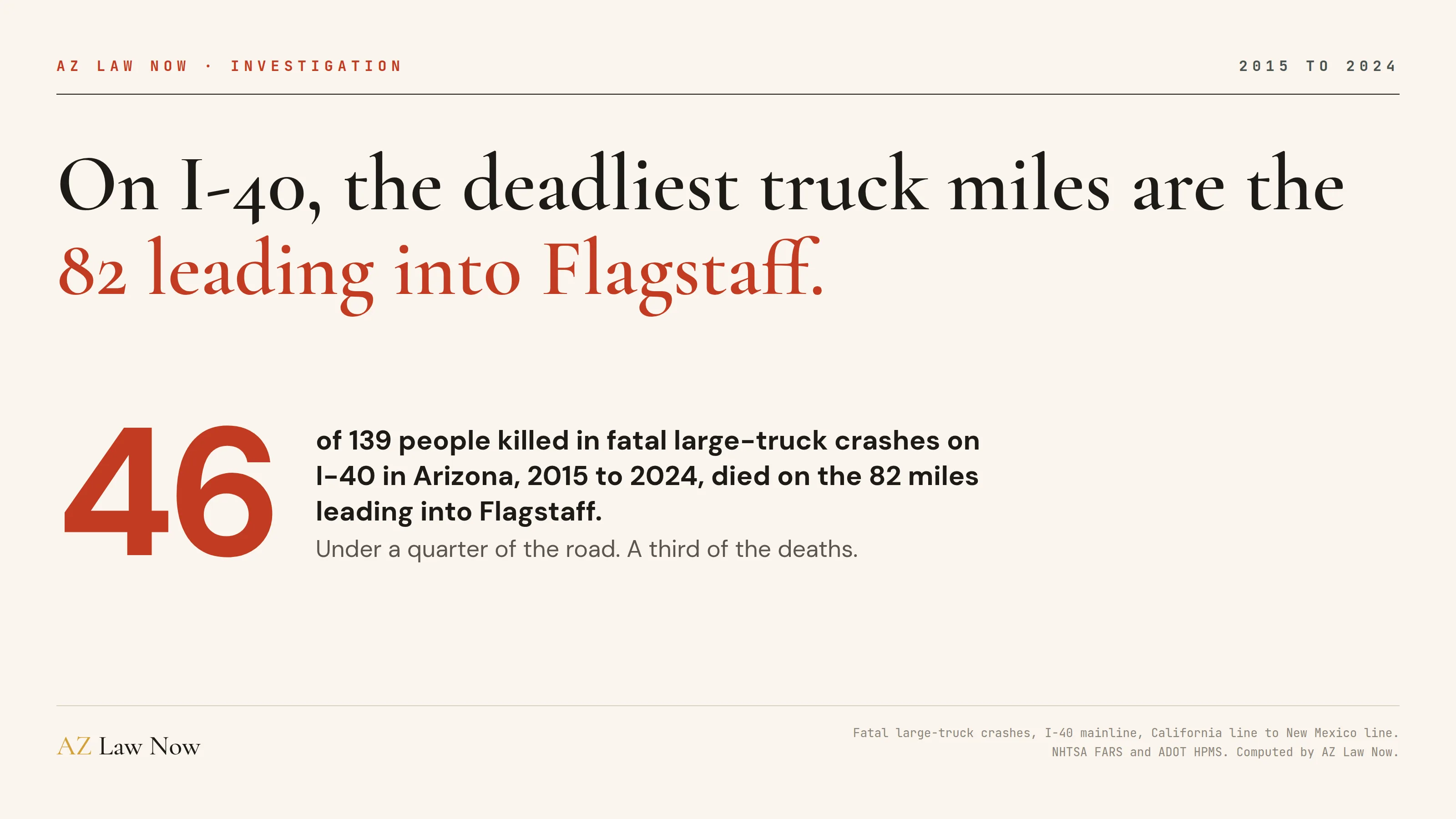
I-40's Deadliest Truck Miles Are the 82 Leading Into Flagstaff
AZ Law Now mapped every fatal large-truck crash on I-40 in Arizona, 2015 to 2024. The 82 miles leading into Flagstaff carried 46 of 139 deaths.
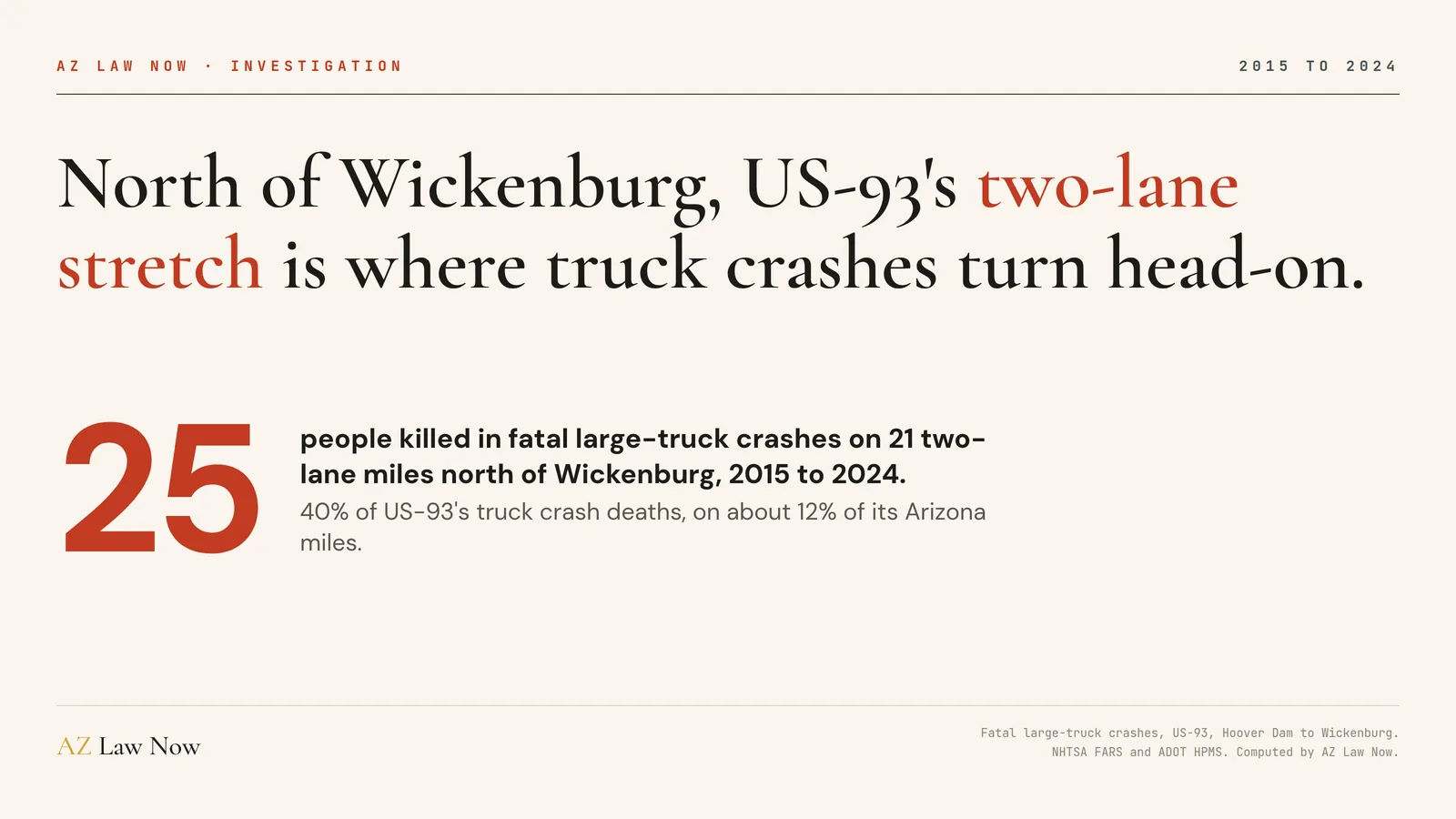
US-93's Deadliest Truck Miles Are Two Lanes North of Wickenburg
AZ Law Now mapped every fatal large-truck crash on US-93 in Arizona, 2015 to 2024. A 21-mile two-lane stretch north of Wickenburg carried 25 of 63 deaths.
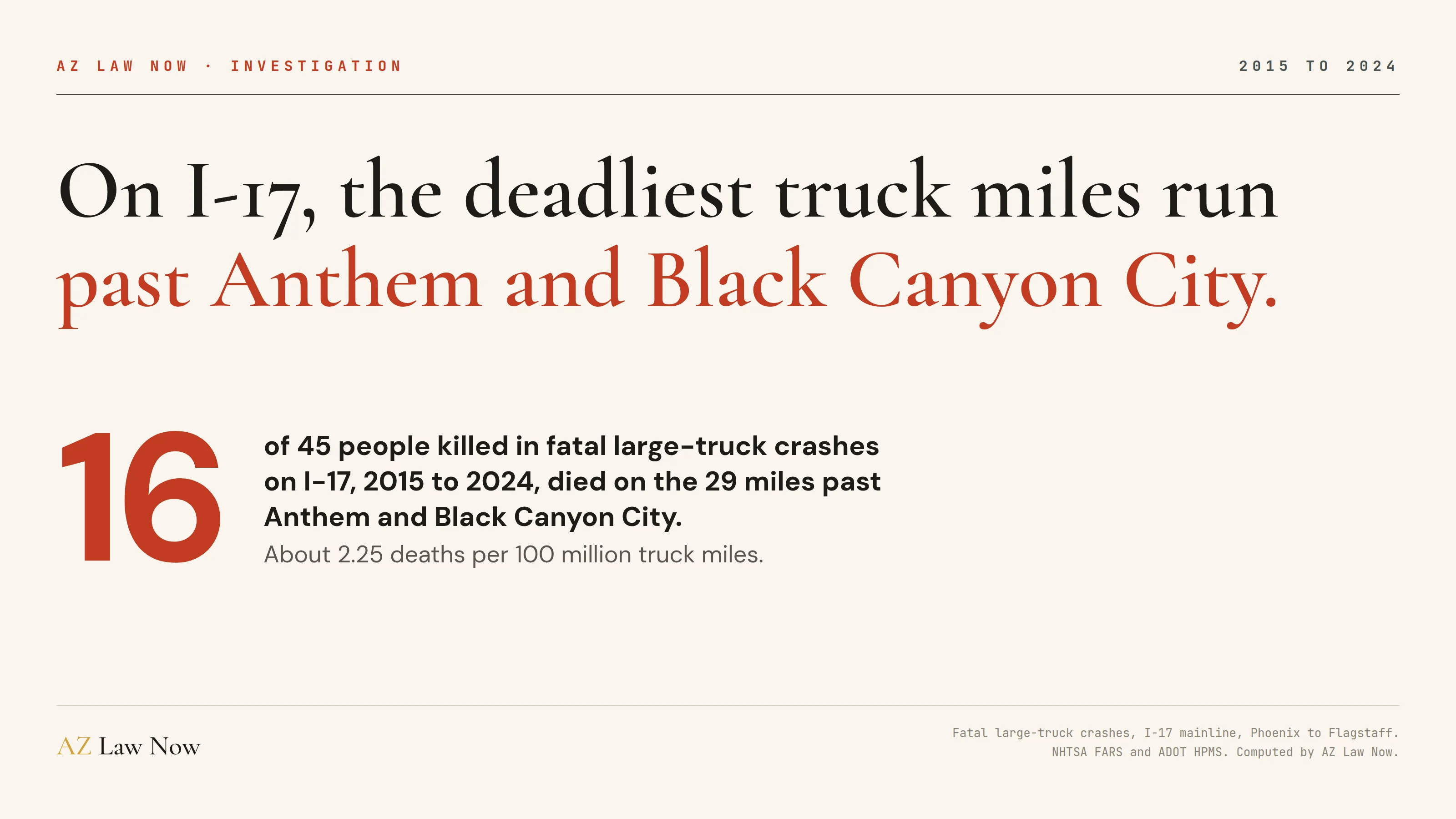
I-17's Deadliest Truck Miles Run Past Anthem and Black Canyon City
AZ Law Now mapped every fatal large-truck crash on I-17, 2015 to 2024. The 29 miles past Anthem and Black Canyon City carried 16 of 45.
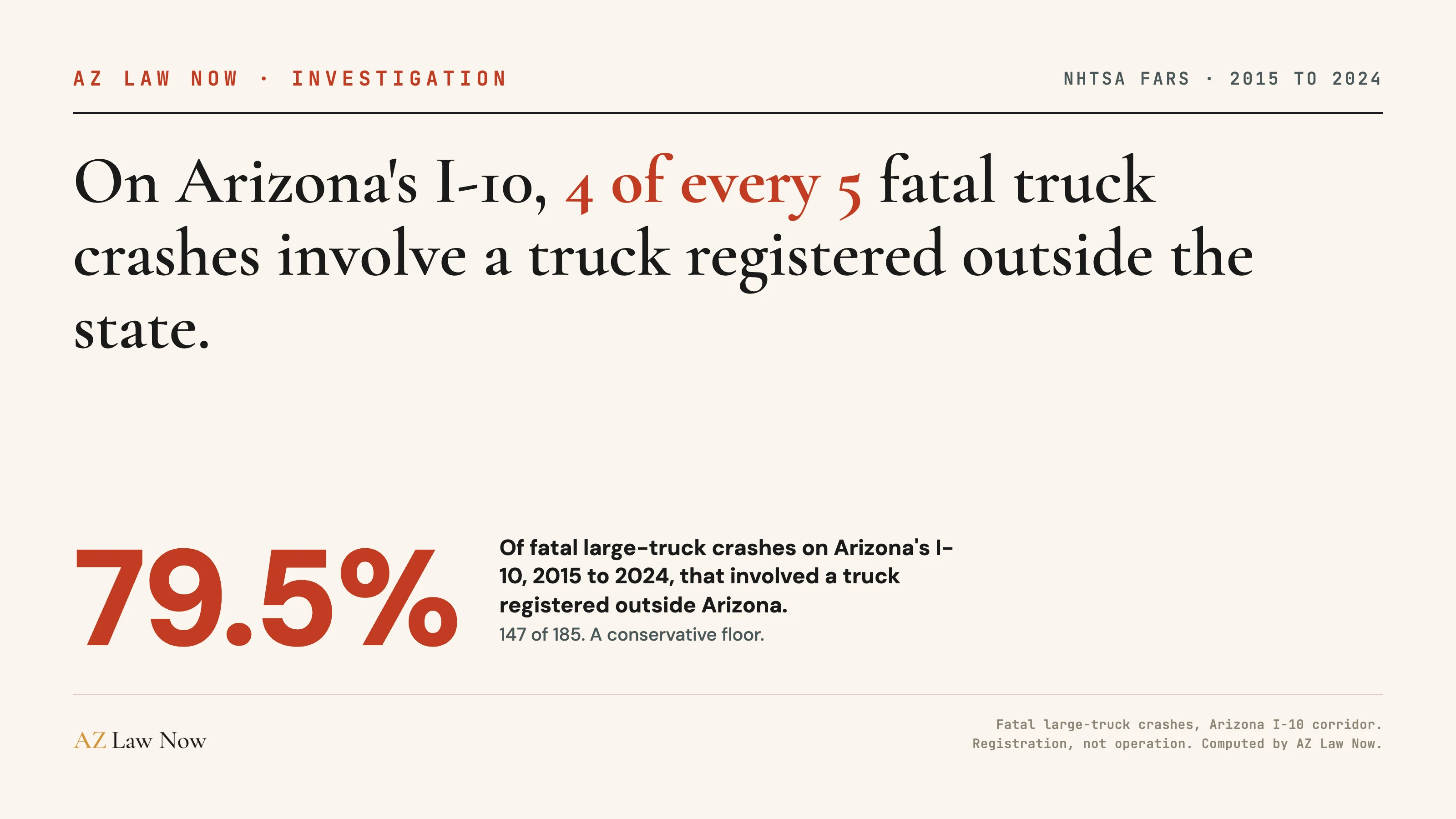
On I-10, 4 of 5 Fatal Truck Crashes Involve an Out-of-State Truck
AZ Law Now counted every fatal large-truck crash on Arizona's I-10, 2015 to 2024. A truck registered outside Arizona shows up in 147 of 185, nearly 4 in 5.
America's truck deaths rose 17%. Arizona's rose 66%.
Federal crash data shows Arizona's large-truck deaths rose 66% over the last five years while the nation's rose 17%, nearly four times the pace.
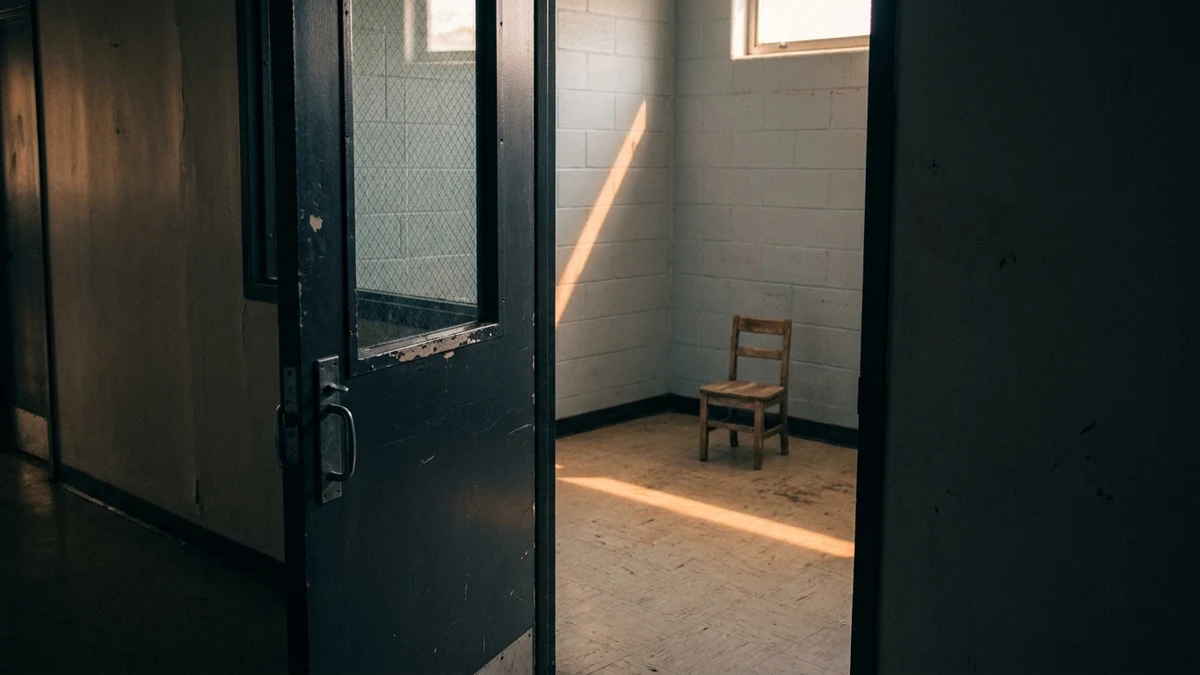
Arizona Restrained 742 Students With Disabilities, and Kept No Count
Arizona schools restrained at least 742 students with disabilities in 2021-22 and secluded 502 more. They're 12% of enrollment, 70% of those restrained.
Side-by-Sides Roll Over. The Rule Written to Stop That Is Gone.
The federal injury system can't separate side-by-sides from quads, and CPSC says so. Congress blocked the stability rule ten years. Withdrawn Sept 29, 2025.
When a Vehicle Hits an Animal, the Rider Is Usually the One Who Dies
Motorcyclists are 51.9% of everyone killed when a US vehicle hits an animal, about four times their 12.8% share of all traffic deaths, federal records show.
Arizona Drivers Flee Pedestrians 8.5 Times More Than Vehicle Occupants
Arizona drivers fled 22.1% of fatal pedestrian crashes, 2009-2024, against 2.6% for vehicle occupants. One west Phoenix corridor runs worse than 1 in 3.
365 Truck Crashes: Maricopa Tops Its Next 3 Counties Combined
Ten years of federal crash data show Maricopa County has more deadly truck crashes than Pima, Yavapai, and Pinal counties combined.
2,042 People Died on Arizona's I-10, and the Toll Is Climbing Again
AZ Law Now counted every fatal crash on Arizona's I-10, 2000 to 2024: 2,042 deaths. After a decade of decline the toll is rising again, and rollovers lead it.
53 People Have Died Walking Through One West Phoenix Patch Since 2000
In one west Phoenix patch, 53 people have died walking since 2000. Nine in ten died in the dark, and most of those died under streetlights that were on.
Arizona's New Safety Plan Skips the Target It Already Set
Arizona's new campaign names no number. The state already set one: cut life-altering crashes 20% by 2030. Its own 25-year record runs the other direction.
Red-Light Running Killed on a Phoenix Road the City Already Targeted
A driver ran a red light at ~96 mph on Indian School Road, a Phoenix corridor already named one of the city's deadliest. Arizona logs nearly 6,000 a year.

Arizona Fines Daycares $100 a Violation. Nursing Homes? $1,000.
Arizona caps daycare fines at $100 a violation, one-tenth the $1,000 cap on other licensed care. What the rules require, and what the public record hides.
About 4x the Crash Rate, and ADOT Graded It the Worst Tier There Is.
ADOT's own safety engineers found this 3-mile I-10 stretch runs about 4x the crash rate of comparable Valley freeways and graded it the worst of four tiers.
Drowning Is the #1 Killer of Arizona's Youngest Children
Arizona's reviewers call every child drowning preventable. In 2024, 36 kids died, most under age 5. What the data shows, the pool law, and who's liable.
Arizona's Third Tier: The Small Group Homes With the Weakest Oversight
Arizona has ~1,711 licensed assisted living homes (10 beds or fewer). No federal oversight, no star ratings, no public comparison database. Here's the record.
3 Checks Around the Child. The Aide Alone With Them Clears None.
Arizona lets autism-therapy aides work with kids before a fingerprint clearance card issues. Three screening layers; the aide in the room clears none.
Phoenix's 2 Worst Intersections Are Both on Indian School Rd
Phoenix's own Vision Zero plan ranks 75th Ave and 67th Ave at Indian School Rd its two worst intersections. Both fixes are years out, breaking ground in 2028.
5 BNSF Filings, 3 Phoenix Crossings, Same Phrase
Five BNSF accident reports at three Phoenix grade crossings carry the identical failure phrase. None of the three crossings has a median or four-quadrant gates.
Gates Went in June 2024. Sonja Was Struck 22 Months Later.
BNSF put active gates on the twin 27th Ave and Thomas Rd crossings in June 2024. Sonja Celius was struck at 27th Ave on April 25, 2026, 22 months later.
Arizona Disciplined 325 Educators in 2024. Maricopa Drove It.
Arizona's 2024 state board report logged 325 educator disciplinary actions, up 491% since 2012. Sexual misconduct leads, and Maricopa County drove 55% of it.
Hurt on Tempe Pavement Near ASU? You May Have Only 180 Days.
Tempe is rebuilding aging pavement near ASU. Arizona gives an injured student just 180 days to file a Notice of Claim, and ASU can't accept service of one.
Buckeye Chose a Signal Over a Roundabout at Durango and Yuma
Buckeye chose a signalized T-intersection over a roundabout at Durango and Yuma on cost, timing, and growth grounds, part of a roughly $8M widening project.
A Mesa Arrest, HB2228, and the Math on Arizona Elder Sexual Abuse.
Mesa caregiver arrested for alleged abuse of a wheelchair-bound dementia patient, caught on family video. HB2228 advances in Arizona. The data links them.
Arizona Pedestrian Deaths Are Nearly Twice the National Average.
263 people were killed walking in Arizona in 2024, among the nation's highest rates. 76% died in darkness, on wide roads built for cars, not for people.
Fatigued Truckers on Arizona Highways: What HOS Data Shows.
HOS violations are the top driver out-of-service offense nationally. Arizona's I-10 corridor logged 147 fatigue and parked-vehicle truck crashes in five years.
Ghost Fleets on I-10: How Chameleon Carriers Hide Their Records.
700,000 trucking companies. 350 federal investigators. Chameleon carriers erase violations and reincarnate under new names. Here's what the data shows on I-10.
Arizona Logs a Hit-and-Run in 1 of Every 8 Crashes
16,136 hit-and-run crashes in Arizona in 2024. One in eight crashes. 86 people killed. Roughly 90% of cases are never solved. Here's what the data shows.
Truck Crashes in Maricopa County: The Data Nobody Publishes.
14,069 trucks and buses hit Arizona crashes in 2024 and Maricopa County logged 594 deaths. The state and federal data no public report breaks out by corridor.
Wrong-Way Crashes on AZ Highways: $4M in Tech, Deaths Continue.
Wrong-way crashes are rare but deadly on Arizona freeways. ADOT's thermal-camera detection system is the state's main defense. Here's what the data shows.
The Same West Valley Intersections Turn Up Deadly Every Year
ADOT data: 263 Arizona pedestrian deaths in 2024. Wide arterials, faded crosswalks, and long gaps between crossings define West Valley's deadliest corridors.
Which Arizona Nursing Homes Draw the Most Federal Violations
CMS data shows which Arizona nursing homes have the most federal violations. Staffing shortages, abuse citations, and penalty data for West Valley facilities.
967 Crashes in Five Years on Maricopa's Only Highway Out
ADOT logged 967 crashes on SR-347 between Maricopa and I-10 over five years. The long-promised widening of the two-lane route is finally under construction.
42 States Skip School Bus Seat Belts. Arizona Is One.
Arizona doesn't require seat belts on school buses. NHTSA counted 971 fatal school-transportation crashes from 2014 to 2023, more pedestrians than occupants.
I-10 Through Buckeye and Goodyear: One of Arizona's Deadliest
ADOT logged 88,094 crashes in Maricopa County in 2024, with 594 killed. I-10 from Buckeye to Goodyear stacks the risk factors that drive fatal crashes.
SR-347 and I-10 Interchange: Maricopa's Daily Choke Point.
SR-347 funnels 31,000+ vehicles a day through one I-10 interchange. Merge geometry and speed differential drive Pinal County's crash concentration here.
Buckeye Doubled in Size. Its Busiest Crossing Didn't Change.
Watson Road and Yuma Road sit at the center of Buckeye's growth. Residential traffic, I-10 commuters, and delivery volume now converge on one aging signal.
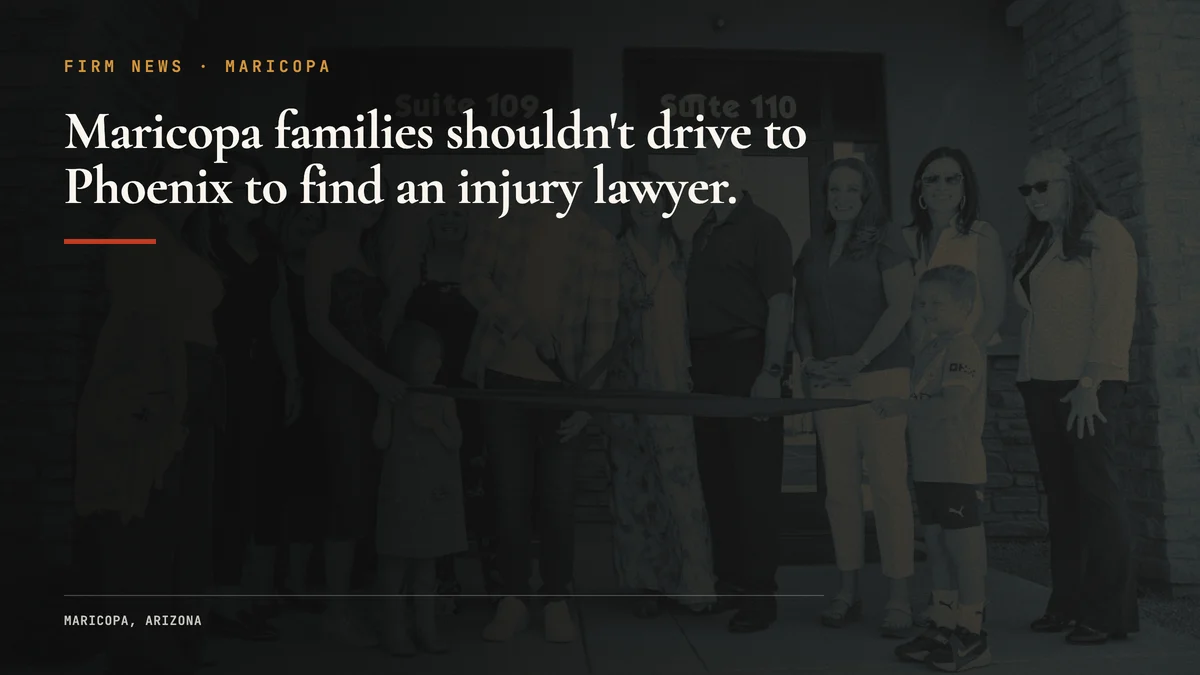
Why AZ Law Now Opened a Local Office in Maricopa
AZ Law Now opened its Maricopa office at 21300 N John Wayne Pkwy on March 5, 2026. Why injured Maricopa residents shouldn't drive an hour for a lawyer.
334 Arizonans Died in Alcohol-Related Crashes in 2025
ADOT's 2025 Crash Facts: 334 alcohol-related traffic deaths in Arizona, 28.9% of all fatalities. Maricopa County saw nearly half. Here's the data.

19 Families, One In-Home Daycare: The Coolidge Lawsuit.
19 Coolidge families are suing a certified in-home daycare over neglect and emotional-abuse claims. What the case reveals about Arizona's daycare oversight.
One Fatal Crash Shut the Only Highway Out of Maricopa
On January 15, a fatal crash on SR-347 near Cement Plant Road closed the only highway out of Maricopa. What that morning reveals about a single-lifeline road.
Killed Riders 55+ Were Helmetless Nearly 3 Times as Often as Under-25s
Arizona crash records show riders 55 and older died without a helmet 56.5% of the time, nearly three times the share for riders under 25.