
Arizona lets a person start working with autistic children in a behavioral health program and gives them seven working days just to apply for a fingerprint clearance card. Not to receive one. To apply.
That window sits in state law, ARS 36-425.03, and it’s the seam in a system that looks, from a distance, like it has three separate background checks protecting these kids. Trace each one to the person actually alone with the child and all three stop short.
I went looking for the answer to one question a parent asked out loud at a kitchen table: who, exactly, cleared the young woman who spends thirty hours a week alone in a room with my nonverbal son? The honest answer in Arizona is that no single agency did.
The clinic did, on a form it keeps.
The Aide in the Room
Applied behavior analysis is the most common autism therapy, and it’s delivered in long, intensive blocks, often 30 or more hours a week, in clinics, homes, and schools. The person delivering most of those hours isn’t the licensed behavior analyst whose name is on the treatment plan. It’s a Registered Behavior Technician.
The Behavior Analyst Certification Board sets the RBT bar: at least 18 years old, a high school diploma or equivalent, a 40-hour training course, a competency assessment, and ongoing supervision of at least 5% of service hours each month with two real-time contacts.
AHCCCS, Arizona’s Medicaid agency, defines the Behavior Technician in policy 320-S as a paraprofessional working under a behavior analyst’s clinical oversight. This is, by design, an entry-level role in a high-turnover field. That’s not a criticism of the people who do it. It’s the structural fact that makes the screening question matter.
Layer One: The Medicaid Screen Checks the Owner, Not the Aide
Arizona funds a large share of ABA through AHCCCS. In 2023 the agency expanded high-risk screening to behavioral health provider types, including behavioral health residential facilities, integrated clinics, and outpatient clinics, requiring a fingerprint-based criminal background check and a site visit at enrollment and revalidation.
That sounds like a fingerprint check on the people doing the work. Read the AHCCCS Fingerprint-Based Criminal Background Check guidance and it isn’t. The check applies to high-risk provider entities and to any individual with a 5% or greater direct or indirect ownership interest.
Non-owner employees — regardless of how many — aren’t covered by that requirement. For a non-profit provider, AHCCCS guidance ties the check to the individual named in the IRS determination letter, not to the clinical staff working with patients.
The Medicaid fingerprint screen reaches the owner, the director, and the 5% stakeholder. The technician assigned to a specific child is a non-owner employee, and the rule’s own scope makes clear that technician isn’t subject to it.
Layer Two: The State Lets the Aide Start Before the Card
So the employee-level check must live somewhere else. It lives in ARS 36-425.03, the children’s behavioral health fingerprinting statute. Here is what the statute actually says.
Personnel, including volunteers, must hold a valid fingerprint clearance card “or, within seven working days after employment or beginning volunteer work, shall apply for a fingerprint clearance card.” Applying isn’t clearing.
The Department of Public Safety still has to run the state and federal record and decide, under ARS 41-1758.03, whether a disqualifying offense bars the card. The statute permits the work to begin while that is pending.
The same section then lists exemptions. A person is exempt from fingerprinting entirely when under the direct visual supervision of, and in the presence of, personnel who hold a valid card.
That includes a volunteer who provides services to children, and an employee who has applied for a good-cause exception after a disqualifying offense and is awaiting a decision.
The employer certifies fitness on a notarized form, and the statute makes those forms confidential. Employers must make “documented, good faith efforts” to contact prior employers. Good faith effort is the standard. Not verification.
Layer Three: The Credential Doesn’t Verify It Either
The last place the check could live is the credential. It doesn’t. The RBT requirements call for a background check, but the Behavior Analyst Certification Board delegates that to the hiring employer. The board certifies competency and supervision. It doesn’t run, hold, or audit Arizona fingerprint clearance cards.
Three layers. The Medicaid screen stops at ownership. The statute lets the worker start and leans on a confidential employer certification. The credential hands the check back to the employer. Every layer assumes another one covers the technician alone with the child. Read together, the assumption has nowhere to land.
The Volume Problem
A design gap is a latent risk until something multiplies the number of times it’s exercised. Private equity is that multiplier.
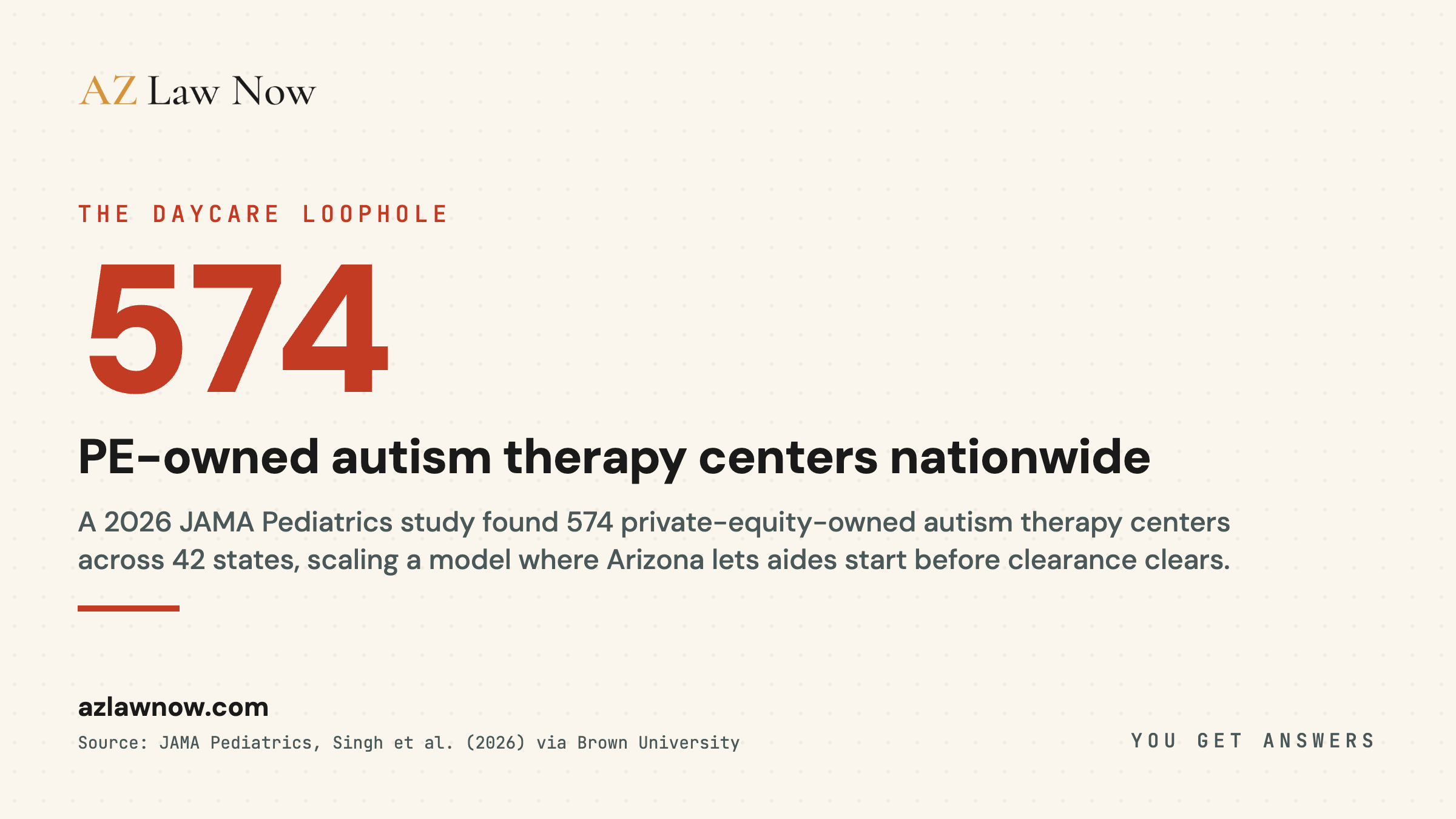
A 2026 study published in JAMA Pediatrics by researchers at Brown University identified 574 autism therapy centers owned by private equity firms across 42 states as of 2024, the result of 142 deals, with roughly 80% of acquisitions between 2018 and 2022.
The study found investment concentrated in states with higher childhood autism prevalence and fewer limits on insurance coverage.
The Private Equity Stakeholder Project, in a 2026 report, described the same model: ABA revenue scales with billable hours and headcount, and audits across states have flagged improper payments, including $77.8 million in Colorado, $56 million in Indiana, up to $94.3 million in Wisconsin, and $16.7 million in Massachusetts.
The report also notes more than $900 billion in expected federal Medicaid reductions over the next decade, which tightens the pressure to keep billable hours up. In Arizona specifically, KJZZ reported in February 2026 that observers say the state’s regulation of the booming ABA industry doesn’t adequately protect children with autism.
Scale a model that bills by the hour, hire fast against a fixed, employer-managed clearance process, and the single point of verification carries more weight every quarter.
The Arizona Chains
Trace that national finding into Arizona and four private-equity-backed chains do most of the volume.
Action Behavior Centers, acquired by Charlesbank Capital Partners in August 2022 at an $840 million valuation, lists more than two dozen Arizona centers across Phoenix, Tucson, Mesa, Gilbert, Chandler, Scottsdale, Glendale, Surprise, Sun City, Buckeye, Maricopa, San Tan Valley, Queen Creek, Peoria, El Mirage, and Tempe.
Hopebridge, now an Arsenal Capital Partners portfolio company, runs more than a dozen Arizona centers from Litchfield Park and Phoenix to Yuma and Flagstaff.
BlueSprig Pediatrics has been a KKR platform since 2017, with nine Arizona locations across Glendale, Scottsdale, Tucson, Phoenix, Surprise, Gilbert, and Chandler.
The Center for Autism and Related Disorders sold out of Chapter 11 bankruptcy in July 2023 in a court-approved $48.5 million three-way sale.
Pantogran LLC (led by CARD founder Doreen Granpeesheh) paid $37.4 million for 112 centers and the clinical IP, while Proud Moments ABA and New Story acquired separate asset groups. The company now runs seven Arizona clinics across Phoenix, Tempe, Chandler, Mesa, Gilbert, and Tucson.
That’s the Arizona stake in the national pattern: dozens of clinics, billed against a Medicaid-funded model, hiring against the same employer-managed clearance process described above.
The one concrete federal enforcement event against a chain with multiple Arizona centers landed on Hopebridge. On October 31, 2025, Hopebridge agreed to pay $25,336.48 to the U.S. Department of Health and Human Services Office of Inspector General after self-disclosing alleged conduct under the Civil Monetary Penalties Law.
OIG alleged the company submitted claims for plans of care that were not individualized to the patient. The matter resolved by settlement and the OIG action recites the allegations, not findings of liability.
The alleged conduct isn’t staff-screening conduct, but it’s the kind of documentation gap that surfaces when audits reach a chain billing many hours across many sites.
What I Asked the State
This investigation rests on Arizona statute and published AHCCCS and DPS policy, which are public and verifiable.
What isn’t public is the operational data that would show how often the seam is exercised: how many RBTs in Arizona started under the seven-working-day window before a card issued, how many work under the direct-visual-supervision exemption, and what AHCCCS audits of Arizona ABA providers have found on staff screening specifically.
Public records requests under ARS 39-121 to AHCCCS and the Department of Public Safety are the appropriate vehicle for that data and for any compliance findings tied to ABA provider staff clearance. AHCCCS expanded entity-level screening for behavioral providers in 2023, which shows the agency tightening at the provider tier.
AHCCCS has also already activated an audit channel that touches these providers.
In its 2025 Managed Care Program Annual Report to the federal government, covering October 1, 2023 through September 30, 2024 and submitted March 28, 2025, AHCCCS reported that its Unified Program Integrity Contractor, Qlarant, has identified ABA providers as a program integrity oversight focus alongside laboratories and hospice providers.
Whether Qlarant’s findings on Arizona ABA providers reach staff-screening compliance, or stop at billing and documentation, is what the records production will show. Whether that tightening reaches the technician tier is the question the records will answer.
I’ll update this report with what each agency provides, what it withholds, and the stated basis for any denial.
Ron DeBrigida’s guide to Arizona negligent hiring law for pediatric behavioral health providers covers the common-law duty and the specific ARS 36-425.03 window in litigation terms, and Stephanie Ramirez’s guide to vetting your Arizona ABA provider walks families through the precise questions to ask before enrolling.
For the analogous framework in licensed childcare settings, see Ron’s Arizona daycare negligence law guide and Stephanie’s guide to vetting an Arizona daycare. For the broader pattern of oversight gaps in settings serving vulnerable Arizonans, see the child abuse practice overview and the Arizona daycare violations investigation.
What the Data Means
This isn’t a story about a scandal. No criminal case anchors it, and it shouldn’t take one. It’s a story about how Arizona built three checks around a child and scoped each one so the person most often alone with that child, the entry-level technician in a high-turnover, fast-scaling, Medicaid-funded industry, falls between them.
The state already knows how to close it. AHCCCS tightened entity screening in 2023. The statute could require the card to issue before unsupervised contact, not merely an application within seven working days. The question isn’t whether Arizona can verify who is in the room. It’s whether anyone is required to, before the door closes.
Frequently asked questions
Does my child's ABA therapist have a background check in Arizona?
Can an ABA aide work with my child before clearance is complete?
What is a Registered Behavior Technician?
Who verifies ABA staff screening in Arizona, AHCCCS, DPS, or the clinic?
What can I ask my ABA provider about staff screening?
Is private equity connected to this?
Sources & references
- Arizona State Legislature. (2024). ARS 36-425.03: Children's behavioral health programs; personnel; fingerprinting requirements; exemptions; definitions. Retrieved May 19, 2026, from https://www.azleg.gov/ars/36/00425-03.htm
- Arizona State Legislature. (2024). ARS 41-1758.03: Fingerprint clearance cards; issuance; immunity. Retrieved May 19, 2026, from https://www.azleg.gov/ars/41/01758-03.htm
- Arizona State Legislature. (2024). ARS 41-1758.07: Level I fingerprint clearance cards; definitions. Retrieved May 19, 2026, from https://www.azleg.gov/ars/41/01758-07.htm
- Arizona Health Care Cost Containment System. (2020). AHCCCS Medical Policy Manual 320-S: Behavior Analysis Services. Retrieved May 19, 2026, from https://www.azahcccs.gov/shared/Downloads/MedicalPolicyManual/300/320S.pdf
- Arizona Health Care Cost Containment System. (n.d.). Fingerprint-Based Criminal Background Check Requirement. Retrieved May 19, 2026, from https://www.azahcccs.gov/PlansProviders/Downloads/apep/FCBC_OnePager.pdf
- Arizona Health Care Cost Containment System. (2023, May 18). New and Revalidating Behavioral Health Providers Subject to High-Risk Screening. Retrieved May 19, 2026, from https://www.azahcccs.gov/shared/News/PressRelease/HighRiskScreening.html
- Behavior Analyst Certification Board. (2026). Registered Behavior Technician (RBT) requirements and handbook. Retrieved May 19, 2026, from https://www.bacb.com/rbt/
- Singh, Y., et al. (2026). Private Equity Acquisitions of Autism Therapy Centers (JAMA Pediatrics), as reported by Brown University School of Public Health. Retrieved May 19, 2026, from https://www.brown.edu/news/2026-01-07/private-equity-autism-centers
- Private Equity Stakeholder Project. (2026). Private equity's autism therapy boom is straining Medicaid. Retrieved May 19, 2026, from https://pestakeholder.org/reports/private-equitys-autism-therapy-boom-is-straining-medicaid/
- Ankrah, A., & Silverman, A. (2026, February 5). ABA therapy costs are soaring. Observers say poor regulations don't protect AZ kids with autism. KJZZ. Retrieved May 19, 2026, from https://www.kjzz.org/the-show/2026-02-05/aba-therapy-costs-are-soaring-observers-say-poor-regulations-dont-protect-az-kids-with-autism
- Charlesbank Capital Partners. (n.d.). Action Behavior Centers (portfolio listing). Retrieved May 19, 2026, from https://www.charlesbank.com/investments/action-behavior-centers/
- Arsenal Capital Partners. (n.d.). Arsenal Capital Partners Announces Acquisition of Hopebridge. Retrieved May 19, 2026, from https://www.arsenalcapital.com/news/arsenal-announces-acquisition-of-hopebridge
- U.S. Department of Health and Human Services, Office of Inspector General. (2025, October 31). Hopebridge Agreed to Pay $25,000 for Allegedly Violating the Civil Monetary Penalties Law by Submitting Claims for Services Without Proper Treatment Plans. Retrieved May 19, 2026, from https://oig.hhs.gov/fraud/enforcement/hopebridge-agreed-to-pay-25000-for-allegedly-violating-the-civil-monetary-penalties-law-by-submitting-claims-for-services-without-proper-treatment-plans/
- Arizona Health Care Cost Containment System. (2025, March 28). Managed Care Program Annual Report (MCPAR) for Arizona Regional Behavioral Health Authority, reporting period October 1, 2023 through September 30, 2024. Retrieved May 19, 2026, from https://www.azahcccs.gov/Resources/Downloads/MCPAR/2025_RBHA-MCPAR.pdf
- Arizona Health Care Cost Containment System. (n.d.). Provider Enrollment Frequently Asked Questions: Fingerprint-Based Criminal Background Check. Retrieved June 8, 2026, from https://www.azahcccs.gov/PlansProviders/APEP/FAQ.html
- Center for Autism and Related Disorders. (2023, July 27). CARD Receives Court Approval of Sale to Pantogran LLC, Proud Moments ABA, and New Story [Press release]. GlobeNewsWire. Retrieved June 8, 2026, from https://www.globenewswire.com/news-release/2023/07/27/2712790/0/en/Center-for-Autism-Related-Disorders-LLC-CARD-Receives-Court-Approval-of-Sale-to-Pantogran-LLC-Proud-Moments-ABA-and-New-Story.html