
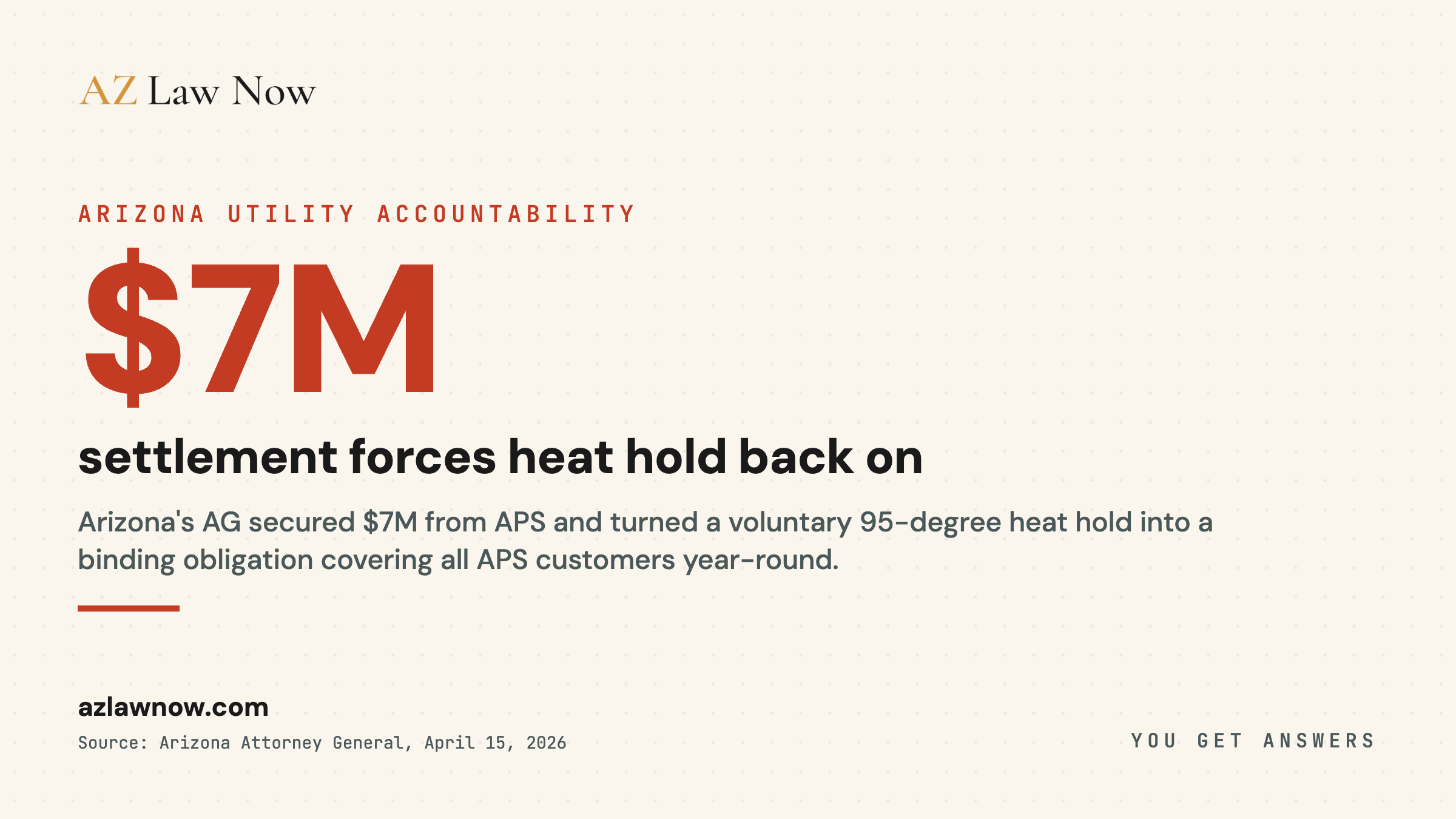
On April 15, 2026, Arizona Attorney General Kris Mayes announced a settlement with Arizona Public Service Company valued at $7 million.
The case resolves a Consumer Fraud Act investigation tied to the death of APS customer Katherine Korman, age 82, who was found dead in Sun City West on May 19, 2024, days after APS disconnected her power.
The single fact that makes this settlement different from a press-release win is the timeline.
MCDPH’s 2025 Heat-Related Deaths Report, published April 2026, finalized 2024 at 608 heat-related deaths and confirmed 430 for 2025, the second straight annual decline from 2023’s record 645.
Of the county’s 111 indoor heat deaths in 2025, an air-conditioning unit was present in 94% of cases and wasn’t functioning in 72% of those.
Our new investigation, Arizona’s recorded heat deaths and the county that counts them, traces the full surveillance record behind these numbers, including AG Mayes’ July 2026 Consumer Fraud Act demand letter to a Glendale complex with failed air conditioning, the same statute used here.
What the Settlement Actually Requires
The settlement structure is precise. Total: $7 million. Allocations:
The reinstated and new APS obligations are the structural change. APS now has to maintain the 95-degree heat hold on residential disconnections outside the existing June 1 to October 15 moratorium window.
That makes disconnections temperature-triggered, not calendar-triggered alone.
APS also has to maintain a 32-degree cold-weather hold, add text-message alerts for past-due and disconnection notices, enhance the APS Safety Net Program for medically vulnerable and at-risk customers, send annual letters comparing the Saver Choice Plus rate plan against alternatives, and encourage other Arizona utilities to adopt similar practices.
APS didn’t admit fault. The settlement says so on its face.
The statutory anchor is the Arizona Consumer Fraud Act, ARS 44-1521 et seq. ARS 44-1522 prohibits unfair acts in connection with the sale of merchandise, with intent that others rely on the conduct, “whether or not any person has in fact been misled, deceived or damaged.”
The AG’s case handler was Senior Litigation Counsel John Raymond Dillion IV in the Consumer Protection and Advocacy Section.
AG Mayes’ verbatim, in the press release: “This settlement ensures that APS will no longer disconnect power based on the date on the calendar alone, if temperatures are dangerous, the power stays on.”
What Happened to Katherine Korman
Katherine “Kate” Korman, age 82, lived in Sun City West, Maricopa County. APS discontinued its voluntary 95-degree heat hold shortly before May 13, 2024.
The AG release describes the timing as “just three days prior” to the disconnection. Working date for the end of the voluntary hold: approximately May 10, 2024.
The AG release doesn’t give a calendar date for the end of the hold. It gives “three days prior” to May 13.
APS disconnected Korman’s electricity remotely on May 13, 2024 for nonpayment. The forecast high was approximately 99 degrees.
She was found deceased on May 19, 2024.
The Maricopa County Medical Examiner ruled her death an accident caused by chronic alcohol use with cardiovascular disease, and listed heat stress as a contributing factor.
APS has said it contacted Korman multiple times before the disconnection and again the day after, urging her to get in touch. That account is APS’s own characterization of its outreach, not a verified third-party record.
Katherine Korman’s sons, Adam and Jonathan Korman, are on public record. Adam Korman, to ABC15: “If her power hadn’t been cut during 100 degree weather, she would not have died when and how she did.”
The Arizona Corporation Commission’s calendar-based June 1 to October 15 moratorium had been on the books since 2019, adopted after a different APS customer died of heat exposure following a disconnection.
But May 13 fell outside that window. APS’s voluntary 95-degree heat hold was the protective layer that should have triggered.
APS removed it three days before pulling Korman’s power on a 99-degree day. The Maricopa County 2024 confirmed heat-death total was 608.
What the ACC Commissioners Said
Arizona Corporation Commissioner Nick Myers, on the Korman matter, made a public statement reported by KJZZ and 12News: “I refuse to tell utilities they have to provide power to people that don’t pay their bills.”
Myers posted that statement on X in April 2025, and Adam Korman publicly clashed with him in the same social-media exchange. The verbatim Korman response from that exchange isn’t in this report.
The current ACC includes Commissioners Lea Marquez Peterson, Kevin Thompson, Nick Myers, and Jim O’Connor. The fifth seat requires direct verification at azcc.gov before publication of any roster.
The 2019 Precedent
The ACC adopted the June 1 to October 15 disconnect moratorium in 2019. The trigger was an earlier heat-related death of an APS customer whose service had been disconnected. The 2019 precedent established that calendar-based extreme-weather protection was within ACC jurisdiction.
The 2024 Korman death exposed the calendar’s limit. May 13 isn’t June 1. A 99-degree day in mid-May is a heat day in Phoenix climate terms even though the calendar moratorium hasn’t started.
The April 15, 2026 settlement closes that gap by adding the 95-degree temperature trigger as a binding obligation. That’s the structural change.
What This Means for Arizona Families
The new APS obligations affect every APS customer in Maricopa, Pinal, and Yavapai counties.
The 95-degree heat hold is now mandatory, not voluntary. APS can’t disconnect residential service when the forecast high is 95 or above, regardless of calendar date.
The 32-degree cold-weather hold is the analog. Below freezing, no disconnection.
The Safety Net Program enhancement matters most for medically vulnerable customers. Arizona families with a household member on home oxygen, a dialysis patient, a medically fragile child, or anyone whose health depends on temperature-controlled environments can enroll. The program provides emergency notifications via text and email and prevents disconnection without additional notice attempts.
The text-alert system is the layer that catches everyone else. Past-due alerts and disconnection notices go to your phone, not just the mailbox.
The $800,000 in direct bill credits, distributed by September 1, 2026, goes to APS customers with outstanding balances. The mechanism for selecting which customers get credits is implemented through the Consumer Assistance and Education Program. Eligibility details belong in any subsequent reporting once the program publishes selection criteria.
Three near-term moves.
Enroll in the APS Safety Net Program if you or a household member is medically vulnerable.
Get a written payment plan in place if you’ve fallen behind (APS suspends disconnection while you pay down a balance under the plan).
Verify your phone number is on file so the new text-alert system reaches you. The April 15, 2026 settlement is now binding APS policy. If your service was disconnected during a covered condition, contact the AG Consumer Protection division at azag.gov.
What’s Missing From This Account
Three layers of detail aren’t in this report and are publicly obtainable.
The first is the actual settlement instrument. The AG press release describes the obligations and the dollar allocations. The operative legal document (the consent decree, assurance of discontinuance, or settlement agreement filed with the court) wasn’t pulled in this reporting window. A public records request to the AG under ARS 39-121 yields the underlying instrument.
The second is the Maricopa County Medical Examiner report on Korman. 12News reporting summarizes the ME findings. The actual report (autopsy, toxicology, scene investigation notes) requires a public records request to the Maricopa County Medical Examiner.
The third is the MCDPH 2024 indoor-heat-death cohort cross-tabbed against utility disconnect status. The 608 confirmed 2024 heat deaths are in the annual surveillance report. The slice that involved a utility disconnect within the prior 30 days isn’t published. It lives in the underlying surveillance dataset. A FOIA-equivalent request to MCDPH yields that cross-tab.
What Comes Next
Three near-term reporting moves on this story.
The first is the AG settlement instrument retrieval. The press release describes. The document binds. Pulling the underlying consent decree confirms the binding language for every obligation listed in this report.
The second is the ACC angle. Regulators were reported looking into APS disconnection procedures after the Korman matter, but we haven’t confirmed a formally docketed ACC investigation.
Whether the ACC opens its own proceeding, and any docket number, schedule, or commissioner votes, would be public at azcc.gov. An ACC proceeding could produce additional rule changes beyond the AG settlement.
The third is the Korman family’s civil-action posture. ABC15’s reporting describes the family pursuing “justice” without naming counsel or referencing a filed action.
Maricopa County Superior Court and PACER docket searches would surface any later wrongful-death filing under ARS 12-611.
Adam Korman and Jonathan Korman are on public record, but the family has the privacy choice on whether to pursue civil litigation. We don’t speculate.
For now, the settlement is announced. The reinstated heat hold is binding. The 2026 heat season is weeks away.
This investigation was built from the AG press release at azag.gov, KJZZ heatbeat reporting (Katherine Davis-Young), and 12News reporting on the Maricopa County Medical Examiner findings.
It also draws on ABC15 reporting on the Korman family, Cronkite News April 15 reporting, the Arizona Consumer Fraud Act statutory text at azleg.gov, and the Maricopa County Department of Public Health 2024 heat surveillance summary.
If you have the AG settlement instrument, the Maricopa County Medical Examiner report on Korman, the ACC docket number for the related investigation, or any record of a filed Korman-family civil action, contact AZ Law Now.
We report from primary sources.
We protect the privacy of family members who haven’t gone on record.
Frequently asked questions
What did the AG / APS settlement actually require?
What happened to Katherine Korman?
What is the 95-degree heat hold and why does it matter?
What did the ACC commissioners say about this case?
What's the statutory frame for the AG case?
How does Arizona's heat-death toll compare to past years?
How can Arizona families protect themselves from utility shutoffs in extreme weather?
Sources & references
- Arizona Attorney General. (2026, April 15). Attorney General Mayes Secures $7 Million Settlement with APS Following Investigation. Retrieved May 2, 2026, from https://www.azag.gov/press-release/attorney-general-mayes-secures-7-million-settlement-aps-following-investigation
- 12News. (2024-2026). Heatbeat reporting on Katherine Korman by Katherine Davis-Young. Citations to Maricopa County Medical Examiner findings. Retrieved from https://www.12news.com/article/news/local/arizona/7-million-dollars-aps-following-investigation-ag-mayes-arizona/75-13c0ae31-f182-412d-952c-1fadf9f28307
- KJZZ. (2026, April 15). After heat-related death, APS agrees not to shut off customers' power when temperatures hit 95. Retrieved from https://www.kjzz.org/business/2026-04-15/after-heat-related-death-aps-agrees-not-to-shut-off-customers-power-when-temperatures-hit-95
- Cronkite News. (2026, April 15). APS reaches $7 million settlement with AG Mayes over heat disconnections. Retrieved from https://cronkitenews.azpbs.org/2026/04/15/aps-reaches-7-million-settlement-with-ag-mayes-over-heat-disconnections-reinstates-95-degree-policy/
- ABC15 reporting on the Korman family. (2024-2026). Coverage by Rachel Louise Just including a verbatim statement from Adam Korman. Retrieved from https://www.abc15.com/news/local-news/family-pursuing-justice-after-82-year-old-died-after-a-c-turned-off-in-triple-digit-temperatures
- Arizona Revised Statutes 44-1521 et seq. (Consumer Fraud Act). Operative unlawful-practices section: ARS 44-1522. Retrieved from https://www.azleg.gov/ars/44/01522.htm
- Arizona Revised Statutes 12-611 (Wrongful death cause of action). Retrieved from https://www.azleg.gov/ars/12/00611.htm
- Arizona Corporation Commission. Public dockets and commissioner page. Retrieved from https://azcc.gov/nick-myers/biography
- Maricopa County Department of Public Health. (2024 and 2025). Heat-related deaths surveillance reports. 2024 confirmed total: 608. Retrieved from https://www.maricopa.gov/1858/Heat-Surveillance
- APS Safety Net Program. Retrieved from https://www.aps.com/en/Residential/Account/Assistance-Programs/Safety-Net
- Residential Utility Consumer Office. Docket Number RU-00000A-19-0132: Final Package of Termination of Service Rules Approved, establishing the 95-degree heat hold, 32-degree cold hold, and June 1 to October 15 disconnection moratorium framework for Arizona electric utilities. Retrieved from https://ruco.az.gov/hot-topics/disconnection-rules
- Courthouse News Service. (2026, April 15). Reporting on the AG / APS settlement. Retrieved from https://www.courthousenews.com/settlement-bars-arizona-utility-from-extreme-heat-disconnections/
Tell Google to show our reporting more often in Search and AI answers.