
NHTSA’s position hasn’t changed: school buses are the safest vehicles on the road. The agency repeats it in press releases, testimony, and fact sheets.
The data supports part of that claim. Compartmentalization works. The padded, high-backed seats absorb energy in frontal crashes. Occupant fatality rates per mile traveled are lower than passenger vehicles.
But that framing hides what the numbers actually show.
971 Fatal Crashes in 10 Years
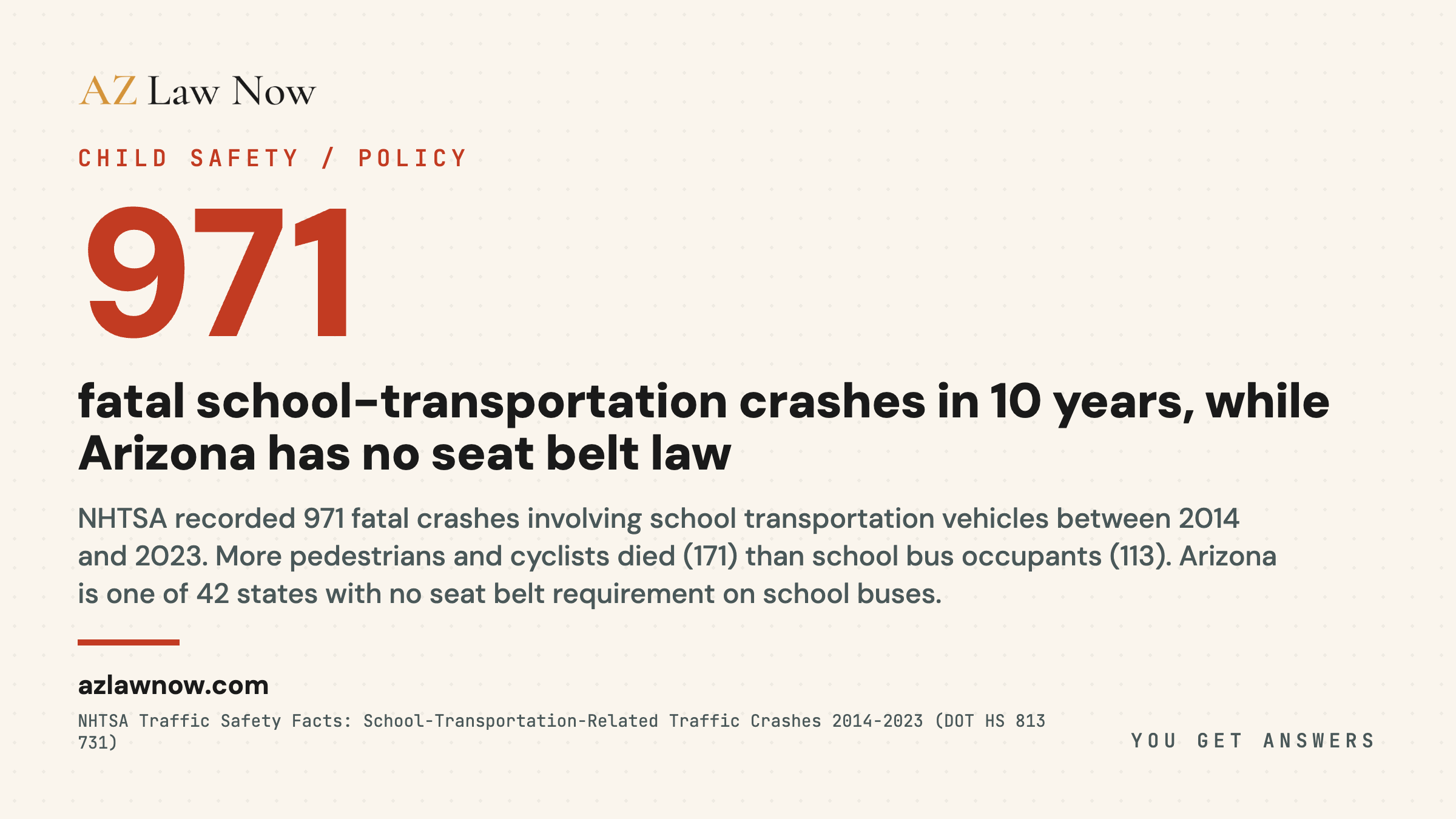
Between 2014 and 2023, NHTSA recorded 971 fatal crashes involving school transportation vehicles across the United States. That’s roughly two per week. The agency tracks these through the Fatality Analysis Reporting System, which captures every crash on a US public road that results in at least one death within 30 days.
The breakdown matters more than the headline number.
Of those fatal crashes, 113 deaths were school bus occupants. Children and drivers inside the bus. Another 171 were pedestrians and bicyclists. More people died outside the bus than inside it. The remaining fatalities occurred in other vehicles involved in the crash.
That 171 figure is the one that deserves more attention. Kids getting on and off the bus. Crossing in front of it. Walking in the loading zone. The bus itself might be safe for occupants, but the environment around it isn’t safe for everyone else.
The Compartmentalization Argument
NHTSA’s position on seat belts in large school buses rests on a concept called compartmentalization. The seats are spaced close together. The seat backs are high and padded. In a frontal crash, a child’s body moves forward and is absorbed by the seat in front of them.
It works for frontal impacts. The physics are sound.
But compartmentalization doesn’t protect against lateral impacts, rollovers, or ejection. When a school bus gets T-boned or tips onto its side, there’s nothing keeping a child in their seat. They become a projectile inside the bus.
NHTSA’s own research acknowledges this gap. A 2011 Federal Register rulemaking examined belt effectiveness in rollover and side-impact scenarios and ultimately declined to issue a federal mandate requiring seat belts on large school buses. The agency still hasn’t issued one.
Compartmentalization protects in frontal crashes. It doesn’t protect in side impacts, rollovers, or rear-end collisions. Children with special needs who can’t brace themselves are especially at risk in any crash type.
Arizona’s Position
Arizona’s school bus equipment requirements are set out in ARS 28-857 and Arizona Administrative Code R13-13-107: flashing warning lights, stop signs, mirrors, and crossing arms. Neither statute nor regulation addresses seat belts. Not for regular routes, not for field trips, not for buses carrying children with disabilities.
The state follows the federal floor. Since NHTSA doesn’t mandate belts on large school buses, Arizona doesn’t either.
Eight states have passed their own requirements. California, Florida, Louisiana, Nevada, New Jersey, New York, and Texas require lap-shoulder belts on new school buses. Arkansas requires lap belts. Arizona isn’t in that group and hasn’t introduced legislation to join it.
The cost argument comes up every time the conversation starts. Retrofitting an existing bus with three-point belts runs an estimated $8,000 to $15,000 per vehicle. Arizona operates approximately 7,100 school buses statewide, according to School Bus Fleet’s 2024-25 K-12 transportation statistics. The math concerns legislators.
But new buses can be ordered with factory-installed belts for a fraction of the retrofit cost.
The Special Needs Problem
Children with physical disabilities, autism spectrum disorders, or behavioral needs can’t brace themselves the way compartmentalization assumes. They can’t put their hands up against the seat in front of them. Some can’t sit upright without support. The compartmentalization model was designed for a neurotypical child sitting forward in their seat.
That’s not every child on every bus.
The Individuals with Disabilities Education Act guarantees transportation as a related service when it’s required by a student’s IEP. Arizona’s special education statutes (ARS 15-763 et seq.) carry that obligation at the state level. But neither framework specifies restraint systems beyond what’s in the student’s IEP. And most IEPs don’t address crash safety.
They address behavioral containment.
There’s a difference between a harness that keeps a child seated during the ride and a harness that keeps a child alive in a rollover. Most districts don’t make that distinction.
The Legal Framework for Restraint Failures
When a school district knows a child needs additional restraint and fails to provide it, that can constitute negligence under Arizona law. The district’s duty of care extends to the transportation it provides, including the adequacy of restraint systems for students whose needs are documented in their IEPs.
Arizona families dealing with a school bus injury need to understand the claim process. School districts are public entities, which means you have to file a notice of claim under ARS 12-821.01 before you can sue. You get 180 days from the date of injury. Miss it and the claim is barred entirely.
Arizona requires a formal notice of claim within 180 days before you can sue a school district. This is a hard deadline. If your child was injured on a school bus, talk to an attorney before the deadline passes.
What the Crash Data Shows in Arizona
ADOT tracks collisions involving school buses on Arizona roads through its crash data system. Nationally, NHTSA data shows most school bus crashes happen in urban and suburban areas during morning and afternoon routes, with rear-end and intersection crashes as the most common types.
Maricopa County accounts for the largest share of Arizona’s school-age population and bus activity, which makes it the focal point for any statewide analysis.
Most crashes don’t make the news. A fender bender with a school bus doesn’t generate a headline. But soft tissue injuries in children often don’t present immediately. A child might seem fine at the scene and develop neck pain, headaches, or behavioral changes days later.
Parents who weren’t notified about the crash in the first place don’t connect the symptoms.
Loading Zone Dangers
The 171 pedestrian and bicyclist fatalities in NHTSA’s data point to a problem that seat belts can’t solve: the loading zone.
Children are most vulnerable in the area immediately around a school bus. Getting on. Getting off. Crossing in front. Walking behind. School transportation safety guidance identifies a danger zone extending roughly 10 feet on all sides of the bus and at least 10 feet ahead of the front bumper where the driver’s sightlines are limited.
In Arizona, ARS 28-857 requires drivers approaching a stopped school bus with flashing red lights to stop. First-time violations carry a minimum civil penalty of $250. A second violation within 36 months raises that to a minimum $750 plus a license suspension of up to six months. Enforcement is inconsistent.
Some districts have started installing stop-arm cameras that photograph vehicles passing stopped buses.
What Families Should Know
If your child rides a school bus in Arizona, here’s what the current laws mean for you.
Your child’s bus almost certainly doesn’t have seat belts. Unless your district has voluntarily installed them or your child has a specific restraint requirement in their IEP, they’re relying on compartmentalization.
You can request a copy of your child’s bus route from the transportation department. You can ask about driver training records, bus maintenance schedules, and the district’s crash notification policy. Most parents don’t know they can request these records. You can.
If your child has a disability and rides a bus, review their IEP’s transportation section. Make sure it addresses crash safety, not just behavioral management during the ride. If the IEP is silent on restraint systems, request an IEP meeting to add specific language.
And if something goes wrong, the 180-day notice of claim deadline starts ticking immediately. Don’t wait for the school district to investigate. Don’t wait for an incident report. Document everything yourself and contact an attorney.
Where This Goes Next
The federal conversation about school bus seat belts has stalled for decades. NHTSA issued a recommendation in 2018 encouraging states to require lap-shoulder belts on new large school buses. It wasn’t a mandate. It was a suggestion.
At the state level, Arizona hasn’t moved. No pending legislation. No interim studies. No task forces. The 971 fatal crashes nationally, the 171 pedestrian deaths, the documented rollover and side-impact gaps in compartmentalization. None of it has produced a policy change in this state.
That doesn’t mean families are powerless. School districts make purchasing decisions about new buses every year. Parents can attend board meetings and ask whether new buses will include belts. Districts that have voluntarily adopted belts report minimal disruption to operations and routing.
What Other States Have Done
Eight states haven’t waited for Washington to act. New York was first, requiring lap belts on buses manufactured after July 1987. California required three-point belts for large school buses manufactured after July 2005. The cost concern that dominates Arizona’s conversation hasn’t materialized as a crisis in any of these states.
Here’s the current landscape.
None of these states reported a significant disruption to school bus operations after implementation. Industry estimates put the cost of factory-installed three-point belts at roughly $7,000 to $10,000 added to the purchase price of a new bus, and new buses are purchased on replacement cycles anyway.
The incremental cost gets absorbed into the normal capital budget over 10 to 15 years.
Several states phased their requirements in gradually: no retrofit mandate, just a requirement that newly purchased buses include belts. Existing buses turn over on their normal replacement cycles. Within 10 to 15 years, the fleet converts without emergency spending.
Arizona could adopt the same model. No retrofit mandate. Just a requirement that every new bus ordered includes belts. The fleet turns over on schedule.
Nobody’s proposed it.
Driver Training and Accountability
Arizona requires school bus drivers to hold a commercial driver’s license with a school bus endorsement (S endorsement). The endorsement requires passing a knowledge test and a skills test. ADOT administers the CDL program and sets minimum requirements.
But the endorsement process tests driving competency. It doesn’t test emergency response, loading zone management, or special needs passenger handling at the level most parents would expect. Those skills come from district-level training, and training programs vary wildly from district to district.
Some Arizona districts run multi-day training programs with annual refreshers. Others meet the bare minimum. State law requires annual physical exams and criminal background checks for bus drivers, but there’s no statewide standard for how many hours of ongoing safety training a driver receives.
The result: the quality of bus safety in Arizona depends almost entirely on which district your child attends. That’s not a system. It’s a patchwork.
What About Small School Buses?
Most of this conversation focuses on large school buses. The yellow, flat-front, 72-passenger vehicles. Federal law draws a distinction based on gross vehicle weight rating.
Large school buses (over 10,000 lbs GVWR) use compartmentalization. Small school buses (under 10,000 lbs GVWR) are required by federal law to have lap belts. Some states require three-point belts on small buses.
Small school buses are used for special education routes, rural transportation, and activity trips. They carry fewer students and operate more like passenger vans. NHTSA determined decades ago that compartmentalization doesn’t work as well in smaller, lighter vehicles, which is why belts are already required.
If your child rides a small school bus, there should be a belt at their seat. If there isn’t, that’s a violation of federal motor vehicle safety standards. Report it to the district transportation department in writing.
The Insurance Question
School districts in Arizona carry liability insurance, typically through pooled risk management programs like the Arizona School Risk Retention Trust. When a child is injured on a school bus, the district’s insurance is the funding source for any settlement or judgment.
But insurance companies don’t pay claims voluntarily. They investigate, they delay, and they minimize. A family dealing with a school bus injury will face an insurance adjuster whose job is to close the claim for the lowest possible amount. The adjuster works for the district’s insurance carrier. Not for your family.
This is why legal representation matters in school bus injury cases. An attorney who understands government liability claims, the notice of claim process, and the specific insurance structures that Arizona school districts use can navigate the process effectively. A family trying to handle it alone is at a structural disadvantage.
The Federal Conversation Is Stalled
Congress has considered school bus seat belt legislation multiple times. Bills have been introduced and died in committee. NHTSA has issued guidance recommending lap-shoulder belts but hasn’t issued a binding federal motor vehicle safety standard requiring them.
The arguments against a federal mandate are consistent: cost, implementation complexity, and the position that compartmentalization is adequate. Proponents point to NHTSA’s own data: 971 fatal crashes, 171 pedestrian deaths, the rollover and side-impact gaps that compartmentalization doesn’t address.
Eight states have decided the data is enough. Arizona hasn’t.
The safety argument isn’t complicated. Seat belts save lives in every other vehicle on the road. The question is why we’ve decided school buses are the exception.
Related Coverage
For the legal and process context, see Ron DeBrigida’s guide to Arizona bus crash law, Stephanie Ramirez’s child injured at school, the school abuse practice overview.
Frequently asked questions
Does Arizona require seat belts on school buses?
What is compartmentalization?
How many people are killed in school bus crashes each year?
What should I do if my child is injured on a school bus in Arizona?
Can I sue a school district in Arizona for a bus crash?
Are school buses with seat belts more expensive?
What is the most common cause of a school bus student fatality?
How much safer is a school bus than a car?
Sources & references
- National Highway Traffic Safety Administration. (2025). Traffic Safety Facts: School-Transportation-Related Traffic Crashes 2014-2023. DOT HS 813 731. Retrieved from https://crashstats.nhtsa.dot.gov/Api/Public/ViewPublication/813731.pdf
- National Highway Traffic Safety Administration. (2025). Fatality Analysis Reporting System (FARS). Retrieved from https://www.nhtsa.gov/research-data/fatality-analysis-reporting-system-fars
- National Highway Traffic Safety Administration. (2011). Federal Register Vol. 76 No. 165: Denial of Petition for Rulemaking; School Buses. Retrieved from https://www.govinfo.gov/content/pkg/FR-2011-08-25/html/2011-21596.htm
- Arizona State Legislature. (2025). ARS 28-857: School bus stop requirements and penalties. Retrieved from https://www.azleg.gov/ars/28/00857.htm
- Arizona Legislature. ARS 12-821.01: Notice of Claim Against Public Entity https://www.azleg.gov/ars/12/00821-01.htm
- School Bus Fleet. (2025). K-12 Student Transportation Statistics 2024-25. Retrieved from https://www.schoolbusfleet.com/news/k-12-student-transportation-statistics-2024-25
- National Conference of State Legislatures. (2025). Should School Buses Have Seat Belts? https://www.ncsl.org/transportation/should-school-buses-have-seat-belts
- NHTSA School Bus Crashworthiness Research https://www.nhtsa.gov/crashworthiness/school-bus-crashworthiness-research
- Arizona Administrative Code R13-13-107: Minimum Standards for School Bus Body https://www.law.cornell.edu/regulations/arizona/Ariz-Admin-Code-SS-R13-13-107