
Arizona has a law on the books that governs when, and whether, a school can physically restrain or seclude a student. It sets a narrow standard, bans the most dangerous methods, and requires schools to tell parents the same day it happens.
What Arizona doesn’t have is a public record a parent can actually search. The incident reports exist, one file at a time inside each district.
What doesn’t exist is any statewide count. Arizona doesn’t require schools to report these incidents to the state, so no agency holds a district-by-district tally. There’s no public dashboard, no district-by-district file you can pull up, no way to see how often the school down the street restrains the kids in it.
That gap, between what the law requires and what a parent can see, is where this report lives.
What the Law Covers, and What the Public Can See
ARS 15-105 requires every public school district and charter school to document each restraint and seclusion incident and notify the child’s parents the same day. What it doesn’t require is any report to the Arizona Department of Education or any other state agency. Arizona keeps no statewide incident record at all.
So there’s no statewide file to publish, and no public record that lets a parent compare schools, see which districts restrain students most, or track a single school year over year.
To get those numbers, you either file a public records request with the district under ARS 39-121 or request your own child’s incident reports directly.
Even the federal totals that do get reported almost certainly understate the real picture.
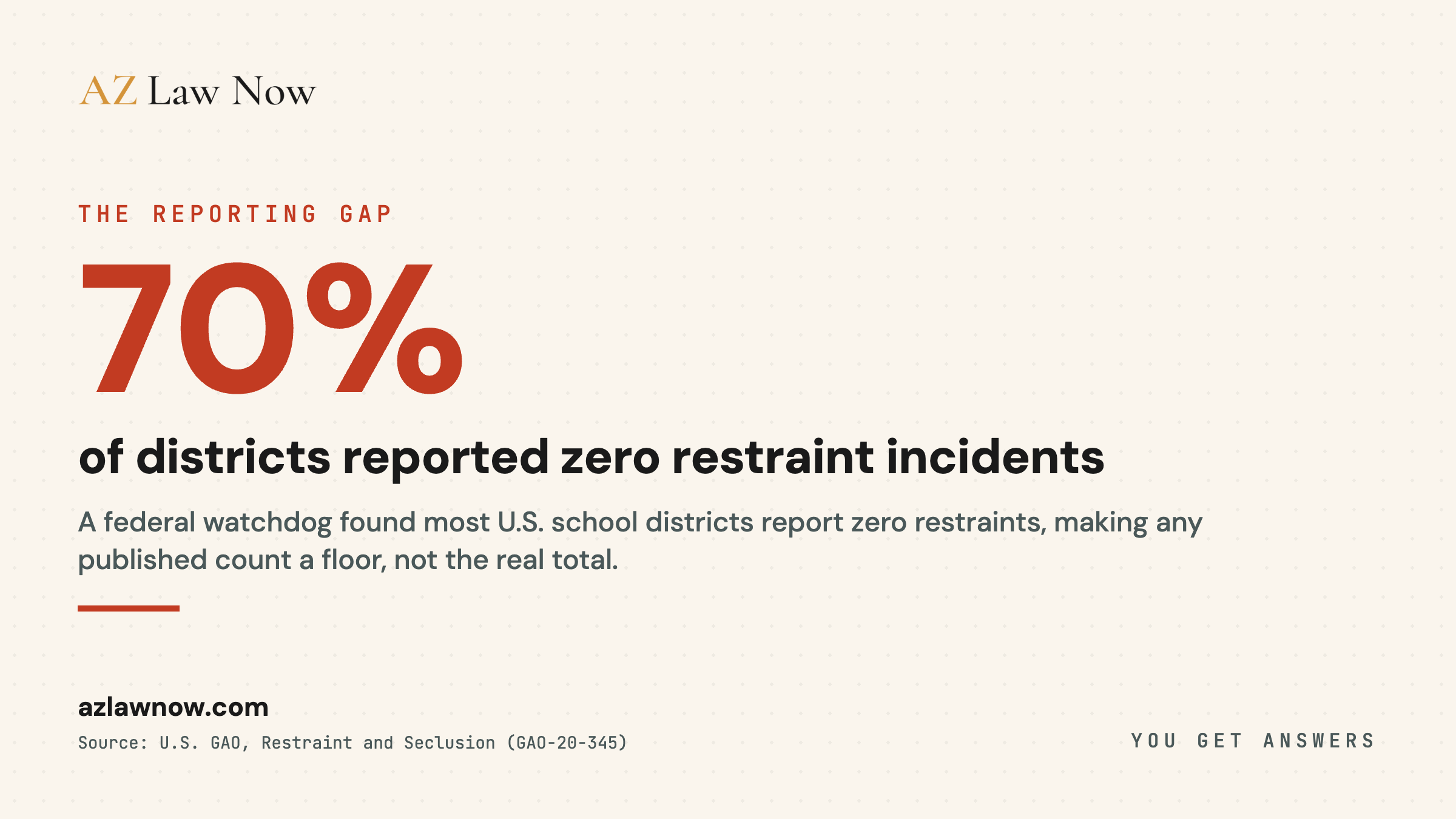
A 2020 report from the U.S. Government Accountability Office found that school restraint and seclusion data is widely underreported: roughly 70% of districts nationally reported zero incidents in the federal collection, and the Department of Education’s data-quality checks reached fewer than 100 of the largest districts.
When most districts report nothing and the checks cover only a handful, the published count is a floor, not a ceiling.
Arizona doesn’t require schools to report these incidents to any state agency, so there’s no statewide record to search. The most reliable way to learn your own district’s numbers is a public records request under ARS 39-121.
Federal data quality is also weak: the GAO has found that most districts report zero incidents and that the Department of Education verifies the data for only a small number of large districts. Treat any published total as a minimum.
Who Gets Restrained, Nationally
The most reliable picture of who restraint falls on comes from the national data, not from any searchable Arizona file.
Students with disabilities make up about 15% of public school enrollment nationally, according to the National Center for Education Statistics. That’s the share of students who receive services under the Individuals with Disabilities Education Act.
The federal Civil Rights Data Collection has long shown that this same group accounts for a large majority of restraint and seclusion incidents, far out of proportion with their share of enrollment.
The most recent complete federal collection covers the 2021-22 school year, released in January 2025. The 2020-21 data came out in November 2023. The 2023-24 CRDC data has not yet been publicly released as of June 2026, despite an originally projected December 2025 release date.
There is no 2024-25 federal data yet. So any claim about Arizona-specific, current-year disability breakdowns can’t be checked against a published federal source, which is exactly why the district-level picture has to come from a records request.
What the national pattern does establish is direction: a student with a disability is far more likely to be restrained at school than a student without one. The disparity is large enough that it demands explanation. The Arizona-specific magnitude is what the public record can’t yet show.
What Counts as Restraint Under Arizona Law
Arizona’s restraint and seclusion statute is ARS 15-105. It defines three categories.
The Three Statutory Categories
Physical restraint
means a personal restriction that immobilizes or reduces the ability of a student to move their arms, legs, body, or head freely. This includes staff physically holding a student, wrapping a student in a blanket hold, or using any body-to-body contact to restrict movement.
The law allows it only when the student poses an imminent danger of serious physical harm to themselves or others.
Mechanical restraint
means any device or material attached to or adjacent to a student’s body that restricts movement. This includes straps, ties, and anything that physically prevents a student from moving. Arizona law prohibits unapproved mechanical restraint.
The statute carves out an exception for methods or devices used by trained school personnel for the specific, approved therapeutic or safety purpose for which they were designed and, where applicable, prescribed.
Seclusion
means the involuntary confinement of a student alone in a room that the student can’t leave. The room doesn’t have to be locked. If a staff member holds the door, stands in the doorway, or tells the student they can’t leave, that’s seclusion under the statute.
ARS 15-105 prohibits any restraint technique that impedes a student’s ability to breathe, and bans the use of mechanical devices unless they’re approved and used by trained personnel for their designed therapeutic or safety purpose.
The statute doesn’t mention prone restraint or chemical restraint by name. A restraint that cuts off a student’s breathing violates state law regardless of the hold position. Restraints must also not be out of proportion to the student’s age or physical condition.
There’s a critical exception that gets stretched. The law says restraint is permissible when a student poses “imminent danger of serious physical harm.” But how a district defines imminent danger can vary. Some read it narrowly: a student actively striking a staff member or another student.
Others read it broadly enough to cover a student throwing a book, knocking over a chair, or refusing to leave a classroom.
The broader the working definition, the more situations a school can treat as restraint-eligible. That’s where the line between a last resort and a routine response starts to blur.
What Parents Are Owed, and What Often Happens
ARS 15-105 requires schools to make a “reasonable effort” to notify parents on the same school day that a restraint or seclusion incident occurs. The law also requires a written incident report that includes the date, time, duration, description of the event, names of involved staff, and what triggered the restraint.
That’s the law. Whether it’s followed in every case is something a parent often can’t confirm without going and getting the file.
Written incident reports are supposed to be permanent records filed with the district and available to parents on request. But the state doesn’t collect these reports at all, and no agency audits whether every required incident report actually exists.
If a school restrains a student and never files a written report, there’s no state-level mechanism that automatically catches the omission. That’s one reason the federal watchdog has found restraint counts to be a floor rather than a true total: in the federal collection, the only count is the one schools choose to file.
There’s a related safeguard worth knowing. Under IDEA (the Individuals with Disabilities Education Act), when a student with an IEP is restrained repeatedly, the school is expected to convene the IEP team to review the student’s behavioral intervention plan. If the student doesn’t have one, the school is supposed to create one.
A restraint is supposed to trigger a conversation about why it’s happening and what can change. If your child has an IEP and has been restrained, you can ask for that meeting in writing and request the underlying incident reports as part of it.
Why the Numbers You’ll See Are Incomplete
The U.S. Department of Education’s Civil Rights Data Collection (CRDC) is the most comprehensive federal dataset on school discipline, and it runs on a multi-year lag, so the most current cycle is always a few years behind. That alone means there’s no published federal source against which to check a current-year Arizona total.
The federal data also comes with a heavy quality caveat. In its 2020 review, the GAO found that most districts reported zero restraint incidents and that the Department of Education ran data-quality checks on fewer than 100 of the largest districts.
The takeaway is consistent across years: published restraint and seclusion counts understate the real number, and the size of that gap stays unknown.
That’s the honest limit of the public record. The national pattern is clear in direction. The Arizona-specific, district-level counts a parent would actually want aren’t posted anywhere searchable, which is why they have to be requested.
What Arizona Law Requires (And What It Doesn’t)
ARS 15-105 sets minimum requirements for restraint and seclusion in schools. Here’s what the law mandates and where the gaps are.
The law requires that physical restraint only be used when there’s imminent danger of serious physical harm. It requires same-day parent notification. It requires a written incident report. It requires that the restraint end as soon as the imminent danger ends.
It prohibits any restraint that impedes the student’s breathing and bans the use of unapproved mechanical devices.
What it doesn’t require is equally important.
The law doesn’t require schools to report incidents to ADE or any state agency at all. No district submits its restraint counts to the state, in real time or at year-end. A student could be restrained 20 times in a semester and no state office would ever know.
The law doesn’t set maximum duration limits. A restraint could last two minutes or 45 minutes. Both count as one incident in the data. Some states set five-minute or 15-minute limits and require escalation procedures after those thresholds. Arizona doesn’t.
The law doesn’t require independent oversight of restraint practices. Districts police themselves. No state office audits individual schools. There’s no independent monitor, no state-level review board, no automatic investigation trigger when a district’s numbers exceed a threshold.
The law doesn’t require districts to publish their restraint data, or even to report it to the state. No agency compiles a statewide count, so there’s no district-level data to post on a public dashboard. Parents who want their district’s numbers have to file a public records request.
Under Arizona’s public records law (ARS 39-121), you can request your district’s restraint and seclusion data directly. Send a written request to the district’s superintendent or records custodian.
Ask for aggregate incident counts by school site, disability status, and grade level for the most recent three school years. Districts must respond within a reasonable time, generally interpreted as 10 to 15 business days.
Where the Law Could Go Further
Reform proposals in this area tend to cluster around the same handful of gaps in the current statute: any requirement to report incidents to the state, which Arizona has none of today, a maximum duration limit on a single restraint, an independent oversight or audit mechanism, and a public district-level dashboard.
Other states have adopted versions of each.
Arizona, so far, has not.
I’m not going to attach those reforms to a specific bill number here. The published record didn’t support the bill references this piece originally carried, and naming a bill that doesn’t match its description is worse than naming none.
If a measure with these provisions is moving in the current Arizona legislature, that’s worth tracking on its own verified terms, not on a number that turns out to point somewhere else.
What You Can Do
If your child has been restrained at school, you have more options than the district might suggest.
Start by requesting your child’s complete educational record, including all incident reports, behavioral intervention plans, IEP meeting notes, and daily behavior logs. Under FERPA and IDEA, the school must provide these within 45 days.
If your child has an IEP, you can request an emergency IEP team meeting to address the restraint and develop or revise a behavioral intervention plan.
File a complaint with the Arizona Department of Education if the school failed to notify you, failed to file an incident report, used a prohibited restraint method, or restrained your child when there was no imminent danger of serious physical harm. ADE’s complaint process is outlined on its website under Special Education Dispute Resolution.
File a complaint with the US Department of Education’s Office for Civil Rights if you believe the restraint was related to your child’s disability, race, or national origin. OCR investigates under Section 504 of the Rehabilitation Act and Title II of the ADA. You can file online at the OCR website. There’s no cost.
You don’t need a lawyer.
Document everything independently. Write down what your child tells you, when they tell you, and any physical marks or behavioral changes you observe. Take photos if there are visible injuries. Keep a timeline.
Schools sometimes dispute the facts. A parent with contemporaneous notes and photos is harder to dismiss.
If the restraint caused physical injury, emotional trauma, or has been recurring, talk to an attorney. Schools aren’t immune from liability when staff injure students through excessive or unnecessary force. ARS 15-105 sets the legal standard: restraint is only permissible in narrow circumstances.
When a school exceeds those circumstances, the student and family may have a legal claim.
AZ Law Now represents families across the West Valley in school restraint and abuse cases. The editors work with parents whose children were injured, traumatized, or repeatedly restrained without proper notification or justification. Families can reach the firm at (602) 654-0202 or through the contact form.
The government claim process under ARS 12-821.01 runs on a 180-day deadline. Intake is confidential. Representation is on contingency.
The Bigger Picture
Arizona has a restraint and seclusion law that sets a narrow standard and bans the most dangerous methods. What it doesn’t have is a public, searchable record that lets a parent see how often any given school uses restraint, or independent oversight that catches a district whose numbers run high.
Whatever count eventually surfaces, whether from the federal data or a records request, is a floor, not a ceiling. The federal watchdog has been clear that restraint counts are widely underreported, and Arizona collects no statewide data of its own for the public to audit.
The honest position is that the practice is real and regulated, the published numbers understate it, and the district-level detail still has to be pried loose one records request at a time.
We’ve filed for that data. When the district-level records come back, this report gets the facility-level findings the public site can’t show on its own. Until then, it sticks to what the law requires and what the federal record can prove.
If you’re a parent, a teacher, or a school administrator with information about restraint practices in West Valley schools, reach out. Every account helps.
The kids in these numbers can’t advocate for themselves. Somebody has to.
Related Coverage
For the legal and process context, see Ron DeBrigida’s guide to Arizona suing school district arizona, Stephanie Ramirez’s child injured at school, the school abuse practice overview.
Frequently asked questions
How do I find out how often a school restrains students in Arizona?
Are schools allowed to restrain students in Arizona?
How do I get my own district's restraint and seclusion data?
What's the difference between restraint and seclusion in schools?
Can I file a complaint if my child was restrained at school?
Do parents have to be told when their child is restrained at school?
What are the grounds for CPS to remove a child in Arizona?
Sources & references
- Arizona State Legislature. (2025). ARS 15-105: Use of restraint and seclusion techniques; requirements; definitions. Retrieved June 8, 2026, from https://www.azleg.gov/ars/15/00105.htm
- Arizona State Legislature. (2025). ARS 15-843: Pupil Disciplinary Proceedings. Retrieved from https://www.azleg.gov/ars/15/00843.htm
- Arizona State Legislature. (2025). ARS 39-121: Public Inspection of Documents. Retrieved from https://www.azleg.gov/ars/39/00121.htm
- National Center for Education Statistics. (2024). Condition of Education: Students with Disabilities. Retrieved June 8, 2026, from https://nces.ed.gov/programs/coe/indicator/cgg/students-with-disabilities
- U.S. Government Accountability Office. (2020). Restraint and Seclusion: Education Should Better Assess Data Quality (GAO-20-345). Retrieved June 8, 2026, from https://www.gao.gov/products/gao-20-345
- U.S. Department of Education. (2025). Civil Rights Data Collection (CRDC). Retrieved June 8, 2026, from https://www.ed.gov/laws-and-policy/civil-rights-laws/civil-rights-data-collection-crdc/civil-rights-data
- U.S. Department of Education Office for Civil Rights. (2025). Filing a Complaint. Retrieved from https://www2.ed.gov/about/offices/list/ocr/complaintintro.html
- Arizona Department of Education. (2025). Special Education Programs. Retrieved from https://www.azed.gov/specialeducation
- Disability Rights Arizona. (2025). Education Rights and IEP Resources. Retrieved from https://disabilityrightsaz.org/resource/the-use-of-restraint-and-seclusion-techniques-in-schools/
- Arizona Department of Education. Special Education Dispute Resolution https://www.azed.gov/specialeducation/dispute-resolution
Tell Google to show our reporting more often in Search and AI answers.