
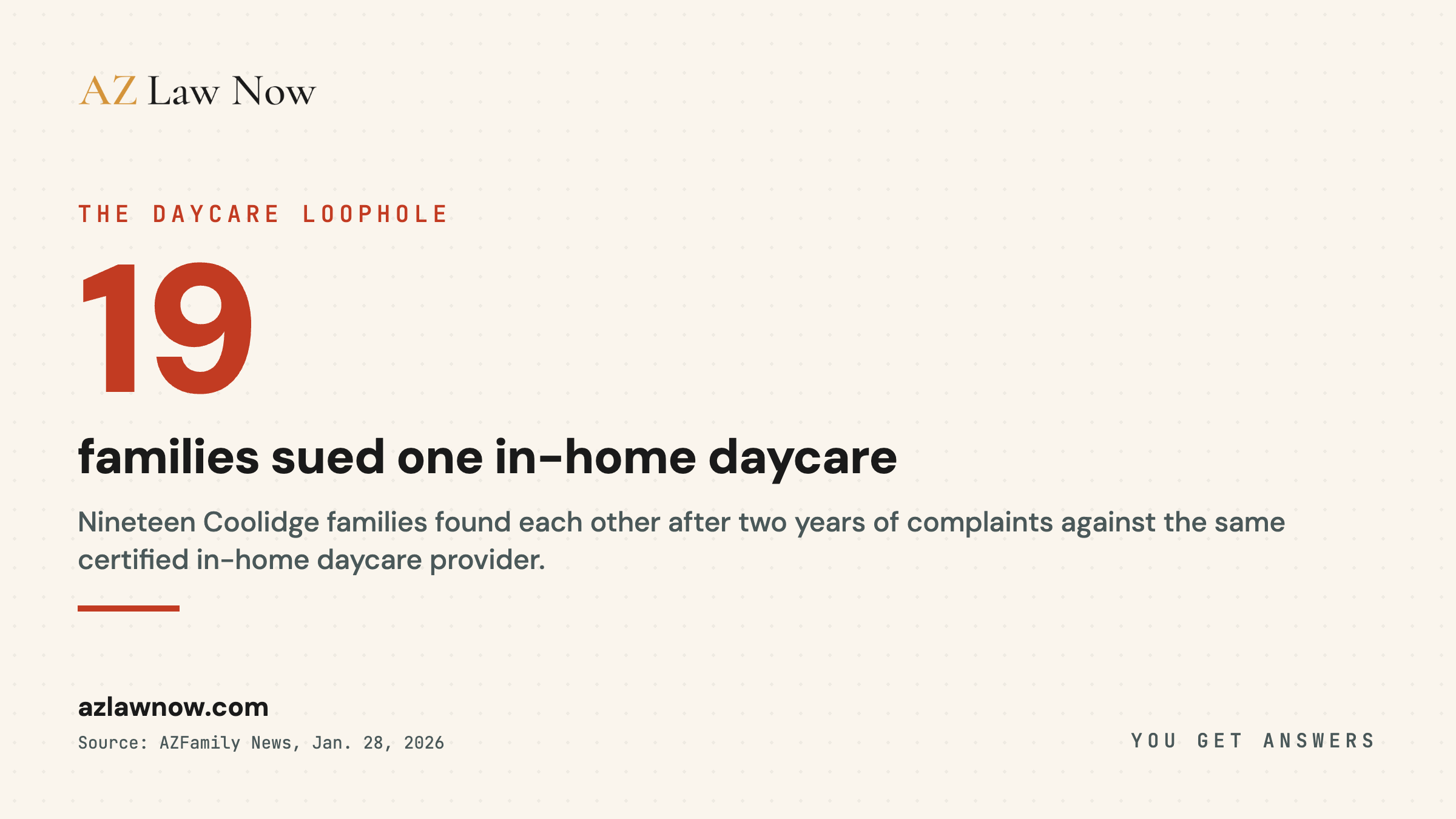
Nineteen families in Coolidge trusted the same in-home daycare provider with their kids. They’re now co-plaintiffs in a civil suit alleging neglect, emotional abuse, and conduct that one mother said left her son screaming every time she mentioned going back.
Two years of complaints. One police report. Zero criminal charges at the time the lawsuit went public.
What the Families Alleged
The allegations center on a provider operating out of a private home in Coolidge, a town of roughly 14,000 in Pinal County about an hour south of Phoenix. Over what families described as a two-year stretch, children reportedly came home with behavioral regression, anxiety, and fear tied to specific incidents at the daycare.
Families told AZFamily that allegations include threats to lock children in a “dark room,” general threatening behavior, emotional distress, and persistent neglect.
Three mothers gave on-record interviews.
She was affordable, said she only watched a handful of kids. She had a playroom, and we decided to trust her with it.
I can’t imagine someone doing that to a child, but he always screams.
Her life should be affected the way ours was and is every single day.
None of the allegations have been proven. The civil case is ongoing.
What the Case Says About Oversight
This is where the story gets bigger than one provider.
Arizona regulates two categories of childcare. Licensed centers, the places with a parking lot and a director and a dozen staff, are inspected at least once a year.
Certified group homes, the in-home operations like the one at the center of this lawsuit, are inspected at least twice a year, and routine and complaint visits are unannounced. So the gap here isn’t that no one inspects in-home providers.
The gap is visibility. Most of the enforcement record only reaches a parent who goes looking for it, and most never do. A provider’s history lives on Arizona’s CareCheck system, which we walked through in detail for West Valley daycares.
The same pattern holds here: the record exists, but it’s reactive, and easy to miss until a complaint forces it into view.
Most parents don’t know AZ CareCheck exists.
The Complaint That Didn’t Become a Case
One mother filed a report with the Coolidge Police Department. As of late January, prosecutors had not filed criminal charges. Civil cases and criminal cases run on separate tracks in Arizona, and neither depends on the other moving first.
Civil liability attaches when a plaintiff can show by a preponderance of evidence that a provider’s conduct fell below the standard of care and caused harm. The criminal standard is higher.
A prosecutor has to prove beyond a reasonable doubt that the provider’s conduct met the elements of a specific criminal statute, like ARS 13-3620 reporting failures or ARS 13-3623 child abuse.
The civil track is often where accountability gets enforced first. Especially when a provider’s conduct falls in the murky zone between “bad judgment” and “criminal.”
Why This Case Matters
Nineteen families. Kids too young to speak for themselves. Allegations that wouldn’t have surfaced if the families hadn’t found each other and compared notes.
It’s also a reminder of how accountability often works in these cases. When the criminal system isn’t moving, the civil track is frequently where families get a forum to be heard.
What Pinal County Parents Can Do Right Now
If you’re a parent in Coolidge, Florence, Casa Grande, or anywhere else in Pinal County where an in-home daycare is part of your routine, here are the three things worth doing before the end of the week.
Check the provider on AZ CareCheck. Search by the operator’s name and the address. Read every inspection finding, not just the most recent one.
File a public records request with Arizona DHS for the full inspection file if CareCheck shows anything concerning or if the provider is relatively new. The online database can lag behind the actual inspections, so the file may not show the most recent findings.
Talk to your kid. Not a formal interview. A normal conversation about their day. Behavioral regression, new fears around specific places, or sudden refusal to go to daycare are the signals that show up first, usually long before a complaint gets filed.
If something feels wrong, file a complaint with Arizona DHS. Anonymously if needed.
Nineteen families in Coolidge spent two years wondering whether what they were seeing was real. Eventually they found each other.
The civil case is now on the record.
Related Coverage
For the legal and process context, see Ron DeBrigida’s guide to Arizona daycare negligence law, Stephanie Ramirez’s how to vet arizona daycare, the daycare negligence practice overview.
Frequently asked questions
What's a certified group home in Arizona?
How are in-home daycares inspected differently than centers?
How do I check a Coolidge or Pinal County daycare's record?
What's the statute of limitations for a daycare negligence claim in Arizona?
Can parents report a daycare to Arizona DHS if they suspect abuse or neglect?
What is an example of daycare negligence?
What constitutes child neglect in Arizona?
How much can you sue a daycare for?
Sources & references
- AZFamily News. (2026, January 28). Families file lawsuit against Coolidge day care provider over alleged abuse. Retrieved April 15, 2026, from https://www.azfamily.com/2026/01/28/families-file-lawsuit-against-coolidge-day-care-provider-over-alleged-abuse
- Arizona Department of Health Services. (2026). AZ CareCheck: Search Licensed Facilities. Retrieved April 15, 2026, from https://azcarecheck.azdhs.gov/s/
- Arizona Department of Health Services. (2026). Childcare Facility Complaints. Retrieved April 15, 2026, from https://facility-licensing.azdhs.gov/s/childcare-facility-complaints
- Arizona State Legislature. (2025). ARS 36-883: Standards of Care; Rules; Classifications. Retrieved from https://www.azleg.gov/ars/36/00883.htm
- Arizona State Legislature. (2025). ARS 12-542: Limitation of Actions. Retrieved from https://www.azleg.gov/ars/12/00542.htm