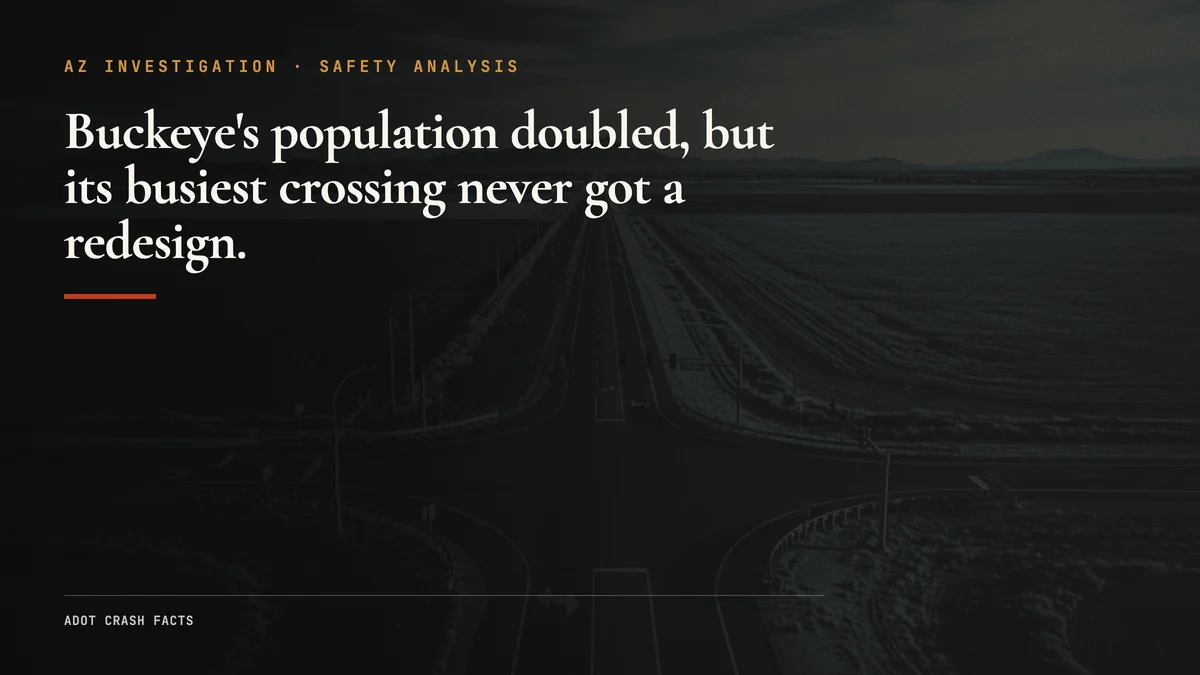
If you live in Buckeye, you’ve driven through Watson and Yuma hundreds of times. It’s where you turn off I-10 to get home. It’s where the grocery run happens.
It’s also, based on the intersection’s geometry and the city’s growth trajectory, one of the more predictable problem spots in a city that’s been building faster than its traffic infrastructure can keep pace with.
Here’s what’s actually happening there.
What the Intersection Is Doing
Watson Road is Buckeye’s main commercial artery running north from I-10. Grocery, retail, pad-site restaurants, auto shops. It’s where most of the city does business during the week. The north side is dense residential. The south side is the I-10 interchange.
Yuma Road is the east-west connector. It’s the route toward Goodyear, Avondale, and the rest of the West Valley. It also carries delivery traffic feeding the commercial corridor.
When those two arteries meet at a single signal, you get every traffic category at once. Commuters racing the light to make I-10. Shoppers turning left into retail parking lots. Delivery trucks queuing to make the turn toward the distribution centers on the south side. Parents picking up from the schools on the north.
Teenagers walking the crosswalks to the shopping center.
One signal, five use cases, at rush hour.
Why Crashes Happen There
The crash types at Watson and Yuma follow a pattern, and the pattern is structural.
Recurring Crash Patterns
Unprotected left turns
The left-turn phase for northbound and southbound Watson isn’t fully protected. Drivers trying to turn left across oncoming traffic misjudge the gap, and the result is a T-bone. Side-impact crashes are the worst category for injury severity. Without a structural barrier between your torso and the oncoming vehicle, the forces transfer straight to your body.
Rear-end queue crashes
The eastbound and westbound Yuma queues get long during peak hours. Drivers approaching from behind aren’t expecting the back of the queue to be where it’s, especially at night or during summer heat when visibility off asphalt glare gets degraded. Rear-end at 40 mph into a stopped vehicle is still a serious crash.
Pedestrian crosswalk incidents
The shopping center entrances sit close to the intersection. Pedestrians coming out of retail try to cross to the residential side. Signal timing is calibrated for vehicles, not pedestrians. Right-turn-on-red drivers looking left for traffic miss the pedestrian stepping off the curb from the right.
None of this is a mystery. It’s what happens when a signal designed for a smaller town gets loaded with a city’s worth of traffic.
What Could Actually Help
Other Arizona cities have retrofit intersections that match this profile with standard countermeasures.
Protected left-turn phases. Dedicated arrows in both directions on Watson. Removes the judgment call from the driver. The tradeoff is longer cycle times, which means more rear-end risk if queue management isn’t handled.
Leading pedestrian intervals. Gives walkers a 3-to-7-second head start before vehicle green. The crosswalk in front of the shopping center is an obvious candidate.
Signal coordination with the I-10 interchange. Watson Road signals south of Yuma need to be timed with the on/off ramps. When they’re not, drivers back up into the interchange or sprint to make gaps.
None of this is exotic engineering. It’s routine for growing cities. Buckeye’s Engineering Division is aware of the corridor. The question is budgeting and prioritization, not capability.
For the broader context on West Valley intersection design, my earlier analysis covered the structural patterns that appear across Buckeye, Goodyear, and Avondale. Watson and Yuma is one of the clearer examples.
What to Do If You Were Hit There
The basics apply. Call 911. Get medical evaluation even if you feel fine at the scene. Adrenaline hides injury. Photograph everything: vehicle positions, signal state, skid marks, the lane configuration.
Get witness contact info if anyone stopped. For an intersection this busy, there are always witnesses. Most won’t volunteer. A few will if you ask calmly.
Don’t discuss fault at the scene. Don’t give a recorded statement to the other driver’s insurance. The first 72 hours are when mistakes get made that cost cases later.
If there’s any possibility that signal timing, sight line obstruction, or city maintenance was a factor, preserve that evidence fast. Pull city traffic logs through a public records request. Signal timing and maintenance history are public.
The Notice of Claim deadline against a public entity is 180 days from the crash, which is shorter than most people realize.
The Bigger Point
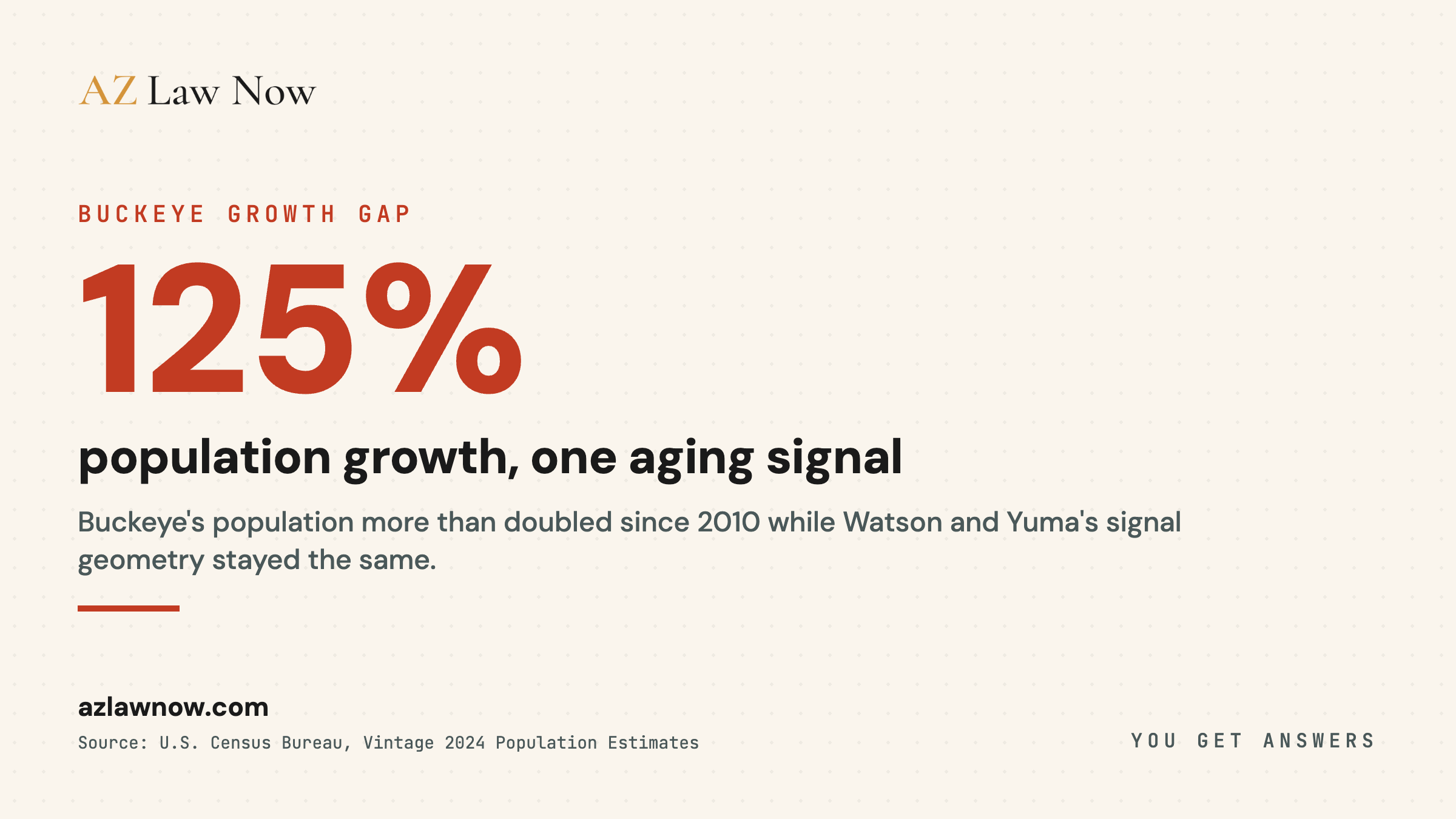
Buckeye is one of the fastest-growing cities in Arizona. The intersections that worked when the population was roughly 51,000 (2010 Census) don’t automatically scale to more than 114,000 (2024 Census estimate). Watson and Yuma is the textbook version of that gap.
The engineering fixes exist. The question is whether they get prioritized before the crash count does the advocacy for them.
Related Coverage
For the legal and process context, see Ron DeBrigida’s guide to Arizona car crash law, Stephanie Ramirez’s pedestrian crash action plan, the pedestrian crashes practice overview.
If you were hurt at Watson and Yuma, our Buckeye car crash lawyer page covers Buckeye crash cases and what we investigate.
Frequently asked questions
Where is Watson Road and Yuma Road in Buckeye?
What types of crashes happen most often at Watson & Yuma?
Who's responsible for fixing traffic safety at Watson & Yuma?
Can I sue the city for a crash at a dangerous intersection?
What's the statute of limitations for a car crash claim in Buckeye?
What is the hardest injury to prove?
Is it worth getting an attorney for a car accident in Arizona?
What not to tell your insurance company?
What percent of hit-and-run cases are solved?
Sources & references
- Arizona Department of Transportation. (2025). 2024 Arizona Motor Vehicle Crash Facts. Retrieved April 15, 2026, from https://azdot.gov/sites/default/files/2025-07/2024-Crash-Facts.pdf
- City of Buckeye. (2025). Engineering and Traffic Division. Retrieved April 15, 2026, from https://www.buckeyeaz.gov/departments/engineering
- Arizona State Legislature. (2025). ARS 12-820.02: Qualified Immunity. Retrieved from https://www.azleg.gov/ars/12/00820-02.htm
- Arizona State Legislature. (2025). ARS 12-821.01: Notice of Claim. Retrieved from https://www.azleg.gov/ars/12/00821-01.htm
- U.S. Census Bureau. (2025). Vintage 2024 Population Estimates, Buckeye city, Arizona. Retrieved June 8, 2026, from https://www.census.gov/programs-surveys/popest.html