
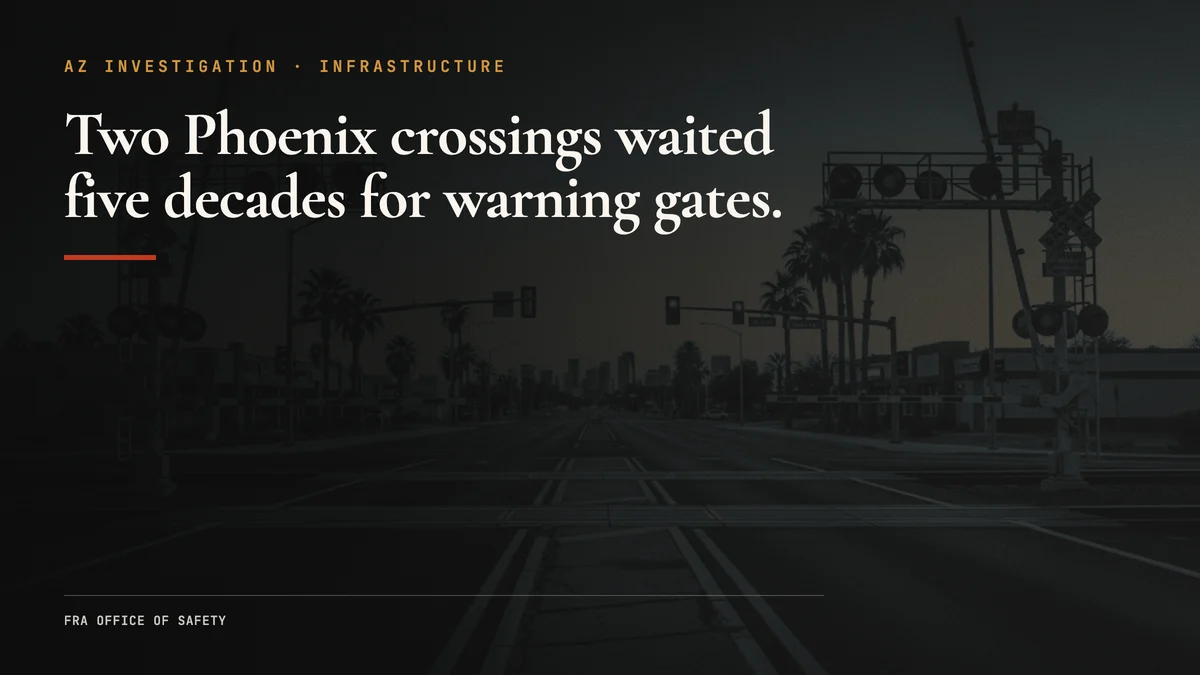
The corner where these crossings sit falls inside what 25 years of federal crash data show is Arizona’s deadliest patch for pedestrians: 53 people killed walking since 2000, on and around the same streets these tracks cut through.
A Nevada visitor named Sonja Celius lost both legs at the 27th Avenue grade crossing in west Phoenix on April 25, 2026. Her family says she’s expected to survive. The investigation into how she got onto the tracks is ongoing.
This piece is about the structural record her case sits on top of.
The crossing where she was struck has a number. DOT crossing 025430G. The one fifty feet north of it has another. DOT crossing 025617C, Thomas Road.
Both are on a single BNSF main, the Phoenix Subdivision, MP 189.580 to 189.615. The Federal Railroad Administration has been keeping records on both of them since the inventory began.
Most of those records are accident reports.
What the FRA Record Says About These Two Crossings
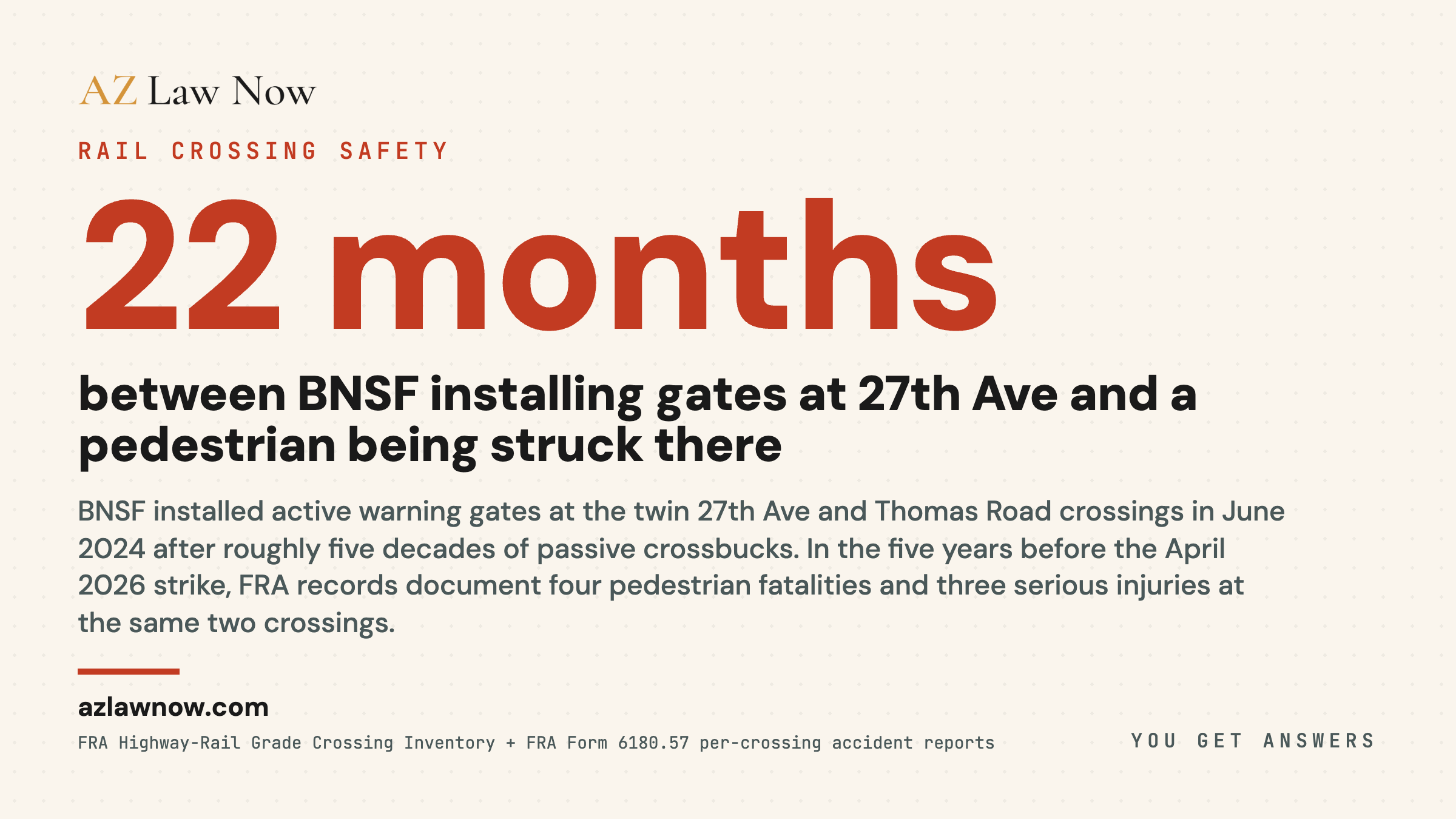
For most of their FRA inventory history, both 27th Avenue and Thomas Road carried passive crossbucks. Just the wooden X. No gates, no flashing lights, no bells. Approximately 50 years of inventory. BNSF’s own Form 6180.57 narratives at both crossings, when accidents happened, uniformly logged the equipment status as HGX NOT EQUIPPED WITH GATES.
In June 2024, BNSF installed active warning gates at both crossings.
22 months later, Sonja Celius was struck at 27th Avenue.
The combined Form 6180.57 record across both crossings runs to roughly 70 reportable accidents since the late 1970s. The pedestrian incidents in the five years before Sonja’s strike are documented in the order they happened:
- March 20, 2021. A 57-year-old woman, fatal pedestrian strike, Thomas Road.
- February 17, 2022. A pedestrian who stepped off the median, fatal.
- November 4, 2022. A wheelchair user, injured.
- October 1, 2023. A fatal pedestrian strike at 27th Avenue.
- October 12, 2023. An injured pedestrian.
- November 25, 2023. An injured pedestrian.
- June 2024. BNSF installs active warning gates at both crossings.
- April 25, 2026. Sonja Celius is struck at 27th Avenue. Both legs amputated.
Four pedestrians died at these two crossings in the three years before BNSF installed gates. Three more were injured, including a wheelchair user. The wheelchair-user incident is the single most direct evidence that the geometry at twin adjacent crossings is hostile to mobility-device users trying to navigate around a lowered gate arm.
Why Gates Aren’t Enough at Twin Adjacent Crossings
A standard active grade crossing has a gate, a flashing light, and a bell. When the train approaches, the gate comes down on the right side of the road. People driving cars stop. People walking, especially people walking with mobility devices or strollers or distracted attention, sometimes don’t.
The federal solution to that walk-around problem is documented in the FRA Quiet Zones rule (49 CFR Part 222) and the Manual on Uniform Traffic Control Devices Part 8. The fix isn’t just a gate.
The fix is one or more of the following: channelizing medians that physically prevent walking or driving around the gate arm, four-quadrant gates that close all four sides of the crossing, or supplementary safety measures like wayside horns and pedestrian gates.
These upgrades are what cities install when they want to qualify a crossing for quiet-zone status (silencing the train horn).
Neither 27th Avenue nor Thomas Road has channelizing medians. Neither has four-quadrant gates. Both still require train horns. WHISTBAN equals zero on the FRA inventory record for both. The June 2024 gate retrofit added the standard two-quadrant arm and that’s it.
Twin crossings 50 feet apart make the walk-around problem worse, not better. A pedestrian on the median strip between the two crossings has a gate arm down on each side, two trains potentially approaching from two directions, and no channelizing fence between them.
Active warning gates reduce the crash risk at a single crossing by requiring drivers and pedestrians to stop. Twin adjacent urban crossings 50 feet apart, on an arterial corridor with combined AADT above 70,000 vehicles and 12 trains per day, are a different problem.
A pedestrian on the median strip between both crossings faces a lowered gate arm on each side and no channelizing fence. The corridor has gates. It still needs channelizing medians, pedestrian-specific gates, and quiet-zone-grade compensating safety measures. The retrofit is incomplete.
What Mikayla’s Piece Set Up
AZ Family reporter Mikayla’s May 7 piece on Sonja Celius’s family was the news. It carried the human dimension and the police statement. It also pointed at the structural record:
The rail crossing where Celius was hit is no stranger to serious incidents and is listed by the city of Phoenix for safety improvements. Federal Railroad Administration crossing data and state rail-safety studies have flagged the corridor as high-risk.
That paragraph is AZ Family’s characterization of the corridor’s record. The FRA data is there. The City of Phoenix listing for safety improvements is referenced in the city’s communications.
The specific state rail-safety studies AZ Family cites have not been independently identified or retrieved for this investigation. The FRA crossing record and the Form 6180.57 accident reports are the primary sources here.
This piece pulled the data Mikayla pointed at. Two FRA crossing IDs. 22 months from gate retrofit to amputation. Seven documented pedestrian incidents in the five years before. A wheelchair-user incident the geometry helped cause.
What Comes Next
Three near-term reporting moves close gaps in this story.
The first is a public records request to the City of Phoenix Streets Transportation Department under ARS 39-121, citing FRA crossing IDs 025430G and 025617C and milepost 189.580 to 189.615.
It asks for the Capital Improvement Program line item that funded the June 2024 gate retrofit, the engineering basis for choosing two-quadrant gates over four-quadrant or channelizing-median upgrades, and the next planned safety improvement at the corridor.
The second is the FRA Region 7 record on whether BNSF or the City of Phoenix submitted any quiet-zone study or safety-analysis filing for this corridor. Quiet-zone studies are public.
The third is a request to BNSF Public Affairs (Lena Kent, Western region) for the railroad’s record on incidents at these two crossings post-June 2024 retrofit, including any preliminary report on April 25.
For people who use these crossings on foot or in mobility devices, the structural finding is straightforward. The gates went in. The geometry didn’t change. The corridor still needs channelizing medians, pedestrian gates, and a real quiet-zone-grade upgrade. The half-measure is what’s on the ground.
This investigation was built from the Federal Railroad Administration Highway-Rail Grade Crossing Inventory, the FRA Office of Safety Analysis per-crossing accident query for DOT IDs 025430G and 025617C, and the federal Quiet Zones rule (49 CFR Part 222) with Manual on Uniform Traffic Control Devices Part 8.
It also draws on AZ Family’s May 7 reporting by Mikayla on Sonja Celius’s family, and ARS 12-821.01 governing public-entity claims in Arizona.
If you have the City of Phoenix CIP record on the June 2024 gate retrofit, BNSF correspondence on the corridor, FRA Region 7 quiet-zone filings, or independent witness accounts of the April 25 incident, contact AZ Law Now.
We report from primary sources. Person-first framing throughout: Sonja Celius is a Nevada visitor and mother of three who was struck on April 25, 2026.
Related Coverage
For the legal and process context, see Ron DeBrigida’s guide to Arizona car crash law, Stephanie Ramirez’s car crash first 48 hours, and the car crashes practice overview.
Frequently asked questions
What happened at 27th Avenue and Thomas Road on April 25, 2026?
What is the FRA record for these crossings?
When did BNSF install gates at these crossings?
What pedestrian incidents happened at these crossings before Sonja Celius?
Are these crossings in a quiet zone?
What's the City of Phoenix planning for this corridor?
What should families do if a loved one is struck at a grade crossing?
Can you sue a railroad if you're hit by a train at a grade crossing?
Sources & references
- Federal Railroad Administration. Highway-Rail Grade Crossing Inventory, DOT crossing 025430G (27th Avenue, Phoenix). Retrieved May 8, 2026, from https://safetydata.fra.dot.gov/officeofsafety/publicsite/crossing/crossing.aspx
- Federal Railroad Administration. Highway-Rail Grade Crossing Inventory, DOT crossing 025617C (Thomas Road, Phoenix). Retrieved May 8, 2026, from https://safetydata.fra.dot.gov/officeofsafety/publicsite/crossing/crossing.aspx
- Federal Railroad Administration. Office of Safety Analysis, per-crossing accident reports for 025430G and 025617C. Retrieved May 8, 2026, from https://safetydata.fra.dot.gov/officeofsafety/publicsite/crossing/crossing.aspx
- AZ Family. (2026, May 7). Woman loses both legs after being struck by train in west Phoenix. Mikayla, KTVK/KPHO. Retrieved from https://www.azfamily.com/2026/05/07/woman-loses-both-legs-after-being-struck-by-train-west-phoenix/
- AZ Family. (2026, April 25). Major intersection partially closed after crash involving train in Phoenix. Retrieved from https://www.azfamily.com/2026/04/25/major-intersection-partially-closed-after-crash-involving-train-phoenix/
- Federal Railroad Administration. Quiet Zones rule and inventory, 49 CFR Part 222. Retrieved from https://railroads.dot.gov/railroad-safety/divisions/crossing-safety-and-trespass-prevention/train-horn-rulequiet-zones
- Arizona Revised Statutes 12-821.01. Authorization of claim against public entity, public school or public employee. Retrieved from https://www.azleg.gov/ars/12/00821-01.htm
- Federal Highway Administration. Manual on Uniform Traffic Control Devices Part 8 (railroad and light rail transit grade crossings). Retrieved from https://mutcd.fhwa.dot.gov/pdfs/11th_Edition/part8.pdf
- Operation Lifesaver Arizona. State coordinator program. Retrieved from https://oli.org/site/az