Arizona Bus Accident Lawyers
Arizona attorneys who know the 180-day government claim deadline and hold districts accountable. Contingency representation.
Free, no obligation. Available 24/7. No fee unless we win.
- $3.07M+ Recovered for Arizona families
- 5.0 ★ 93 verified Google reviews
- No Fee Unless we win your case
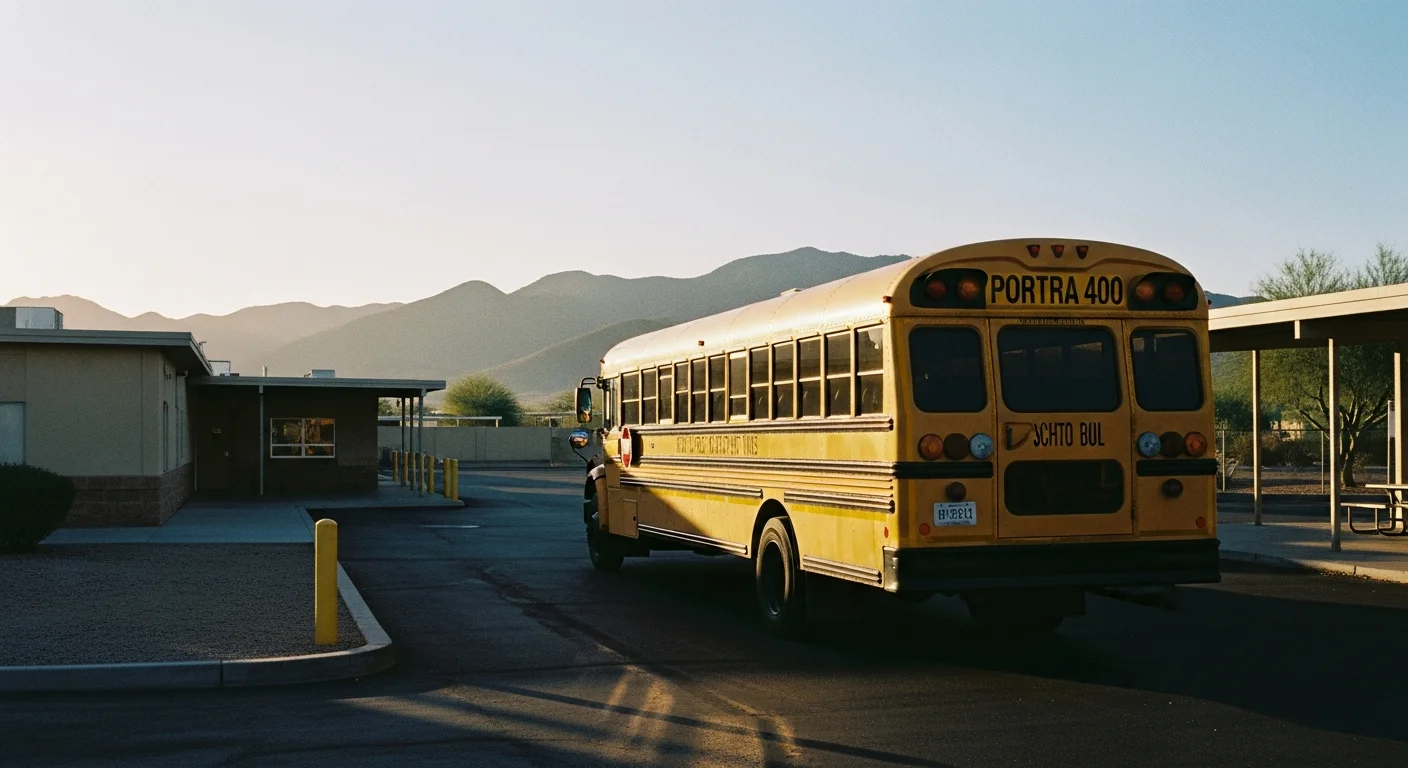
A five-year-old autistic, non-verbal boy was left on a school bus for six hours. No one noticed. No one checked the bus after the route ended. No one counted heads. His mother contacted 22 law firms before Brendan Franks took the case. AZ Law Now recovered $800,000 from Hartford Insurance based entirely on emotional trauma. No physical injuries.
That case captures what makes bus accident claims different. The injuries can be invisible. The defendants are government entities. The deadlines are compressed. And the legal framework adds layers of complexity that standard car crash claims don’t involve.
The 180-Day Deadline That Kills Cases
School districts are public entities. So are city transit agencies. Under ARS 12-821.01, anyone bringing a claim against a public entity must file a notice of claim within 180 days of the incident. Not six months. Not “about” six months. Exactly 180 days.
The notice must contain two things. First, facts sufficient to permit the public entity to understand the basis for the claim. Second, a specific settlement amount supported by facts. Vague language doesn’t work. Round numbers without supporting documentation don’t work.
Arizona courts enforce this requirement with zero flexibility. Actual notice of the incident doesn’t substitute for a formal notice of claim. Substantial compliance doesn’t count. If the notice is late, incomplete, or served on the wrong person, the claim is barred.
Under ARS 12-821.01, claims against school districts and public transit agencies require a formal notice of claim within 180 days. The notice must include specific facts and a specific dollar amount. Arizona courts require strict compliance. Missing this deadline or filing an incomplete notice permanently bars the claim.
After the notice is filed, the public entity has 60 days to respond with a written denial. If it doesn’t respond, the claim is deemed denied. The statute of limitations for filing suit is one year from the date of the incident under ARS 12-821, not the standard two years that applies to private party claims.
Government Immunity: What It Blocks and What It Doesn’t
Arizona’s immunity framework under ARS 12-820 et seq. creates several layers of protection for public entities. Understanding which layer applies determines whether a claim survives.
ARS 12-820.01 provides absolute immunity for judicial, legislative, and fundamental governmental policy decisions. If a school board decides to cut the transportation budget, that policy decision is immune from suit.
ARS 12-820.02 provides qualified immunity for discretionary functions. This is the category most bus accident claims fall into. Discretionary immunity protects decisions that require judgment and deliberation. But it doesn’t apply when the employee intended harm or was grossly negligent.
The distinction between policy decisions and operational decisions matters. In Warrington v. Tempe Elementary School District No. 3 (1996), the Arizona Court of Appeals held that bus stop placement is an operational decision, not a policy decision. Operational negligence doesn’t qualify for absolute immunity. This means decisions about where to place bus stops, how to supervise loading zones, and how to manage bus routes can all be challenged.
ARS 12-820.04 prohibits punitive damages against public entities and their employees acting within the scope of employment. This is a hard limit. Regardless of how reckless the conduct was, punitive damages aren’t available against school districts or transit agencies.
Arizona’s Standard of Care for Bus Operators
Many states hold common carriers, including bus companies, to the “highest degree of care.” Arizona doesn’t. In Nunez v. Professional Transit Management of Tucson, Inc. (2012), the Arizona Supreme Court abolished that heightened standard. Bus operators in Arizona owe the same ordinary reasonable care that everyone else owes.
That doesn’t mean the standard is low. What constitutes reasonable care depends on the circumstances. A school bus carrying 40 children creates a fundamentally different standard than a delivery truck. The age and vulnerability of the passengers, the predictability of hazards on the route, and the training provided to drivers all factor into what a jury would consider reasonable.
When a bus company or school district falls below that standard, and a child is injured as a result, the negligence claim is viable.
School Bus Seat Belts: A Gap in Arizona Law
Arizona doesn’t require seat belts on school buses. Under ARS 28-909, vehicles designed for 10 or more passengers are exempt from the state’s seat belt law. Only eight states currently require them: California, Florida, Texas, New York, New Jersey, Louisiana, Arkansas, and Nevada.
The Federal School Bus Safety Act of 2025 (S.828 / H.R.1828) is pending in Congress. It would require three-point seat belts on all school buses with a gross vehicle weight rating over 10,000 pounds. The bill hasn’t passed.
The absence of seat belts means children are thrown around the interior of the bus during crashes, colliding with seats, windows, and each other. The NHTSA design standard relies on “compartmentalization” (padded, high-backed seats) as the safety mechanism instead of restraints. Whether compartmentalization provides adequate protection in rollover or high-speed crashes is debatable.
Recent Arizona Bus Crashes
The data isn’t abstract. These crashes happened in the communities we serve.
In April 2025, a Kingman Unified School District bus was hit on I-10 near Marana. 21 students and four adults were transported to Banner Medical Center. 15 went to Tucson Medical Center. One person’s hand was amputated. The driver who caused the crash, Nicolas Luis Rodriguez, faces three felony aggravated assault charges.
In January 2026, two school buses crashed near 87th Avenue and Cactus Road in Peoria. Seven people were hospitalized: five students and two adults.
Nationally, the NHTSA reports 971 fatal school-bus-related crashes over the 2014 to 2023 period, killing 1,079 people. In 2023 alone, 128 people died in school bus crashes, a 23% increase over 2022. Most deaths (71%) occur in other vehicles. 16% are pedestrians, typically children in loading zones. Only 6% are bus passengers.
Types of Bus Accident Claims
Bus crash cases in Arizona generally fall into several categories.
Driver negligence is the most familiar category: speeding, distracted driving, failure to yield, running signals. The same negligence theories that apply to any motor vehicle crash apply to bus drivers, full stop.
Supervision failures are the category unique to school and youth transport: children left on buses, injuries during boarding or exiting, incidents at unsupervised bus stops. The $800,000 AZ Law Now settlement involved a supervision failure where no one checked the bus after the route.
Maintenance failures cover brake failures, tire blowouts, and mechanical defects. Bus operators have a duty to maintain vehicles in safe operating condition under both federal motor carrier rules and Arizona’s negligence standards.
Comparative Negligence in Bus Crashes
Arizona’s pure comparative negligence system under ARS 12-2505 applies to bus crashes. If multiple parties share fault, the damages are apportioned by percentage. A bus driver who was speeding and a car driver who ran a red light might share fault 40/60 or 30/70.
For passenger claims, comparative negligence rarely reduces the award. Passengers on a bus have no control over either vehicle. Their fault percentage is typically zero unless they were doing something that contributed to their own injuries, like standing in the aisle when the bus was moving.
What to Do After a Bus Crash
Get medical attention for every person involved, even those who seem uninjured. Children don’t always report pain. Soft tissue injuries and concussions can take hours or days to present symptoms.
Document the scene. Photograph the vehicles, the road, and any visible injuries. Get the names of witnesses and responding officers. If a school district is involved, request the incident report in writing.
Don’t sign any releases or give recorded statements to insurance companies without an attorney. Government entities and their insurers are sophisticated. They know the immunity framework and will use it to minimize or deny the claim.
Contact an attorney immediately. The 180-day notice of claim deadline starts running on the day of the crash. Every day of delay is a day you can’t get back.
Families whose child was injured in an Arizona bus crash can reach AZ Law Now at (602) 654-0202. The government claim process under ARS 12-821.01 runs on a 180-day notice deadline, and immunity exceptions require early documentation. Intake is confidential. Representation is on contingency.
Recent Investigation
See our arizona school bus seat belts investigation for the data behind the pattern.
Frequently asked questions
How long do I have to file a bus accident claim against a school district?
Are school buses required to have seat belts in Arizona?
Can I sue a school district for a bus accident?
What damages are available in a school bus accident case?
What if my child was emotionally traumatized but not physically hurt?
Do I need a lawyer for a bus accident claim?
What is the standard of care for bus companies in Arizona?
What if a third party caused the bus accident?
How do I file a notice of claim against a public entity?
Sources & references
- Arizona Revised Statutes § 12-821.01: Claims Against Public Entities; Notice; Limitations https://www.azleg.gov/ars/12/00821-01.htm
- Arizona Revised Statutes § 12-820 through 12-820.04: Public Entity and Employee Immunity https://www.azleg.gov/ars/12/00820.htm
- Nunez v. Professional Transit Management of Tucson, Inc., 229 Ariz. 117 (2012) https://law.justia.com/cases/arizona/supreme-court/2012/cv-11-0186-pr.html
- Warrington v. Tempe Elementary School Dist. No. 3, 187 Ariz. 249 (1996) https://law.justia.com/cases/arizona/court-of-appeals-division-one/1996/1-ca-cv-95-0299-2.html
- National Highway Traffic Safety Administration. (2024). Traffic Safety Facts: School-Transportation-Related Crashes (2014-2023) https://crashstats.nhtsa.dot.gov/Api/Public/ViewPublication/813731.pdf
- Federal School Bus Safety Act of 2025, S.828 / H.R.1828, 119th Congress https://www.congress.gov/bill/119th-congress/senate-bill/828/text
- InBuckeye.com. (2026, January 5). Report: Family Settles for $800,000 After Autistic Boy, 5, Left on School Bus https://inbuckeye.com/community/report-family-settles-for-800000-after-autistic-boy-5-left-on-school-bus/