
Sixteen thousand one hundred thirty-six. That’s how many hit-and-run crashes happened in Arizona in 2024. One in every eight crashes. Forty-four per day.
Eighty-six people died.
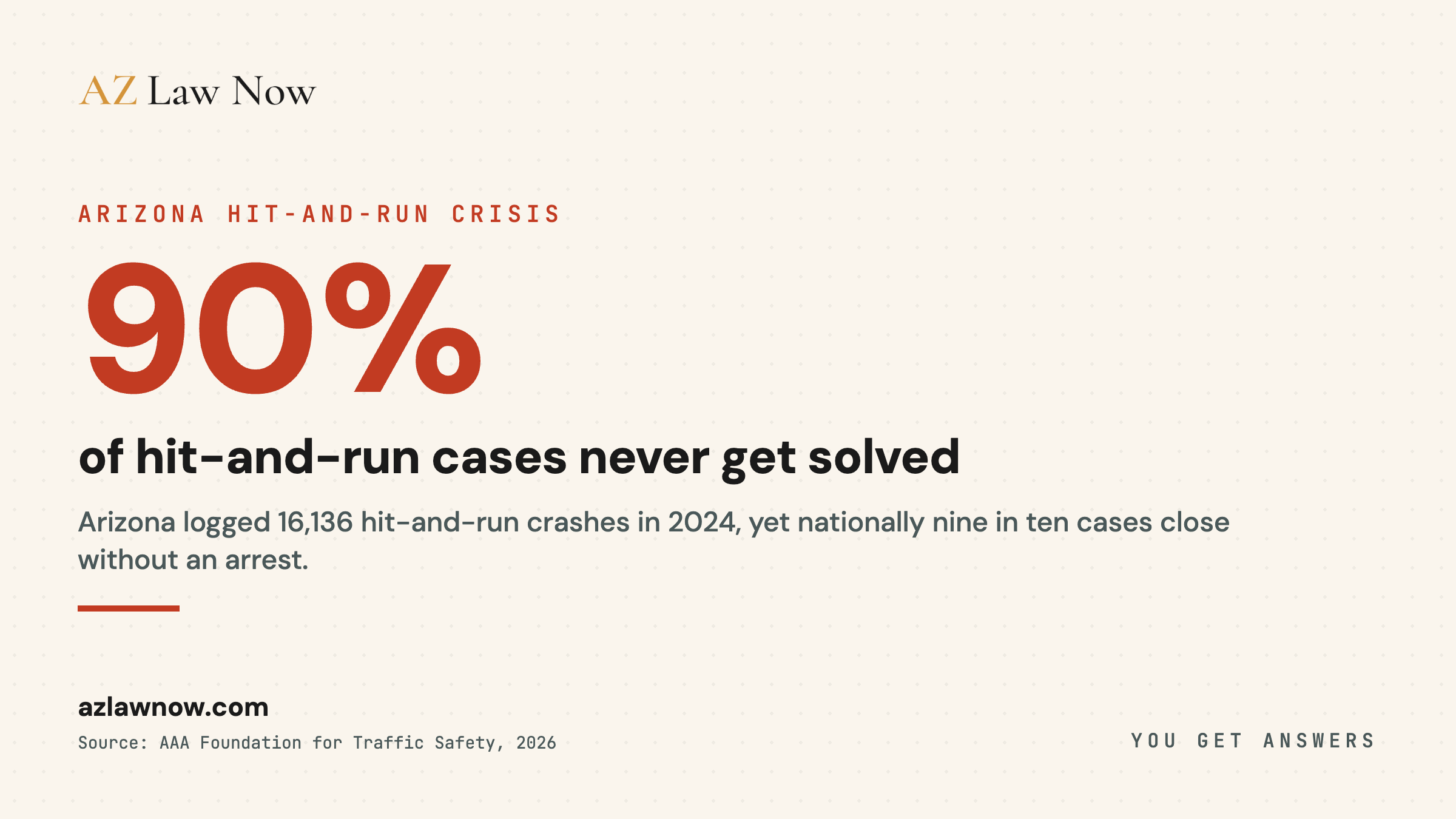
I keep coming back to the solve rate. Nationally, roughly 90% of hit-and-run cases are never solved. The AAA Foundation found that even in fatal hit-and-runs, 53% of drivers were never apprehended. More than half of the drivers who killed someone and fled were never identified.
That means the 86 people killed in Arizona hit-and-runs in 2024 represent families where, statistically, about 45 will never know who did it. No arrest. No trial. No accountability.
The Numbers Are Getting Worse
The AAA Foundation for Traffic Safety published a landmark study in March 2026 tracking hit-and-run trends from 2017 through 2023. The national picture is grim.
Over 900,000 hit-and-run crashes in the US in 2023. That’s 15% of all police-reported crashes. The highest percentage ever recorded. In 2017, the rate was 12.2%. By 2023, it jumped to 15%. More drivers are fleeing.
Hit-and-run fatalities hit a record 2,972 in 2022 and stayed at 2,872 in 2023. Seven percent of all traffic deaths in America now involve a driver who fled the scene.
Arizona’s ADOT data tells the same story at the state level. In 2024, hit-and-runs accounted for 13.3% of all crashes statewide. Between 2017 and 2023, the rate averaged about 7.5%. It’s nearly doubled.
The 2024 breakdown: 84 fatal hit-and-run crashes killing 86 people. 3,321 injury crashes hurting 4,202 people. And 12,731 property-damage-only crashes where someone drove away and left the other driver staring at a damaged car and no information.
Maricopa County: Ground Zero
Maricopa County accounts for 72.74% of all crashes in Arizona. If the hit-and-run distribution follows the overall pattern, that’s roughly 11,700 hit-and-runs in Maricopa County alone in 2024.
Phoenix is the epicenter. The city’s 2023 Traffic Collision Summary counted 3,610 hit-and-run crashes out of 23,318 total collisions. That’s 15.5%. The rate is higher than the state average because hit-and-runs concentrate in urban areas where there are more intersections, more pedestrians, and more opportunities to disappear into traffic.
The AAA Foundation’s data confirms the pattern nationally. In cities with populations over 500,000, hit-and-runs account for 16.4% of all traffic fatalities. In those same cities, 32.6% of pedestrian fatalities involve a driver who fled. Nearly one in three.
Move to suburban areas and the rate drops to 7.7%. Rural areas: 2.2%. This is an urban problem, and Maricopa County is the fourth-largest county in the country.
Nationally, one in four pedestrians killed in traffic in 2023 was struck by a driver who fled the scene. In Maricopa County, 158 pedestrians were killed in 2024. If the national ratio holds, roughly 40 of those involved a driver who didn’t stop. The pedestrian was left on the road.
Who Flees and Why
The AAA Foundation’s 2026 study is the most comprehensive look at hit-and-run driver demographics ever published. They analyzed FARS data for all fatal hit-and-runs where the driver was eventually identified, roughly 47% of cases.
The profile: 78.3% male. 71.4% between 18 and 44 years old. Seventy percent crashed within 10 miles of home. Eighty-five percent within 25 miles.
But the two most telling numbers: 40% of identified hit-and-run drivers in fatal crashes had no valid license. Suspended, revoked, or never licensed. And nearly three in five were driving a vehicle not registered in their name.
Those numbers explain the decision to flee. A driver with a suspended license knows that any police contact means arrest. A driver in a borrowed or unregistered vehicle knows the trail is harder to follow. Add alcohol, and the calculation tips further.
Research published in the Journal of Studies on Alcohol found that identified hit-and-run motorists are “far more likely to have had a previous arrest for driving while intoxicated.” A separate study found that lower BAC limits were associated with higher rates of hit-and-run fatalities.
The interpretation: impaired drivers flee specifically to avoid DUI detection. The penalty for fleeing, if caught later and sober, may be less severe than the penalty for staying at the scene with a 0.15 BAC.
ADOT’s 2024 data reinforces the connection. Arizona had 5,520 alcohol-related crashes last year. 347 people died. 71.5% of those crashes happened at night. The overlap between impaired driving, nighttime conditions, and hit-and-run behavior is nearly complete.
The Solve Rate Problem
This is where the system breaks down.
Nationally, roughly 10% of hit-and-run cases are solved. LAPD reported an 8% solve rate. Even in fatal hit-and-runs, where police devote more resources, 53% of drivers are never identified.
The reasons are structural. Hit-and-runs typically happen fast. At night. On arterials with limited surveillance. Witnesses may see a car drive away but can’t read a license plate at 45 mph in the dark. By the time police respond, the vehicle is gone.
Property-damage-only hit-and-runs are the lowest priority for investigation. If nobody was hurt and the only evidence is paint transfer on a bumper, the case sits in a queue that rarely moves. Even injury cases struggle. A pedestrian hit at 5 a.m. on a dark arterial may have no witnesses at all.
The cases that get solved typically involve one of three things: surveillance camera footage from a nearby business, a distinctive vehicle that’s identified through community tips, or a driver who returns to the scene or confesses.
Consider the case of Leandro Antonio, 43, hit and killed crossing Dunlap Avenue near 16th Avenue in Phoenix in January 2025. Over a year later, no arrest. The only evidence: a damaged front bumper found at the scene. His family is still looking for answers.
Or Jacob Wren, 19, arrested in October 2024 for a fatal hit-and-run that happened in July. Two months between the crash and the arrest. Pedro Luis Leyva Cobas, 51, was dead the entire time Wren was free.
What the Crashes Look Like
The cases that make the news in Maricopa County follow a pattern.
January 2025. Dunlap Avenue near 16th Avenue, Phoenix
Leandro Antonio, 43, hit while crossing the street. No arrest after more than a year. Only evidence: a damaged bumper at the scene.
October 2025. 43rd Avenue and McDowell Road, West Phoenix
Michelle Guzman-Garcia, 24, hit and killed Miguel Alteres, 32, at 5:43 a.m. Witnesses saw her get out of the Jeep Cherokee, look at the scene, get back in, and drive away. Arrested the next day.
November 2025. 35th and Grand Avenues, West Phoenix
A man killed just after 5 a.m. Police searching for the driver. Early morning. Dark. West side arterial.
April 2025. McKellips and Scottsdale Roads, Tempe
A pedestrian killed at 11:30 p.m. The vehicle fled. Scottsdale PD located it and chased the driver on foot. All occupants arrested.
The pattern: dark conditions, arterial roads, pedestrians, early morning or late night. The same profile that shows up in the ADOT pedestrian crash data. The same roads I wrote about in the pedestrian deaths piece.
The difference is that in a hit-and-run, the driver is gone. The pedestrian is on the road, and nobody is there to call 911 except a passing driver who may or may not have seen what happened.
A police lieutenant’s son, Jacob Moore, 20, struck and killed Lisa Mancuso, 43, while she was jogging near 7th Avenue and Cloud Street in New River at 10 a.m. in February 2024. He didn’t stop.
He was sentenced in June 2025 to four years in prison and three years probation. Under ARS 28-661, a fatal hit-and-run where the driver caused the crash is a Class 2 felony carrying 3 to 12.5 years. Four years for killing a jogger and driving away.
Arizona’s Hit-and-Run Laws
Arizona treats hit-and-run crashes on a sliding scale based on severity. The statute that controls is ARS 28-661, and Maricopa County Superior Court handles the felony cases.
Under ARS 28-663, drivers are required to provide name, address, and vehicle registration after any crash, and to render reasonable assistance to injured people. Failure to render assistance is a Class 6 felony.
The sentences run consecutively to any other charges from the same crash. If the driver was also DUI, the hit-and-run time stacks on top of the impaired driving sentence. Courts must order alcohol and drug screening if substance use was a contributing factor.
The Uninsured Motorist Problem
Here’s where hit-and-run crashes create a second layer of damage for families.
Roughly 11.9% of Arizona drivers are uninsured. That’s about one in eight vehicles on the road with no active auto insurance. Nationally, the rate is even higher at 15.4%.
When a hit-and-run driver is never found, your own insurance is the only path to compensation. Specifically, the uninsured motorist (UM) coverage on your own auto policy.
Arizona doesn’t require UM coverage. Insurers must offer it, and drivers can reject it in writing. Many do, to save on premiums. If you declined UM coverage and a hit-and-run driver injures you or kills a family member, there may be no source of compensation at all.
Even Arizona’s minimum liability policy, $25,000 per person and $50,000 per accident, is grossly insufficient for the kind of injuries hit-and-run crashes produce. A pedestrian struck at 45 mph on an arterial road faces potential traumatic brain injury, spinal cord damage, pelvic fractures, and internal bleeding.
Medical costs alone can exceed $25,000 in the first 48 hours.
If the hit-and-run driver is eventually found but was uninsured, the same UM/UIM coverage applies. Your own policy covers what the other driver can’t.
What You Can Do If You’re Hit
Arizona gives you two years under A.R.S. 12-542 to file a civil claim, but the window that actually decides your case is the first 72 hours. That’s when surveillance footage is still live, witnesses still remember details, and physical evidence at the scene hasn’t been swept clean.
Get medical attention immediately. Then document everything you can remember: the vehicle’s color, make, approximate model, direction of travel, and any partial plate information. Even a single digit or letter can narrow the search.
Look for cameras. Gas stations, convenience stores, ATMs, residential doorbell cameras, traffic cameras. Any business within line of sight of the crash may have footage. Footage gets overwritten on 30-day loops at most businesses and faster at some. Ask immediately. Don’t wait for police to canvass.
File a police report the same day. Even if you think the injuries are minor. The report creates a record that connects your injuries to the crash. Without it, your own insurance company will fight the UM claim.
If you were a pedestrian or cyclist, the injuries are almost certainly worse than you think at the scene. Adrenaline masks pain. Soft tissue injuries, concussions, and internal bleeding don’t always present immediately. An ER visit within 24 hours creates the medical record that anchors your case.
People injured in a hit-and-run in Maricopa County can reach AZ Law Now at (602) 654-0202 or through the contact form. An initial review investigates the scene, helps locate surveillance footage, and walks through UM/UIM insurance coverage under the client’s policy. Intake is confidential. Representation is on contingency.
Call an attorney before accepting any settlement from your own insurance company. UM claims are adversarial. Your insurer is paying the claim, which means their adjuster is trying to minimize the payout. The fact that the other driver fled doesn’t change the negotiation dynamic. It just shifts the fight from their insurer to yours.
The two-year statute of limitations under ARS 12-542 applies. For wrongful death claims under ARS 12-611, the clock starts on the date of death.
What I’m Watching
The AAA Foundation’s 2026 study recommended “Yellow Alerts,” similar to Amber Alerts, specifically for hit-and-run crashes. California, Colorado, and Maryland have already implemented versions. Arizona hasn’t.
The study also found that communities with “higher judicial effectiveness,” meaning faster case processing and higher conviction rates, see fewer hit-and-runs. The solve rate drives the behavior. Drivers are less likely to flee when they believe they’ll be caught.
In Maricopa County, with 11,700-plus estimated hit-and-runs per year and a solve rate around 10%, the math tells drivers that fleeing works. Until that calculation changes, the numbers won’t.
I’m tracking the Yellow Alert legislation and any changes to Arizona’s hit-and-run penalty structure. I’m also pulling intersection-level data from ADOT’s Crash Information System to map exactly where hit-and-runs concentrate in the West Valley.
Forty-four hit-and-runs per day. Somebody knows something. Most of the time, nobody talks.
Related Coverage
For the legal and process context, see Ron DeBrigida’s guide to Arizona hit and run law, Stephanie Ramirez’s hit and run victim guide, the car crashes practice overview.
Frequently asked questions
How many hit-and-run crashes happen in Arizona?
What percentage of hit-and-run cases are solved?
What are the penalties for hit-and-run in Arizona?
Why do drivers flee after a crash?
What should I do after a hit-and-run?
Does my insurance cover a hit-and-run if the driver is never found?
What not to tell your insurance company?
Sources & references
- Arizona Department of Transportation. (2025). 2024 Arizona Motor Vehicle Crash Facts. Retrieved from https://azdot.gov/sites/default/files/2025-07/2024-Crash-Facts.pdf
- AAA Foundation for Traffic Safety. (2026, March). Understanding the Increase in Fatal Hit-and-Run Crashes. Retrieved from https://newsroom.aaa.com/wp-content/uploads/2026/03/NO-STATE-DATA-202603-AAAFTS-Hit-and-Run-Crashes.pdf
- City of Phoenix. (2024). 2023 Traffic Collision Summary. Retrieved from https://www.phoenix.gov/content/dam/phoenix/streetssite/mediaassets/2023%20Citywide%20Summary%20-%20Final.pdf
- Arizona Revised Statutes § 28-661 through § 28-663. Retrieved from https://www.azleg.gov/ars/28/00661.htm
- Insurance Research Council. (2024). Uninsured Motorists Study. Retrieved from https://insurance-research.org/node/130
- AAA Foundation for Traffic Safety. (2018). Hit-and-Run Crashes: Prevalence, Contributing Factors, and Countermeasures. Retrieved from https://aaafoundation.org/research/hit-and-run-crashes-prevalence-contributing-factors-and-countermeasures/
- AAA Newsroom. (2026, March). Fatal Hit-and-Run Crashes Reach Record High, AAA Foundation Study Finds https://newsroom.aaa.com/2026/03/fatal-hit-and-run-crashes-reach-record-high-aaa-foundation-study-finds/
- Arizona Revised Statutes § 28-662: Accidents Involving Damage to Vehicle https://www.azleg.gov/ars/28/00662.htm
- ABC15 Arizona. (2026, March 12). Family of Phoenix Hit-and-Run Victim Looking for Answers https://www.abc15.com/news/crime/family-of-phoenix-hit-and-run-victim-looking-for-answers-more-than-a-year-after-his-death
- AZ Central. (2025, June 11). Phoenix Police Lieutenant's Son Sentenced After Fatal Hit-and-Run https://www.azcentral.com/story/news/local/arizona/2025/06/11/phoenix-police-lieutenants-son-sentenced-after-fatal-hit-and-run/84133263007/