
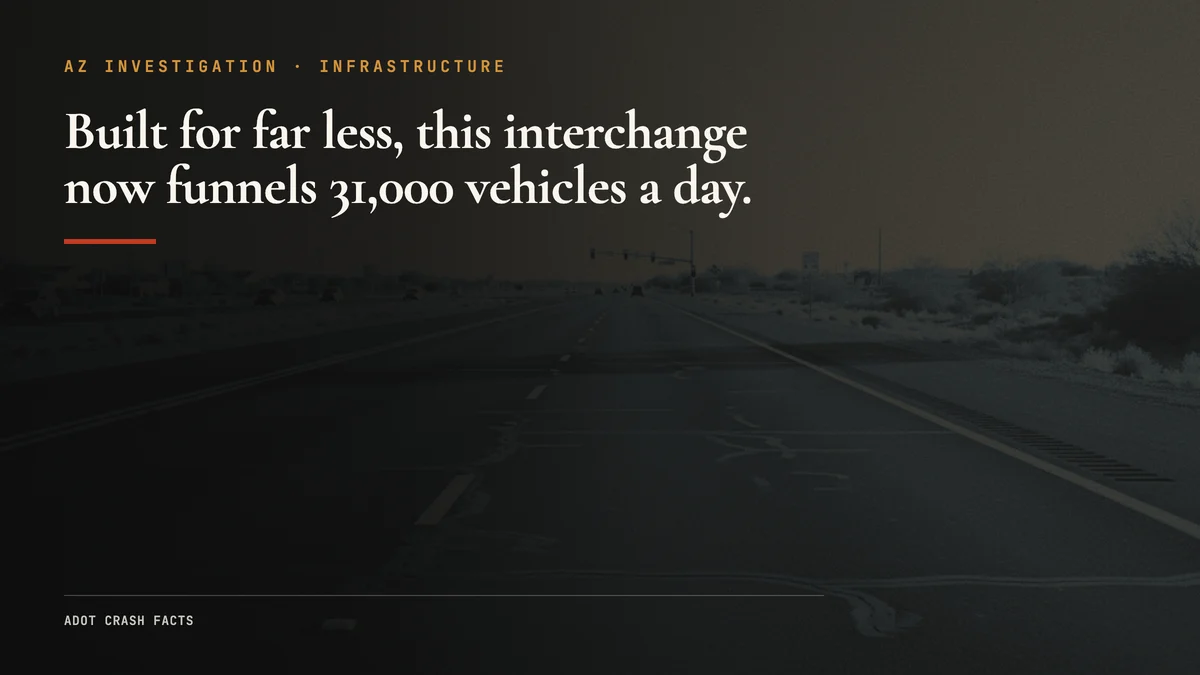
The SR-347 and I-10 interchange is the single piece of infrastructure that decides whether tens of thousands of Maricopa residents get to work on time.
It’s also where a disproportionate share of Pinal County’s serious crashes happen.
Two corridors meet at one merge. Both operate above design capacity during peak hours. The crash data is the predictable result.

The Geometry of the Problem
SR-347 is a two-lane divided highway for most of its run between Maricopa City and I-10, then expands modestly at the interchange approach. I-10 at this point is a full interstate carrying long-haul freight between Tucson, Phoenix, and the Southwest.
When SR-347 traffic hits the interchange, the lane patterns force quick decisions. Drivers heading to Phoenix need the eastbound I-10 on-ramp. Drivers from I-10 headed to Maricopa need the southbound SR-347 exit. Local traffic threads through both. Commercial trucks make wide turns that eat shoulder space.
The design works when traffic is light. It doesn’t work at rush hour.
The Speed Differential Problem
Here’s what most people don’t account for. Approaching the interchange from the north on SR-347, drivers are at or near the 65 mph posted speed. Once queue backup starts, traffic transitions from 65 to 10 within a few hundred feet. The driver three cars back doesn’t see the brake lights until the gap closes.
Rear-end at a speed differential of 40 mph is a major-injury crash. When a commercial truck is in the chain, it’s a multi-vehicle event.
This pattern shows up in the broader SR-347 corridor data. The interchange concentrates the problem.
The Truck Factor
Commercial traffic on SR-347 has been growing as distribution and logistics operations expand in Maricopa and Casa Grande. No published ADOT source provides a current truck-mix percentage for this corridor, but the growth in regional warehousing and freight activity is documented in ADOT’s project justification for the widening.
The interchange makes the truck problem worse for a reason that has nothing to do with the truckers. Heavy vehicles need longer stopping distances and more room to change lanes. The geometry at the interchange doesn’t give them that room during peak volumes.
A truck in the middle lane of a three-lane merge, trying to make an exit while cars cut across, creates a crash pattern that’s visible in ADOT’s category data.
Ghost-fleet and chameleon-carrier issues on I-10 compound the liability picture after a crash. If the truck that hit you is operating under a questionable MC authority or the insurance is layered through a freight broker, identifying the right defendant becomes a preservation-of-evidence issue.
The Structural Fix
ADOT’s $396M SR-347 Improvement Project adds one lane in each direction across 14 miles from I-10 to the Maricopa city limits, with grade-separated interchanges at Riggs Road and Mammoth Way. The engineering rationale for the fix isn’t controversial.
Four lanes divided with proper auxiliary lanes at the interchange would reduce the speed-differential problem, give commercial vehicles room to operate, and add capacity for bicycle and pedestrian facilities on the shoulders.
ADOT awarded the design-build contract to Sundt Construction in early 2026. Pavement rehabilitation started summer 2026. Widening and interchange construction is expected to begin winter 2026-2027, with full completion roughly 3.5 years from start.
The project took more than a decade of local advocacy from Maricopa city officials and regional partners to reach this point. Funding is split: the Pinal County segment (I-10 to Riggs Road) is programmed at $136.3M in FY27, partly through a $50M contribution from the City of Maricopa and Pinal County.
The Maricopa County segment (Riggs Road to the city limits) is programmed for FY31 through Proposition 479 and the MAG Freeway Lifecycle program.
What You Can Do
Defensive driving at the interchange is the first line. Leave extra following distance when SR-347 volumes are high. Watch for brake lights two or three cars ahead, not just the car in front of you. Don’t ride the left lane if you’re not passing.
Most of all, stay out of truck blind spots on the approach to the interchange.
If you can adjust your commute window, even 15 minutes off peak makes the interchange materially safer. The data supports it.
If you’re hit, the evidence window is short. Traffic camera data, truck ELD records, and witness accounts all fade fast. Call a lawyer within 24 to 48 hours if you’re injured. On commercial vehicle claims specifically, the defendant’s insurance representatives will be on the scene or calling you within hours.
Anything you say or sign without counsel can cost you the case.
The Bigger Point
Maricopa is growing faster than its only highway out of town can handle. The interchange is where that gap becomes measurable in crash reports. The $396M fix is now funded and under contract.
But construction on the full corridor and the I-10 interchange runs through roughly 2029-2030, which means Maricopa commuters will navigate the current configuration for several more years.
Until the widening is complete, the corridor demands attention from every driver using it.
Related Coverage
For the legal and process context, see Ron DeBrigida’s guide to Arizona car crash law, Stephanie Ramirez’s car crash first 48 hours, the car crashes practice overview.
If you were hurt at this interchange, our Maricopa car crash lawyer and Maricopa truck crash lawyer pages cover SR-347 cases and Pinal County venue.
Frequently asked questions
How many commuters use the SR-347 and I-10 interchange daily?
What's the most common crash type at the SR-347 and I-10 interchange?
Is ADOT planning to widen SR-347 or improve the I-10 interchange?
Are there alternate routes to get from Maricopa to the I-10?
What should I do if I'm in a crash at the interchange?
Who's responsible for safety on SR-347 and at the interchange?
How much of a $30K settlement will I get?
What is the hardest injury to prove?
What not to say to an injury lawyer?
Is it worth hiring an attorney after a car accident?
Sources & references
- Arizona Department of Transportation. (2026). SR 347 Improvement Project. Retrieved June 8, 2026, from https://azdot.gov/sr347
- Arizona Department of Transportation. (2026). SR-347 Corridor Widening, I-10 to City of Maricopa. Retrieved June 8, 2026, from https://azdot.gov/projects/central-district-projects/sr-347-corridor-widening-i-10-city-maricopa
- Arizona Department of Transportation. (2024). Average Annual Daily Traffic Report 2023, Arizona State Routes. Retrieved from https://azdot.gov/sites/default/files/2024-07/2023-AADT-PUBLICATION_StateRoutes.pdf
- Arizona Department of Transportation. (2025). 2024 Arizona Motor Vehicle Crash Facts. Retrieved from https://azdot.gov/sites/default/files/2025-07/2024-Crash-Facts.pdf
- Arizona State Legislature. (2025). ARS 12-821.01: Notice of Claim. Retrieved from https://www.azleg.gov/ars/12/00821-01.htm