
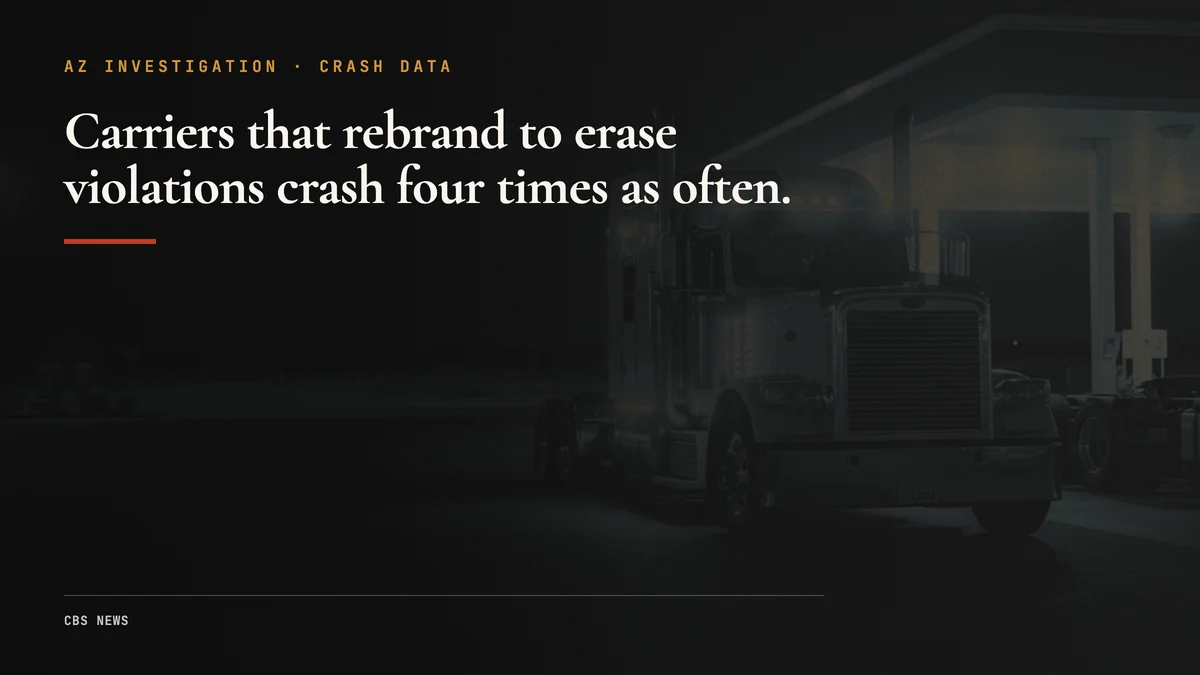
Last week, 60 Minutes aired an eight-month investigation into something most people have never heard of. Chameleon carriers. Trucking companies that rack up hundreds of safety violations, dissolve overnight, slap a new name and DOT number on the same trucks, and keep hauling freight like nothing happened.
I watched it twice. Then I looked at what Arizona’s own crash and enforcement records show.
Because I-10 runs right through my backyard. Right through Buckeye and Goodyear, past the warehouses in Avondale, through the Ehrenberg port of entry on the California border. It’s one of the heaviest freight corridors in the country.
And the enforcement infrastructure supposed to keep dangerous trucks off this road has holes you could drive a semi through.
What a Chameleon Carrier Actually Is
The concept is simple. A trucking company racks up safety violations. Bad brakes, overworked drivers, falsified logs, crashes. When the record gets bad enough to attract federal attention, the company dissolves. The owner registers a new company with a new name and a fresh DOT number. Same trucks. Same drivers. Same dangerous practices. Clean record.
Rob Carpenter, a trucking safety consultant who’s tracked chameleon carriers for 25 years, told 60 Minutes the math. There are 700,000 trucking companies operating in the US. His estimate is 10 to 20% operate “somewhere in that spectrum of chameleon carrier.”
That’s 70,000 to 140,000 companies.
Fusable, a risk assessment firm, put a number on the danger. Chameleon carriers are four times more likely to be involved in a crash. Not twice. Not three times. Four.
And the barrier to entry is almost nonexistent. As Carpenter explained: “$1,000, pay online, say you are who you say you are, and you’ve got a trucking company.” No requirement to be an American citizen. No requirement to own a truck. Twenty-one days from application to operating authority.
The Enforcement Gap
Here’s where the math breaks.
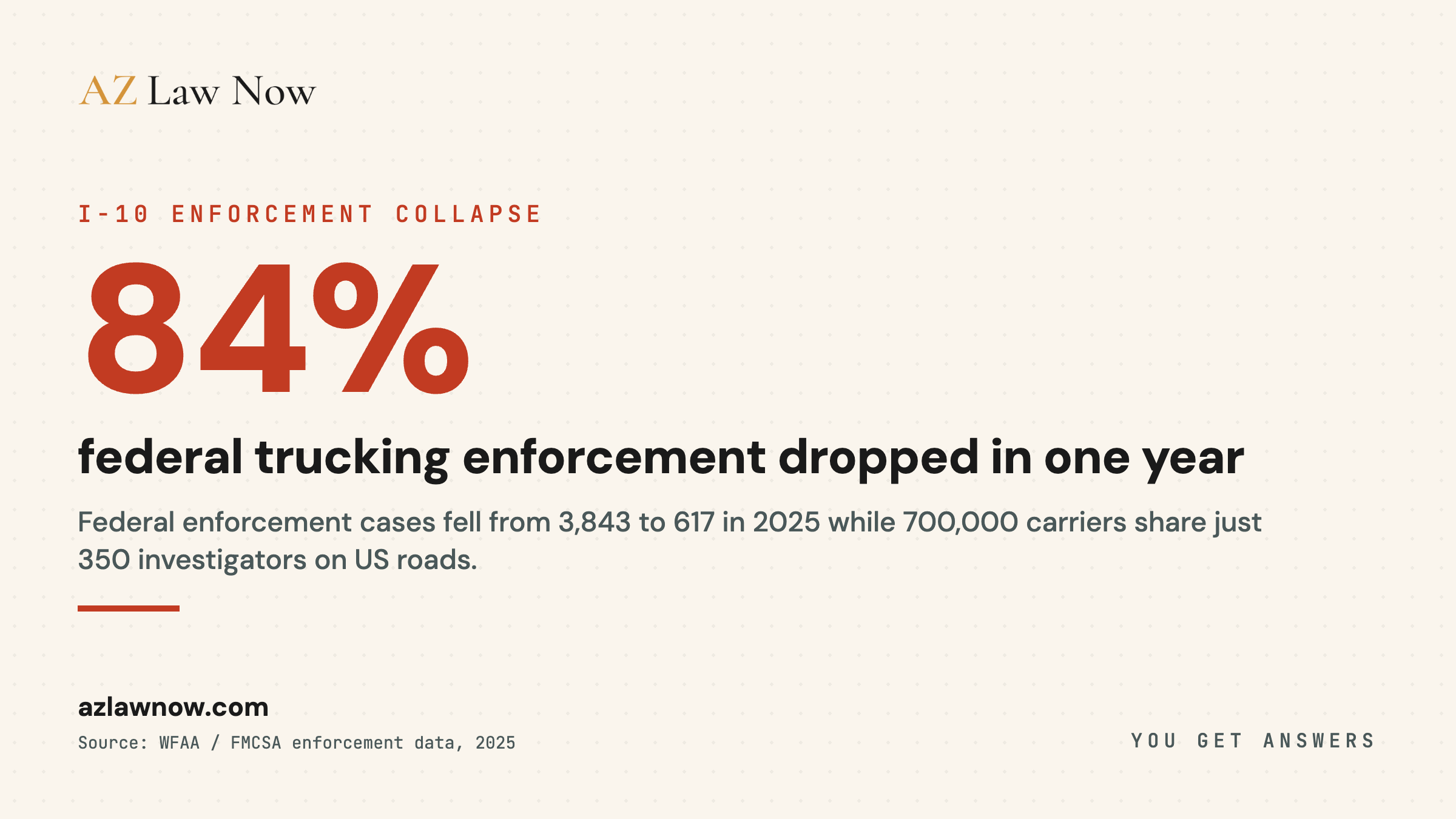
The Federal Motor Carrier Safety Administration has 350 investigators overseeing all 700,000 trucking companies on American roads. That’s one investigator for every 2,000 carriers. FMCSA Administrator Derek Barrs told 60 Minutes they’re trying to hire 40 more. The registration system they use to track carriers is 40 years old.
Nationally, FMCSA closed 617 enforcement cases in 2025. Down from 3,843 in 2024. An 84% drop in one year.
That means roughly 1 in 1,134 trucking companies faced any federal enforcement action in 2025. For context, your odds of getting audited by the IRS are better than a trucking company’s odds of getting investigated by FMCSA.
In Arizona, the numbers are just as thin. The state’s Commercial Vehicle Safety Partnership runs through DPS with 115 authorized positions. Only 87 are filled. Six personnel handle investigations and compliance reviews. Six people covering 594,538 registered commercial vehicles in Arizona.
ADOT runs the New Entrant Program with nine staff. That’s the program that’s supposed to vet new carriers before they hit the road. Nine people processing new DOT numbers for the entire state.
What I-10 Looks Like From the Cab
I-10 isn’t just a highway. It’s a supply chain. The corridor runs 2,400 miles from California to Florida across eight states. The Federal Highway Administration classifies it as a “Corridor of the Future.” Average daily truck traffic exceeds 8,000 vehicles, with peaks above 55,000 in urban segments.
By 2035, FHWA projects those numbers will more than double.
Arizona sits in the middle of it.
Everything moving between the ports of Los Angeles and Long Beach and the rest of the country comes through here. The West Valley has become one of the fastest-growing logistics hubs in the country. Walmart built a $152 million distribution facility. Amazon, FedEx, UPS all have major operations along I-10.
More than 25 million square feet of industrial space was under construction across Phoenix metro in 2024.
More warehouses. More trucks. More miles on I-10 through Buckeye and Goodyear.
And two ports of entry are supposed to screen what comes through.
The Ehrenberg Problem
Arizona’s I-10 port of entry at Ehrenberg sits at milepost 3.5, right at the California border. Every eastbound truck entering Arizona on I-10 passes this checkpoint.
It operates Tuesday through Friday. 6 a.m. to 4 p.m.
That’s it. Four days a week, ten hours a day. If you’re driving a truck with bad brakes, an expired DOT number, or a falsified logbook, you can cross into Arizona on I-10 any evening, any weekend, or any Monday without passing an inspection point.
The San Simon port on I-10 at the New Mexico border runs Monday through Friday, 7 a.m. to 5 p.m. Slightly better. Still closed nights and weekends.
In March 2026, Arizona DPS ran Operation Full House at the Ehrenberg port of entry. A two-day enforcement blitz. They inspected 254 commercial vehicles in 48 hours.
The results should make anyone who drives I-10 uncomfortable.
In 48 hours, DPS logged 925 total violations across those 254 vehicles. That’s 3.6 violations per truck. 51 drivers were placed out of service, meaning one in five drivers inspected was too dangerous to continue driving.
82 vehicles were placed out of service, which is nearly one in three trucks failing badly enough to be pulled off the road on the spot.
Brakes and defective lighting were the most common problems. The same mechanical failures that turn a truck from a heavy vehicle into an uncontrollable one.
An out-of-service order isn’t a warning. It means the vehicle or driver is so far out of compliance that they pose an imminent hazard.
The truck can’t move until repairs are made. The driver can’t drive until rest requirements are met. When 32% of inspected trucks fail at that level, it tells you what’s rolling past when nobody’s checking.
235,029 New DOT Numbers in One Year
The pandemic broke the carrier market open. In 2021, FMCSA issued 235,029 new carrier DOT numbers. That’s more than double the pre-pandemic pace. The total carrier count jumped from 1.67 million in December 2019 to over 2 million by March 2024. A 22.5% surge in four years.
Not all of those are chameleon operations. Many are legitimate owner-operators who entered the market when freight rates spiked. But the data shows a pattern. Of the carriers that entered the New Entrant Program in recent years, 42 to 58% of program exits were classified as inactive, no-show, or no contact.
Not because they passed a safety audit. Because they disappeared.
Only about 1% of new entrants ever get revoked through an actual safety audit.
The math is staggering. Hundreds of thousands of new carriers flooded the system during a period when FMCSA had fewer investigators than ever and was running a registration system built in the 1980s. The agency itself admits it has “a front door problem.”
The Super Ego Case Study
60 Minutes focused on Super Ego Holding, a network founded by Serbian entrepreneur Aleksandar Mimic. The operation spans more than two dozen US-based carriers with hubs in Elmhurst, Illinois, and Jacksonville, Florida. Their customers include Amazon, Walmart, Costco, and the United States Postal Service.
DOT data shows chameleon carriers connected to Super Ego logged nearly 15,000 safety violations and 500 crashes in two years.
Former drivers described a system designed to extract maximum revenue at maximum risk. Dispatchers in Serbia remotely reset electronic logging devices to give drivers fresh hours after they’d already hit the 11-hour legal limit. One driver told 60 Minutes he drove 18 hours straight.
When he tried to stop, the text from dispatch said “they’re not payin’ for you to do anything but use the restroom and drive.”
Drivers described being told to change DOT numbers and carrier names with duct tape. Print the new information, tape it over the old, and the truck becomes a clean carrier with no violation history.
A former Super Ego employee, interviewed in Europe with his identity concealed, confirmed that pay-skimming was competitive. Lists were posted inside the Belgrade office. The top dispatcher cut nearly $24,000 from drivers’ pay in a single period. Thirty-two percent of what the drivers earned. Weekly company profit from the scheme: $1 to $2 million.
More than 800 truckers are suing Super Ego for fraud and breach of contract.
What This Means for I-10
I don’t know how many Super Ego-affiliated trucks have driven through Buckeye and Goodyear. Nobody does. That’s the whole point of the chameleon model. The trail is designed to disappear.
But I know the conditions that make Arizona vulnerable.
I-10 is one of the highest-volume freight corridors in the country, and it passes through a state with 87 of 115 authorized enforcement positions filled. The primary entry point from California operates four days a week. The registration system that’s supposed to catch reincarnated carriers is being replaced this year because it’s 40 years old.
Federal enforcement cases dropped 84% in 2025.
Arizona’s 2024 crash data counted thousands of large trucks in crashes statewide, more than 3,200 truck-tractors with semitrailers alone. Maricopa County recorded 594 traffic fatalities that year.
We already know what happens when a dangerous truck hits I-10 at speed.
On January 12, 2023, Danny Glen Tiner was driving a commercial garbage truck on I-10 near Wildhorse Pass Boulevard at 68 miles per hour in a 55 mph construction zone. He was scrolling TikTok. He never saw the congested traffic ahead. His truck plowed into two passenger vehicles, wedging them into a second semi.
Five people died. The vehicles burst into flames.
Tiner’s employer, Mr. Bult’s Inc., had 26 crashes on record with DOT at the time. Tiner was sentenced to over 22 years in prison.
That crash involved a legitimate carrier with a known record. Imagine the carrier that already dissolved its previous identity twice.
What’s Changing (Slowly)
FMCSA announced new rules in February 2026 targeting chameleon carriers. The key changes: carriers must demonstrate safety knowledge before getting operating authority. They must maintain a physical location where records can be inspected within 48 hours. You can’t register 200 DOT numbers to a P.O. box anymore.
The new Motus registration system rolling out in 2026 is supposed to flag pattern indicators: same addresses, same registered agents, same principal officers showing up under different company names.
Congress introduced the SAFE Act (H.R. 7539) directing FMCSA to study chameleon carriers and build a detection system into the registration process. Both the American Trucking Associations and the Teamsters support it.
These are real steps. They’re also years late and underfunded. The 40 additional investigators FMCSA is trying to hire would bring the total to 390 for 700,000-plus carriers. That’s still one investigator per 1,795 companies.
What You Can Do If a Truck Hits You on I-10
Truck crash cases are different from car crashes in ways that matter immediately.
Trucking companies deploy rapid-response teams to crash scenes within hours. They’re preserving evidence for their defense before you’ve left the hospital. The driver’s electronic logging device data, the truck’s event data recorder, the carrier’s maintenance records, dispatch communications, these can all be overwritten or destroyed if nobody sends a preservation letter fast enough.
If the carrier is a chameleon operation, the complexity multiplies. You’re not suing one company. You’re trying to trace liability through a network of shell companies, leasing arrangements, and dissolved entities designed to scatter responsibility.
Arizona follows pure comparative negligence under ARS 12-2505. Your compensation gets reduced by your percentage of fault. Trucking defense attorneys are paid to shift fault onto you.
A lawyer who handles truck crashes on I-10 needs to move fast, send spoliation letters on day one, pull FMCSA carrier records, and subpoena the ELD data before it disappears.
Drivers and families hit by a truck on I-10 can reach AZ Law Now at (602) 654-0202 or through the contact form. An initial review pulls FMCSA carrier records, ADOT crash data, and ELD logs on every trucking case. Intake is confidential. Representation is on contingency.
If a loved one was killed, Arizona’s wrongful death statute (ARS 12-611) gives the surviving spouse, children, or parents the right to file a claim. The statute of limitations is two years. But in trucking cases, evidence starts disappearing in days, not months.
The sooner an attorney sends a preservation letter to the carrier, the better your case.
What I’m Watching
Arizona DPS holds roadside inspection data for I-10 between Ehrenberg and Phoenix. A public records request for the past three years of carrier names, DOT numbers, and violation types, cross-referenced with FMCSA’s SAFER system, would show how many of those carriers have been shut down and restarted under new numbers.
If the national estimate holds, 10 to 20% of carriers on I-10 through Arizona are operating somewhere in the chameleon spectrum. On a corridor with 8,000-plus trucks per day, that’s 800 to 1,600 trucks daily that may be running with erased safety records.
I’ll publish what the data shows when it comes back. In the meantime, drive I-10 knowing that the truck in the next lane might have a clean DOT number and a history you’ll never see.
Related Coverage
For the legal and process context, see Ron DeBrigida’s guide to Arizona truck crash law, Stephanie Ramirez’s truck crash action plan, the truck crashes practice overview.
Families and drivers hit by commercial trucks in the West Valley: the Buckeye truck accident lawyer page and Goodyear truck accident lawyer page cover the specific corridor patterns, FMCSA record pulls, and chameleon carrier tracing for I-10 crash cases in those cities.
Frequently asked questions
What is a chameleon carrier?
How common are chameleon carriers?
How many truck crashes happen in Arizona each year?
Why is I-10 through Arizona especially vulnerable?
What should I do if I'm hit by a truck on I-10?
What is FMCSA doing about chameleon carriers?
How much are most truck accident settlements?
What is the 8 70 rule?
How long does it take to settle a trucking accident case?
Is it better to settle or sue in an accident with a company vehicle?
Sources & references
- CBS News. (2026, April 12). How dangerous trucking schemes are putting Americans at risk: 60 Minutes transcript. Retrieved from https://www.cbsnews.com/news/how-dangerous-trucking-schemes-putting-americans-at-risk-60-minutes-transcript/
- Federal Motor Carrier Safety Administration. (2024). Motor Carrier Statistics Overview: 2024 Safety Research Forum. Retrieved from https://www.fmcsa.dot.gov/sites/fmcsa.dot.gov/files/2024-04/2024%20Safety%20Research%20Forum_Motor%20Carrier%20Stats%20Overview%20508.pdf
- National Highway Traffic Safety Administration. (2024). 2023 FARS Final Data: Large Trucks. Retrieved from https://crashstats.nhtsa.dot.gov/Api/Public/ViewPublication/813717.pdf
- Federal Motor Carrier Safety Administration. (2024). Arizona FY2024 Commercial Vehicle Safety Plan. Retrieved from https://www.fmcsa.dot.gov/sites/fmcsa.dot.gov/files/2024-11/Arizona%20FY2024%20Final%20CVSP.pdf
- Arizona Department of Transportation. (2025). 2024 Arizona Motor Vehicle Crash Facts. Retrieved from https://azdot.gov/sites/default/files/2025-07/2024-Crash-Facts.pdf
- Federal Highway Administration. (n.d.). I-10 Corridor Coalition Fact Sheet. Retrieved from https://www.fhwa.dot.gov/pressroom/fsi10.cfm
- WFAA. (2025). Federal trucking safety enforcement dropped 84% in 2025 https://www.wfaa.com/article/news/investigations/trucking-investigation/federal-trucking-safety-enforcement-dropped-84-in-2025/287-5c3d624c-5775-4556-a6f8-1397767e2320
- CDL Life. (2026). Over 900 violations uncovered during two-day commercial vehicle enforcement detail in Arizona https://cdllife.com/2026/over-900-violations-uncovered-during-two-day-commercial-vehicle-enforcement-detail-in-arizona/
- Trucking Dive. (2026). FMCSA chameleon carriers rulemaking: DOT number switching https://www.truckingdive.com/news/fmcsa-chamelon-carriers-rulemaking-dot-number-switching/812745/
- NBC News. (2024). Truck driver distracted by TikTok in Arizona crash that killed 5 sentenced to 22 years https://www.nbcnews.com/news/us-news/truck-driver-distracted-tiktok-arizona-crash-killed-5-sentenced-22-yea-rcna167370