
Every Arizonan has seen the headline. Wrong-way driver on I-17. Wrong-way crash on Loop 202. Two dead. Three dead. A family coming home from dinner meets an 80-mph head-on collision with someone going the wrong direction on a divided highway.
It keeps happening. Despite $4 million in thermal cameras. Despite larger signs, flashing lights, reflective pavement markers, and an automated detection system that ADOT calls first-in-the-nation.
In 2024, Arizona recorded 1,740 wrong-way driver incidents. That’s nearly five per day. Fifty-nine resulted in crashes. Fourteen people died.
The detection system works. The fatal crashes keep coming. Here’s why.
The Scale of the Problem
Most wrong-way incidents don’t end in a crash. A driver enters an off-ramp going the wrong direction, realizes the mistake, and turns around. Or the detection system catches them and triggers warnings. Or another driver calls 911.
But when a wrong-way driver doesn’t stop, the results are catastrophic.
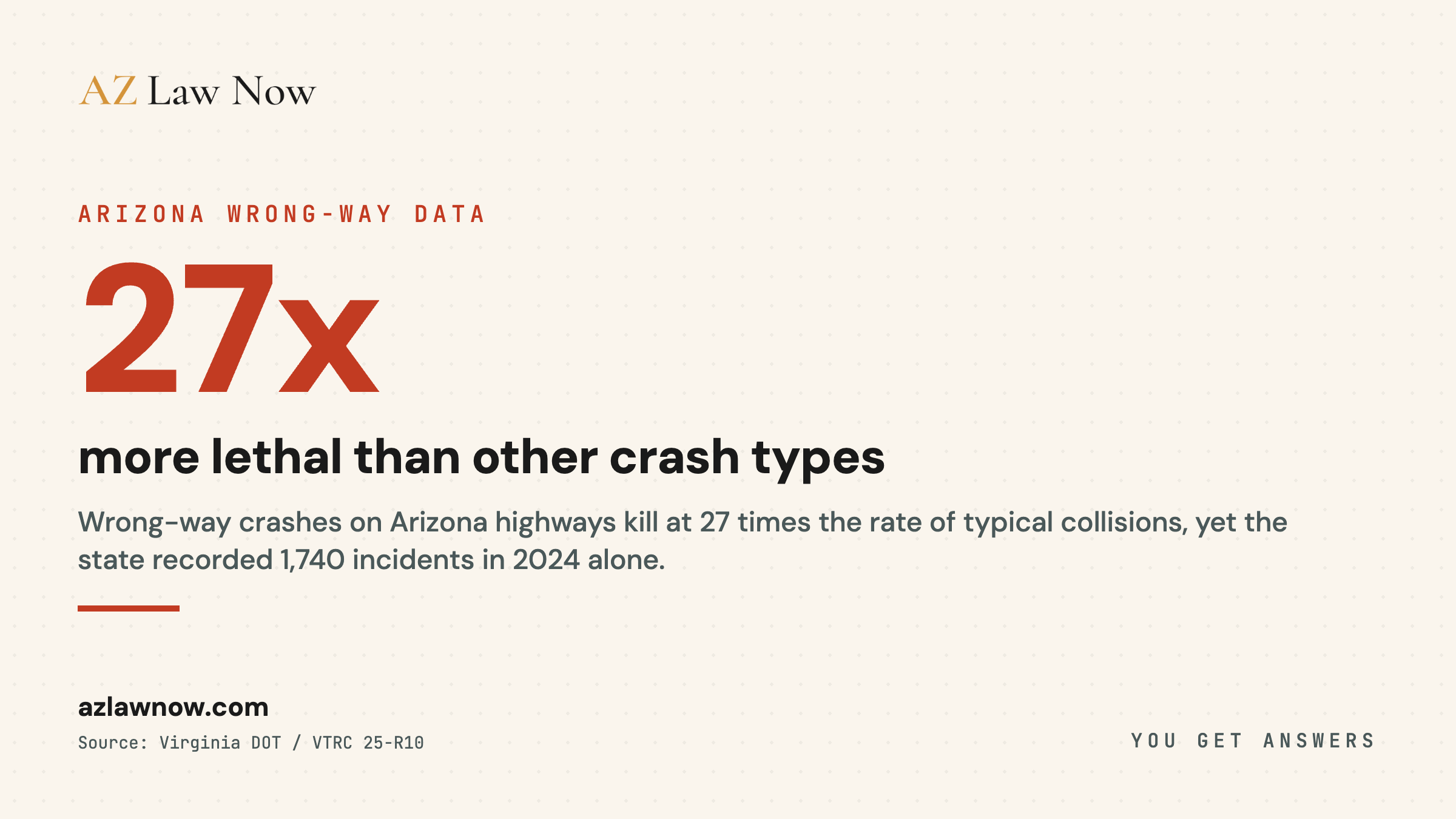
The FHWA found a 16.1% fatality rate for wrong-way crashes on limited-access freeways, compared to 0.6% for all other crashes. A Virginia DOT study put the gap even wider: wrong-way crashes are 27 times more lethal than other crash types.
By any of these measures, a wrong-way crash is dramatically more likely to kill than a typical highway collision.
The math is simple. Eighty-two percent of wrong-way crashes are head-on collisions. Two vehicles, each doing 60 to 70 mph, meet with a combined closing speed of 120 to 140 mph. At those speeds, crumple zones and airbags run out of physics.
Head-on collisions involve roughly four times the kinetic energy of a same-direction rear-end crash at the same speed. At a combined closing speed of 130 mph, the energy transfer is equivalent to driving into a concrete wall at 65 mph.
Fifty-one percent of wrong-way crashes are frontal impacts. The survival rate is among the lowest of any crash type.
Two-Thirds Are Drunk
This is a DUI problem wearing a highway safety disguise.
ADOT’s own data shows two out of three wrong-way crashes are caused by impaired drivers. And these aren’t borderline cases. Impaired wrong-way drivers often have blood alcohol levels more than twice the legal limit. BACs of 0.16 and higher.
The AAA Foundation studied nine years of national FARS data and found a dose-response relationship. The higher the BAC, the higher the odds of being the wrong-way driver.
At 0.08 or above, the legal limit, the odds are 18 times higher than a sober driver.
Seventy-five percent of wrong-way crashes happen between 6 p.m. and 6 a.m. One-third happen between midnight and 3 a.m. More than half occur on weekends. The time signature maps perfectly onto bar-closing patterns.
Law enforcement has made the same point repeatedly after fatal wrong-way crashes: this won’t stop until drivers stop getting behind the wheel impaired.
ADOT says it more diplomatically: “We can’t prevent someone from becoming a drunk driver.”
The detection system can alert. It can warn. It can’t sober someone up at 2 a.m. on an I-17 off-ramp.
The $4 Million Detection System
ADOT’s wrong-way vehicle detection system launched on I-17 in January 2018. First of its kind in the country. Ninety thermal cameras positioned on off-ramps and along a 15-mile stretch of I-17 between the I-10 Stack interchange and Loop 101. Cost: $3.7 million initially, closer to $4 million with expansions.
Here’s how it works. A thermal camera detects a vehicle heading the wrong direction on an off-ramp. Internally illuminated “Wrong Way” signs with flashing LED lights activate. The system simultaneously alerts ADOT’s Traffic Operations Center and DPS. Overhead message boards display warnings. Traffic cameras automatically turn toward the wrong-way vehicle for tracking.
Real-time alerts go out through the ADOT Alerts app.
The pilot data is striking. In 2018 and 2019, the system detected 109 wrong-way vehicle incursions. Eighty-eight percent of drivers self-corrected on the off-ramp before entering the freeway. The system provides more than a threefold increase in detections compared to relying on 911 calls alone.
In one documented case, the operations center was alerted four minutes before the first 911 call. Law enforcement stopped the driver six minutes after the system alert.
The detection works. The alerting works. The self-correction rate proves the signs and lights make a difference for drivers who are merely confused or distracted.
But on the corridor that has the technology, the collision count hasn’t dropped.
The Flat Line
AZFamily analyzed wrong-way collision data on I-17 from 2019 through 2023. The numbers stayed “fairly consistent.” Six collisions in 2019. Five in 2020. Four in 2021. Six in 2022. Three in 2023.
Statewide, the trend is more encouraging. DPS data shows total wrong-way incidents and deaths edging down over the same period. But on I-17, the stretch with the most detection coverage, the collision count has not fallen the way the self-correction numbers might suggest it should.
The detection system catches the confused drivers. The ones who entered the wrong ramp, see the flashing lights, and turn around. Eighty-eight percent of them. That’s a real safety improvement.
The drivers who don’t self-correct are overwhelmingly drunk. At 2 a.m. with a BAC of 0.20 or higher, flashing signs aren’t going to register. The system detects them, alerts authorities, and then everyone watches a car heading the wrong direction on a freeway at highway speed, hoping law enforcement can intercept before the head-on.
In the November 2024 I-17 fatality, Maria Delrefugio Vazquez of Glendale drove the wrong way on I-17 before crashing head-on. Two people died. The thermal cameras detected her. Overhead warnings triggered. But other motorists actually called 911 before the detection system’s alert reached DPS.
The system did exactly what it was built to do. It still wasn’t enough to stop what happened.
The Crashes That Made the News
Every wrong-way fatality in Arizona has a name attached to it. Here are some.
May 21, 2023. Loop 202 at 32nd Street
Allen Michael Johnson drove the wrong way on the South Mountain Freeway at 5 p.m. Not the typical late-night pattern. His BAC was 0.327. Four times the legal limit. He crashed into a car carrying a family. A 10-year-old boy died. A girl, a woman, and another woman in a separate car were injured.
Johnson told police he didn’t think he was impaired. He was booked on $1 million bond and charged with second-degree homicide.
August 14, 2022. I-10 near Vail
Andrea Crespin, 32, drove eastbound in westbound lanes. Her BAC was more than three times the legal limit. Her own two-year-old daughter was unrestrained in the front passenger seat. The child died at the scene. Crespin was sentenced to over 22 years in prison.
2022. Loop 303 near Bethany Home Road
Just before 4 a.m. in the West Valley. Fabian Javier Grimaldo, 21, drove a pickup truck the wrong way. Head-on with an SUV. Brian Vaughn, 61, of Surprise was killed. Grimaldo’s passenger, Joaquin Santiago Ruiz, 21, also died.
That stretch, from Camelback Road to Northern Avenue, carried 13 of Loop 303’s 40 crash deaths from 2015 to 2025. Our Loop 303 crash investigation has the numbers.
April 4, 2026. US 60 near Queen Valley
Edwin Orlando Martinez-Caudillo, 19, killed after driving the wrong way on eastbound US 60.
These aren’t statistics. They’re people who got in a car and drove into oncoming traffic. And people who were in the right lane, doing nothing wrong, who died because someone else was.
Where It Happens
I-10 is the highway with the most reported wrong-way drivers statewide. I-17 and Loop 202 follow.
ADOT has expanded detection technology beyond the original I-17 pilot. Current installations include Loop 101 Agua Fria interchanges at 59th, 67th, 75th, and Northern avenues. I-17 at 19th Avenue and Jomax Road. I-10 at 27th and 91st avenues. Multiple intersections along SR-347 between I-10 and Maricopa. Most Loop 202 South Mountain Freeway interchanges.
Loop 303 from I-10 through the West Valley to I-17 in north Phoenix. Loop 101 segments in Chandler and Scottsdale.
The newest expansion: a detection system on I-19 between Tucson and Nogales, ADOT’s first deployment in Southern Arizona.
While Maricopa County has the most crashes overall, wrong-way fatalities are disproportionately rural. Of 187 drivers involved in wrong-way fatalities from 2010 to 2020, 102 died outside the Phoenix and Tucson metro areas. Rural highways lack detection systems, have higher speed limits, and longer response times.
What Other States Are Doing Better
Florida’s FDOT runs the most aggressive wrong-way driving program in the country. They’ve installed LED-illuminated “Wrong Way” signs at more than 520 off-ramps statewide. Their program claims to prevent over 95% of potential wrong-way crashes. The LED signs alone reduced wrong-way events by 48 to 69% at equipped locations.
Arizona has 90 thermal cameras on one stretch of I-17 and expanding coverage elsewhere. Florida has illuminated signs at 520-plus off-ramps. The scale is different.
Connecticut, Massachusetts, Ohio, and Washington all enacted new wrong-way driving legislation in 2023 with detection systems, awareness campaigns, and highway design changes.
Arizona’s technology is more sophisticated than most states’. Thermal cameras, automated alerts, camera re-pointing. But the coverage footprint is still growing. And the fundamental problem isn’t detection. It’s that two-thirds of wrong-way drivers are too impaired to respond to any warning system.
What You Can Do If a Wrong-Way Driver Hits You
Wrong-way crashes produce some of the most severe injuries in traffic law. Head-on impacts at highway speed cause traumatic brain injuries, spinal cord damage, internal organ injuries, and crush injuries that require multiple surgeries and years of rehabilitation.
Arizona is a pure comparative negligence state under ARS 12-2505. In a wrong-way crash, the wrong-way driver typically bears the overwhelming majority of fault. But insurance companies for the wrong-way driver will still try to reduce their exposure.
If the wrong-way driver was impaired, there may be additional liability. Arizona’s dram shop law holds bars and restaurants liable if they serve a visibly intoxicated person who then causes a crash. If the wrong-way driver came from a bar, the establishment may share liability.
If they came from a private party, social host liability may apply.
If the wrong-way driver died in the crash, the claim goes against their estate and their insurance policy. In Arizona, the minimum liability policy is $25,000 per person and $50,000 per accident. For a catastrophic wrong-way crash, that’s often insufficient. Your own uninsured/underinsured motorist coverage becomes critical.
The two-year statute of limitations under ARS 12-542 applies. For wrongful death claims under ARS 12-611, the deadline is two years from the date of death.
Drivers and families hit by a wrong-way driver on any Arizona highway can reach AZ Law Now at (602) 654-0202 or through the contact form.
An initial review handles wrong-way crash claims across Maricopa County and looks at dram shop liability under ARS 4-311 along with any available insurance coverage. Intake is confidential. Representation is on contingency.
What I’m Watching
ADOT’s detection expansion to Loop 303, I-10, and I-19 is adding coverage, but the rural corridors where wrong-way fatalities are disproportionately high remain largely unprotected. I-40 and I-10 west of Phoenix don’t have detection systems.
The core question is whether Arizona will shift resources from detection to prevention. Florida’s 95% prevention rate comes from sign-level intervention at every off-ramp, not from sophisticated camera systems that detect but can’t stop.
Arizona’s technology is impressive engineering. But the fatal crashes keep happening because the drivers causing them are too impaired to respond to any alert.
Until the DUI enforcement piece catches up to the detection technology, the core problem stays the same. Nearly five wrong-way incidents per day in 2024. Fourteen people dead that year. And a detection system that watches it happen.
Related Coverage
For the legal and process context, see Ron DeBrigida’s guide to Arizona wrong way crash law, Stephanie Ramirez’s wrong way crash family guide, the wrongful death practice overview.
Frequently asked questions
How many wrong-way crashes happen in Arizona each year?
Why are wrong-way crashes so deadly?
What percentage of wrong-way drivers are drunk?
Does Arizona's wrong-way detection system work?
Which Arizona highways have the most wrong-way incidents?
Can I sue a bar if a wrong-way driver was served alcohol?
What damages can a family recover in a fatal wrong-way crash?
What is the wrongful death law in Arizona?
Sources & references
- Arizona Department of Transportation. (2020). Wrong-Way Vehicle Detection Report. Retrieved from https://azdot.gov/sites/default/files/2020/07/Wrong-Way-Vehicle-Detection-Report-June-2020.pdf
- Arizona Department of Transportation. (n.d.). Wrong-Way Drivers: Transportation Safety. Retrieved from https://azdot.gov/about/transportation-safety/wrong-way-drivers
- AAA Foundation for Traffic Safety. (n.d.). Fatal Wrong-Way Crashes on Divided Highways. Retrieved from https://aaafoundation.org/fatal-wrong-way-crashes-on-divided-highways/
- National Transportation Safety Board. (2012). Wrong-Way Driving Special Investigation Report SIR-12/01. Retrieved from https://www.ntsb.gov/safety/safety-studies/Documents/SIR1201.pdf
- Cronkite News / Arizona PBS. (2025, June 26). Arizona Wrong-Way Drivers: Crashes Decrease. Retrieved from https://cronkitenews.azpbs.org/2025/06/26/arizona-wrong-way-drivers-crashes-decrease/
- AZFamily. (2024, November 8). Millions Spent on Technology, No Drop in Arizona Wrong-Way Crashes. Retrieved from https://www.azfamily.com/2024/11/08/millions-spent-technology-no-drop-arizona-wrong-way-crashes/
- ABC15 Arizona. (2021). Data: Wrong-Way Driver Deaths 2010-2020 https://www.abc15.com/news/operation-safe-roads/data-wrong-way-driver-deaths-2010-2020
- FLIR Systems. (n.d.). Arizona Turns to FLIR Thermal Cameras to Detect Wrong-Way Drivers https://www.flir.com/discover/traffic/roads-tunnels/Arizona-Turns-to-FLIR-Thermal-Cameras-to-Detect-Wrong-Way-Drivers/
- Virginia Transportation Research Council. (2025). Wrong-Way Driving Crashes on Virginia Highways (VTRC 25-R10) https://vtrc.virginia.gov/media/vtrc/vtrc-pdf/vtrc-pdf/25-R10.pdf
- 12 News. (2024). Here's Where You're Most Likely to Encounter a Wrong-Way Driver in Arizona https://www.12news.com/article/traffic/heres-where-youre-most-likely-to-encounter-wrong-way-driver-in-arizona/75-913f069b-b1fe-42ce-bce6-dd1a1523b332