
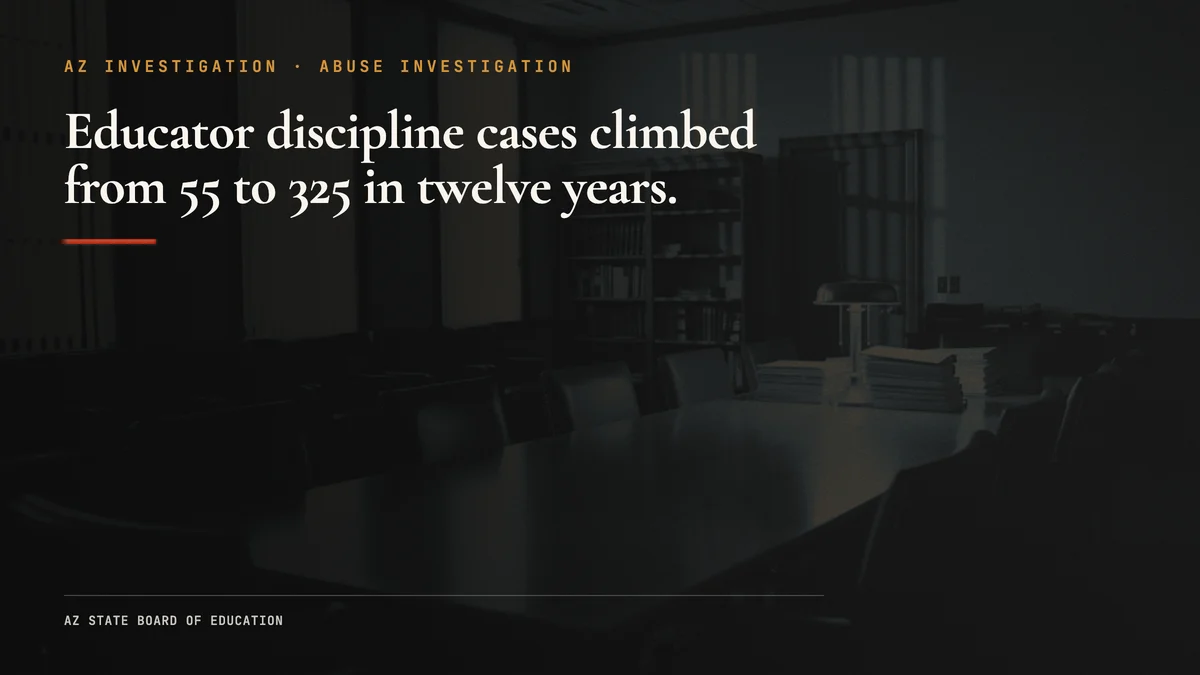
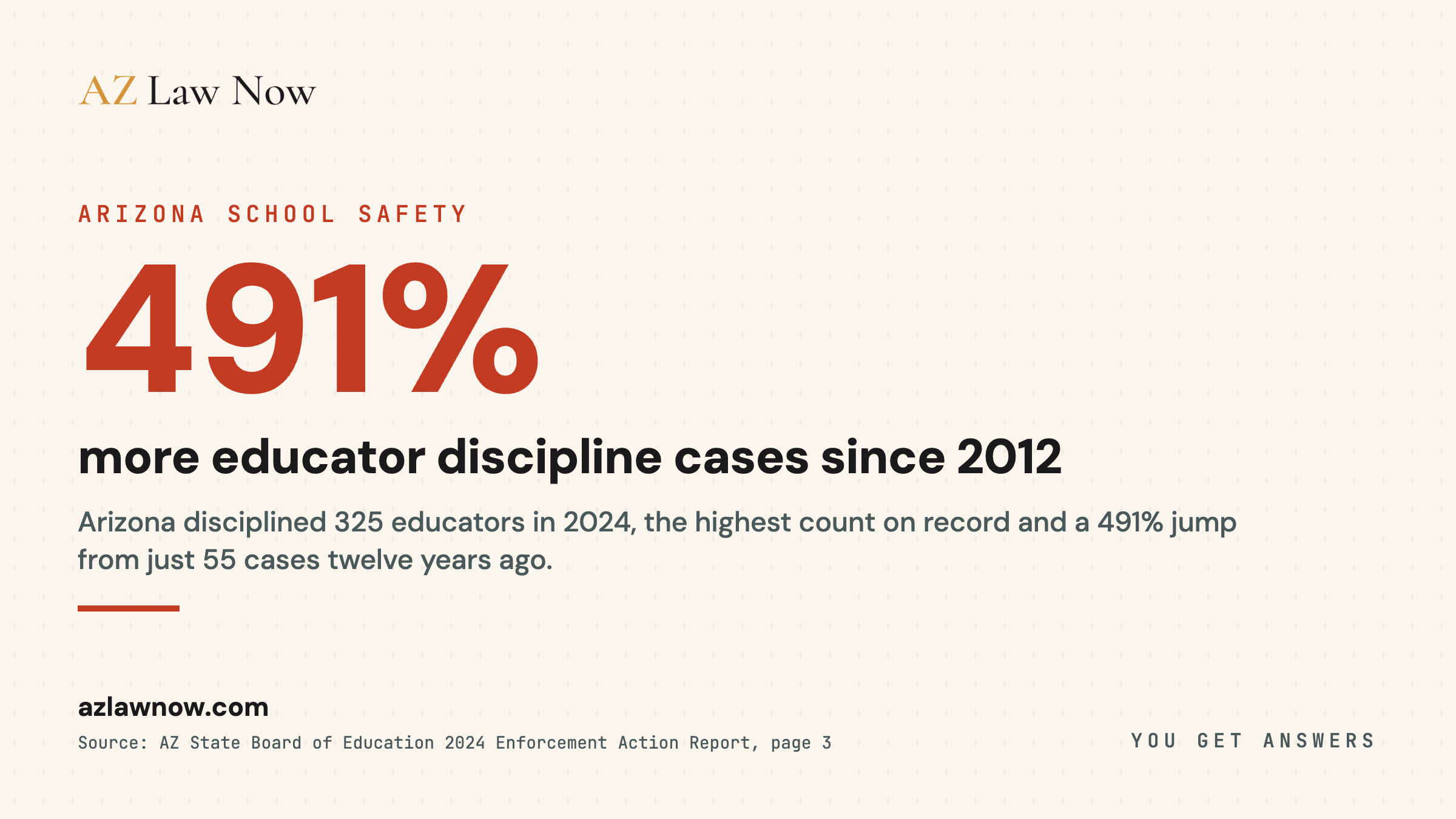
In May 2025 the Arizona State Board of Education published its annual Enforcement Action Report. The headline number on page 3: 325 disciplinary cases adjudicated in calendar year 2024. The Board itself had projected 240. The actual count overshot the Board’s own projection by 85.
That 325 sits inside a 13-year arc the Board has been tracking since 2012. Across that arc, the dataset has 1,876 cases. Sexual misconduct is the largest single category at 36% of every case the Board has ruled on.
The single number tells you how many educators the system caught. It doesn’t tell you how many survivors are still inside the legal time clocks Arizona uses to handle these cases. That conversation is what this piece is for.
What the Numbers Actually Say
The Board’s CY2024 report breaks the 325 cases into categories. The category mix varies year to year because the Board prioritizes investigating sexual misconduct cases, which means those cases can adjudicate faster and dominate one year while assault cases dominate the next.
The cumulative picture is more stable. Here is the 13-year breakdown, taken from Exhibit 11 of the Board’s report:
For 2024 alone, the order shifts. Non-sexual assault was 45% of the 325 cases (about 146 cases). Sexual misconduct was second at 29% (about 94 cases). That 94 isn’t a small number for a single year. It’s also not the only year-on-year shift the data shows.
What the cumulative figure tells a survivor or a survivor family is something specific. Over a 13-year window, more than one in three cases the Board acts on involves alleged sexual misconduct against a student. That’s not a one-year anomaly. That’s the pattern.
Where the Discipline Originates
If you map the 597 educators disciplined between January 2023 and December 2024 by the county where each one was last employed, the geographic concentration is striking.
Maricopa’s count is more than every other Arizona county combined. That tracks with Maricopa’s share of Arizona’s K-12 enrollment and the absolute number of certified educators in the Phoenix metro. It also means that for survivor-side civil cases against Arizona school districts, the practical case volume sits in Maricopa Superior Court.
The Outcome That Doesn’t Get Headlines
Of the 1,876 cumulative cases, the largest single disposition is voluntary surrender of the educator’s teaching certificate. 734 cases. 39% of the total. The Board’s own narrative on page 21 puts it directly: “In 2024, more surrenders were received than in any year exhibited in the data prior. This trend continues to rise.”
Voluntary surrender ends Arizona certification permanently. It doesn’t produce the public hearing record and the findings of fact that a revocation produces. From an accountability standpoint, the educator can’t teach in Arizona again. From a record standpoint, the surrender doesn’t produce the same paper trail.
For families, the practical effect is this. If a school district notifies a community that an educator “voluntarily resigned” or “is no longer with the district,” that may be true on its face and also may be the front-end of a Board surrender that ended the educator’s certificate.
The Board’s discipline search at azsbe.az.gov/educator-discipline/discipline-search is the public mechanism to verify. Search by name. The portal returns the disciplinary record.
Voluntary surrender, suspension, and revocation all show up in the public discipline search. A “resignation” announcement from a district doesn’t preclude a parallel Board action. Search the database. The 2024 spike in surrenders is the Board’s own characterization, not an outside critique.
The Two Time Clocks Survivor Families Need to Know
Arizona has two civil statutes that run on different clocks. Both can apply to a single case.
ARS 12-514, expanded by HB2466 in 2019, governs civil actions for childhood sexual abuse. A survivor has 12 years from reaching age 18 to file a civil action against the abuser. The statute sets a hard deadline: no action can proceed after the plaintiff turns 30.
The 2019 expansion also included a temporary revival window for previously time-barred claims (deadline December 31, 2020) and covers liability for failure to report under ARS 13-3620.
ARS 12-821.01 imposes a 180-day Notice of Claim requirement against any public school district, the same statute that covers Tempe pavement claims and AZ Board of Regents claims. A survivor or family suing a district must file the Notice of Claim within 180 days of the cause of action accruing.
Missing the 180-day window bars the suit against the district. It doesn’t necessarily bar the suit against the educator individually.
The two clocks can apply to the same case. The educator individually is on the longer 12-year clock under ARS 12-514. The district is on the 180-day clock under ARS 12-821.01.
The strategy decision for a survivor-side firm is when to file the Notice of Claim against the district versus when to lean on the longer ARS 12-514 clock against the individual.
Six theories of district liability commonly come up in these cases. Negligent hiring (common law duty, with ARS 15-341 as the statutory hook for the district’s general duty to maintain safe schools). Negligent supervision (ARS 15-514). Negligent retention. Failure to report (ARS 15-514 and ARS 13-3620).
Title IX deliberate indifference (20 USC 1681). Direct vicarious liability for acts within scope of employment. The federal Title IX claim, when it fits, brings federal-court venue and federal-fee-shifting that state-court claims don’t.
What the Board’s Own Process Actually Does
The investigative path runs through the Board’s Investigative Unit. Allegations get reported, often by school officials (50% of 2024 sources), DPS Fingerprint Clearance Card status updates (about 22%), self-disclosure on certification applications (7%), or NASDTEC database hits (about 4%).
Cases route to one of three Professional Practices Advisory Committee panels (nine members each). PPAC issues findings of fact, conclusions of law, and a recommendation. The full Board votes. The educator is then in the public discipline record.
A negotiated settlement agreement (NSA) can short-circuit the hearing path. NSAs are about 20% of adjudications, ranging from a letter of censure to a 5-year suspension. Voluntary surrender often happens during this stage.
The Fingerprint Clearance Card requirement under HB2023 (Laws 2021, Chapter 2) extended the Board’s reach to non-certificated school personnel. That closed a loophole where bus drivers, paraprofessionals, and contracted staff fell outside the certification system entirely.
The Cross-State Question
Arizona is a NASDTEC jurisdiction member. The Board reports final public misconduct dispositions to the National Association of State Directors of Teacher Education and Certification’s national Clearinghouse. About 4% of 2024 cases came in via NASDTEC database monitoring of out-of-state revocations.
What’s not in the public record is whether individual Arizona school districts subscribe as NASDTEC Associate Members. Associate Membership gives a district proactive search and alert features when an educator with an out-of-state revocation applies for a job.
Without that subscription, an Arizona district hiring a teacher revoked in another state may not catch the prior revocation unless the candidate self-discloses or DPS catches it during fingerprinting.
USA Today’s 2016 “Broken Discipline Tracking System” investigation found educators moving state to state to evade discipline. Arizona’s NASDTEC inclusion is the policy response. Whether your local district has fully implemented the proactive membership features is a question you can ask the district directly.
Three records requests can move this from a state-level data piece into a district-level accountability piece. (1) AZ State Board of Education monthly meeting minutes for 2024 to enumerate the 325 cases by name and outcome (azsbe.az.gov/public-meetings, public records).
(2) Each large district’s NASDTEC Associate Membership status. (3) Each district’s annual Title IX coordinator report and complaint volume. Public records under ARS 39-121.
What This Means for Survivors and Families
The 325 figure tells you how many educators the system caught in one year. It doesn’t tell you how many survivors haven’t yet decided whether what happened to them or their child has a legal remedy. Three things matter most for that decision.
First, the public discipline portal is the verification tool
If you’ve heard that an educator “resigned” or is “no longer with the district,” search azsbe.az.gov/educator-discipline/discipline-search. The Board’s record is the source of truth on whether a teaching certificate was surrendered, suspended, or revoked.
Second, the time clocks run independently
The 12-year window under ARS 12-514 is generous compared to most personal-injury claims, but the 180-day Notice of Claim window under ARS 12-821.01 against a school district is short. If the district missed warning signs or breached its duty to supervise, the 180-day clock starts when the family reasonably should have known.
Don’t wait to consult a lawyer.
Third, the available claim theories are layered
A single case can support negligent hiring, negligent supervision, failure to report, Title IX deliberate indifference, and vicarious liability simultaneously. Pleading them all at the start matters. Pleadings narrow over time, they rarely expand.
The Bigger Pattern
The 491% increase from 2012 to 2024 isn’t a one-year story. It’s the cumulative effect of better reporting, expanded statutory authority (HB2023), and a Board that has built out an Investigative Unit that processes cases faster than it used to.
The Board projects 280 actions in 2025, lower than 2024’s 325 but still on the higher end of the historical range.
Sexual misconduct accounts for more than one in three cases the Board has acted on across that arc. Maricopa County is the geographic center of the discipline pipeline. Voluntary surrender is the most common outcome and is rising. The Board’s own data tells you all of that on a single PDF.
What the data doesn’t tell you, and what no Board report can tell you, is whether your child or a child you know is part of a case that hasn’t surfaced yet. That part of the picture is private until a survivor decides what they want to do with it.
Arizona’s law gives them more time than most states to make that decision.
This investigation was built from the Arizona State Board of Education 2024 Enforcement Action Report, the Arizona Revised Statutes governing civil actions and Notice of Claim procedure, AAC Title 7 Chapter 2 educator discipline rules, and the Board’s public discipline search portal.
If you have records, board minutes, district correspondence, or a personal account of an Arizona educator-misconduct case, contact AZ Law Now.
We protect the identities of survivors and families who share documents. Children are never named or made identifiable in our reporting.
Related Coverage
For the legal and process context, see Stephanie Ramirez’s educator harmed my child arizona and the school abuse practice overview.
Frequently asked questions
What is the Arizona State Board of Education's enforcement role?
What did the Board's 2024 Enforcement Action Report actually say?
Why does Maricopa County drive so many cases?
What is voluntary surrender and why does it matter to survivors?
I'm a survivor or a parent of a survivor. What are the legal time clocks I need to know?
What claim theories are available against Arizona school districts on educator-misconduct facts?
How can a parent verify whether an educator has been disciplined?
Sources & references
- Arizona State Board of Education. (2025, May). 2024 Enforcement Action Report. Retrieved April 27, 2026, from https://azsbe.az.gov/sites/default/files/2025-05/2024%20Enforcement%20Action%20Report.pdf
- Arizona State Board of Education. (2024, May). 2023 Enforcement Action Report. Retrieved April 27, 2026, from https://azsbe.az.gov/sites/default/files/2025-05/EA%20Report%202023_v3.pdf
- Arizona State Board of Education. Educator Discipline. Retrieved April 27, 2026, from https://azsbe.az.gov/educator-discipline
- Arizona State Board of Education. Public Discipline Search. Retrieved April 27, 2026, from https://azsbe.az.gov/educator-discipline/discipline-search
- Arizona State Board of Education. Board Members and Staff. Retrieved April 27, 2026, from https://azsbe.az.gov/about/board-committees-staff
- Arizona Revised Statutes 15-203 (Powers and duties of the State Board). Retrieved April 27, 2026, from https://www.azleg.gov/ars/15/00203.htm
- Arizona Revised Statutes 15-514 (Mandatory reporting of educator misconduct). Retrieved April 27, 2026, from https://www.azleg.gov/ars/15/00514.htm
- Arizona Revised Statutes 12-514 (Civil action for childhood sexual abuse, 12-year statute of limitations). Retrieved April 27, 2026, from https://www.azleg.gov/ars/12/00514.htm
- Arizona Revised Statutes 12-821.01 (Notice of Claim against a public entity, 180 days). Retrieved April 27, 2026, from https://www.azleg.gov/ars/12/00821-01.htm
- Arizona Revised Statutes 13-3620 (Mandatory child abuse reporter). Retrieved April 27, 2026, from https://www.azleg.gov/ars/13/03620.htm
- Arizona Administrative Code Title 7 Chapter 2 (Educator discipline rules, R7-2-1301 et seq.). Retrieved April 27, 2026, from https://apps.azsos.gov/public_services/Title_07/7-02.pdf
- Arizona Department of Education. Educator Certification. Retrieved April 27, 2026, from https://www.azed.gov/educator-certification
- Arizona Department of Education. Arizona Teacher Shortage Report, Fall 2024. Retrieved from https://www.azed.gov/sites/default/files/2024/09/AZ_Teacher_Shortage_Report_Fall_2024.pdf
- Title IX of the Education Amendments of 1972, 20 USC Section 1681. Retrieved from https://www.ed.gov/laws-and-policy/civil-rights-laws/title-ix-and-sex-discrimination
- NASDTEC Clearinghouse FAQ. Retrieved April 27, 2026, from https://www.nasdtec.net/?page=Clearinghouse_FAQ
- ABC15 Arizona. (2025, May). State Board of Education Releases Annual Educator Discipline Report. Retrieved from https://www.abc15.com/news/local-news/state-board-of-education-releases-annual-educator-discipline-report