
Arizona runs three separate tiers of licensed elder residential care. The oversight architecture is different at each level. The smallest tier, which most people call adult care homes, has the weakest oversight and the least public data.
That’s not a design flaw. It’s a design choice. And when something goes wrong in a small group home, families find out they have fewer tools to have seen it coming.
What an adult care home actually is
In Arizona statutes, the facility most people call an “adult care home” is licensed as an assisted living home: a residential facility with 10 or fewer residents that provides supervisory, personal, or directed care services on a continuous basis. The statute is ARS 36-401. The licensing authority is the Arizona Department of Health Services.
That puts it in a specific tier of a three-tier stack:
-
Nursing homes (skilled nursing facilities): Federally licensed. CMS inspects them through ADHS. Their deficiency citations go on Medicare’s Care Compare. There’s a star rating, staffing data, penalty history, and a national database families can search before placement.
-
Assisted living centers: State-licensed by ADHS. Eleven or more residents. Same Arizona Administrative Code Article 8 rules as small homes. AZ Care Check publishes deficiency records. No federal counterpart. No star rating.
-
Assisted living homes (adult care homes): State-licensed by ADHS. Ten or fewer residents. Same Article 8 rules. AZ Care Check is the only public record source. No federal counterpart. No star rating. No national comparison database.
There’s also a fourth sub-tier: adult foster care homes, capped at four residents, where the sponsor lives on site. Each step down in size means one fewer public accountability layer for families.
Arizona has approximately 1,711 licensed assisted living homes and about 330 licensed assisted living centers. Roughly 84% of licensed elder residential care facilities in this state operate with no federal oversight counterpart.
The data ADHS publishes and the data it doesn’t
AZ Care Check (azcarecheck.azdhs.gov) is the primary public tool for researching an assisted living home in Arizona. ADHS updated the system in 2025. It’s searchable by facility name, address, and license type. It shows inspection history, complaint investigation outcomes, and enforcement actions.
What it doesn’t show: a star rating, staffing levels, staff turnover rates, or any ranked comparison of facilities by deficiency severity. You can look up one facility at a time. You can’t pull up “all assisted living homes in Maricopa County with more than five deficiencies in the last three years” in a single query.
That’s the structural gap for families. With a nursing home, Medicare’s Care Compare lets you search a zip code and pull a ranked comparison across every certified facility. With a small assisted living home, you’re doing manual lookups on each place you’re considering, with no standardized scoring to compare them.
ADHS doesn’t publish aggregate data on how many assisted living homes received citations in a given year, how many complaints it received against the small-home category, or how many complaints it investigated with an on-site visit versus closing without one. That data exists. It’s a public records request under ARS 39-121 away.
The ombudsman program adds another layer, but it has its own coverage problem. Arizona’s Long-Term Care Ombudsman Program serves assisted living homes through seven regional entities. But coverage is inconsistent. An investigation by the Hertel Report documented that Navajo County had no paid ombudsman at all.
One Maricopa County operator with three assisted living homes reported no ombudsman visits since the pandemic began, despite monthly pre-pandemic visits.
What the records show when enforcement gets stressed
When the Arizona Republic investigated Heritage Village, a Mesa assisted living facility, the records that came back were striking. Over three years, ADHS had issued more than 148 citations against the facility, 2.5 times more than any other assisted living facility in the state.
Incidents included a resident death following a roommate attack and a documented sexual assault.
Before the Republic’s reporting, Arizona had no statewide tracking system for resident-on-resident assaults at assisted living facilities.
ADHS issued a Notice of Intent to Revoke Heritage Village’s license on January 12, 2024. AG Kris Mayes filed for receivership in March 2024. A court appointed a receiver in April, removing owners Gary and Tracy Langendoen.
The AG later added racketeering claims, alleging the owners had diverted more than $2.9 million from the facility’s operating accounts, submitted at least six forged ADHS license applications between October 2022 and August 2023, and transferred hundreds of thousands of dollars across multiple facilities in their portfolio.
The AG sought receivership for two additional Langendoen-controlled facilities.
The licensing system didn’t catch the forged applications. A yearlong newspaper investigation did.
Repeat-operator patterns: what the records don’t cross-reference
The Heritage Village case documents something structural: one operator, multiple licensed facilities, documented violations at multiple locations, funds moving between them.
No public system in Arizona cross-references an operator’s licensing history across their full portfolio. Families checking a facility on AZ Care Check see that facility’s record. They don’t see a flag indicating the operator holds three other licenses with active enforcement actions, or that the same entity was cited for forgery at a different address.
When a problem operator acquires a new facility, or opens under a new business entity name, the public record doesn’t connect the dots automatically. The ADHS Licensing portal and AZ Care Check are facility-by-facility lookups, not operator-level views.
Pulling the operator’s full license history requires knowing what entities to search, which requires knowing the corporate structure, which requires an Arizona Corporation Commission lookup.
How ADHS has handled complaint investigations
The Arizona Auditor General’s 2022 report on ADHS nursing home complaint investigations is the clearest public documentation available on how the state’s complaint-investigation track has functioned.
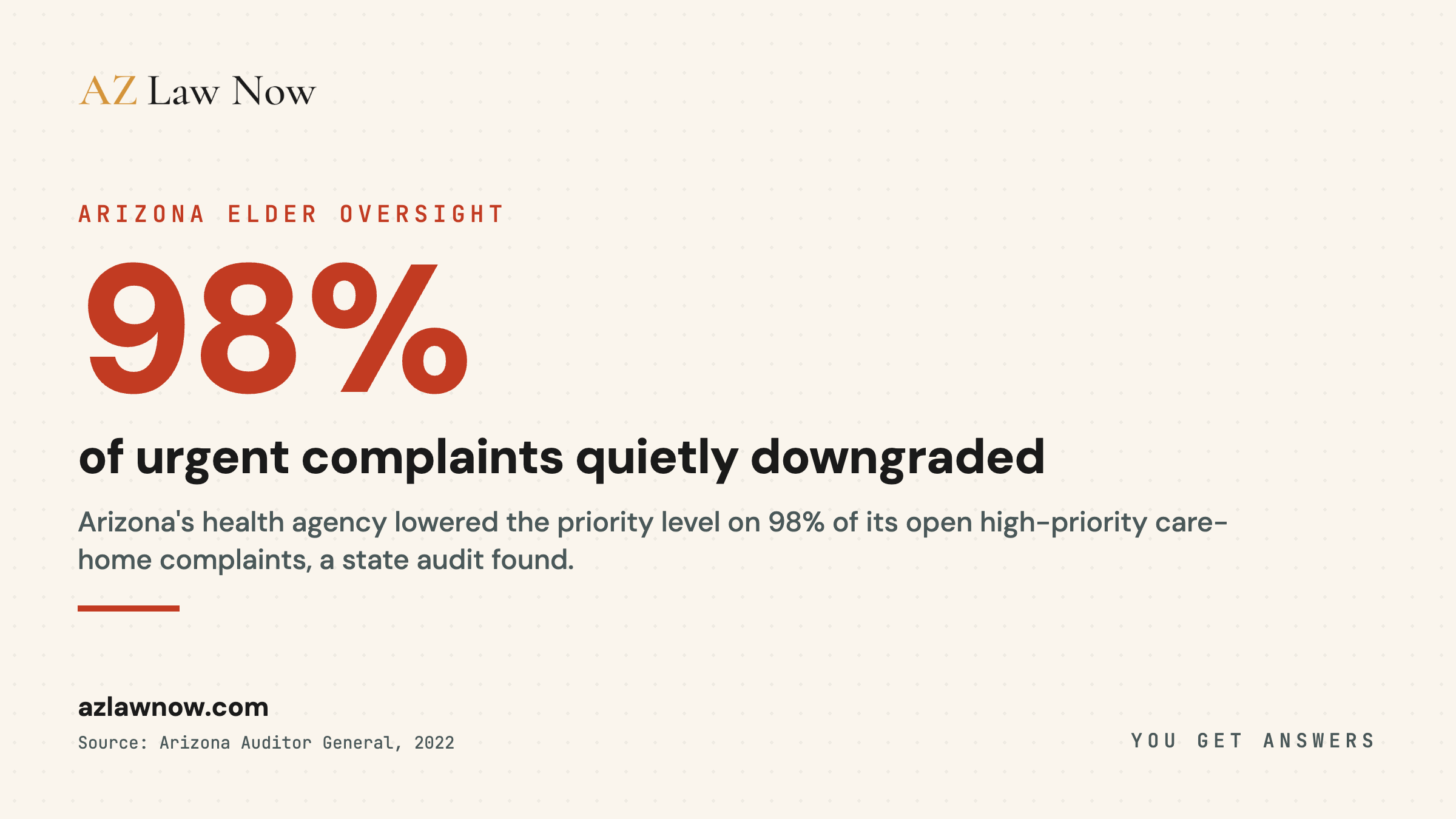
The findings are specific: between July 1, 2019 and April 21, 2021, ADHS lowered the priority level of 98% of its open high-priority complaints. It failed to initiate on-site investigations for nearly three-quarters of high-priority complaints.
When the Auditor General returned in 2021 to check on implementation, ADHS had made none of the required changes from a prior 2019 audit.
That 42%-to-4% drop in high-priority complaint classifications after the first audit wasn’t a sign the complaints got less serious. It was a sign that complaints were being reclassified.
This record covers nursing homes, which have a federal backstop. CMS can survey a nursing home independently when ADHS fails to act. Assisted living homes don’t have that backstop. There’s no federal agency that can step in when ADHS drops the ball on a small group home complaint.
How adult care home oversight compares to nursing home oversight
The oversight gap between nursing homes and small assisted living homes isn’t subtle. It’s structural.
Nursing homes:
- Federally certified under CMS. ADHS acts as a state survey agency under federal contract.
- Annual standard surveys plus complaint investigations, with timelines governed by CMS rules.
- Form 2567 deficiency narratives published publicly on Care Compare.
- Five-star quality rating published monthly.
Includes health inspection score, staffing score, and quality measures score.
- Staffing data submitted quarterly via Payroll-Based Journal system and published at facility level.
- Federal civil monetary penalties published per facility.
- Special Focus Facility designation for the worst performers: double-frequency surveys, federal escalation.
- HHS Office of Inspector General and CMS regional offices provide federal oversight of ADHS survey activity.
Assisted living homes (10 beds or fewer):
- State-licensed by ADHS only.
- Inspection at least every 15 months, same as assisted living centers.
- AZ Care Check deficiency records: yes.
- Star rating: no.
- Staffing data: not publicly reported.
- Federal oversight counterpart: none.
- Special Focus Facility equivalent: none.
- When ADHS fails to act on a complaint: the family’s options are the LTC ombudsman (inconsistent coverage), APS (separate track, separate mandate), or an attorney.
That’s the architecture. The same ADHS agency that the Auditor General found was deliberately downgrading complaint investigations is the sole regulatory backstop for 1,711 small group homes across Arizona.
An assisted living home in Arizona is a licensed health care institution under ARS 36-401. That license carries legal duties.
When a facility fails those duties and someone is harmed, the legal theories available include negligence per se (violation of Article 8 rules that foreseeably caused the harm), ordinary negligence, breach of the resident care contract, and wrongful death under ARS 12-611.
Mandatory-reporter obligations under ARS 46-454 extend to every person responsible for the care of a vulnerable adult. That includes assisted living home staff. If staff knew of abuse or neglect and failed to report to APS or law enforcement, that failure is itself a violation with legal consequence.
HB2764 (signed April 4, 2024) increased the civil penalty cap for ADHS licensing violations from $500 to $1,000 per resident per day and added Elder Abuse Central Registry background check requirements for employees. The law also allows ADHS to impose monitoring fees of up to $1,000 per visit for repeat deficiency violations.
In a harm case at a small assisted living home, the records that matter are: the ADHS licensing file, AZ Care Check deficiency history, complaint investigation records (obtainable via ARS 39-121 public records request if not on the public portal), the resident care agreement, the service plan, medication administration records, and any APS investigation records.
Bring these to your attorney before the statute of limitations runs. In Arizona, the standard personal injury statute of limitations is two years from the date of injury under ARS 12-542.
If your loved one lives in a small group home
The lack of a Care Compare equivalent doesn’t mean you can’t research a facility. It means you have to work harder to do it.
Before placement:
- Pull the facility’s AZ Care Check record at azcarecheck.azdhs.gov. Search by name. Read every deficiency entry and every complaint investigation outcome.
- Confirm the facility’s license is active via ADHS Licensing (licensing.azdhs.gov).
- Ask who the owner of record is. Then search the owner’s name in the ADHS Licensing portal to find all facilities they hold licenses for.
Pull AZ Care Check records for each.
- Search the Arizona Corporation Commission (azsos.gov/business-services/corporations) for the legal entity operating the facility.
- Ask the facility directly: how many residents do you have, what’s your staff-to-resident ratio during the night shift, and what happens when a resident has a medical emergency at 2 a.m.?
After placement:
- Visit regularly. The research from the Heritage Village investigation showed that incidents happened at night and on weekends, when family members weren’t present.
- Document what you observe. Photographs, notes with dates, conversations with staff. If something seems wrong, write it down the same day.
- File a complaint with ADHS if you see a problem.
Use the Complaint Tracker at app3.azdhs.gov/PROD-AZHSComplaint-UI or call 602-542-1025.
- Report abuse, neglect, or exploitation to Adult Protective Services at 1-877-767-2385. APS and ADHS run separate investigations. File with both.
- Contact the LTC Ombudsman at 602-542-6454 ext 9. Ombudsmen advocate for people in long-term care settings including small assisted living homes.
If your loved one was hurt at an assisted living home badly enough to be hospitalized, or died, talk to an attorney. The injuries that most often support a civil claim are:
- A fall that caused a fracture or head injury and a hospital stay
- A stage 3 or 4 pressure injury (bedsore)
- A medication error that led to hospitalization
- An assault by staff or another resident
- Dehydration or malnutrition that led to hospitalization
- A death that followed any of the above
Cases involving small group homes are handled by the same attorneys who handle nursing home neglect, and the legal framework is the same. AZ Law Now doesn’t handle financial exploitation, guardianship or family disputes, and doesn’t represent people accused of abuse.
If someone you care about has been harmed at an assisted living home in Arizona, or if you have records about conditions at a facility you want to share, we want to hear from you.
Our team, including Ron DeBrigida, J.D., handles injury and wrongful death cases involving all types of Arizona long-term care settings, including small assisted living homes.
Call us at (602) 654-0202 or reach out through our contact page. We don’t charge for the initial conversation. If you have documents or records to share, bring them. The cases we can do the most for are the ones where families have taken the time to document what they saw.
This investigation is part of AZ Law Now’s elder care series. For related reporting, see Arizona Nursing Homes With the Most Federal Violations and Grand Court Mesa and the Elder Abuse Bill That Followed.
For the statutory and legal framework, see the Arizona Elder Abuse Law guide and practice area pages on elder abuse and nursing home abuse.
Frequently asked questions
What is an adult care home in Arizona?
How do I look up violations for an Arizona adult care home?
How often are Arizona adult care homes inspected?
What's the difference between an adult care home, assisted living, and a nursing home?
What is ARS 36-401 and why does it matter for adult care homes?
How do I file a complaint against an adult care home in Arizona?
Can a nursing home abuse attorney handle a case involving a small group home?
What did Arizona's legislature change for adult care homes after recent investigations?
Sources & references
- Arizona Revised Statutes § 36-401 (2025). Definitions; adult foster care. Retrieved from https://www.azleg.gov/ars/36/00401.htm
- Arizona Department of Health Services. Residential Facilities Licensing. Retrieved from https://www.azdhs.gov/licensing/residential-facilities/index.php
- Arizona Department of Health Services. AZ Care Check. Retrieved from https://azcarecheck.azdhs.gov/s/
- Arizona Administrative Code Title 9, Chapter 10, Article 8. Assisted Living Facilities. Retrieved from https://www.azdhs.gov/documents/licensing/residential-facilities/article-8.pdf
- Arizona Auditor General. (2022, May). Department of Health Services: Nursing Care Institution Complaint Investigations Follow-Up. Retrieved from https://www.azauditor.gov/sites/default/files/2023-11/20-101_42-Mth_Followup.pdf
- Arizona Office of the Attorney General. (2024). Attorney General Mayes Adds Racketeering Claims in Heritage Village Lawsuit, Seeks Receivership for Two Additional Assisted Living Facilities. Retrieved from https://www.azag.gov/press-release/attorney-general-mayes-adds-racketeering-claims-heritage-village-lawsuit-seeks
- Association of Health Care Journalists. (2024, May). How we did it: Uncovering abuse in Arizona assisted living facilities. Retrieved from https://healthjournalism.org/blog/2024/05/how-we-did-it-uncovering-abuse-in-arizona-assisted-living-facilities/
- HB2764. (2024). Signed April 4, 2024. Senate Fact Sheet. Retrieved from https://www.azleg.gov/legtext/56leg/2R/summary/S.2764HHS.DOCX.htm
- Arizona Revised Statutes § 46-454 (2025). Duty to report abuse, neglect and exploitation of vulnerable adults. Retrieved from https://azleg.gov/ars/46/00454.htm
- AZ Public Health Association. (2024, February). Licensing and Regulating Care Facilities: A Root Cause Analysis. Retrieved from https://azpha.org/2024/02/21/licensing-regulating-care-facilities-a-root-cause-analysis-of-arizonas-failure-to-protect-vulnerable-persons-pathway-to-redemption/
- AZ Public Health Association. (2025, April). AzCareCheck 2.0. Retrieved from https://azpha.org/2025/04/07/azcarecheck-2-0/
- The Hertel Report. Where are all the Arizona Long-term Care Ombudsmen? Retrieved from https://www.thehertelreport.com/investigative-report/
- Arizona Department of Economic Security. Long-Term Care Ombudsman Program. Retrieved from https://des.az.gov/LTCOP
- 12News. (2022). ADHS failing to investigate complaints at nursing homes: Auditor General report. Retrieved from https://www.12news.com/article/news/investigations/arizona-department-of-health-services-failing-to-investigate-complaints-at-nursing-homes-auditor-general-report/75-62b1f574-e5ee-4d5f-a57d-f1d72a9209c6