A student signs up for a career-training program in Arizona because the brochure promises a clinical placement, a credential, and a job. What the brochure doesn’t explain is the plumbing. The school gets paid on a schedule that’s tied to when the student crosses thresholds.
The federal rule set behind that schedule has numbers in it. And when those numbers collide with thin supervision at a practicum site, the consequences land on the student.
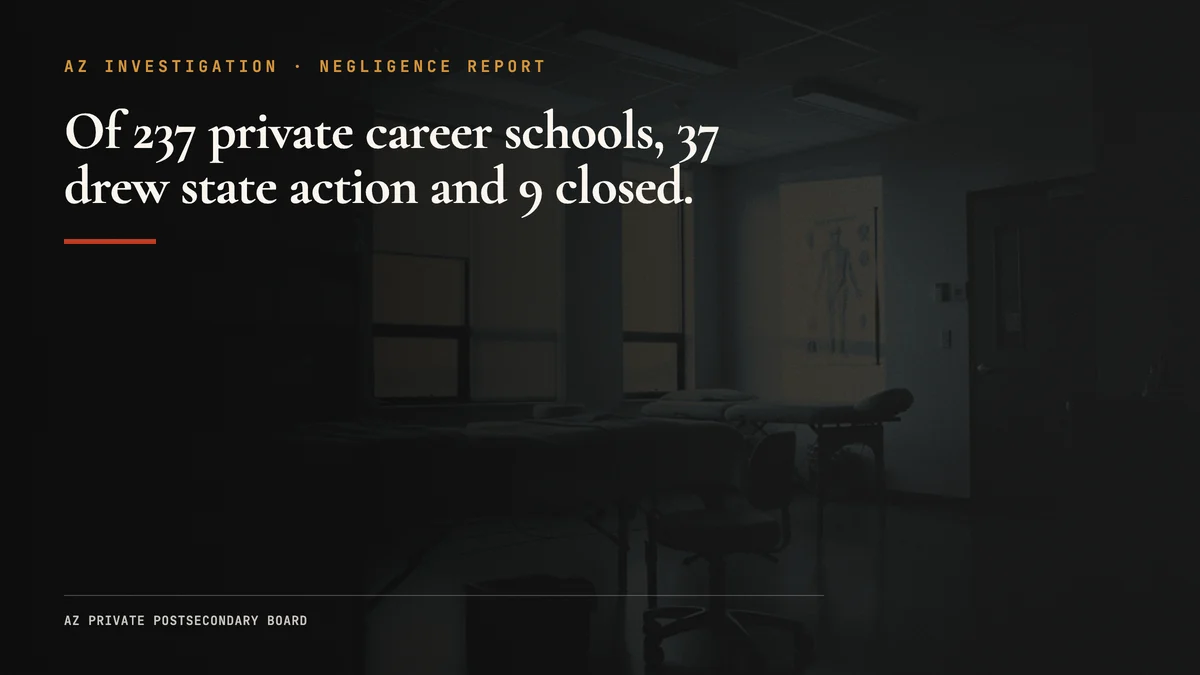
The Arizona State Board for Private Postsecondary Education is the state backstop. In its own FY25 numbers, the Board licensed 237 institutions, issued 37 adverse actions against them, and assisted 9 school closures.
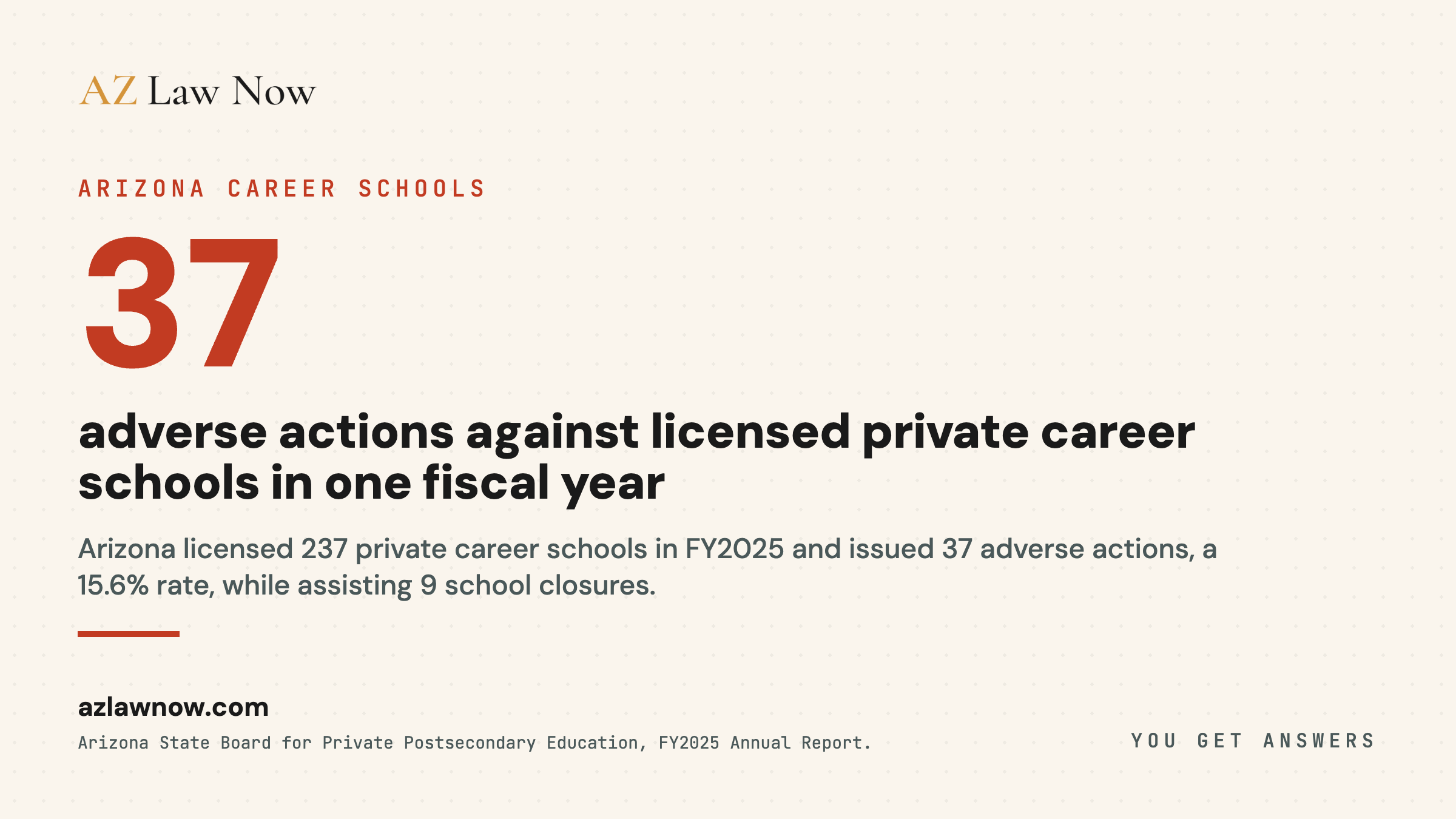
That’s one fiscal year.
What the FY25 Numbers Mean
PPSE is the licensing authority that stands between Arizona’s private career-training industry and the students who pay into it.
When a student enrolls at a cosmetology school, a massage therapy program, a medical assistant course, a trade school, or a non-exempt private college, PPSE is the agency that issued the school’s license, that holds the bond, and that accepts the complaint when something goes wrong.
The FY25 enforcement list is diverse by design. The 37 adverse actions include probationary measures, increased bond requirements, quarterly reporting orders, letters of concern, cease-and-desist orders, and ongoing monitoring.
The 9 closures include schools that ran out of money, schools that lost accreditation, and schools that couldn’t correct compliance problems fast enough to keep the license.
The individual action list, respondent by respondent, isn’t fully public on the PPSE enforcement page in scrapeable form. A public records request to PPSE at 1740 W Adams Street, Suite 3008, Phoenix, AZ 85007 can pull the underlying orders. This reporting relies on the aggregate FY25 numbers the Board itself published.
One aggregate data point is enough to warrant the question: 37 adverse actions across 237 licensees is a 15.6% action rate in a single fiscal year. That’s not a rounding error. That’s a sector with a structural problem.
The Federal Rule That Explains the Pressure
The structural problem starts above Arizona. Proprietary career schools that participate in federal student aid run on Title IV money. Title IV disbursement, withdrawal, and refund rules are codified at 34 CFR 668.22 and related sections. Inside that rule set, two mechanisms matter more than the rest.
The 60% rule
Under 34 CFR 668.22, once a student passes the 60% point of a payment period or period of enrollment, the school has earned 100% of the scheduled Title IV aid for that student. Before the 60% mark, earned aid is calculated pro rata by days or clock hours attended.
The Federal Student Aid Handbook puts it in plain language: “After the 60% point in the payment period or period of enrollment, a student has earned 100% of the Title IV funds.”
Most massage, cosmetology, and short-credential vocational programs are clock-hour programs. That means the calculation happens by hours attended against hours scheduled. Every missed hour counts. A school that loses a student at the 58% mark has to return a proportional slice of funds.
A school that loses the same student at the 61% mark keeps the full draw.
The 90/10 rule
Higher Education Act section 487(a)(24), implemented at 34 CFR 668.28, limits a proprietary institution to no more than 90% of tuition and fee revenue from federal education assistance in any fiscal year. The other 10% must come from non-federal sources. Cash-pay students. Private loans.
In some regulatory years, veterans benefits count inside the federal bucket, in others they don’t.
Why the plumbing shapes the practicum
Put the two rules together. A school has every financial reason to enroll to capacity, to keep students across the 60% waterline, and to close non-federal payers into the mix. The supervision model at the clinical practicum is where the pressure lands. Clinical hours count.
Unsupervised or minimally supervised clinical hours count the same as closely supervised ones, unless an inspector or a complaint says otherwise.
The Department of Education published final Return of Title IV Funds rules on January 3, 2025, effective July 1, 2026. Schools and their auditors are working the transition now.
The new framework changes which students count as withdrawn, when clocks start, and how modular programs are treated. Members of the public who interact with school-run clinics during this transition should expect uneven implementation.
National Precedent: Settled at the Billion-Dollar Scale
The structural story isn’t a theory. The Department of Education has already written it, twice, at nine-figure scale.
On June 1, 2022, the Department of Education announced a full discharge of federal student loans for approximately 560,000 former Corinthian Colleges borrowers, totaling $5.8 billion. Corinthian operated Everest, Heald, and WyoTech brands. The basis for the discharge was findings that Corinthian misrepresented job placement rates, career services, and transferability of credits.
Two months later, on August 16, 2022, the Department announced a full discharge of $3.9 billion in federal loans for approximately 208,000 former ITT Technical Institute students. ITT had closed its 130-plus US campuses in September 2016 after Department of Education restrictions.
The discharge findings referenced misrepresentations about job placement, credit transferability, program cost, and employer partnerships.
Borrower Defense to Repayment regulations at 34 CFR 685.206 allow federal loan discharge where a school substantially misrepresented program outcomes, used aggressive or misleading recruiting, or breached contract. The Department has processed hundreds of thousands of additional claims since.
None of that establishes liability for an Arizona-licensed school. What it establishes is the baseline plausibility. When a plaintiff tells a story about a Title IV proprietary school that enrolled past safe capacity, that didn’t do the supervision it advertised, and that marketed outcomes it couldn’t deliver, the federal record already supports the template.
Arizona Tort Law: Plaintiff Leaning on This Fact Pattern
Arizona’s common-law and statutory framework is favorable to plaintiffs on career-school supervision facts.
Pruitt v. Pavelin, 141 Ariz. 195, 685 P.2d 1347 (App. 1984), establishes that an employer owes a duty of reasonable care in selecting, supervising, and retaining employees whose work brings them into contact with members of the public.
Mulhern v. City of Scottsdale, 165 Ariz. 395, 799 P.2d 15 (App. 1990), expanded the doctrine. Both cases feed the Restatement (Second) of Agency section 213 and the Restatement (Second) of Torts section 317.
A career school that directs student conduct during a supervised practicum stands in the employer role for purposes of these theories. The school is also the entity that held itself out to the public as providing trained supervision.
The available claims include negligent supervision of instructors, negligent supervision of students during practicum, negligent training, and negligent retention where prior complaints on an instructor or student were documented and ignored.
Layer on the Consumer Fraud Act at ARS 44-1522. Where a school’s marketing misstated supervision ratios, licensure outcomes, placement rates, or the safety of its clinic for public clients, a private right of action under Arizona’s consumer-fraud statute runs in parallel with common-law claims.
And the ceiling matters. Arizona Constitution article 2, section 31 bars caps on damages in death and personal-injury actions. Punitive damages are available on clear-and-convincing evidence of evil mind, spite, or malice. The combination makes Arizona a state where jury verdicts on supervision failure can reach the full measure of harm.
Personal injury claims in Arizona run two years under ARS 12-542. Consumer fraud claims under ARS 44-1522 have their own limits. Claims against public entities or state-affiliated institutions run 180 days for the Notice of Claim under ARS 12-821.01 and one year for suit under ARS 12-821.
The applicable clock depends on whether the school is private, publicly-affiliated, or public. Check the school’s licensure and affiliation before assuming the deadline.
The Title IX and Clery Coverage Gap
Title IX applies to any education program or activity receiving federal financial assistance. A Title-IV-participating proprietary school is covered. The Department of Education Office for Civil Rights, Region IX, handles Arizona.
The Clery Act at 20 USC section 1092(f) requires Title-IV-participating schools to publish an Annual Security Report, maintain a daily crime log, and issue timely warnings for Clery-geography crimes. The coverage looks comprehensive on paper. In practice, three gaps open up.
First, short clock-hour schools often publish minimal Annual Security Reports. Compliance is uneven and primarily enforcement-driven.
Second, off-site clinical practicum locations are a fact question. A school-run massage clinic in leased retail space. A student-staffed salon at a mall. An externship at a third-party clinic. Whether each site falls inside the school’s Clery geography depends on the written control agreement the school holds over that space. Few schools pressure-test this publicly.
Third, a career school that elects not to take federal aid is exempt from both Title IX and Clery. Arizona PPSE continues to license those schools through the state process, but the federal civil-rights layer isn’t there. A student or public-facing client at a non-Title-IV school has state tort and consumer-protection theories, not Title IX.
What a Records Request Can Reveal
The public data is a starting point. A records request under Arizona’s Public Records Law to PPSE can return the respondent-level adverse action list for FY23 through FY26. A records request to the Attorney General’s Consumer Protection Section returns complaints filed under ARS 44-1522 against career schools.
A records request to the Arizona State Board of Massage Therapy returns disciplinary orders against licensed therapists who were trained at or affiliated with recognized schools.
PACER and Maricopa and Pima Superior Court dockets, filtered by defendant-business-name patterns matching licensed career schools, return the filed-complaint layer. The Auditor General’s 2022 sunset review of the Massage Therapy Board (Report 22-106) is public and addresses enforcement cycle times and complaint backlogs for that sector.
This investigation was built from the aggregate FY25 numbers the Board published, the federal rule set that explains why those numbers exist, the tort law that governs what a plaintiff can plead, and the federal precedent that the Department of Education has already written at scale. The respondent-by-respondent record will arrive by records request.
What to Do If You Were Harmed at an Arizona Career School
Seven concrete steps in the first two weeks after an incident.
- Get medical care and keep every record. Discharge notes, imaging, bills, prescription receipts.
- Document the physical site. Photograph the location, equipment, signage, and, where relevant, the exact room or chair.
- Identify the school, the instructor, and the student. Many school-run clinics post rosters. Get names.
- Request the school’s incident report. Refuse to sign a general release. A release signed under duress is often unenforceable, but why give the school the argument.
- File a complaint with PPSE. And, depending on the program, the Board of Massage Therapy, the Board of Nursing, the Board of Cosmetology, or the Department of Insurance.
- Note the date of injury. The two-year personal-injury clock under ARS 12-542 runs from accrual. If the school is public or publicly-affiliated, the shorter 180-day Notice of Claim clock applies.
- Call a lawyer. Career-school cases layer common-law tort, consumer fraud, Title IX where applicable, and federal contract and regulatory claims. Getting the right claims pled at the start matters.
The Bigger Point
Arizona licenses 237 private career schools. Thirty-seven of them got hit with adverse actions in one fiscal year. Nine more closed. The federal funding rules that govern how these schools get paid create a direct financial interest in keeping students past the 60% waterline, whatever the supervision picture looks like at that mark.
The Department of Education has already discharged close to $10 billion in loans from two national chains for misrepresentation. Arizona tort law is favorable to plaintiffs on the supervision theory. The damages ceiling is the full measure of harm.
None of this means every Arizona career school is running a bad program. Most aren’t. The ones that are, though, are a known-shape problem, with a known-shape cause, and a known-shape set of remedies.
The state’s own Board said 37 times last year that something warranted action. The Department of Education said twice, at nine-figure scale, that the business model can hide misrepresentation at industrial volume.
If you were placed into a clinical practicum and something happened, the paperwork you’ll need already exists.
This investigation was built from the Arizona State Board for Private Postsecondary Education FY25 Key Results, the Federal Student Aid Handbook and 34 CFR 668 rule set, Department of Education press releases on Corinthian and ITT discharges, Arizona appellate case law, and the Arizona Revised Statutes.
Schools were not named in this piece because primary-source documentation on specific respondents was not retrievable in aggregate form. If you have documents, filed complaints, Board orders, or firsthand accounts of an incident at an Arizona career school, contact AZ Law Now.
We report from primary sources and protect the identities of people who share them when asked.
Frequently asked questions
What is the Arizona State Board for Private Postsecondary Education?
What is the 60% rule and why does it matter for student safety?
What is the 90/10 rule?
Does Title IX apply to private career schools in Arizona?
Does the Clery Act apply at off-site clinical practicum locations?
What Arizona tort theories work against a career school on a supervision fact pattern?
What should I do if I was injured at a career-school clinic or externship in Arizona?
What is the penalty for fraud in Arizona?
Sources & references
- Arizona State Board for Private Postsecondary Education. FY25 Key Results. Retrieved April 23, 2026, from https://ppse.az.gov/news/fy25-key-results
- Arizona State Board for Private Postsecondary Education. Agency Overview. Retrieved April 23, 2026, from https://ppse.az.gov/about
- US Department of Education, Federal Student Aid. FSA Handbook 2025-2026, Volume 5, Chapter 1: General Requirements, Withdrawals, and Return of Title IV Funds. Retrieved April 23, 2026, from https://fsapartners.ed.gov/knowledge-center/fsa-handbook/2025-2026/vol5/ch1-general-requirements-withdrawals-and-return-title-iv-funds
- US Department of Education, Federal Student Aid. Electronic Announcement: Implementation of R2T4 Regulations Effective July 1, 2026. Retrieved April 23, 2026, from https://fsapartners.ed.gov/knowledge-center/library/electronic-announcements/2026-03-27/implementation-return-title-iv-funds-r2t4-regulations-effective-july-1-2026
- Code of Federal Regulations. 34 CFR 668.22 (Treatment of Title IV Funds When a Student Withdraws). Retrieved April 23, 2026.
- Code of Federal Regulations. 34 CFR 668.28 (Non-Title IV Revenue, 90/10). Retrieved April 23, 2026.
- Higher Education Act of 1965 as amended, Section 487(a)(24). Codified at 20 USC § 1094(a)(24).
- US Department of Education. (2022, June 1). Education Department Approves $5.8 Billion Group Discharge to Fully Cancel Loans for 560,000 Borrowers Who Attended Corinthian Colleges. Retrieved from https://www.presidency.ucsb.edu/documents/icymi-vice-president-harris-announces-58-billion-student-loan-forgiveness-for-560000
- US Department of Education. (2022, August 16). Department of Education Announces Approval of $3.9 Billion Group Discharge for 208,000 Borrowers Who Attended ITT Technical Institute. Retrieved from https://www.presidency.ucsb.edu/documents/white-house-press-release-education-department-approves-39-billion-group-discharge-for
- US Department of Education. Borrower Defense to Repayment. Retrieved April 23, 2026, from https://studentaid.gov/manage-loans/forgiveness-cancellation/borrower-defense
- Arizona Court of Appeals. Pruitt v. Pavelin, 141 Ariz. 195, 685 P.2d 1347 (App. 1984).
- Arizona Court of Appeals. Mulhern v. City of Scottsdale, 165 Ariz. 395, 799 P.2d 15 (App. 1990).
- Arizona Revised Statutes 44-1522 (Consumer Fraud Act). Retrieved April 23, 2026, from https://www.azleg.gov/ars/44/01522.htm
- Arizona Revised Statutes 12-542 (Personal Injury Statute of Limitations). Retrieved April 23, 2026, from https://www.azleg.gov/ars/12/00542.htm
- Arizona Constitution Article 2, Section 31 (Damages for Injuries, no cap).
- Title IX of the Education Amendments of 1972. 20 USC § 1681. US Department of Education Office for Civil Rights overview at https://www.ed.gov/laws-and-policy/civil-rights-laws/title-ix-and-sex-discrimination
- Jeanne Clery Disclosure of Campus Security Policy and Campus Crime Statistics Act. 20 USC § 1092(f).
- Arizona State Board of Massage Therapy. Retrieved April 23, 2026, from https://massagetherapy.az.gov/about
Tell Google to show our reporting more often in Search and AI answers.