
A truck driver’s legal driving limit is 11 hours in a 14-hour duty window. After that, the law says stop. Rest for 10 hours. Then you can drive again.
That’s the rule. Here’s what actually happens on I-10.
In the 60 Minutes investigation that aired April 12, 2026, former drivers for Super Ego Holding described dispatchers in Serbia remotely resetting their electronic logging devices after they’d already hit 11 hours. One driver said he drove 18 hours straight.
When he tried to stop, the text from dispatch said they weren’t paying him “to do anything but use the restroom and drive.”
That’s not an outlier. It’s the system working exactly as designed by carriers who treat hours-of-service rules as optional. And Arizona’s enforcement infrastructure can’t keep up.
The Number One Driver Violation in America
The Commercial Vehicle Safety Alliance runs an annual International Roadcheck. Three days. Tens of thousands of inspections across North America. The 2024 edition inspected 48,761 trucks.
Hours-of-service violations were the number one reason drivers were placed out of service. 870 drivers pulled off the road for HOS violations alone. That’s 32.1% of all driver out-of-service violations.
As of April 1, 2026, CVSA inspectors can now distinguish between traditional false log violations and false logs caused by ELD tampering. Tampering violations trigger mandatory 10-hour out-of-service orders. FMCSA has revoked 64 ELD devices from its registered list since 2019 and blocked 280 new registrations since September 2025.
What the Official Numbers Miss
Here’s the problem with the official data on drowsy driving.
NHTSA reports 633 drowsy-driving fatalities in 2023. That’s 1.5% of all traffic deaths. The number looks small because it’s small. It’s also wrong.
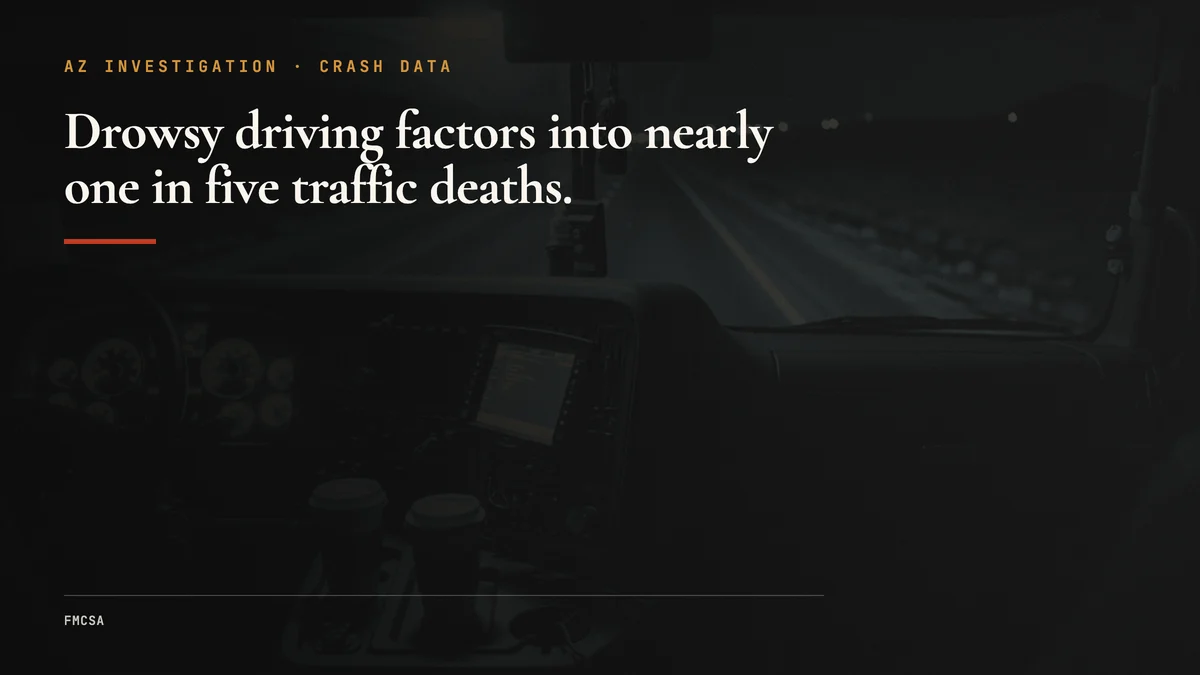
The AAA Foundation for Traffic Safety published research in 2024 that tells a different story. Their analysis of crash data from 2017 through 2021 found that drowsy driving is a factor in roughly 18% of all traffic fatalities. Not 1.5%. Eighteen percent. Nearly 30,000 deaths over five years.
That’s roughly 12 times higher than the official count.
The gap exists because drowsy driving is hard to code in a crash report. There’s no breathalyzer for fatigue.
If a driver falls asleep, crosses the median, and dies in the collision, the crash report codes the cause as “crossed center line” or “failure to maintain lane.” The fatigue that caused it never makes the report.
FMCSA’s own Large Truck Crash Causation Study found that 13% of truck drivers in crashes were coded as fatigued. Another 3.2% were coded as “pressured to operate even though fatigued.” Driver non-performance, meaning the driver was asleep or incapacitated, was the critical reason in 11.6% of cases where the truck was assigned fault.
Fatigue doesn’t show up in the data the way alcohol does. But it kills at a scale that AAA’s research puts closer to impaired driving than anyone wants to admit.
147 Crashes on I-10 in Five Years
ADOT published a Statewide Truck Parking Plan in January 2024. Buried in the working paper is a five-year analysis of driver-fatigue and parked-vehicle crashes on Arizona’s interstates from 2017 through 2022.
I-40 led with 158 driver-fatigue and parked-vehicle crashes. Thirty-two percent of the state total.
Our I-40 truck crash investigation maps where fatal truck crashes on that corridor cluster, on the 82 miles leading into Flagstaff.
I-10 was a close second at 147. Roughly 30%.
Our I-10 truck crash investigation maps every fatal truck crash on that road from 2015 to 2024. Deaths rose 76% between the first five years and the last five.
Those two corridors account for more than 60% of all driver-fatigue and parked-vehicle truck crashes in Arizona. I-10 runs through the West Valley. Through Buckeye. Through Goodyear. Past the warehouses and the construction zones and the schools.
The data doesn’t surprise me. I-10 through Arizona is a long-haul corridor. Trucks come off the California border at Ehrenberg, run 180 miles to Phoenix, and another 115 to Tucson. The stretch between Ehrenberg and Phoenix is flat, straight, and monotonous. Temperatures above 100 degrees for months at a time. The cab gets hot.
The road doesn’t change. Fatigue sets in.
And when it sets in at 65 miles per hour in an 80,000-pound vehicle, the margins disappear.
The Loop 202 Milk Tanker: What 83 Hours a Week Looks Like
On June 9, 2021, a milk tanker on Loop 202 in Phoenix crashed into stopped traffic near Van Buren Street at about 10 p.m. The tanker separated from the truck, crossed the median into westbound lanes, and burst into flames. Eight vehicles were involved in the chain reaction.
Four people died. Sedeqwa Keyara-Parker, 35. Alexius Hooper, 21. Dante Brubeck, 20. Jennifer Vidal, 20. Eleven more were injured.
The NTSB investigated. The probable cause: driver fatigue.
The driver, Cesar Gavonel, was going 64 mph. He never slowed. No evidence of impairment. Dash cam footage showed him staring forward for 10 seconds before impact with no awareness of the stopped traffic ahead. He wasn’t drunk. He was exhausted.
The NTSB report revealed what his schedule looked like. He’d worked 83 hours one week and 77 hours another within the month before the crash. Thirteen to fourteen hour days were routine.
He’d gotten five to six hours of sleep opportunity in the day before the crash. He was paid per load of milk transported, not by the hour.
His employer, Arizona Milk Transport, operated under an agricultural hours-of-service exemption that allowed unlimited driving within a 150 air-mile radius. The company had no standalone fatigue management program. Seventy-seven percent of dash cam safety events at AMT didn’t have a driver assigned. One driver had 128 flagged events in ten months.
The NTSB found AMT’s safety culture “inadequate.” They recommended FMCSA study the safety performance of carriers using the agricultural exemption.
FMCSA responded that it was “unable to satisfy the statutory criteria to modify or revoke the exemption” due to limited data.
The Maricopa County Attorney declined to file manslaughter charges despite a DPS recommendation.
Federal HOS rules include an exemption for agricultural carriers operating within 150 air miles of their base. There’s no driving time limit within that radius.
The Loop 202 milk tanker crash killed four people and injured eleven because a driver operating under this exemption was working 83-hour weeks with no regulatory limit. The exemption still exists.
The Pay Structure That Kills
Most long-haul truck drivers are paid per mile. Not by the hour. The difference matters.
Per-mile pay creates a direct financial incentive to maximize driving hours and minimize rest. Every hour parked is an hour of lost income. Loading, unloading, waiting at docks, running inspections, none of it generates a paycheck for most drivers. Only miles count.
The National Academy of Sciences documented drivers working roughly 70 hours per week under this structure. The FMCSA’s own crash causation study found 9.2% of truck drivers in crashes were under work-related pressure. Three percent were pressured to drive while fatigued.
The Super Ego model exposed by 60 Minutes takes this further. Drivers described coming home with negative amounts on their paychecks after fees for leases, insurance, and repairs were deducted. When your take-home is zero or negative, you run harder. You skip the rest break. You let the dispatcher reset your clock.
The American Trucking Associations reported a shortage of roughly 60,000 drivers in 2024. Annual turnover at large truckload carriers exceeds 90%. High turnover plus a shortage means the remaining drivers face pressure to run harder, longer, and with less rest.
Where Do Tired Drivers Park?
They often can’t. That’s part of the problem.
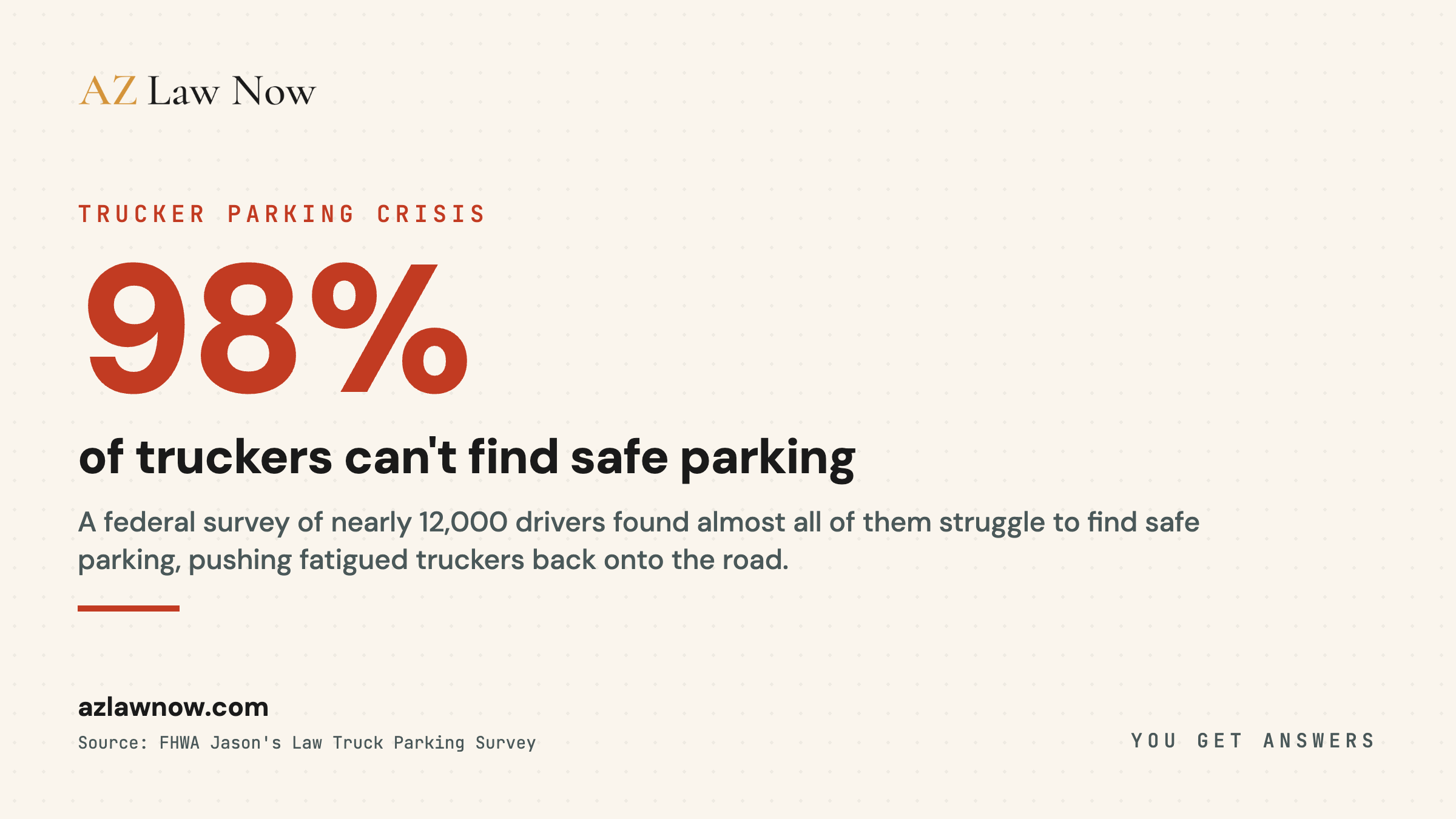
The FHWA’s Jason’s Law survey found approximately 313,000 truck parking spaces nationwide. Of 11,696 drivers surveyed, 98% reported problems finding safe parking. Seventy-five percent said it happened at least weekly. Parking is most difficult between 4 p.m. and 5 a.m., which is exactly when fatigued drivers need it most.
Arizona was among states that saw a decline in public truck parking spaces between 2014 and 2019.
ADOT responded with a $2.8 million Truck Parking Availability System on I-10, installing real-time monitoring at four rest area locations between Ehrenberg and the New Mexico border. The system tracks 550-plus spaces and shows availability on electronic signs and az511.gov.
They’ve also proposed 842 new parking spaces and secured $32 million to add 370 spaces at the Burnt Wells rest area near Tonopah, the Meteor Crater rest area near Winslow, and a new lot near Willcox.
These are real investments. But the I-10 Corridor Coalition’s own survey found 78% of drivers spend more than 30 minutes searching for safe parking. When they can’t find it, they face a choice. Park on a shoulder or ramp. Or keep driving.
The connection between parking shortage and fatigue crashes is direct. ADOT’s own truck parking plan acknowledges it. Drivers who can’t find safe parking either park unsafely or exceed their hours. Both create risk.
The ELD Cheating Network
Electronic logging devices were supposed to solve the hours-of-service enforcement problem. The mandate took full effect in December 2019. Every truck must have one. The device records driving time automatically and can’t be manually overridden.
Except it can.
The 60 Minutes investigation showed Super Ego dispatchers remotely resetting ELD clocks from Serbia. Court documents from a separate case against Chicago-area fleet Extra Mile International revealed a Telegram group chat where drivers could request extra hours. Screenshots showed logbooks being reset through a “Log Department.”
The ELD providers involved, Phoenix ELD and Log365, had common ownership. Phoenix ELD was subsequently removed from FMCSA’s registered device list.
Since 2019, FMCSA has revoked 64 ELD devices from the registered list. Since September 2025, they’ve blocked 280 new ELD registrations under a new vetting process. In early 2026, FMCSA announced six concurrent investigations targeting chameleon carriers, CDL mills, and ELD fraud, cooperating with the FBI, ATF, DOJ, and DHS.
CVSA made ELD tampering the driver emphasis area for the 2025 International Roadcheck. The message is clear: the agency knows the devices are being gamed.
The question is whether enforcement can match the scale of the fraud. FMCSA found carrier addresses listed as principal places of business for 400 to 500 carriers. Over 2,000 carriers operating from P.O. boxes and UPS stores. The new Motus registration system is supposed to flag these patterns.
It’s replacing a system built 40 years ago.
What You Can Do If a Fatigued Trucker Hits You
Fatigue cases are harder to prove than impairment cases. There’s no blood test. No breathalyzer. The evidence is in the electronic records.
The ELD data shows exactly when the driver was driving and for how long. The event data recorder captures speed, braking, and acceleration in the seconds before impact. Dispatch communications show whether the driver was pressured to keep running.
Maintenance logs show whether the carrier was cutting corners elsewhere. The driver’s personal phone records can show whether they were awake and active during hours they were supposed to be resting.
All of this data has limited retention windows. ELD data can be overwritten. Event data recorder storage varies by manufacturer. Dispatch records are held by the carrier, who has every incentive to let them disappear.
A spoliation letter sent on day one to the carrier, the ELD provider, and the truck manufacturer preserves everything. Without it, the evidence that proves fatigue was the cause may not exist by the time you need it.
Arizona’s pure comparative negligence system under ARS 12-2505 means the trucking company will try to shift fault onto you. If they can show you were 20% at fault, your recovery drops by 20%. But there’s no cap on damages in Arizona, and if the carrier’s negligence was willful, a jury can award punitive damages.
Drivers and families in a truck crash on I-10 or any Arizona highway who suspect the driver was fatigued can reach AZ Law Now at (602) 654-0202 or through the contact form. An initial review pulls ELD data, dispatch records, and carrier safety histories. Intake is confidential. Representation is on contingency.
What I’m Watching
FMCSA announced plans for a new Large Truck Crash Causation Study starting in 2026. It’ll examine over 2,000 fatal truck crashes to identify causes including fatigue, distraction, and speeding. It’s the first update to the original study in 20 years.
The agricultural HOS exemption that enabled the Loop 202 milk tanker crash still exists. NTSB recommended FMCSA study it. FMCSA said they lack the statutory authority to change it. Four people are dead and eleven were injured, and the regulatory gap that caused it remains open.
I’ll keep pulling the data as it comes. The I-10 corridor through the West Valley is adding trucks faster than it’s adding parking spaces or enforcement capacity. The math only goes one direction.
Related Coverage
For the legal and process context, see Ron DeBrigida’s guide to Arizona truck crash law, Stephanie Ramirez’s truck crash guide, the truck crashes practice overview.
Frequently asked questions
What are hours-of-service rules for truck drivers?
How common are HOS violations?
Can electronic logging devices be tampered with?
How many fatigue-related truck crashes happen on I-10 in Arizona?
How do I prove a truck driver was fatigued?
What was the Loop 202 milk tanker crash?
Is driving tired illegal in Arizona?
What is the 8 70 rule?
Who is Bekzhan Beishekeev?
What are 5 signs of driver fatigue?
Sources & references
- Federal Motor Carrier Safety Administration. (2024). Pocket Guide to Large Truck and Bus Statistics. Retrieved from https://www.fmcsa.dot.gov/sites/fmcsa.dot.gov/files/2025-09/FMCSA%20Pocket%20Guide%202024-v6%20508%20.pdf
- AAA Foundation for Traffic Safety. (2024). Drowsy Driving in Fatal Crashes: United States, 2017-2021. Retrieved from https://aaafoundation.org/drowsy-driving-in-fatal-crashes-united-states-2017-2021/
- Commercial Vehicle Safety Alliance. (2024). 2024 International Roadcheck Results. Retrieved from https://cvsa.org/news/2024-roadcheck-results/
- National Transportation Safety Board. (2023). Highway Investigation Report HWY21MH008: Loop 202 Milk Tanker Crash. Retrieved from https://www.ntsb.gov/investigations/AccidentReports/Reports/HIR2304.pdf
- Arizona Department of Transportation. (2024). Statewide Truck Parking Plan. Retrieved from https://azdot.gov/sites/default/files/2025-08/WP1-Statewide-Truck-Parking-Plan.pdf
- Federal Motor Carrier Safety Administration. (n.d.). Report to Congress: Large Truck Crash Causation Study. Retrieved from https://www.fmcsa.dot.gov/safety/research-and-analysis/report-congress-large-truck-crash-causation-study
- FHWA. (2019). Jason's Law Truck Parking Survey Results https://ops.fhwa.dot.gov/freight/infrastructure/truck_parking/jasons_law/truckparkingsurvey/jasons_law.pdf
- Overdrive. (2026). ELD Tampering Officially an Out-of-Service Violation https://www.overdriveonline.com/electronic-logging-devices/article/15821159/eld-tampering-officially-an-outofservice-violation
- FOX 10 Phoenix. (2023). Fatal Fatigue: Loophole Allows Specific Truckers to Drive Beyond Time Limits https://www.fox10phoenix.com/news/fatal-fatigue-loophole-allows-specific-truckers-drive-beyond-time-limits
- CDL Life. (2026). Over 900 Violations Uncovered During Two-Day Enforcement Detail in Arizona https://cdllife.com/2026/over-900-violations-uncovered-during-two-day-commercial-vehicle-enforcement-detail-in-arizona/