
The Finding
When a semi hits you on I-10 or I-17 in Phoenix, the first question in your case isn’t only who was at fault. It’s how much insurance stands behind the truck.
Federal law sets the floor at $750,000 for most trucks hauling freight. We checked how often the floor is all there is.
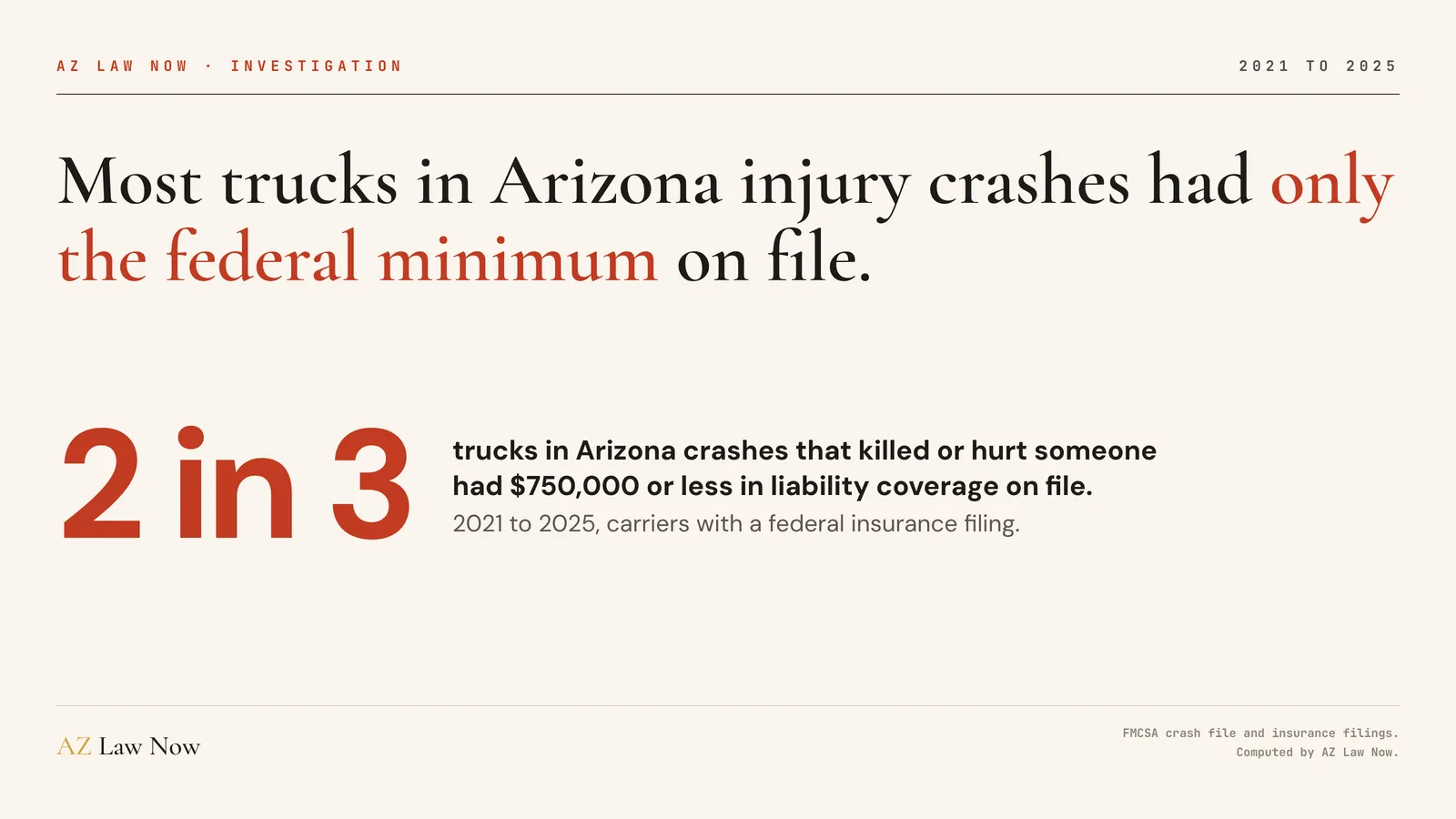
Of 2,648 trucks in Arizona injury and fatal crashes whose carriers had a federal insurance filing, 1,647 had exactly $750,000 on file on the day of the crash. Another 105 had less. Only 272 had more than $1 million.
How I Counted
The Federal Motor Carrier Safety Administration keeps a crash file of every truck and bus crash states report to it. Arizona reports crashes where someone died, someone was taken for medical treatment, or a vehicle had to be towed.
I kept trucks in Arizona crashes from 2021 through 2025 that killed or injured at least one person. That’s 3,769 trucks.
Each record carries the carrier’s USDOT number. FMCSA also publishes the liability insurance every carrier has filed to keep its operating authority, active and canceled, with start and end dates.
I matched each truck to the filings in force on the crash date and kept the highest liability limit. 2,648 trucks had a filing that day. The other 1,121 didn’t, which the next section explains.
We don’t name trucking companies. Every number here is an aggregate.
What the Federal Rule Requires
Under 49 CFR 387.9, a for-hire carrier hauling non-hazardous property across state lines, in a vehicle rated at 10,001 pounds or more, must carry at least $750,000 in liability coverage.
Oil, hazardous waste, and some hazardous materials raise the floor to $1 million. Certain bulk hazardous loads raise it to $5 million. Smaller for-hire vehicles under 10,001 pounds have a $300,000 floor, which is where most of the 105 lower filings come from.
The data tracks the rule. Of the 100 trucks in these crashes carrying hazardous-materials placards, only 13 had $750,000 or less on file.

The Same in Fatal Crashes
You might expect trucks in the worst crashes to carry more coverage. They didn’t.
In crashes where someone died, 305 of 485 trucks with a filing had $750,000 or less, about 63%. Only 56 had more than $1 million.
The share barely moved over five years. In every year from 2021 to 2025, between 64% and 70% of trucks in Arizona injury and fatal crashes had $750,000 or less on file.
In the Phoenix area, where the crash report named the city, 337 of 588 trucks had $750,000 or less, about 57%. Many reports list no city, so the statewide figure is the firmer one.
The trucking company’s insurer starts working the claim right away, and its job is to pay as little as it can. You should have someone finding every policy that applies.
Call (602) 654-0202, 24/7, or get your free case review. No fee unless we recover.
Small Carriers, Minimum Coverage
The biggest split in the data is fleet size. FMCSA’s carrier census lists how many power units each company runs.
For carriers with 10 or fewer trucks, 948 of 1,071 trucks in these crashes had $750,000 or less on file, about 89%. Exactly one had more than $1 million.
For carriers with more than 500 trucks, the share at $750,000 or less fell to 30%. About the same share had more than $1 million on file.

Small carriers made up about 40% of the trucks with a filing in these crashes. On Arizona’s freight routes, a crash with a one- or two-truck operation is common, not rare.
Home state matters too. Carriers based in Arizona had $750,000 or less on file for 63% of their trucks in these crashes. For carriers based in California, the largest out-of-state group, it was 633 of 704 trucks, about 90%.
A 1985 Number
Congress set the $750,000 floor decades ago, and it has applied since 1985. It has never been raised.
In a January 2026 report to Congress, FMCSA calculated what the minimum would be if it had kept pace. Adjusted for general inflation, $750,000 from 1985 is about $2.19 million. Adjusted for medical costs, it’s about $3.73 million.
Those figures are FMCSA’s own. A $750,000 policy today has about a third of the buying power the minimum had in 1985.
One Limit, Every Victim
A liability limit covers the crash, not each person in it. When a truck hits several cars, everyone hurt draws from the same policy.
In these records, 369 trucks with $750,000 or less on file were in crashes that killed or injured two or more people. In 139 of them, three or more people were killed or hurt.
A long hospital stay, surgery, and months away from work can use up a large share of a $750,000 policy for one person. With several people hurt, it goes faster.
When There’s No Filing at All
The 1,121 trucks with no federal filing aren’t necessarily uninsured. Many belong to carriers that never have to file with FMCSA.
Private fleets hauling their own goods, such as a contractor’s dump truck or a store’s delivery truck, don’t file liability insurance with FMCSA. Neither do most carriers that only operate inside Arizona. In FMCSA’s census, 512 of these trucks belonged to carriers listed as Arizona-only operations without hazardous materials.
For those trucks, the coverage exists or doesn’t, but the public can’t see it. A lawyer has to ask for it.
What the Filing Doesn’t Show
The federal filing is the coverage a carrier certifies to keep its authority to haul freight. It isn’t always everything the carrier has.
A carrier can buy excess or umbrella coverage above the filed amount without filing it. Large fleets often do. A truck with $750,000 on file may have more behind it, or it may not.
Other companies can also matter. The business that owns the trailer, the shipper that loaded it, or the company that arranged the load may each have its own insurance, depending on what they did. Sorting that out takes the crash report, the bill of lading, the lease, and the driver’s records.
What This Means If You’re Hurt
For most trucks in serious Arizona crashes, the coverage on file is the federal minimum. For small carriers, it’s almost always the minimum.
That makes the first weeks of a truck case different from a car crash. The questions are whether there’s excess coverage, whether anyone else shares responsibility, and whether the evidence that proves it still exists.
If you were hurt or lost someone in a crash with a semi in Phoenix, don’t give a recorded statement to the trucking company’s insurer before you talk with a lawyer. Our Phoenix truck crash lawyers can look up the truck’s federal filings and start asking for the rest, and the first conversation is free.
Electronic logging data, dashcam video, and the truck’s engine data can be overwritten if no one asks for them in time. We move quickly to lock that evidence down and find every policy.
Call (602) 654-0202 now or start your free case review. No fee unless we recover.
Related Coverage
For where truck crashes happen most, see how I-10 truck crash deaths rose 76% between Phoenix and Tucson, where I-17 truck crash deaths cluster past Anthem, and the 82 miles of I-40 into Flagstaff.
For how carriers dodge their safety records, see our report on chameleon carriers on I-10. For what the law requires of trucking companies, see Ron DeBrigida’s guide to Arizona truck crash law.
Frequently asked questions
How much insurance does a semi truck have to carry in Arizona?
How many trucks in Arizona crashes carry only $750,000?
Is $750,000 enough to cover a serious truck crash?
Do small trucking companies carry less insurance?
Does the federal filing show all of a trucking company's insurance?
How did AZ Law Now match trucks to their insurance?
What should I do after a crash with a semi in Phoenix?
Sources & references
- Federal Motor Carrier Safety Administration. Crash File (aayw-vxb3), Arizona crashes 2021 to 2025. Retrieved October 19, 2026, from https://data.transportation.gov/Trucking-and-Motorcoaches/Crash-File/aayw-vxb3
- Federal Motor Carrier Safety Administration. ActPendInsur, All With History (qh9u-swkp). Retrieved October 19, 2026, from https://data.transportation.gov/resource/qh9u-swkp
- Federal Motor Carrier Safety Administration. InsHist, All With History (6sqe-dvqs). Retrieved October 19, 2026, from https://data.transportation.gov/resource/6sqe-dvqs
- Federal Motor Carrier Safety Administration. Company Census File (az4n-8mr2). Retrieved October 19, 2026, from https://data.transportation.gov/resource/az4n-8mr2
- Federal Motor Carrier Safety Administration. (2026). Examining the Appropriateness of the Current Financial Responsibility and Security Requirements for Motor Carriers, Brokers, and Freight Forwarders. Report to Congress, January 2026.
- Code of Federal Regulations. 49 CFR 387.9: Financial Responsibility, Minimum Levels. Retrieved October 19, 2026, from https://www.ecfr.gov/current/title-49/subtitle-B/chapter-III/subchapter-B/part-387/subpart-A/section-387.9
- Arizona State Legislature. ARS 12-542: Limitation of Actions, Personal Injury. Retrieved October 19, 2026, from https://www.azleg.gov/ars/12/00542.htm
- Arizona State Legislature. ARS 12-611: Wrongful Death Action. Retrieved October 19, 2026, from https://www.azleg.gov/ars/12/00611.htm