
You’re in a Phoenix emergency room. A doctor has told you that you need to be admitted. And then nothing moves.
An hour passes. Two hours. You’re still on a gurney in the hallway. You’re watching nurses walk past. You’re watching other patients arrive, get assessed, and either leave or get moved. You’re still in the hallway.
What’s happening to you has a name: ER boarding. It’s when admitted patients wait in the emergency department for an inpatient bed that isn’t ready. It’s one of the most documented patient safety risks in American hospitals. And in Arizona, it’s nearly invisible to the public.
The data exists. The federal government publishes it. What Arizona doesn’t do is put it in front of the people who need it most.
What ER Boarding Actually Means
Boarding isn’t the same as waiting to see a doctor. Boarding starts after the doctor has already seen you, assessed you, and decided you need hospital admission. The hospital doesn’t have a floor bed ready, so you stay in the ED.
The Joint Commission, the accreditation body that certifies most US hospitals, has said boarding shouldn’t exceed four hours. That benchmark has since been sunsetted as a mandatory reporting measure. It’s a recommended standard, not an enforced limit.
What the data shows nationally is that the standard is routinely missed. A Health Affairs study of 46.2 million hospitalizations from 2017 to 2024 found that at the peak in January 2022, 40.1% of patients boarded more than four hours and 6.3% boarded more than 24 hours.
The clinical consequences are documented: excess in-hospital mortality, increased medication errors, delayed treatments, delirium (especially in elderly patients), longer overall hospital stays, and higher costs.
Per the AHRQ technical report published in March 2025, boarding is “harmful to patients and linked to higher mortality rates, increased medical errors, longer hospital stays, increased healthcare costs, staff burnout, ED violence, and strain that ripples through entire healthcare systems.”
AHRQ held a Summit to Address Emergency Department Boarding on October 8, 2024, following a bipartisan letter from 44 members of Congress to HHS asking for federal action.
That’s where we’re at nationally: bipartisan congressional alarm, an AHRQ summit, a 2025 technical report. In Arizona, the state hasn’t passed a law or published guidance on the subject.
The Data Arizona Doesn’t Synthesize
CMS publishes emergency department throughput data for every Medicare-participating hospital in the country.
The relevant measures are OP-18b (median time from ED arrival to departure for patients who aren’t admitted) and ED-1b (median time for patients who are admitted, from arrival to the admit decision). These are public. You can download the CSV from the CMS Provider Data Catalog.
What you can’t do, if you’re an Arizona patient or family member, is find a state-level synthesis of that data that lets you compare hospitals before you need one.
I’ve looked at what Arizona publishes. ADHS maintains a Hospital Compare tool at gis.azdhs.gov. Whether it includes OP-18b or boarding-specific metrics requires a direct portal query, and it doesn’t appear to surface boarding measures as a comparison category for patients.
The Arizona Hospital and Healthcare Association endorses “transfer pathways that prioritize clinical need, reduce ambulance offload delays and prevent unnecessary ED boarding.” That’s the industry association, on the record, acknowledging the problem. It’s not a reporting obligation. It’s a position statement.
ACEP maintains a list of states with specific laws, regulations, or health department guidance on ER boarding and crowding. Minnesota has a joint task force report. Pennsylvania has Department of Health guidance. Virginia, Texas, New Mexico, Massachusetts, and New Jersey each have documented state-level approaches. Arizona doesn’t appear.
Seven states. Zero Arizona.
The federal data sits in a CSV. No Arizona state agency tells you what it means for the hospital near your house.
Which Arizona Hospitals Have the Longest ER Waits
The CMS-derived data, aggregated by third-party sources that pull from the federal dataset, shows a pattern worth reporting carefully.
Based on available CMS-derived figures:
- Banner Estrella Medical Center (Phoenix): 5.6 hours average ER time
- Banner University Medical Center Tucson: 5.4 hours
- Banner University Medical Center Phoenix: 4.9 hours
- Banner Baywood Medical Center: 4.5 hours
- Banner Desert Medical Center: 4.2 hours
For comparison, the shortest average wait times in Arizona are below two hours, clustered at rural and smaller facilities: Dignity Health Arizona General Hospital (1.5 hours), Banner Health Page Hospital (1.5 hours), and several rural and tribal facilities.
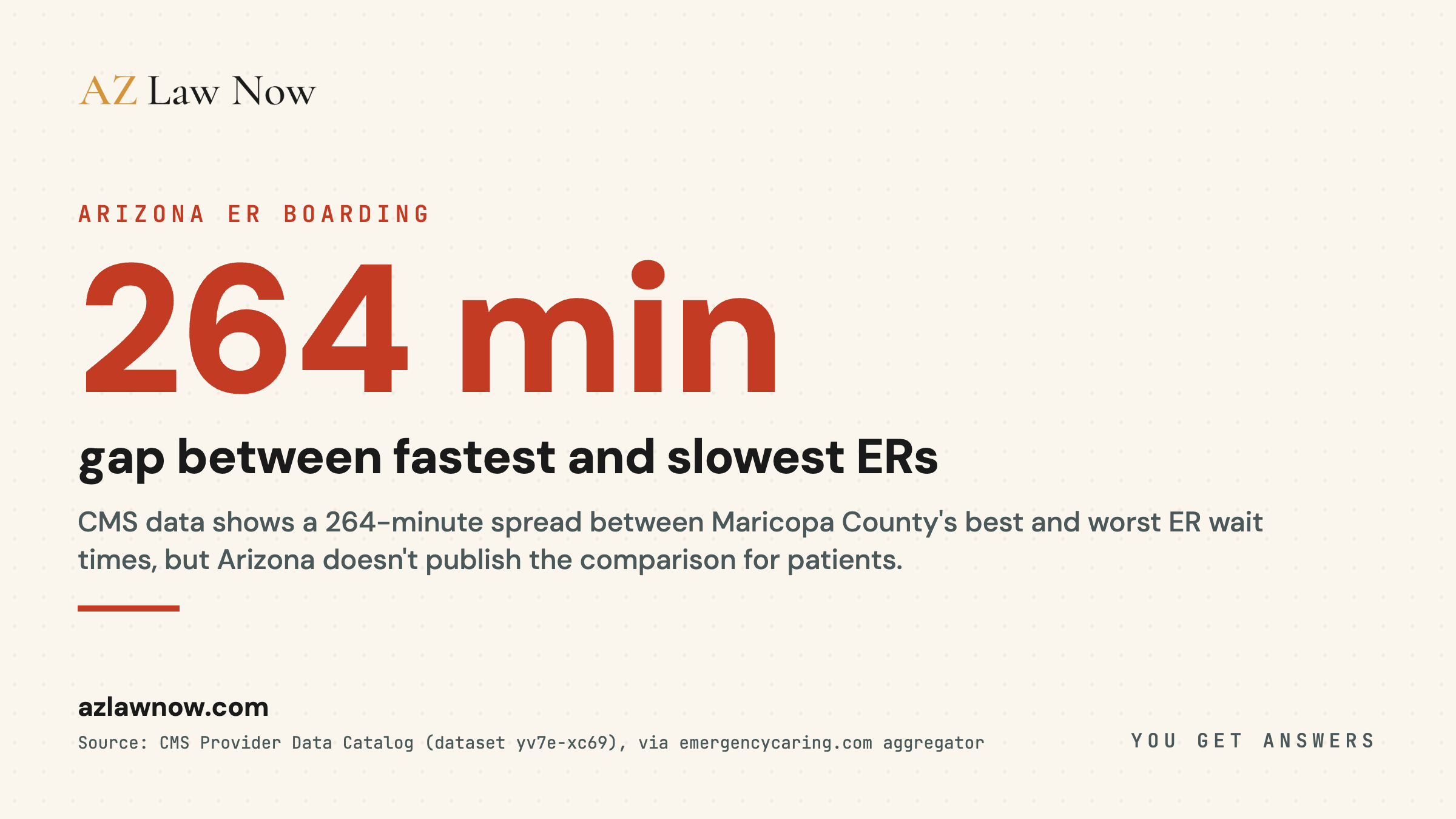
The gap between the fastest and slowest ER in Maricopa County is 264 minutes.
I need to flag the verification status of these numbers. The figures above come from secondary aggregators that pull from the CMS dataset.
They report average total visit times, not the specific boarding measure (median time from admit decision to departure). Those two things are different.
The CMS CSV is the right source. The secondary aggregators have date-unknown pulls. Before citing Banner Estrella at 5.6 hours in any legal or regulatory context, pull the CMS raw data at data.cms.gov/provider-data/dataset/yv7e-xc69 and verify the collection period.
That’s the pre-publication action this investigation is flagging openly.
What’s confirmed at HIGH confidence: the data exists. The gap exists. Arizona doesn’t synthesize it. That’s the story.
The Psychiatric Boarding Curve
The worst-case boarding scenario in any Arizona ED isn’t a cardiac patient waiting for a floor bed. It’s a person in psychiatric crisis waiting for a psychiatric bed.
Psychiatric patients board longer. They need a specific level of care that a medical floor can’t provide. When there are no psychiatric beds, they stay in the ED indefinitely. And in Maricopa County, the psychiatric bed situation in 2024 was bad.
In August 2024, St. Luke’s Behavioral Health was required to close. That removed 127 beds from Arizona’s psychiatric capacity. Agave Ridge Behavioral Hospital opened with 100 beds around the same time, a net reduction of at least 27 beds.
After St. Luke’s closed, Phoenix Medical Psychiatric Hospital, which has 96 total beds and 24 involuntary units, reported no availability in its involuntary units. In the prior three years, demand for beds more than doubled.
Meanwhile, across town, the Arizona State Hospital has empty floors.
The Ironwood and Palo Verde buildings at the Arizona State Hospital have physical space to house additional patients. They sit empty.
The reason is a 1995 stipulation agreement: the Arnold v. Sarn Stipulation Agreement caps Maricopa County residents at 55 beds in the Arizona State Hospital’s civil units.
This cap isn’t in state statute. It lives in the Arnold v. Sarn stipulation, with the litigation formally closed by a 2014 settlement agreement.
SB1813, introduced in the 2026 Arizona legislative session, would remove the cap. The Arizona Public Health Association estimates this could add “more than twenty badly needed treatment slots.”
The bill’s final status as of this report’s publication date hasn’t been confirmed. Pull from the AZ Legislature tracker at azleg.gov before citing it as passed or enacted.
Dr. Michael White, Valleywise Health’s chief clinical officer, put it plainly to KJZZ in October 2025: “They may be having to sit in the emergency department because we do not have a bed to admit them to.”
Valleywise Health is the only health system in Maricopa County that provides court-ordered mental health evaluation services for adults. When Valleywise is full, the line ends at the emergency department.
As of the Prop. 409 campaign in 2025, Valleywise was experiencing patient volumes it had projected for 2028 to 2029.
Maricopa County voters approved the $898 million Prop. 409 bond on November 4, 2025, to fund a new 200-bed behavioral health hospital and expanded ED capacity. That facility doesn’t exist yet.
Heat Season and the Boarding Curve
Arizona’s boarding problem has a seasonal dimension that’s specific to this state.
Phoenix logged 113 consecutive days at or above 100 degrees in 2024, from May 27 to September 16. Approximately 4,298 Arizonans visit emergency rooms annually for heat-related illness. The heat-illness peak and the psychiatric decompensation peak land in the same months: June, July, and August.
Heat exacerbates psychiatric conditions. It worsens psychosis, interacts badly with psychiatric medications, and causes dehydration-driven cognitive deterioration. During summer, Maricopa County ERs face concurrent pressure from both heat-illness patients and people in psychiatric crisis, often the same patients.
Maricopa County confirmed 608 heat-related deaths in 2024. The 2024 figure was a decrease from 645 in 2023, the first year-over-year decline since 2014. That decline is partly attributed to heat-mitigation programs, partly to surveillance improvements. It’s not a trend yet. It’s one data point.
In the same 2024 heat season, a person in Arizona who needed inpatient psychiatric care faced a St. Luke’s-sized gap in the system and the 55-bed cap at the state hospital. The intersection of heat season, psychiatric bed shortage, and ER boarding pressure isn’t theoretical. It’s the calendar overlap every summer in Maricopa County.
Add the rural transfer dimension. Arizona has 17 critical access hospitals, each with fewer than 25 inpatient beds and an average patient stay cap of 96 hours.
When a CAH patient needs more time or specialty care, they transfer. The transfer destination is almost always Maricopa County. Rural transfers into metro Phoenix during heat season add to the pressure on already-stressed emergency departments.
Local boarders, psychiatric holds, heat-illness surge, and rural-transfer patients all compete for the same limited inpatient beds during the same summer months. That combination is Arizona’s specific boarding problem.
No other state has this exact pattern: extreme-heat metro, psychiatric bed cap from an Arnold v. Sarn stipulation agreement, sole court-ordered evaluation provider, and no state-level boarding regulation.
What the Federal Benchmarks Say vs. What Arizona Reports
Here’s the reporting gap in plain terms.
CMS collects OP-18b and ED-1b data from every Medicare-participating hospital in Arizona and publishes it in a publicly downloadable CSV. The most recent release covers 12 months ending June 2025.
The national median ED visit time is 161 minutes, down from 163 minutes the prior year. CMS also publishes state-level averages. Arizona’s specific state average for admitted-patient boarding time hasn’t been pulled and synthesized for this report. That’s a flagged pre-publication action.
What I can say: the secondary aggregators show a 264-minute range within Maricopa County alone. The best Arizona hospital in the CMS data is more than four times faster than the worst.
That range is a patient safety story. It means that where you’re taken in an ambulance may decide your boarding time more than your own acuity does.
Arizona doesn’t publish this comparison for patients. The federal government does, but not in a form that a family member searching “best ER near me” will find. That’s the transparency gap.
This investigation is built on HIGH and MEDIUM confidence claims. Several additional data points would sharpen the comparison but weren’t retrievable in this reporting window:
Facility-level OP-18b values for specific Arizona hospitals directly from the CMS CSV (not secondary aggregators). Arizona’s state-average admitted-patient boarding time from the CMS state dataset.
Heat-illness ER visit volume for Maricopa County specifically in summer 2024, from the CDC NSSP/BioSense dashboard. ADHS complaint records involving ER patient safety incidents tied to boarding, from the ADHS Complaint Tracker at app3.azdhs.gov.
These are public records. Pull them. The framework for what they’d show is in this investigation.
EMTALA and boarding patients
EMTALA (42 USC 1395dd) requires all Medicare-participating hospitals to provide a medical screening exam to any patient presenting to the emergency department, and to stabilize emergency conditions before discharge or transfer.
Those obligations end when a patient is formally admitted as an inpatient, even if they’re still physically in the ED. A patient boarding in the pre-admission window retains full EMTALA protection.
Violations carry a civil monetary penalty of $119,942 per violation for hospitals with more than 100 beds, and $59,973 for hospitals with 100 beds or fewer (current inflation-adjusted figures per 42 CFR §1003.500), separate from malpractice exposure.
Negligence claims
A boarding patient who suffers harm from delayed treatment, whether through an unmonitored condition, a missed medication, or a lab that wasn’t ordered, may have a negligence claim under Arizona common law.
The standard: what a reasonably competent emergency physician would have done. Arizona’s Supreme Court clarified in October 2025 in Henke v. Hospital Development of West Phoenix that expert testimony that negligence was “likely” the cause can satisfy the standard.
Statute of limitations
ARS 12-542: two years from the date the cause of action accrues. Arizona follows a discovery rule (Kenyon v. Hammer), meaning the clock starts when you knew or should have known of both the injury and the negligent cause. Wrongful death: two years from date of death. No statute of repose.
No damages cap
Arizona Constitution Article 2, Section 31 bars statutory caps on damages for death or personal injury. There is no ceiling on what a Maricopa County jury can award.
ADHS complaint pathway
ARS 36-405 gives the ADHS Director licensing authority over health care institutions, including enforcement authority for patient care standards. If a hospital’s ER operations caused harm, an ADHS complaint is one accountability channel available in parallel with any civil action. File at app3.azdhs.gov.
This is informational, not legal advice. Families who believe a boarding delay caused harm should consult an Arizona attorney promptly.
If Your Family Was Harmed in an ER Hallway
Three things to do now.
First, get the timeline on paper. The exact time the attending physician said “we’re admitting you” is the start of the boarding clock. Ask the medical records department for the admit-decision timestamp, the time of transfer to the floor, and the nursing notes from the ED period. Those records are yours under Arizona law.
Second, document what changed while you were waiting. Did the patient’s condition worsen? Was there a missed medication window? Was a lab ordered late? Was there a deterioration that a floor nurse would have caught sooner?
The harm from boarding isn’t always a single catastrophic event. It’s often incremental: the antibiotic that was four hours late, the delirium that set in because an elderly patient was alone in a hallway, the blood pressure reading no one noticed.
Third, talk to an attorney. The two-year clock under ARS 12-542 starts when you knew or should have known of the negligent cause. Don’t wait to figure out whether the delay mattered. Let an attorney make that assessment with the records in front of them.
ER boarding delays don’t only hurt the patient. They hurt the whole family. Contact AZ Law Now at (602) 654-0202 or through the contact form. We handle medical negligence cases across Maricopa County. Intake is confidential. Representation is contingency.
This investigation connects to AZ Law Now’s broader coverage of Arizona’s heat-season patient safety gap. Related: APS Cut a Sun City Widow’s Power After Ending the 95-Degree Hold and the Arizona pedestrian death data showing the same infrastructure-lagging-behind-population pattern.
What I’m Watching
The immediate reporting move is the CMS CSV pull. The facility-level OP-18b figures for every Arizona hospital are in that dataset. What’s in this investigation is the secondary-aggregator summary. The primary data is one download away. When I publish those numbers with the CMS collection period cited, the hospital comparison becomes definitive.
SB1813 matters. If Arizona lifts the 55-bed cap at the state hospital, that directly reduces psychiatric boarding in Maricopa County EDs. I want to see the vote. I want to see the governor sign or veto. I want to track whether the Ironwood and Palo Verde floors actually open.
The Prop. 409 funding is real. The 200-bed behavioral health facility it funds won’t be built tomorrow. The question is whether Maricopa County’s ED psychiatric boarding capacity closes the gap between now and when that building opens.
And I’m watching whether AHRQ’s 2025 boarding technical report translates into federal CMS action: new mandatory reporting requirements, transparency upgrades, or reimbursement changes that give hospitals a financial incentive to clear ED boarding faster. The bipartisan congressional letter that triggered the October 2024 AHRQ summit suggests there’s political will. What happens next is the story.
Arizona’s ER boarding problem isn’t a secret. It’s a documented national crisis with a local face. The data is federal and it’s public. What’s missing is a state that synthesizes it, reports it, and holds hospitals accountable to a standard. Seven states have started down that road. Arizona hasn’t taken the first step.
Frequently Asked Questions
Frequently asked questions
What is ER boarding and why does it matter?
Which Arizona hospitals have the longest ER wait times?
Why is Arizona's psychiatric bed shortage making ER boarding worse?
Does Arizona have any laws about ER boarding?
How does the Arizona heat season affect ER boarding?
Can I sue if I or a family member was harmed while boarding in an ER?
What is EMTALA and how does it protect ER patients?
What should I do if a family member is waiting in an ER for hours after being told they're admitted?
Sources & references
- Centers for Medicare and Medicaid Services. Timely and Effective Care (Hospital). Provider Data Catalog dataset yv7e-xc69. Retrieved from https://data.cms.gov/provider-data/dataset/yv7e-xc69
- Centers for Medicare and Medicaid Services. Timely and Effective Care (State). Provider Data Catalog dataset apyc-v239. Retrieved from https://data.cms.gov/provider-data/dataset/apyc-v239
- Agency for Healthcare Research and Quality. (2025, March 25). AHRQ Summit to Address Emergency Department Boarding Technical Report. Retrieved from https://www.ahrq.gov/sites/default/files/wysiwyg/topics/ed-boarding-summit-report.pdf
- AHCCCS. (2025, March 20). 2024 Inpatient Psychiatric Treatment Report. Retrieved from https://www.azahcccs.gov/shared/Downloads/Reporting/2025/AHCCCS2024InpatientPsychiatricTreatmentReport.pdf
- Maricopa County Department of Public Health. (2025, May). 2024 Heat-Related Deaths Report. Division of Epidemiology and Informatics. Retrieved from https://www.maricopa.gov/ArchiveCenter/ViewFile/Item/5934
- Arizona Public Health Association. (2026, March 13). Bill Spotlight: SB1813 Ending the 55-Bed Cap for Maricopa County Residents at the Arizona State Hospital. Retrieved from https://azpha.org/2026/03/13/bill-spotlight-sb1813-ending-the-55-bed-cap-for-maricopa-county-residents-at-the-arizona-state-hospital/
- KJZZ. (2025, October 8). Maricopa County needs more behavioral health services. Prop. 409 would help, supporters say. Retrieved from https://www.kjzz.org/elections/2025-10-08/maricopa-county-needs-more-behavioral-health-services-prop-409-would-help-supporters-say
- Valleywise Health. (2024). Valleywise Health Welcomes Patients to New Medical Center. Retrieved from https://valleywisehealth.org/valleywise-health-welcomes-patients-to-new-medical-center/
- Ballotpedia. Maricopa County Special Health Care District, Arizona, Proposition 409 (November 2025). Retrieved from https://ballotpedia.org/Maricopa_County_Special_Health_Care_District,_Arizona,_Proposition_409,_Valleywise_Health_Healthcare_Facilities_Bond_Measure_(November_2025)
- Cronkite News. (2024, October 9). SMI patients at risk after St. Luke's hospital closure. Retrieved from https://cronkitenews.azpbs.org/2024/10/09/smi-patients-risk-after-st-lukes-hospital-closure/
- American College of Emergency Physicians. EMTALA Fact Sheet. Retrieved from https://www.acep.org/life-as-a-physician/ethics--legal/emtala/emtala-fact-sheet
- American College of Emergency Physicians. State Approaches to Boarding and Crowding. Retrieved from https://www.acep.org/state-advocacy/state-approaches-to-boarding--crowding
- Arizona Hospital and Healthcare Association. Access, Flow and Utilization Management. Retrieved from https://www.azhha.org/access-flow-and-utilization-mangement/
- Arizona Revised Statutes 12-542. Two-year limitation on personal injury and malpractice claims. Retrieved from https://www.azleg.gov/ars/12/00542.htm
- Arizona Revised Statutes 36-405. ADHS Director powers and duties over licensed health care institutions. Retrieved from https://www.azleg.gov/ars/36/00405.htm
- University of Arizona Center for Rural Health. Arizona Critical Access Hospitals. Retrieved from https://crh.arizona.edu/arizona-critical-access-hospitals
- emergencycaring.com. Arizona ER Wait Times (CMS-derived). Retrieved from https://emergencycaring.com/arizona-er-wait-times/
Tell Google to show our reporting more often in Search and AI answers.