
We mapped all 25 years of federal crash data to a uniform grid. The result: Arizona’s single deadliest patch for pedestrians is in west Phoenix, around Indian School Road between 27th and 35th avenues. 53 people have died walking there since 2000, most of them under working streetlights.
Arizona launched Arrive Alive Arizona, a five-year statewide traffic safety campaign, on June 29. Our new investigation measures it against the state’s own 25-year fatality record, where pedestrians’ share of Arizona’s traffic deaths has climbed from 13% to 21%.
Two hundred sixty-three people were killed walking in Arizona in 2024. That’s five per week. One every 33 hours.
The Governors Highway Safety Association puts Arizona’s pedestrian fatality rate at 3.6 per 100,000 residents, nearly twice the national average. By that measure, only New Mexico is worse.
I keep coming back to a question that sounds simple but isn’t. Why here? Why is Arizona consistently second in the country for killing pedestrians?
The answer isn’t complicated. It’s just uncomfortable. The roads were designed this way.
The Crashes Keep Climbing While the Country Gets Safer
Nationally, pedestrian deaths are finally trending down. The Governors Highway Safety Association reported 7,148 pedestrian fatalities across the US in 2024, a 4.3% drop from 2023. The first half of 2025 showed an even bigger decline, down 10.9%.
Arizona’s deaths edged down, from 273 in 2023 to 263 in 2024 per ADOT’s final count, a 3.66% drop. But the real warning sign isn’t the death count. It’s the crashes.
Pedestrian crashes in Arizona rose 35% between 2020 and 2024, from 1,538 to 2,079. That’s not a blip. That’s a trend with a slope. More people are getting struck every year, even as the national death toll falls.
2022 was the worst year on record for deaths: 307 people killed walking. The toll came down to 273 in 2023 and 263 in 2024. But “better than the worst year ever” isn’t progress when the crash count keeps climbing. It’s a plateau at an unacceptable level, propped up on a rising tide of collisions.
Five states account for 46% of all pedestrian deaths nationally. Arizona is one of them, alongside California, Florida, Georgia, and Texas. Arizona has a fraction of the population of those other states.
Maricopa County Is the Epicenter
ADOT’s 2024 data shows 2,079 pedestrian crashes statewide. Maricopa County had 1,516 of them, 73%.
Of 263 pedestrian fatalities, 158 were in Maricopa County. Sixty percent.
Add Pima County’s 52 deaths, and two counties account for nearly 80% of all pedestrian fatalities in Arizona.
This isn’t a statewide problem distributed evenly. It’s a Maricopa County problem with satellite numbers elsewhere.
The AAA Foundation for Traffic Safety published a 2025 study covering 2018 to 2022 that quantified the gap. Arizona’s male pedestrian fatality rate rose to 6.0 per 100,000, nearly double the national rate of 3.2. The female rate rose to 2.6 per 100,000, also roughly double the national figure.
The study tied that gap to the same root cause running through this whole story: a car-dependent built environment, where the road design itself puts people on foot in harm’s way.
76% Die in Darkness
Here’s the number that explains more than any other.
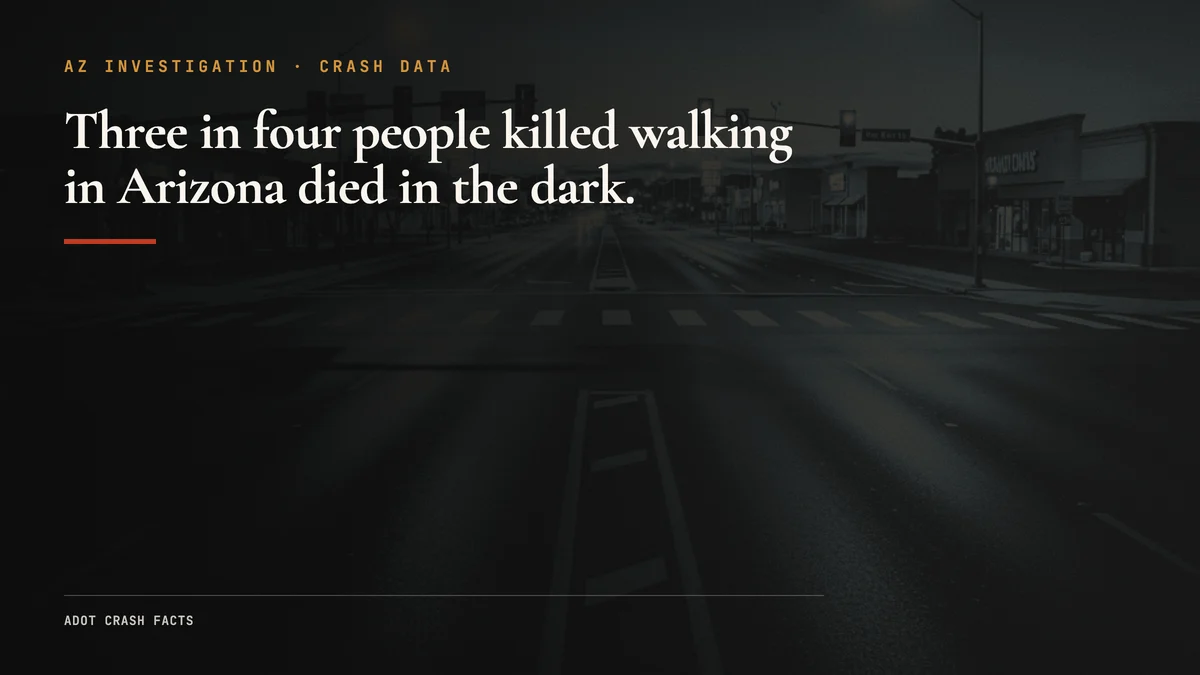
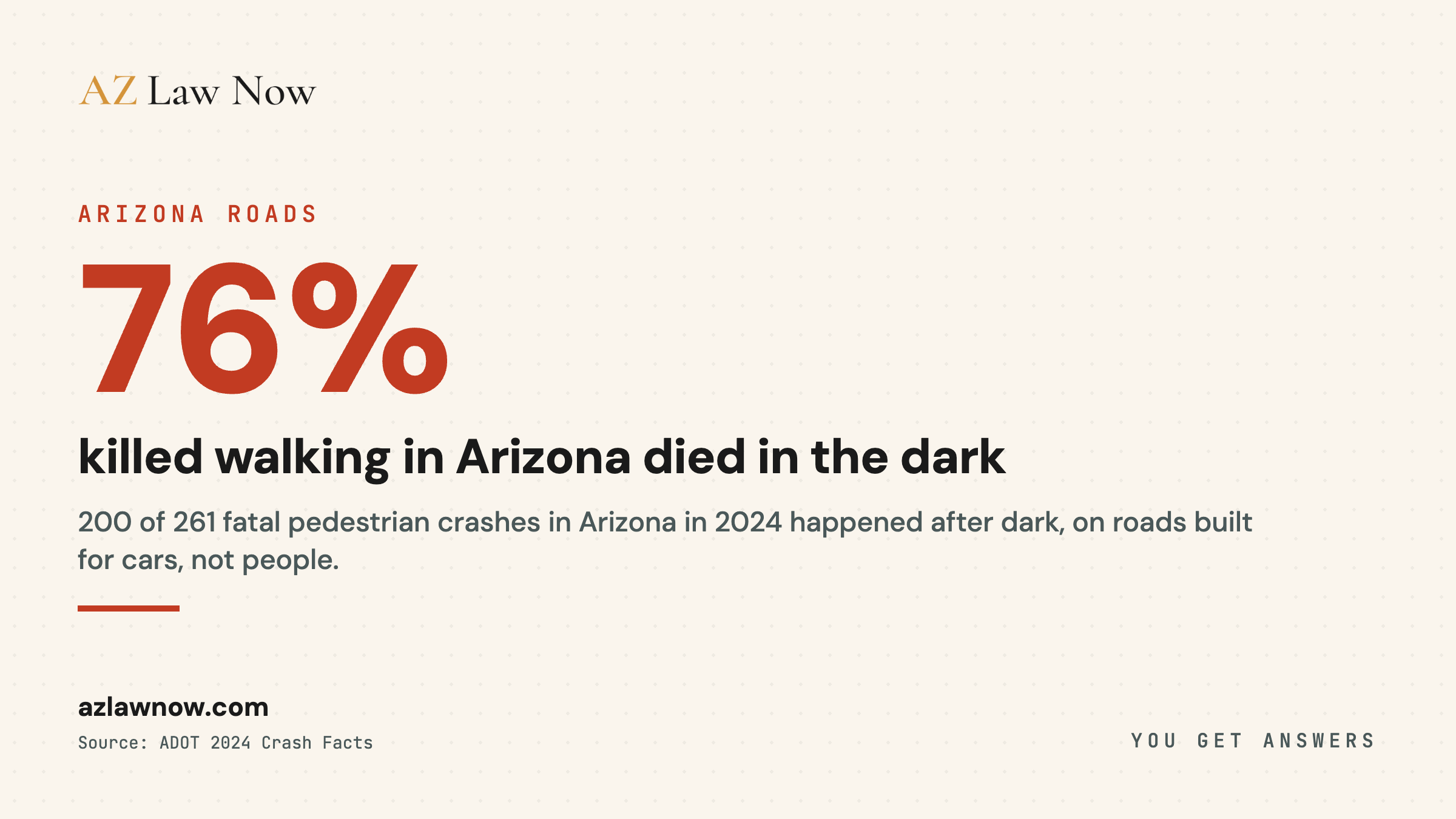
Of the 261 fatal pedestrian crashes in Arizona in 2024, 200 happened in the dark. That’s 76% of the people killed walking, struck after dark on roads built for vehicle speed, not for people on foot. Roughly three out of every four died at night or in low-light conditions, not in daylight.
Here’s the part that should change the conversation. 136 of those 200 dark fatal crashes happened in lighted areas, where streetlights were present. Only 49 were on roads with no lighting at all.
So this isn’t simply a missing-streetlight problem. People are dying under the lights, on wide arterials where the design itself invites speed. The road is the problem, not just the wattage.
Impairment is a recurring factor in Arizona’s pedestrian deaths, alongside darkness and road design. Alcohol and drug involvement, on the part of the pedestrian, the driver, or both, raises the odds that a crash turns fatal. It’s a public health problem intersecting with a road design problem.
Nationally, NHTSA data confirms the pattern. Seventy-seven percent of all US pedestrian fatalities occur in darkness. Seventy-three percent happen at non-intersection locations, away from any crosswalk or signal.
The profile is consistent. A person walking at night on a wide, fast road with no crosswalk and insufficient lighting. That describes thousands of road segments across Maricopa County.
The Roads Were Built for Cars
The Valley Urban Action Alliance put it plainly. “Much of the Phoenix MSA contains wide, multi-lane, high speed arterial roads.” Arterial roads are the most dangerous road type. Over two-thirds of all crashes nationwide happen on arterials, despite arterials making up a minority of total road miles.
Wide lanes communicate speed. A 12-foot lane feels like a highway. Drivers go faster than the posted limit because the road tells them to.
A road built for 45 mph with wide lanes and long sight lines will see actual speeds of 50 to 55 mph. The posted sign is a suggestion that the design contradicts.
Phoenix’s arterial grid was laid out for a city of cars. Seven-lane roads. Continuous turn lanes. Half-mile spacing between signals. No raised medians. No pedestrian refuges. Crosswalks that exist on paper but feel like a dare.
The ADOT Active Transportation Safety Action Plan, published in October 2024, identifies missing crosswalks, missing sidewalks, and missing pedestrian signals as key gaps across the state highway system. The plan’s goal is to reduce pedestrian fatal and incapacitating injury crashes by 25%.
That goal acknowledges the current design is killing people. The question is whether the fix comes fast enough.
Dangerous by Design
Smart Growth America publishes a Pedestrian Danger Index using five years of federal crash data. Arizona ranks fifth most dangerous in the country.
The top five: New Mexico (4.17), Florida (3.43), Louisiana and South Carolina (tied at 3.41), Arizona (3.38).
At the metro level, Tucson ranks third most dangerous in America with a 4.16 PDI score. Phoenix-Mesa-Chandler ranks 23rd among the 100 largest metros at 3.10.
The pattern across the rankings is consistent. Sun Belt states with sprawling, car-dependent development dominate the worst spots. Wide arterials, low-density land use, limited transit, and roads designed for throughput rather than safety.
Arizona fits the profile exactly.
Who’s Dying
The demographics tell a story the aggregate numbers hide.
Demographic Breakdown
Age
Working-age adults make up the largest share of the raw death toll. They’re the people walking most often on roads not designed for walking, to bus stops, to work, to the corner store.
But raw counts and fatality rates tell different stories. The very young and the elderly are more fragile in a crash. When a young child or an older adult is struck, they survive at far lower rates than the general population.
Gender
Men die as pedestrians at far higher rates than women. The AAA Foundation puts Arizona’s male pedestrian fatality rate at 6.0 per 100,000, against 2.6 for women, both well above the national figures for each.
Time
The deadliest stretch is the evening, after dark. A crash in dark conditions is far more likely to kill than the same crash in daylight. And it isn’t weather doing it. The vast majority of these crashes happen in clear conditions. It’s darkness on wide roads.
The West Valley Is Building Into the Problem
Buckeye went from 6,537 residents in 2000 to roughly 124,630 today. The city grew 33% just since the 2020 census. Teravalis, the Howard Hughes master-planned community, is approved for 300,000 residents at full buildout. The Sun Valley Parkway corridor could eventually house 750,000 people.
That growth is happening on roads designed for a town of 6,000.
Goodyear logged 10,000 traffic crashes on its roadways between 2018 and 2024. Of those, 59 were fatal and 170 resulted in serious injuries. The city is now developing a Road Safety Action Plan for 2026, collecting public input on which corridors need intervention.
Buckeye is building a Bicycle and Pedestrian Master Plan in collaboration with MAG. That plan addresses the infrastructure gap, but infrastructure takes years from plan to pavement. Homes are going up now. Roads aren’t changing until the funding, engineering, and construction timelines catch up.
The pattern is predictable. New subdivisions go in. Residents drive to work on I-10. But they also walk to the mailbox, to the bus stop, to the gas station at the corner.
They walk on roads with no sidewalks. They cross arterials with no crosswalks. They do it in the dark, because Arizona’s summer heat pushes outdoor activity to the evening hours.
A new subdivision in Buckeye can go from dirt to occupied homes in 18 months. A sidewalk project on the adjacent arterial can take three to five years from planning through construction. In the gap between rooftops and infrastructure, pedestrians walk on roads designed for 55-mph traffic.
Phoenix Tried Vision Zero. People Are Still Dying.
In September 2022, the Phoenix City Council unanimously approved a Vision Zero Road Safety Action Plan. The city committed $10 million annually to implementation. An 11-member community advisory committee was appointed. High-visibility crosswalks, red light cameras, traffic calming in neighborhoods.
Ed Hermes, the committee chair, said it plainly in 2025: “200 people a year die on our streets. We are double the national average in pedestrian deaths.”
The investment is real. The intention is real. But three years in, the death count hasn’t meaningfully dropped. Phoenix is still one of the deadliest cities in America for pedestrians, second only to Los Angeles in raw fatalities in 2023 with 109 pedestrian deaths.
ADOT published a statewide Strategic Highway Safety Plan updated in October 2024 with a pedestrian focus. The federal Safe Streets and Roads for All program has sent over $5 million to Arizona communities through the Bipartisan Infrastructure Law. Over a dozen Arizona communities have received SS4A grants in the first three years.
These are steps. They’re not enough yet. The roads that kill people today were built decades ago. Rebuilding them takes money, political will, and time. Meanwhile, 263 people died last year.
The MAG Top 100 List
The Maricopa Association of Governments publishes a Top 100 Crash-Risk Intersections list based on five years of data. The pedestrian crash hotspots cluster on the west and south sides of Phoenix, precisely where wide arterials meet populations with fewer transportation options.
67th Avenue and McDowell Road ranks first for crash risk on the MAG list. The other high-risk intersections cluster nearby, on the wide arterials of west and south Phoenix.
These aren’t highways. They’re the arterials people drive and walk on every day.
What You Can Do If You’re Hit While Walking
Arizona is a pure comparative negligence state under ARS 12-2505. You can recover compensation even if you were partially at fault for the crash. That matters in pedestrian cases because insurance companies routinely argue the pedestrian shouldn’t have been crossing where they crossed, or was wearing dark clothing, or was impaired.
The two-year statute of limitations under ARS 12-542 applies. But pedestrian injury cases are medically complex. Head injuries, spinal cord damage, pelvic fractures, internal bleeding. Treatment timelines often extend well beyond the initial ER visit. Documenting the full scope of injuries takes months.
If the crash involved a vehicle that left the scene, Arizona’s hit-and-run statute (ARS 28-661 through 28-665) requires drivers to stop and render aid.
A driver who causes a fatal pedestrian crash and then leaves the scene faces a Class 2 felony. Uninsured motorist coverage on your own auto policy may cover your injuries even if the driver is never found.
Get medical attention immediately. Even if you feel functional at the scene, adrenaline masks serious injuries. A hospital visit within 24 hours creates a medical record connecting your injuries to the crash. Without that record, the insurance company will argue the injuries came from something else.
Pedestrians and families of pedestrians struck while walking in Maricopa County can reach AZ Law Now at (602) 654-0202 or through the contact form. The firm handles pedestrian crash cases across the West Valley and Phoenix metro. Intake is confidential. Representation is on contingency.
What I’m Watching
I’m pulling intersection-level pedestrian crash data from ADOT’s Crash Information System for the West Valley. I want to map the specific crossings in Buckeye, Goodyear, and Avondale where pedestrians are getting hit. The MAG list covers the metro, but it doesn’t drill down to the specific suburban corridors where growth is outpacing infrastructure.
I’m also tracking the Goodyear Road Safety Action Plan as it moves through public input. If a city with 10,000 crashes in six years produces a plan with real engineering changes, that’s worth covering. If it produces a plan that’s mostly public awareness campaigns, that’s worth covering too.
Arizona doesn’t have a pedestrian death problem because people make bad choices. Arizona has a pedestrian death problem because the roads were designed for vehicles moving at speed, and then millions of people were asked to live, walk, and cross those roads.
The design is the problem. Until the design changes, the numbers won’t.
Related Coverage
For the legal and process context, see Ron DeBrigida’s guide to Arizona pedestrian law, Stephanie Ramirez’s pedestrian crash action plan, the pedestrian crashes practice overview.
Frequently asked questions
How many pedestrians are killed in Arizona each year?
Why is Arizona so dangerous for pedestrians?
Where do most pedestrian crashes happen in Maricopa County?
Is the West Valley getting more dangerous for pedestrians?
Can I sue if I was hit by a car while crossing the street?
What if the driver left the scene after hitting me?
Does Arizona have damage caps on pedestrian injury cases?
Sources & references
- Arizona Department of Transportation. (2025). 2024 Arizona Motor Vehicle Crash Facts. Retrieved from https://azdot.gov/sites/default/files/2025-07/2024-Crash-Facts.pdf
- Governors Highway Safety Association. (2025). Pedestrian Traffic Fatalities: 2024 Full-Year Preliminary Data. Retrieved from https://www.ghsa.org/resource-hub/pedestrian-traffic-fatalities-2024-data
- Smart Growth America. (2024). Dangerous by Design 2024. Retrieved from https://www.smartgrowthamerica.org/signature-reports/dangerous-by-design/rankings/
- AAA Foundation for Traffic Safety. (2025). Examining Traffic Safety across Communities: A National Perspective and Case Studies in Arizona, Maryland, North Carolina, and Oregon. Retrieved from https://aaafoundation.org/wp-content/uploads/2026/02/AAAFTS-202510-Equity-in-Traffic-Safety-Arizona.pdf
- National Highway Traffic Safety Administration. (2025). 2023 Traffic Safety Facts: Pedestrians. Retrieved from https://crashstats.nhtsa.dot.gov/Api/Public/ViewPublication/813727
- Arizona Department of Transportation. (2024). Active Transportation Safety Action Plan. Retrieved from https://azdot.gov/sites/default/files/2024-10/atsap-final-10-15-24-noappendices.pdf
- Maricopa Association of Governments. (2023). Top 100 Crash-Risk Intersections (2018-2022) https://azmag.gov/Portals/0/Documents/List-Top-100-Intersections-Ranked-by-Crash-Risk-MAG-2018-2022.pdf
- City of Phoenix. (2024). Road Safety Action Plan 2024 Annual Report https://www.phoenix.gov/content/dam/phoenix/streetssite/documents/safety-resources/PHXRSAP_2024AnnualReport_Final_reduced%20(2).pdf
- City of Goodyear. (2026). Road Safety Action Plan Development https://www.goodyearaz.gov/Home/Components/News/News/13601/1549
- KJZZ. (2025, July 16). Arizona's Pedestrian Fatality Rate Remains Second Highest in the U.S https://www.kjzz.org/kjzz-news/2025-07-16/arizonas-pedestrian-fatality-rate-remains-second-highest-in-the-u-s
Tell Google to show our reporting more often in Search and AI answers.