
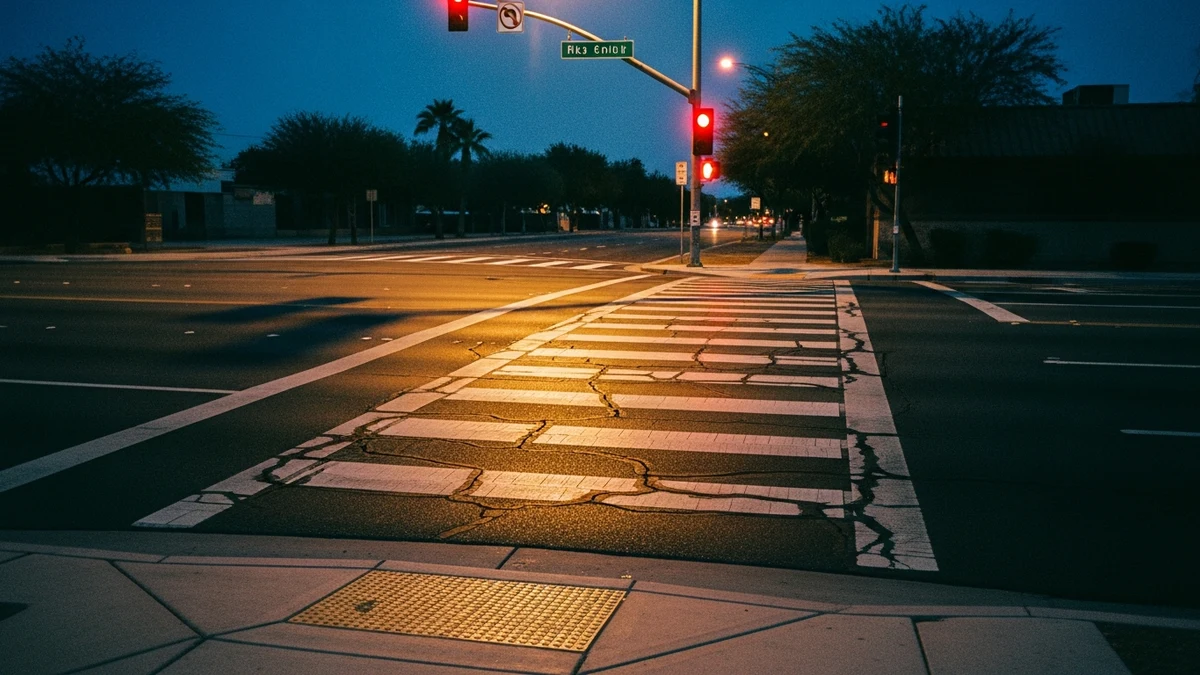
Arizona’s pedestrian fatality rate is 3.6 per 100,000 residents. That’s nearly twice the national average. In 2024, 263 pedestrians died on Arizona roads. Seventy-six percent of those deaths happened in darkness, mostly on wide arterials designed for vehicle throughput, not pedestrian safety.
The legal framework governing pedestrian rights and driver duties sits in ARS Title 28, Article 8, Sections 790 through 797. These statutes establish when pedestrians have the right of way, when they don’t, what duties drivers owe regardless of right of way, and what obligations pedestrians have when crossing outside designated areas.
Our investigation into pedestrian deaths and road design in Arizona documents the data, and a separate report shows Phoenix ranked its own two deadliest intersections on Indian School Road in 2022 yet doesn’t break ground on the fix until 2028.
This guide covers every statute in the pedestrian code, the government liability questions that arise from dangerous road design, and the insurance and claims framework for pedestrian crash cases.
ARS 28-790: Obedience to Traffic Control Devices
ARS 28-790 establishes the foundational rule: pedestrians must obey traffic control signals and devices. At signalized intersections, pedestrians cross when the pedestrian signal or the green light indicates they may do so. Crossing against a “Don’t Walk” signal or a red light violates the statute.
This sounds simple. The application isn’t always straightforward.
Many Arizona intersections have vehicle signals but no dedicated pedestrian signals. At those intersections, the pedestrian follows the vehicle signal. Green means walk. Red means don’t walk.
But the timing of vehicle signals isn’t designed for pedestrians. A green phase that gives cars 30 seconds to clear an intersection may not give a pedestrian enough time to cross six lanes.
Where pedestrian countdown signals exist, the pedestrian must start crossing during the walk phase and must clear the roadway before the countdown reaches zero.
Starting to cross during the flashing countdown, when the signal shows the number of seconds remaining, is technically a violation in some interpretations, though the primary intent of the countdown is to indicate whether enough time remains to cross safely.
Violating ARS 28-790 creates a comparative fault argument. It doesn’t bar recovery under Arizona’s pure comparative negligence system. A pedestrian who crossed against a signal and was struck by a speeding driver shares fault with that driver. The jury assigns percentages.
ARS 28-791: Pedestrian Right of Way at Signalized Intersections
ARS 28-791 provides specific rules for signalized intersections with pedestrian signals.
When the signal shows “WALK” or a walking person symbol, pedestrians may enter the crosswalk and cross in the direction of the signal.
When the signal shows “DON’T WALK” or an upraised hand symbol, whether steady or flashing, pedestrians must not enter the crosswalk. A pedestrian who’s already in the crosswalk when the signal changes to flashing “DON’T WALK” should proceed to the nearest sidewalk or safety island.
The distinction between steady and flashing “DON’T WALK” matters in crash litigation. A pedestrian who entered during the “WALK” phase and is still crossing when the signal changes hasn’t violated the statute. They started legally.
A pedestrian who entered during a flashing “DON’T WALK” may have violated the statute, but the practical question remains whether there was sufficient time to cross before the signal changed.
ARS 28-792: Right of Way in Crosswalks
ARS 28-792 is the statute that matters most in pedestrian crash cases. It establishes the right-of-way rules for crosswalks.
The statute provides that when a pedestrian is crossing the roadway within a crosswalk, the driver of a vehicle must yield the right of way to the pedestrian when the pedestrian is on the driver’s half of the roadway or is approaching so closely from the other half that the pedestrian is in danger.
Two critical features of this statute.
It applies to marked and unmarked crosswalks. An unmarked crosswalk exists at every intersection as the natural extension of the sidewalk or roadway shoulder across the road.
No painted lines are needed. The crosswalk exists by operation of law. This means pedestrians have right-of-way protection at every intersection in Arizona, whether the city has painted a crosswalk or not.
It’s bidirectional. The driver must yield when the pedestrian is in the driver’s half of the roadway or approaching closely from the opposite half. A driver can’t argue “the pedestrian was on the other side of the road” if the pedestrian was close enough to be in danger.
Most Arizona drivers don’t know unmarked crosswalks exist. They see an intersection with no painted lines and assume pedestrians have no right of way. That assumption is wrong. The legal crosswalk exists at every intersection regardless of markings.
This knowledge gap contributes to a significant number of crashes where drivers fail to yield at uncontrolled intersections, particularly in residential neighborhoods and older commercial corridors where marked crosswalks are rare.
The statute also limits the pedestrian’s right. A pedestrian can’t suddenly leave the curb and walk or run into the path of a vehicle that’s close enough to constitute an immediate hazard. This prevents pedestrians from stepping in front of a car at the last second and claiming right of way.
The right of way exists for pedestrians already in or approaching the crosswalk, not for pedestrians who materialize in front of moving vehicles.
ARS 28-793: Crossing Outside a Crosswalk
ARS 28-793
flips the priority. When a pedestrian crosses a roadway at any point other than within a marked or unmarked crosswalk, the pedestrian must yield the right of way to all vehicles on the roadway.
This is what people informally call “jaywalking.” The pedestrian loses right-of-way priority but doesn’t lose all legal protection. ARS 28-796 still requires drivers to exercise due care regardless of whether the pedestrian has the right of way.
From a liability standpoint, crossing outside a crosswalk shifts comparative fault toward the pedestrian. The exact percentage depends on the circumstances. Was the pedestrian crossing a residential street at low traffic volume?
That’s different from crossing a six-lane arterial at rush hour. Was the nearest crosswalk a quarter mile away? That’s different from crossing 50 feet from a marked crosswalk.
Arizona’s pure comparative negligence system means the pedestrian still recovers. At 30% fault, they recover 70%. At 60% fault, they recover 40%. The recovery is reduced but not eliminated.
ARS 28-794: Between Adjacent Signalized Intersections
ARS 28-794
adds a specific rule for urban corridors. Between two adjacent signalized intersections, a pedestrian must cross only at the marked crosswalk at one of those intersections.
This applies to blocks where both ends have traffic signals. The intent is clear: two controlled crossing points bracket the block, and pedestrians should use one of them instead of crossing mid-block.
Violation of ARS 28-794 strengthens the defense’s comparative fault argument. An insurance company will argue the pedestrian had a safe, signalized crossing available within a short distance and chose a more dangerous mid-block crossing instead.
The strength of the argument depends on specific facts. How far apart were the intersections? Was the mid-block crossing point visible to approaching drivers? Was there a median or other infrastructure that invited mid-block crossing? Some Arizona arterials have bus stops mid-block with no crossing infrastructure, effectively requiring transit riders to cross mid-block.
ARS 28-795: Pedestrians on Roadways
ARS 28-795
requires pedestrians to use sidewalks where available. When there’s no sidewalk, pedestrians must walk on the left side of the roadway facing oncoming traffic, or on the shoulder.
The purpose is visibility. A pedestrian walking on the left side, facing traffic, can see approaching vehicles and take evasive action. A pedestrian walking with traffic can’t see what’s coming from behind.
In areas without sidewalks, which describes many rural Arizona roads, suburban arterials, and unimproved areas in the West Valley, pedestrians are forced into the roadway itself. Violating ARS 28-795 by walking on the right side with traffic or in the travel lane creates comparative fault.
But the absence of sidewalks in the first place may support a government liability claim for failure to provide adequate pedestrian infrastructure.
ARS 28-796: Drivers Must Exercise Due Care
ARS 28-796
is the statute pedestrian injury attorneys rely on most heavily. It imposes a duty on every driver to exercise due care to avoid colliding with a pedestrian on any roadway.
The critical language: “on any roadway.” Not in a crosswalk. Not at an intersection. Any roadway. This means a driver’s duty to exercise care exists even when the pedestrian doesn’t have the right of way, is crossing outside a crosswalk, or is walking in the travel lane.
The statute further requires drivers to sound a horn when necessary and to exercise proper precaution upon observing a child, an obviously confused person, or an incapacitated person.
Even when the pedestrian is violating every other statute in the book, crossing mid-block against traffic on a dark road with no crosswalk, the driver still has a duty to exercise due care.
A driver who sees a pedestrian and fails to brake, slow down, change lanes, or take any evasive action is negligent under ARS 28-796. This statute is what allows pedestrians to recover damages even when they share substantial fault.
In crash reconstruction, ARS 28-796 creates a separate analysis track. The first question is whether the pedestrian had the right of way.
The second question is whether the driver exercised due care regardless of the answer to the first. A “no” on the second question creates driver liability even when the first question favors the defense.
ARS 28-797: Pedestrians Soliciting Rides or Business
ARS 28-797 prohibits pedestrians from standing in a roadway to solicit a ride, employment, or business from the occupant of a vehicle. This statute primarily targets hitchhiking and roadside solicitation.
In crash cases, ARS 28-797 occasionally arises when a pedestrian standing in or near the roadway is struck. The defense argues the pedestrian shouldn’t have been in the road at all. The same comparative fault framework applies: the violation shifts fault toward the pedestrian but doesn’t eliminate the driver’s duty under ARS 28-796.
Parking Near Crosswalks: ARS 28-873
A separate statute protects pedestrians before they ever step off the curb. ARS 28-873 lists the places where a driver can’t stop, stand, or park, and two of them guard crosswalks directly.
A driver can’t park within twenty feet of a crosswalk at an intersection (ARS 28-873(A)(7)), and can’t stop, stand, or park on a crosswalk at all (ARS 28-873(A)(6)).
The rule exists for sight lines. A vehicle parked up to the edge of a crosswalk hides a crossing pedestrian from approaching drivers and hides those drivers from the pedestrian.
The twenty-foot buffer gives both sides a moment to see each other before anyone enters the roadway. The same statute keeps drivers thirty feet back from a stop sign, yield sign, or traffic signal at the side of the road (ARS 28-873(A)(8)), for the same visibility reason.
When a vehicle parked too close to a crosswalk blocks the view and a pedestrian is struck, that parking violation can become evidence of negligence against the driver who left it there, separate from the claim against the driver who did the striking.
A crash reconstruction that shows an illegally parked vehicle obstructed the sight line adds a second liable party and a second insurance policy to the case.
Government Liability for Road Design Defects
When road design contributes to pedestrian crashes, the government entity responsible for the road may bear liability. This is one of the most complex areas of Arizona pedestrian law.
The Immunity Framework
Arizona provides qualified immunity to government entities under ARS 12-820 and related statutes. The immunity isn’t absolute. Several exceptions allow claims to proceed.
Plan or design immunity (ARS 12-820.03)
A government entity isn’t liable for injuries resulting from a plan or design for construction or improvement of roads if the plan was approved by the governing body or an authorized employee. This protects original design decisions.
The limitation: plan or design immunity protects the original design choice. It doesn’t protect failure to maintain. It doesn’t protect modifications made after the original design. And it doesn’t protect designs that deviate from the approved plan.
Failure to maintain
If a dangerous condition exists because the government failed to maintain the road, such as a burned-out streetlight, a missing crosswalk sign, or an overgrown median that blocks sight lines, and the government had notice of the condition, liability can attach.
Known dangerous conditions
If the government knows about a dangerous condition, whether from crash data, citizen complaints, or its own traffic studies, and fails to warn or remediate within a reasonable time, the qualified immunity weakens.
Notice of Claim: ARS 12-821.01
Any claim against a government entity in Arizona requires a written notice of claim filed within 180 calendar days of the injury under ARS 12-821.01. Two deadlines apply, and they’re different from the private-defendant rule. The 180-day notice comes first.
Then, under ARS 12-821, the lawsuit itself must be filed within one year of the date the cause of action accrued, not the two years that applies to private defendants under ARS 12-542.
Missing the 180-day notice is a complete defense to the claim, but the public entity must raise it or it waives the defense. Miss the one-year suit deadline instead, and the lawsuit itself is untimely.
The notice must identify the claimant, the government entity, the factual basis for the claim, and the damages sought. It must be served on the correct official. Claims against a city go to the city clerk. Claims against ADOT go to the attorney general.
The notice of claim deadline for government entities is 180 calendar days, and the lawsuit must then be filed within one year under ARS 12-821, not the two-year window that applies to private defendants. That notice window is roughly six months.
In pedestrian cases involving severe brain injuries or spinal cord injuries, the injured person may still be hospitalized or in rehabilitation when the 180-day deadline arrives. A family member or attorney must handle the notice of claim process while the injured person recovers.
Building a Road Design Case
Building a pedestrian road design case requires specific evidence.
Start with crash history. ADOT and municipal traffic departments maintain crash data for every intersection and road segment in Arizona. A pattern of pedestrian crashes at a specific location demonstrates the government had notice of a dangerous condition, which is the linchpin of any claim against a public entity.
Layer traffic studies on top. Government entities conduct traffic studies that sometimes identify pedestrian safety concerns. If a study recommended a crosswalk, a signal, or a speed reduction and the recommendation wasn’t implemented, that’s strong evidence of negligent inaction.
Design standards give the case its spine. AASHTO and the Manual on Uniform Traffic Control Devices (MUTCD) publish design standards for roads, crosswalks, signals, and pedestrian infrastructure. Deviations from those standards can support negligence claims directly, because they establish what a reasonably prudent agency would have done.
Hit-and-Run Pedestrian Claims
When a pedestrian is struck by a driver who flees, the criminal and civil analysis follows Arizona’s hit-and-run statutes (ARS 28-661 through 28-665). Our guide to Arizona hit-and-run law covers the full framework.
The key points specific to pedestrians.
Criminal penalties for fleeing
Leaving the scene of a pedestrian crash causing serious physical injury or death is a class 3 felony. The duty to stop and render aid applies regardless of who had the right of way.
Uninsured motorist (UM) coverage
When the hit-and-run driver isn’t identified, the pedestrian’s own auto insurance policy may provide uninsured motorist coverage. Arizona law extends UM/UIM coverage to policyholders struck as pedestrians, not just while driving. Pedestrians without auto insurance face a significant coverage gap.
Why investigation speed matters
Pedestrian hit-and-run cases are harder to solve than vehicle-to-vehicle hit-and-runs because pedestrian crashes produce less vehicle debris, no vehicle damage on the injured person’s side, and often occur in areas with less surveillance coverage. Speed matters. Surveillance footage from nearby businesses and doorbell cameras gets overwritten within days.
Comparative Negligence in Pedestrian Cases: ARS 12-2505
Arizona’s pure comparative negligence system allows pedestrians to recover damages at any fault percentage. There’s no threshold that bars recovery.
A pedestrian found 40% at fault for crossing outside a crosswalk recovers 60% of their damages. A pedestrian found 70% at fault can still recover 30%. Pure comparative negligence is one of the most plaintiff-favorable systems in the country.
Factors that commonly shift fault toward the driver include exceeding the speed limit, texting or using a phone, failing to activate headlights in low-light conditions, ignoring yield signs, failing to check crosswalks during right turns, and driving under the influence.
Factors that commonly shift fault toward the pedestrian include crossing outside a crosswalk when a signalized crossing was nearby, wearing dark clothing at night, entering the roadway from between parked vehicles, walking while impaired, and violating ARS 28-794 by crossing mid-block between signalized intersections.
The jury weighs all factors and assigns percentages. Those percentages directly control the dollar amount of the verdict.
Insurance Coverage for Pedestrian Crashes
Pedestrian crash injuries are severe because there’s no vehicle structure absorbing the impact. Medical costs reflect that severity.
The first layer is the at-fault driver’s liability insurance. Arizona’s minimum is $25,000 per person, which covers a fraction of the medical bills from a typical serious pedestrian injury. Traumatic brain injuries, spinal cord injuries, and multiple fractures can produce first-year medical costs exceeding $500,000. Minimum policies run dry in the ER.
The second layer is the pedestrian’s own auto policy. UM/UIM coverage on that policy can fill the gap when the at-fault driver’s coverage is insufficient or nonexistent. UM coverage applies in hit-and-run cases. UIM coverage applies when the driver’s insurance isn’t enough.
Arizona insurers must offer UM/UIM coverage under ARS 20-259.01, and many pedestrians don’t realize their own policy covers them when they’re walking.
For pedestrians who don’t own a car and don’t carry auto insurance, the coverage options are severely limited. No UM/UIM policy exists. The only source of compensation is the at-fault driver’s liability insurance and the driver’s personal assets. If the driver has minimum coverage and no assets, the pedestrian absorbs the uncompensated loss.
Wrongful Death in Pedestrian Crashes
When a pedestrian crash results in death, Arizona’s wrongful death statute (ARS 12-611 through 12-613) provides the framework. Our comprehensive guide to Arizona wrongful death law covers the full statutory analysis.
Key points for pedestrian wrongful death cases.
The Arizona Constitution prohibits caps on death damages, so juries can award whatever amount the evidence supports. Beneficiary priority under ARS 12-612 runs spouse and children first, parents second, and personal representative of the estate third.
If the pedestrian experienced conscious pain before death, even briefly, the estate can bring a survival action under ARS 14-3110 for pre-death suffering on top of the wrongful death claim. Punitive damages become available when the driver’s conduct rises to the “evil mind” standard. DUI crashes, hit-and-run fatalities, and extreme speeding can all qualify.
Pedestrian wrongful death cases often produce large verdicts because of the extreme vulnerability of the person who was hit and the severity of the driver’s negligence. A driver who strikes and kills a pedestrian in a crosswalk where the pedestrian had the right of way faces a strong liability case with substantial damage exposure.
If you’ve been struck by a vehicle while walking, or if you’ve lost a family member in a pedestrian crash, call (602) 654-0202 to discuss the case.
Consultations are free. We don’t charge unless we recover compensation. Our client guide on what to do if you’re hit by a car while walking covers the immediate steps.
Building a Pedestrian Crash Case
Pedestrian crash cases require specific evidence beyond what a typical car crash case demands.
The investigation should address whether a crosswalk existed (marked or unmarked), the signal state at the time of the crash, the speed of the vehicle, lighting conditions, the driver’s line of sight, whether the pedestrian was visible, and the road design itself.
Road design evidence can be critical. If the speed limit was 45 mph in a commercial area with regular pedestrian traffic, that’s a factor.
If the nearest crosswalk was a quarter mile away, that’s a factor. If the sidewalk ended and forced the pedestrian into the road, that’s a factor. If the lighting was inadequate, that’s a factor.
The investigation covers the scene, the infrastructure, signal timing records, surveillance footage from nearby businesses, and ADOT crash history for the intersection. The goal is to build the fullest possible picture of what the road was asking people to do and what actually happened.
Frequently asked questions
Do pedestrians always have the right of way in Arizona?
What is an unmarked crosswalk?
Can I recover damages if I was crossing outside a crosswalk?
Can I sue the city for a dangerous road that caused a pedestrian crash?
Does my car insurance cover me if I'm hit as a pedestrian?
What are the penalties for a hit-and-run involving a pedestrian?
How long do I have to file a pedestrian injury claim in Arizona?
What speed makes a pedestrian crash fatal?
Sources & references
- Arizona State Legislature. (2024). ARS 28-790: Obedience to Traffic Control Devices https://www.azleg.gov/ars/28/00791.htm
- Arizona State Legislature. (2024). ARS 28-791: Pedestrian Control Signals https://www.azleg.gov/ars/28/00791.htm
- Arizona State Legislature. (2024). ARS 28-792: Pedestrian Right of Way in Crosswalk https://www.azleg.gov/ars/28/00792.htm
- Arizona State Legislature. (2024). ARS 28-793: Crossing at Other Than Crosswalk https://www.azleg.gov/ars/28/00793.htm
- Arizona State Legislature. (2024). ARS 28-794: Crossing Between Adjacent Signalized Intersections https://www.azleg.gov/ars/28/00794.htm
- Arizona State Legislature. (2024). ARS 28-795: Pedestrians on Roadways https://www.azleg.gov/ars/28/00795.htm
- Arizona State Legislature. (2024). ARS 28-796: Drivers to Exercise Due Care https://www.azleg.gov/ars/28/00796.htm
- Arizona State Legislature. (2024). ARS 28-797: Soliciting Rides or Business https://www.azleg.gov/ars/28/00797.htm
- Arizona State Legislature. (2024). ARS 28-873: Stopping, Standing or Parking Prohibitions; Exceptions; Definition https://www.azleg.gov/ars/28/00873.htm
- Arizona State Legislature. (2024). ARS 12-2505: Comparative Negligence; Definition https://www.azleg.gov/ars/12/02505.htm
- Arizona State Legislature. (2024). ARS 28-661: Duty to Stop; Violation; Classification https://www.azleg.gov/ars/28/00661.htm
- Arizona State Legislature. (2024). ARS 12-820 et seq.: Government Immunity and Liability https://www.azleg.gov/ars/12/00820.htm
- Arizona State Legislature. (2024). ARS 12-821.01: Claims Against Public Entities; Notice of Claim https://www.azleg.gov/ars/12/00821-01.htm
- Arizona State Legislature. (2024). ARS 20-259.01: Uninsured and Underinsured Motorist Coverage https://www.azleg.gov/ars/20/00259-01.htm
- Arizona Department of Transportation. (2025). 2024 Arizona Motor Vehicle Crash Facts https://azdot.gov/sites/default/files/2025-07/2024-Crash-Facts.pdf
Tell Google to show our reporting more often in Search and AI answers.