
Arizona launched Arrive Alive Arizona, a five-year statewide traffic safety campaign, on June 29. Our new investigation measures it against Arizona’s 25-year crash record, including the July 4th drinking-driver spike this campaign faces as its first test.
Arizona’s drunk driving crashes don’t make front pages every day. They make obituary pages. Quietly. Consistently. In numbers that should embarrass a state with some of the country’s strictest DUI laws and most aggressive enforcement.
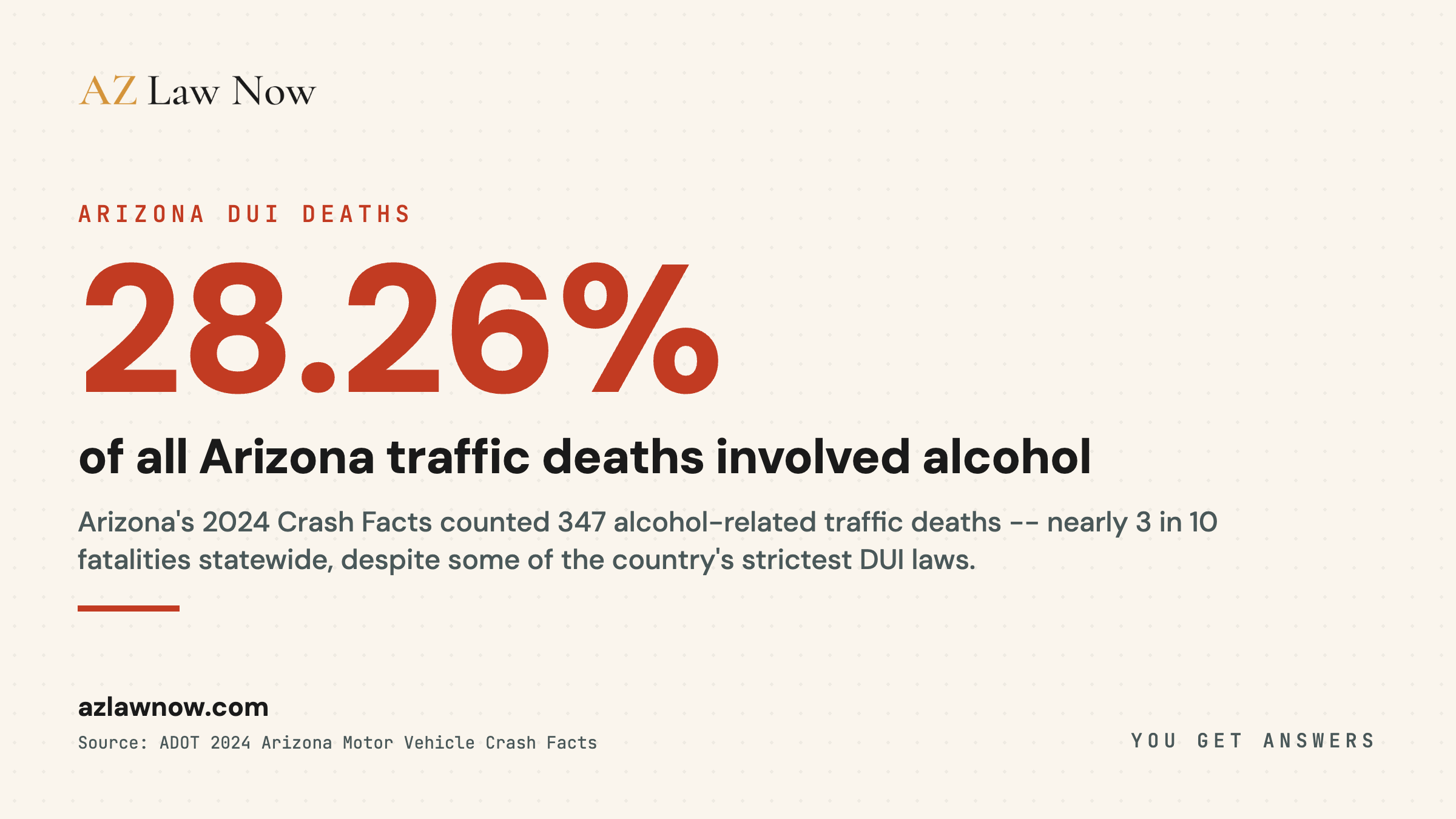
Arizona’s 2024 Crash Facts report, published by ADOT on July 9, 2025, documents 347 people killed in alcohol-related crashes out of 1,228 total traffic fatalities statewide.
That’s 28.26% of all traffic deaths. Over the prior five years, the alcohol share ranged from about 21% to just over 28%. The pattern is consistent and the floor is high.
What ADOT’s 2024 Report Documents
Arizona’s 2024 Crash Facts report counted 1,228 total traffic fatalities. That’s down 6.12% from 1,308 in 2023, which the state noted as progress.
Inside that overall number, alcohol-related crashes accounted for 28.26% of all traffic deaths in 2024. The five-year range — 21.27% in 2021 to 28.26% in 2024 — shows the share trending upward, not down.
ADOT’s “Arizona at a Glance” summary puts it plainly: alcohol-related crashes accounted for 4.56% of all crashes but 27.93% of all fatal crashes. Alcohol-involved crashes are a small share of total volume and a disproportionately large share of deaths.
The Crash Facts report breaks down the data by:
- County (Maricopa dominates)
- Time of day (late night and early morning peak)
- Day of week (Friday and Saturday peak)
- Vehicle type
- Crash severity
- Contributing factors (alcohol/drug involvement is a coded field)
ADOT compiles this data from Arizona Traffic Crash Reports submitted by state, county, city, tribal, and other law enforcement agencies. The Governor’s Office of Highway Safety publishes separate enforcement statistics — arrest counts during saturation patrols — that document the response side of the same pattern.
The Maricopa County Concentration
Maricopa County contains roughly 60% of Arizona’s population and in 2024 recorded 88,094 of the state’s 121,107 total crashes, about 72.7% of all crash volume.
On the fatality side, Maricopa recorded 594 of 1,228 persons killed statewide, 48.4% of all traffic deaths.
For alcohol-related fatalities specifically, Maricopa recorded 180 of 347 persons killed statewide, 51.9% of all alcohol-related traffic deaths in Arizona.
That’s worth examining. The county’s share of alcohol fatalities (51.9%) is somewhat lower than its share of total crash volume (72.7%), which reflects the higher fatality rates per crash in rural counties where higher-speed collisions are more common.
What’s worth examining is the concentration within Maricopa County itself.
Phoenix proper, Scottsdale, Tempe, and the East Valley produce a disproportionate share of DUI crashes relative to their population. The West Valley — Buckeye, Goodyear, Avondale — produces fewer total DUI crashes but at higher fatality rates per crash.
The reason for the difference is speed. East Valley DUI crashes happen on surface streets and lower-speed corridors. West Valley DUI crashes are more likely to occur on I-10 or rural state highways at 65 to 75 mph.
The physics of a high-speed collision involving an impaired driver almost always produces a worse outcome than a slow-speed urban collision.
The Weekend and Nighttime Pattern
The 2024 Crash Facts data show a sharp concentration of alcohol crashes at night and on weekends.
Nighttime hours account for about 71.5% of all alcohol-related crashes — 3,947 of 5,520.
The peak hour for alcohol-related crashes is 2 AM to 3 AM. That’s the window after bars close at 2:00 AM under Arizona state law, and the data confirms it.
Weekends account for 54.62% of all alcohol-related crashes and 55.13% of alcohol-related fatal crashes. Saturday recorded 61 alcohol-related fatal crashes and Sunday 68 — the two highest days of the week by a significant margin.
The second-largest window is the after-work period in the evening hours. This produces fewer fatal crashes than the late-night window but more total crashes.
A particularly dangerous Arizona DUI subpattern is the wrong-way driver.
ADOT and DPS track wrong-way driving incidents on Phoenix freeways. The crashes they cause are almost always head-on collisions at high speed. Phoenix has had several serious wrong-way crashes in recent years, and the response has included sensor systems on freeway off-ramps that flash warnings when a driver enters the wrong way.
The Holiday Pattern
ADOT tracks crash data across six major holidays. The 2024 data show:
- New Year’s Day period: 13 fatal crashes, 13 persons killed (4 alcohol-related fatal crashes)
- Memorial Day weekend: 11 fatal crashes, 14 killed (3 alcohol-related fatal crashes)
- July 4th period: 12 fatal crashes, 15 killed (5 alcohol-related fatal crashes — the highest holiday alcohol count in 2024)
- Labor Day weekend: 10 fatal crashes, 10 killed (3 alcohol-related fatal crashes)
- Thanksgiving period: 10 fatal crashes, 10 killed (4 alcohol-related fatal crashes)
- Christmas period: 4 fatal crashes, 4 killed (2 alcohol-related fatal crashes)
The Governor’s Office of Highway Safety publishes enforcement data showing DUI arrest counts during these same holiday windows and additional enforcement windows throughout the year. Even with heightened enforcement, the fatal crash counts during holiday periods are consistent year over year.
What Arizona Has Done About It
Arizona has some of the strictest DUI laws in the country.
A first-offense DUI in Arizona carries mandatory jail time (10 days, with most suspended for completion of treatment), ignition interlock device installation for at least one year, license suspension, mandatory alcohol screening, and significant fines.
Repeat DUI within seven years escalates the penalties dramatically.
Aggravated DUI — driving impaired with a license suspension, with a child under 15 in the vehicle, or with a third DUI in seven years — is a felony charge that can carry years of prison time.
Arizona also operates DUI task forces that conduct saturation patrols on holiday weekends and other high-risk periods. The deterrent effect, based on the fatality data, is uneven.
The Enforcement vs. Outcome Gap
Arizona’s DUI enforcement is aggressive. Arizona’s DUI fatality rate is high. Both things are true at the same time.
Possible explanations:
-
Enforcement is concentrated in time and place (saturation patrols on specific holidays at specific locations) but DUI is distributed (Tuesday evening drives home from the bar happen everywhere all the time).
-
Penalties deter some drivers but not the highest-risk drivers (chronic DUI offenders who don’t respond to penalty escalation).
-
Phoenix is a sprawl city with poor public transit and long driving distances, so impaired drivers have fewer alternatives to driving home.
-
Cultural factors around drinking, weather (year-round outdoor drinking), and tourism (Phoenix metro hosts large events year-round).
The data doesn’t tell us which of these is the biggest contributor. It tells us the outcome is consistent and the response, while substantial, isn’t moving the needle.
What This Means for Families
A drunk-driving crash doesn’t only hurt you. It hurts your family too, and you have legal options beyond what the criminal case provides.
The civil case — your personal injury claim or wrongful death claim — runs on a parallel track to the criminal case and addresses different things.
Criminal case: punishes the drunk driver, may impose restitution, but the focus is the state’s interest in punishing the offense.
Civil case: compensates the injured person for medical bills, lost wages, pain and suffering, and (in cases involving particularly egregious conduct) punitive damages.
Arizona allows punitive damages in DUI cases when the driver acted with the “evil mind” required by Arizona case law. Drunk driving rises to that standard relatively often, especially for repeat offenders or drivers with very high BAC levels.
If a bar or restaurant served the driver while they were obviously intoxicated, Arizona dram shop law may give the injured person a separate claim against the establishment.
The Criminal Case in Maricopa County Superior Court
Most DUI cases in Maricopa County follow a predictable path through the courts. Standard first-offense misdemeanor DUIs land in municipal courts or justice courts depending on where the crash occurred. Phoenix Municipal Court handles cases within Phoenix city limits.
Glendale, Mesa, Scottsdale, Peoria, Surprise, Buckeye, and Goodyear each operate their own municipal courts for DUIs that occurred within their boundaries. Justice courts cover the unincorporated parts of the county.
Aggravated DUI charges, wrong-way DUI fatalities, and DUI manslaughter cases move to Maricopa County Superior Court in downtown Phoenix. These are felony cases, and the sentencing ranges under A.R.S. 28-1381 through A.R.S. 28-1383 are substantial.
A third DUI within 84 months is a Class 4 felony with presumptive sentencing starting at 2.5 years in prison. Aggravated DUI with a fatality can run into Class 2 or Class 3 felony territory under Arizona’s homicide statutes, with prison ranges of 3 to 12.5 years.
The Maricopa County Attorney’s Office handles felony DUI prosecutions through its Vehicular Crimes Bureau. That bureau has specialized prosecutors who handle nothing but DUI cases involving death or serious injury.
The office coordinates with Arizona DPS and local police accident reconstruction units, and it pursues these cases aggressively.
Civil Recovery: The Tracks That Run in Parallel
The civil side of a Phoenix DUI crash case runs through Maricopa County Superior Court’s civil division. The claim gets filed against the drunk driver, the bar or restaurant that over-served them under dram shop liability (A.R.S. 4-311), and any other parties with independent liability.
Each defendant brings its own insurance. The drunk driver typically carries minimum liability coverage of $25,000 per person under A.R.S. 28-4009, which almost never covers a serious injury or fatality.
The dram shop claim is where the money is, because licensed establishments typically carry $1 million or more in commercial general liability and liquor liability coverage.
Arizona courts haven’t settled the dram shop filing deadline. After the 2023 Arizona Supreme Court decision in *Torres v.
JAI Dining Services*, which closed off the common-law dram shop route, the strongest argument is one year under A.R.S. 12-541(5); a 2000 court of appeals case held two years applied and no court has revisited that question since Torres changed the underlying law.
Families who delay consulting an attorney until the criminal case progresses risk burning through the shorter window before they realize the claim exists.
Maricopa County Superior Court enforces filing deadlines strictly. Almost no exceptions apply.
Evidence Preservation in Phoenix DUI Cases
Phoenix DUI cases turn on evidence that degrades fast. Bar surveillance footage overwrites in 7 to 30 days at most establishments. Credit card and POS records are archived but often require subpoena to produce. Server and bartender memory fades quickly.
Witness contact information at the scene is irreplaceable if not captured on day one. An attorney sends preservation letters to every identified establishment, the driver’s insurer, and any rideshare platform within 24 to 48 hours.
ADOT’s freeway management system cameras capture wrong-way vehicles and high-speed crashes, but that footage is also on overwriting loops. DPS crash reconstruction reports become available 30 to 60 days after the crash. Toxicology reports from the Maricopa County Office of the Medical Examiner take 60 to 90 days.
The civil case is built on that evidence, and every day of delay makes the case harder.
Punitive Damages and Arizona’s “Evil Mind” Standard
Arizona allows punitive damages in DUI civil cases when the driver acted with the “evil mind” required by Arizona case law. Drunk driving rises to that standard relatively often, especially for repeat offenders, drivers with BACs above 0.15, or drivers involved in wrong-way crashes on Phoenix freeways.
Punitive damages are uncapped under Article 2, Section 31 of the Arizona Constitution, and Maricopa County Superior Court juries have been publicly reported as awarding multi-million-dollar punitive verdicts in particularly egregious DUI fatality cases.
Punitive damages are paid personally by the defendant, not by insurance, which makes them especially relevant in dram shop cases where the defendant bar has commercial coverage.
What’s Coming
The 2025 Crash Facts report will be published by ADOT in mid-2026. When it arrives, this article will be updated with the new alcohol fatality share, total fatality count, and Maricopa County breakdown.
The numbers will probably look similar to 2024. The pattern is structural. Arizona’s DUI fatality rate hasn’t dropped meaningfully in a decade despite enforcement, education campaigns, ignition interlock laws, and stricter penalties. The data shows what works isn’t working enough.
If you’ve lost someone to an impaired driver in Maricopa County, the criminal process will run its course on the state’s timeline. Your civil options have a separate timeline and a separate set of rights. Talk to an attorney early.
The two-year statute of limitations under A.R.S. 12-611 runs from the date of death, the dram shop deadline (treated as one year, given the unsettled question above) runs from the date of the crash, and the 180-day notice of claim under A.R.S. 12-821.01 runs from the crash if a government entity is involved.
Each deadline operates independently. Missing the shortest one eliminates that path to recovery.
Evidence preservation can’t wait. Bar surveillance overwrites in weeks. Credit card records require subpoena to produce. Witness memory fades. Toxicology takes 60 to 90 days.
The investigation into where the driver was served, how much they consumed, and whether the bar continued serving them past the point of obvious intoxication has to start within days of the crash.
An attorney sends preservation letters to every identified establishment, to the driver’s insurer, and to any rideshare platform within 24 to 48 hours. After that, key evidence begins disappearing.
Arizona’s impaired driving problem isn’t going to solve itself. The enforcement structure, the penalties, and the education programs haven’t moved the fatality rate meaningfully in a decade. What’s changed, in the past few years, is how fast civil litigation has grown as a tool for accountability.
Dram shop verdicts against establishments that over-served drunk drivers have been publicly reported in the multi-million-dollar range in Maricopa County Superior Court. Punitive damage awards against repeat DUI offenders are climbing, driven by juries that see the conduct as the kind of conscious disregard for safety that Arizona’s “evil mind” standard was written to punish.
Families who used to absorb the losses quietly are pressing the civil system to fill the gap that criminal penalties don’t cover, and they’re finding that the civil recovery often exceeds the sum of all criminal restitution orders combined.
Related Coverage
For the legal and process context, see Stephanie Ramirez’s hit by drunk driver, the car crashes practice overview.
Frequently asked questions
How many DUI fatalities does Maricopa County have each year?
When do most DUI crashes happen in Phoenix?
What's Arizona doing about DUI?
Can a bar be sued for serving a drunk driver in Arizona?
What should people injured by drunk drivers do legally?
What is the average settlement amount for a car accident in Arizona?
How long does a DUI settlement take?
How long after a car accident can you sue in Arizona?
When a driver injures someone in a DUI crash?
Sources & references
- Arizona Department of Transportation. (2025). 2024 Arizona Motor Vehicle Crash Facts. Multimodal Planning Division, Traffic Safety Group. Publication Date July 9, 2025. Retrieved from https://azdot.gov/sites/default/files/2025-07/2024-Crash-Facts.pdf
- Arizona Governor's Office of Highway Safety. DUI Enforcement Statistics. Retrieved from https://gohs.az.gov/about/statewide-reporting
- National Highway Traffic Safety Administration. (2025). Fatality Analysis Reporting System (FARS). Retrieved from https://www.nhtsa.gov/research-data/fatality-analysis-reporting-system-fars
Tell Google to show our reporting more often in Search and AI answers.