
A little before noon on June 9, a driver ran a red light at 27th Avenue and Indian School Road in Phoenix. Court records put the speed at roughly 96 mph. The car hit vehicles stopped at the light, shoved them into the intersection, and the chain reaction took in seven cars.
One person died. Two more went to the hospital, one of them a pedestrian crossing the street. Prosecutors charged the driver with second-degree murder and allege impairment.
I’m not going to name the people in that crash. It’s an active case and the families are living it right now.
What I can do is show you why this crash was not a freak event. It happened on a road the City of Phoenix had already flagged, in a state that already ranks among the worst in the country for exactly this kind of death.
The Road Was Already on Every List
The crash happened at 27th Avenue, just east of a stretch of Indian School Road that Phoenix has spent years calling one of its deadliest.
The City’s Vision Zero Road Safety Action Plan, adopted by council vote on September 7, 2022, names the Indian School Road corridor one of the city’s High Injury Network priorities, the streets where the most people are killed or seriously hurt.
We covered that ranking in detail in Phoenix’s 2 deadliest intersections sit on one road.
The numbers behind the ranking come from the City itself. When Phoenix applied for federal money to rebuild the corridor between 91st and 39th avenues, its grant paperwork documented 39 fatal crashes and 85 serious-injury crashes from 2017 through 2021.
The City reported that 48 percent of those fatalities involved a person walking or biking, and that 52 percent happened in the dark.
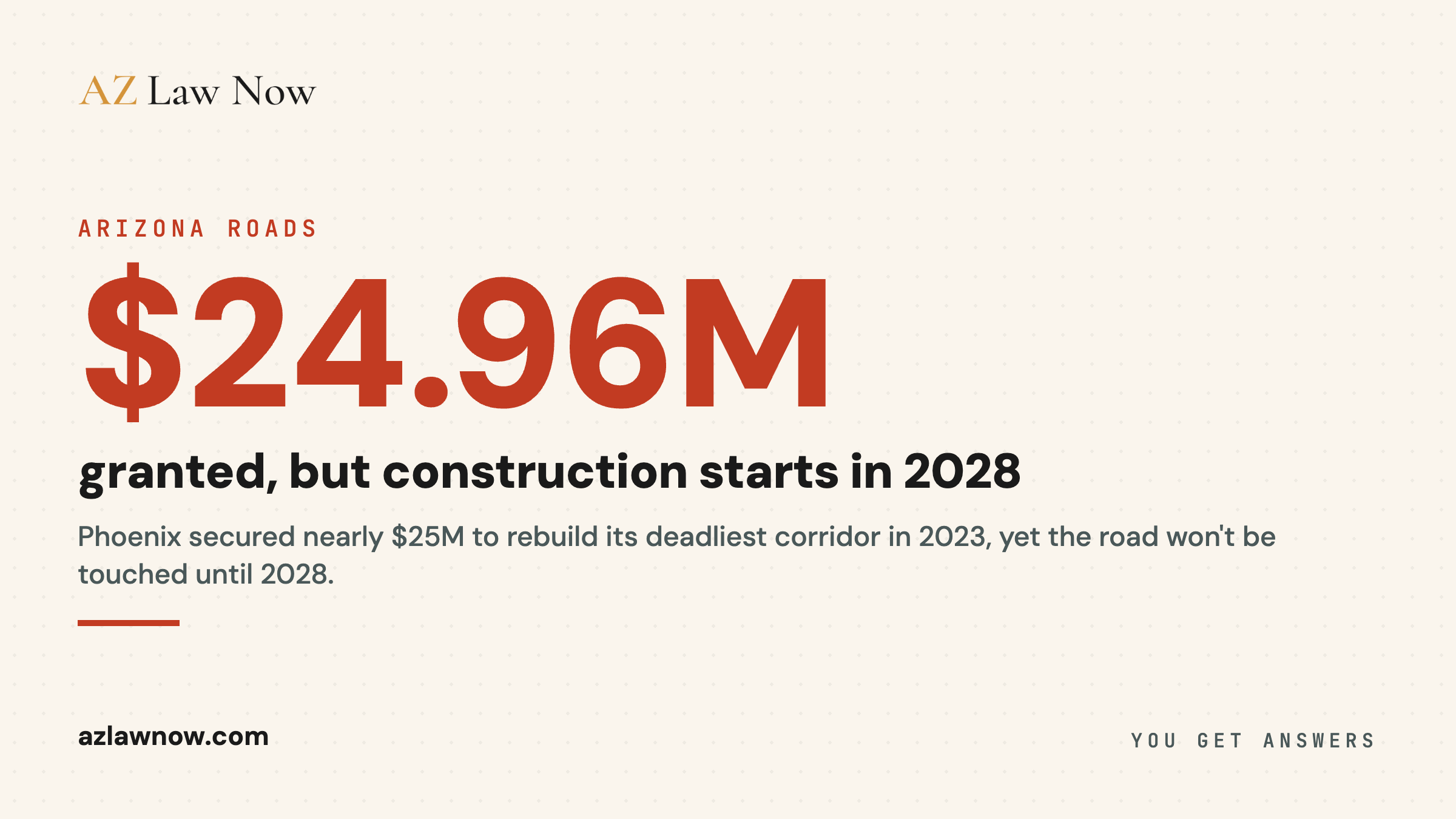
The U.S. Department of Transportation committed nearly $25 million to Phoenix in December 2023 to rebuild that corridor with better lighting, raised medians, and modern signals. The City’s project page says construction won’t start until 2028.
So Phoenix identified the danger in 2022, secured the money in 2023, and the fix is still years out. The June 9 crash landed on the same road, just past the eastern edge of the stretch the grant covers.
Arizona’s Red-Light Problem, Counted
Pull back from the one crash and the pattern is worse. Arizona’s Department of Transportation publishes a Crash Facts report every year. The 2024 edition counted nearly 6,000 red-light-running collisions across the state, and 64 of them were fatal.
Reviewing that data, Arizona’s Family reported that Arizona ranks among the worst states in the country for deadly red-light running.
That’s not a Phoenix problem alone, but Phoenix carries the weight of it. Maricopa County recorded 594 of Arizona’s 1,228 traffic deaths in 2024, nearly half the state’s total in a single county.
Impairment Is the Other Half
The June 9 case carries a second charge that turns a tragedy into a pattern: the driver is alleged to have been impaired. That’s why prosecutors reached for second-degree murder instead of a lesser count.
Impaired driving is its own Arizona epidemic. In 2024, 347 people died in alcohol-related crashes in the state, which ADOT puts at 28.26 percent of all traffic deaths. More than one in four people killed on Arizona roads died in a crash involving alcohol.
We broke down where and when those crashes cluster in Phoenix DUI crashes: the data nobody wants to see.
Phoenix named this road one of its deadliest in 2022 and has held the construction money since 2023. The build doesn’t start until 2028. In the years between, the crashes keep coming, and the public crash data that would track them by intersection isn’t published.
What the Public Data Still Won’t Show
Here’s the gap. You can find the statewide red-light count in ADOT’s report. You can find the corridor’s 2017-to-2021 toll in the City’s grant paperwork. What you can’t find, anywhere public, is how many red-light crashes happen at a specific Phoenix intersection in a specific recent year.
That data exists. It lives in ADOT’s Crash Information System, the database behind the 2024 Crash Facts, which holds records down to the intersection with contributing factors like “disregarded a traffic signal.”
But that system is credentialed-only. The public can’t download it, and the City of Phoenix open-data portal publishes no crash records at all. The most recent public intersection-level red-light analysis Arizona reporters have produced relied on data they had to request, and it’s now years old.
So we’re filing for it. Under Arizona’s public records law, ARS 39-121, we’ve requested the 2024 intersection-level red-light-running crash records for Maricopa County, including 27th Avenue and Indian School Road.
When the records come back, we’ll update this report with what the corridor and the crossing actually recorded. The point of a public records law is that the public gets to see the count.
What the Data Means
A red-light crash at this scale isn’t bad luck.
It’s the predictable end of three things the data already tracks: a road the City ranked as deadly and hasn’t yet rebuilt, a state that ranks among the worst for red-light running, and an impairment problem that kills more than a quarter of everyone who dies on Arizona roads.
Each of those is documented. None of them is secret. The June 9 crash sat at the exact point where all three meet.
If you or someone you love was hurt in a crash like this, the legal framework is its own subject. Arizona’s pure comparative fault rule under ARS 12-2505 governs how fault and recovery work, and a corridor’s documented crash history, signal timing, and lighting can all be evidence.
And when a government entity is at fault, an injured person must file a formal notice of claim within 180 days under ARS 12-821.01. Failure to file is a complete defense to the claim, one the government entity must raise or it waives.
For the statutes and the first steps, read Ron DeBrigida’s guide to Arizona pedestrian law and Stephanie Ramirez’s crash action plan. An Arizona car crash lawyer can weigh how a corridor’s documented crash history bears on a specific case. This report is journalism, not legal advice, and it names no one in an active case.
Frequently asked questions
How common is red-light running in Arizona?
What happened at 27th Avenue and Indian School Road on June 9, 2026?
Is Indian School Road one of the most dangerous roads in Phoenix?
Who is liable in a red-light-running crash in Arizona?
Does impairment make a crash worse legally?
Sources & references
- Arizona Department of Transportation. (2025). 2024 Motor Vehicle Crash Facts for the State of Arizona. Retrieved June 16, 2026, from https://azdot.gov/sites/default/files/2025-07/2024-Crash-Facts.pdf
- Arizona's Family. (2026, January 2). Arizona among worst states for deadly red-light running. Retrieved June 16, 2026, from https://www.azfamily.com/2026/01/02/arizona-among-worst-states-deadly-red-light-running/
- Office of U.S. Senator Mark Kelly. (2023, December 15). Kelly announces nearly $25 million for Indian School Road safety improvements. Retrieved June 16, 2026, from https://www.kelly.senate.gov/?p=76630
- City of Phoenix Street Transportation Department. (2022). Road Safety Action Plan (Vision Zero), adopted September 7, 2022. Retrieved June 16, 2026, from https://www.phoenix.gov/content/dam/phoenix/streetssite/documents/vision_zero_road_safety_action_plan.pdf
- U.S. Department of Transportation. (2023). Safe Streets and Roads for All (SS4A) Grant Program, FY2023 awards. Retrieved June 16, 2026, from https://www.transportation.gov/grants/SS4A
- Arizona Revised Statutes 12-2505 (Comparative fault) and 39-121 (Public Records). Retrieved June 16, 2026, from https://www.azleg.gov/arstitle/
Tell Google to show our reporting more often in Search and AI answers.