
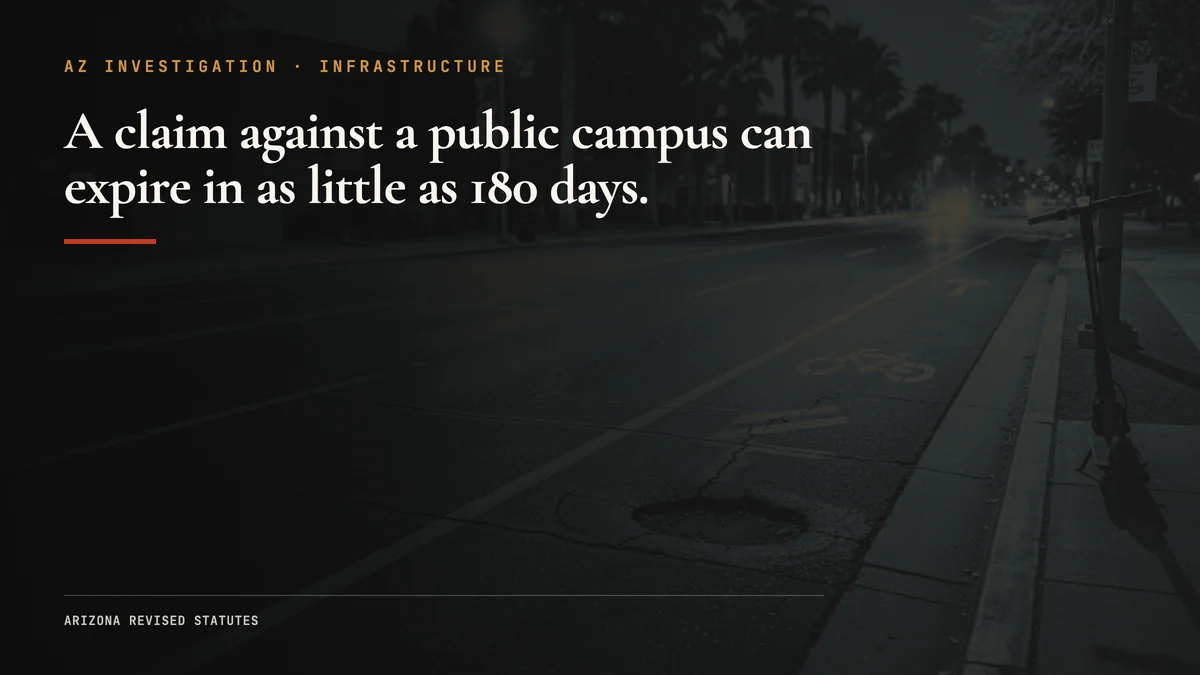
On any given morning on Tempe pavement, a student rides an e-scooter or a bicycle across a seam, a patch, or a pothole, and the rider goes down. Concussion. Road rash. A broken wrist on the way to an 8 a.m. class. A face-first fall that sidelines the semester.
What happens next is where the law gets strange. Arizona treats a crash on public pavement differently from a crash between two cars.
The clock is shorter. The defendant is a government entity.
And if the road happens to sit inside the boundary of Arizona State University, there’s a jurisdictional trap built into the state’s own rules about who can accept a claim.
What Tempe Says About Its Own Pavement
The City of Tempe runs a Pavement Management Program that measures street condition on a three-year cycle. The city’s page states the policy directly: “The city collects pavement condition data every three years. We use the information to prioritize paving schedules and determine what treatment will be used.”
That’s the cadence. Nothing surprising. What matters is where the city is spending its reconstruction dollars.
Tempe has a 2026 Maricopa Association of Governments Arterial Road Reconstruction Program application for Broadway Road from 55th Street to Mill Avenue. Cities apply to this program to reconstruct aging arterial pavement.
Broadway terminates at Mill Avenue, and Mill Avenue runs north toward ASU’s Tempe campus, about a mile from the campus core.
The corridor Tempe wants to rebuild is one of the routes students and riders use to reach the university area.
Street-by-street Pavement Quality Index scores for Mill Avenue, University Drive, Rural Road, Apache Boulevard, College Avenue, Forest Avenue, and Farmer Avenue weren’t publicly tabulated at the segment level on tempe.gov at the time of this writing.
The Pavement Quality Index performance dashboard exists. The segment-level numbers behind it don’t appear to be public. A public records request can pull them.
Tempe also runs Tempe 311, the phone, app, and web intake for non-emergency issues including potholes, sidewalk and curb defects, and debris in the right-of-way.
Open tickets, backlog counts, and average repair times for potholes specifically weren’t published on the city’s open data portal at the time of this writing. The 311 caller wait-time dashboard is public. The pothole dashboard isn’t.
None of that changes the law. Tempe’s duty to keep its streets reasonably safe is older than the 311 system. It goes back to the Arizona Supreme Court’s 1951 decision in City of Phoenix v. Weedon. What has changed is the statute of limitations, and what triggers it.
The 180-Day Clock
Arizona Revised Statutes 12-821.01 sets the rule. Here’s the operative language, pulled from the Arizona Legislature’s own site:
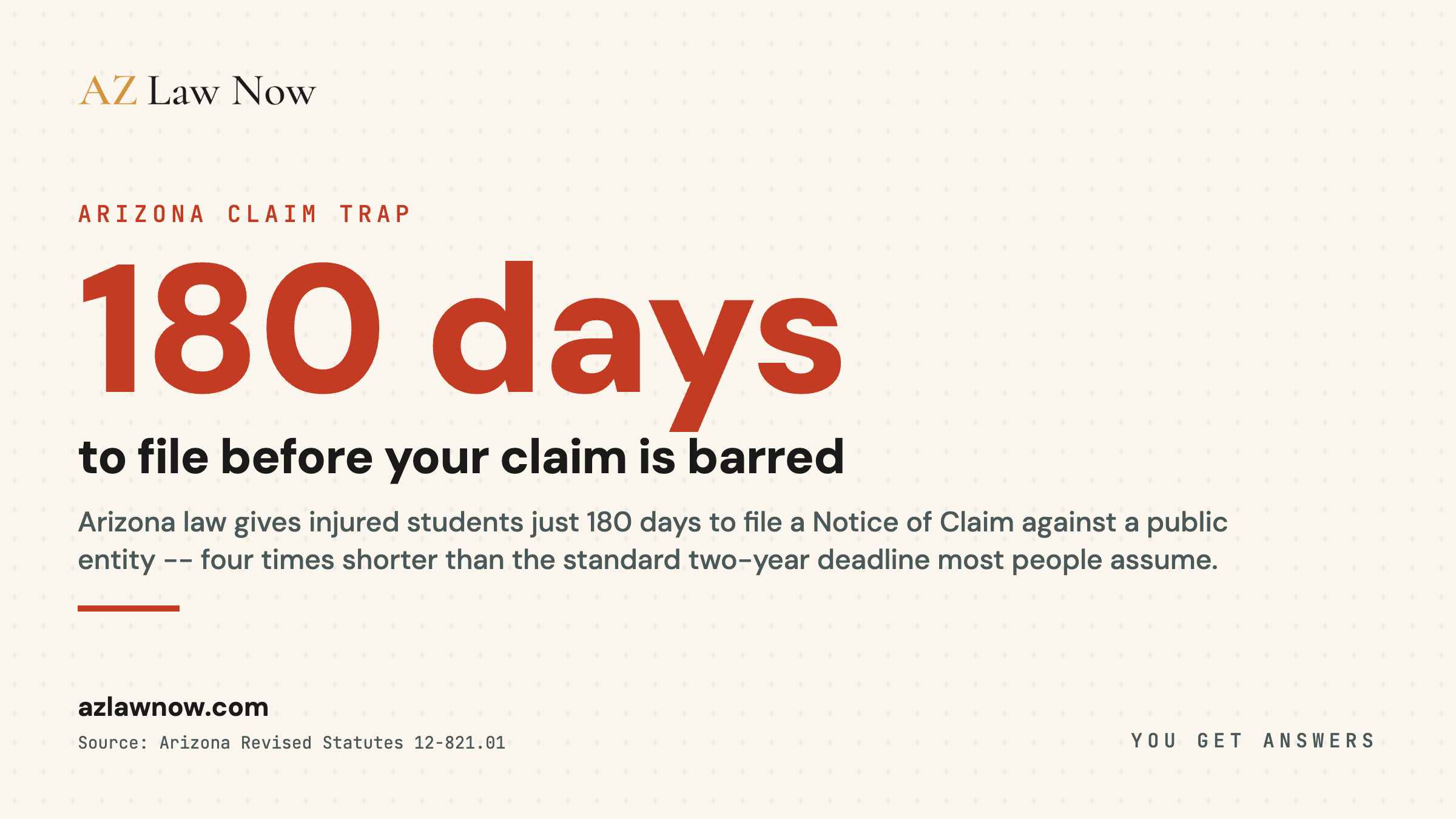
Persons who have claims against a public entity, public school or a public employee shall file claims with the person or persons authorized to accept service for the public entity, public school or public employee as set forth in the Arizona rules of civil procedure within one hundred eighty days after the cause of action accrues. The claim shall contain facts sufficient to permit the public entity, public school or public employee to understand the basis on which liability is claimed. The claim shall also contain a specific amount for which the claim can be settled and the facts supporting that amount. Any claim that isn’t filed within one hundred eighty days after the cause of action accrues is barred and no action may be maintained thereon.
A private crash between two drivers runs on a different clock. Arizona gives a private personal-injury plaintiff two years under ARS 12-542. The public entity rule is roughly four times shorter.
Most injured people don’t know the difference. A student who goes down on Mill Avenue and assumes they have two years to figure out their legal options is already six months deep on a clock they didn’t know was running.
When the 180 days ends, the public entity has a complete defense, one it must raise or it waives. The statute is unforgiving.
There’s a second clock behind the first. ARS 12-821 gives one year from the date the cause of action accrues to actually file suit against a public entity.
The Notice of Claim at 180 days is the gate. The lawsuit at one year is the act. Both have to be right, in sequence, or the case dies.
The statute also deems a claim denied 60 days after filing unless the claimant is notified of the denial earlier. That 60-day deemed-denial rule means the public entity doesn’t have to do anything. Silence becomes denial. The one-year suit-filing clock starts running from that denial, explicit or implied.
The Jurisdictional Patchwork Around ASU
The second thing that catches injured people is that the “public entity” isn’t a single address. Around ASU’s Tempe campus, four different jurisdictions overlap in a one-mile radius:
- City of Tempe for arterials like Mill Avenue, University Drive (within Tempe), Rural Road, McClintock Drive, College Avenue, Forest Avenue, and Farmer Avenue, and for the right-of-way improvements and pavement that Tempe maintains on those streets.
- Arizona Department of Transportation for the state system: US-60, Loop 202, the on-ramps, and the frontage roads inside the state right-of-way.
- Arizona Board of Regents, through ASU for interior campus routes. Tyler Mall, Orange Street, the pedestrian malls, and the internal campus street grid fall under ABOR jurisdiction.
- Private parking structure owners, private easements, and adjacent development sites that are neither city nor state.
A fall 50 feet east of Mill and University might be a Tempe claim. A fall 50 feet west on the same sidewalk might be an ABOR claim. Each jurisdiction has its own Notice of Claim recipient, and serving the wrong one doesn’t stop the clock.
A verified public jurisdictional overlay of ASU-area streets wasn’t retrievable at the time of this writing. ADOT maintains a pavement portal that shows the state system.
Tempe’s own street-maintenance boundaries can be confirmed by public records request.
Anyone building a claim needs a jurisdictional map before they file. Guessing doesn’t get you a deemed-denial start date. It hands the government a defense instead.
The ABOR Rule That Closes the Trap
Here’s the catch that compounds the 180-day clock. The Arizona Board of Regents publishes its own service-of-process guidance. The guidance states, plainly:
The universities (ASU, NAU or UArizona) aren’t authorized to accept service of lawsuits or notices of claim.
Claims must be served on ABOR itself. The Arizona Department of Administration Risk Management manages the state Notice of Claim intake. The delivery address for state-entity claims, including ABOR, is the Arizona Attorney General at 2005 N. Central Avenue, Phoenix, AZ 85004.
This matters because a student who assumes the right way to put the university on notice is to hand a letter to an ASU office is wrong. ASU staff can receive mail. They can forward it. They can’t legally accept service.
The Notice of Claim clock keeps running during that forwarding. If the student finds out in month five that the paperwork has to go to the Attorney General, the deadline may already be gone.
A crash on a Tempe city street sends the Notice of Claim to the City of Tempe.
A crash on an ADOT state highway sends it to the Arizona Department of Administration Risk Management on behalf of the state.
A crash on an ASU-controlled road sends it to the Attorney General on behalf of the Arizona Board of Regents.
A crash at Tempe and ABOR’s shared boundary may require filing with both. Getting the recipient right is part of the statutory requirement.
How Arizona Courts Have Treated Pavement Cases
Two cases tell you how Arizona courts approach pavement and road-condition claims against a public entity.
In City of Phoenix v. Weedon, 71 Ariz. 259 (1951), the Arizona Supreme Court confirmed that a city has a duty to keep its streets and sidewalks reasonably safe.
The Court declined to adopt a hard-and-fast rule that a minor defect is non-actionable as a matter of law, treating the question of whether a given defect is actionable as one of fact rather than one the court decides for the city automatically.
Fong v. City of Phoenix, 1 CA-CV 23-0520 (Ariz. Ct. App. Div. 1, 2024), is the recent case that matters for cyclists and scooter riders. The plaintiff rode into an unbarricaded ditch inside an active bike-lane excavation and was injured.
The Court of Appeals reversed summary judgment for the City. The reversal means the plaintiff’s claim was allowed to proceed rather than being thrown out before trial.
There’s no Arizona appellate opinion squarely on an e-scooter pavement-defect crash. The Fong 2024 bike-lane ditch case is the nearest analog.
Taken together, Weedon and Fong show that pavement and road-condition claims can be fact-intensive and can survive past summary judgment.
None of that helps a plaintiff who misses the 180-day Notice of Claim deadline, which closes the door before the merits are ever reached.
The Insurance Reality for International Students
Arizona State University requires international F-1 and J-1 students to carry the university-sponsored health insurance plan administered by UnitedHealthcare StudentResources unless they’re sponsored by a waiver-eligible program. The 2025-2026 plan is a Platinum-level plan with an actuarial value of 92.97 percent and a $250 per-insured-person per-policy-year deductible. The Fall 2025 semester premium was $1,045.
The plan covers injury, including injury on an e-scooter or a bicycle, under the general injury benefit. What the public summary doesn’t publish is the Certificate of Coverage detail on urgent-care and emergency-room copays.
The dollar figures matter. A concussion workup with a CT scan in an Arizona ER runs between $1,000 and $3,000 before insurance. National ER-visit benchmarks land in the $1,500 to $3,000 range without coverage.
The plan year runs August 16 through August 15. A student who graduates in May and has medical follow-ups continuing into summer may lose coverage mid-treatment. The 180-day Notice of Claim clock runs in parallel with whatever the insurance timeline looks like. The two don’t coordinate.
The Policy Window
On December 22, 2025, Tempe formed the Motorized and Electric Mobility Device Safety Council Subcommittee. The stated purpose is to analyze injury and crash data for e-bikes and e-scooters and to draft new regulations. The first meeting was held in January 2026.
Early reporting on the subcommittee’s draft indicates it would allow e-scooters to travel up to 20 miles per hour on nearly all Tempe sidewalks, walkways, and preserve trails.
That policy direction runs against the Arizona state-level rule classifying e-scooters as bicycle-adjacent and generally barring them from sidewalks.
Faster riders on shared pavement raise the same question every micromobility policy has to answer: how the surface holds up under the speeds being allowed.
The subcommittee roster, meeting agendas, and public-comment opportunities are posted on the Tempe subcommittees page. The policy window is open. For anyone tracking the pavement issue, the next several months are a chance to shape what rules Tempe writes for micromobility on city streets.
What to Do If You’re Hurt
Seven practical steps in the first two weeks after a crash on or near ASU:
- Get medical care and keep every record. Photocopy or photograph every bill, every imaging report, every discharge note. Head injuries can worsen over days. Document everything.
- Photograph the crash site. The pavement defect, the direction of travel, the sight lines, the lane width, any signage or lack of signage. Take wide shots and close-ups. Include a phone or a coin in close-ups for scale.
- Get witness contact information. Names, phone numbers, and a one-line account of what they saw. Memory fades fast. Get it on the same day.
- File a police report. Tempe Police, ASU Police, or state troopers depending on jurisdiction. Request a copy as soon as the report is available.
- Don’t give a recorded statement to any insurer. Anything recorded can be used to narrow a case later.
- Note the date of the crash. The 180-day Notice of Claim clock runs from the date the cause of action accrues. The discovery rule in ARS 12-821.01(B) can sometimes extend accrual if the injury wasn’t reasonably knowable, but it’s not a reliable fallback.
- Call a lawyer. An attorney can identify the correct public entity, pull Tempe or ADOT records, line up any experts the case needs, and prepare the Notice of Claim with the specific settlement amount the statute requires.
For a claim involving an ASU-controlled road, the paperwork goes to the Arizona Attorney General on behalf of the Arizona Board of Regents. Not to ASU. Not to the dean of students. Not to the ASU Police Department.
For a claim involving Tempe pavement, the paperwork goes to the City of Tempe City Clerk’s office.
For a claim involving a state highway like US-60 or Loop 202, the paperwork goes to the Arizona Department of Administration Risk Management.
If the crash site straddles a boundary, a claim may need to go to more than one entity. The cost of over-filing is a few stamps. The cost of under-filing is losing the case.
The Bigger Point
Tempe is spending reconstruction dollars on aging arterial pavement near ASU. Arizona law gives an injured student 180 days to do something about a crash on public pavement.
The Arizona Board of Regents publicly forecloses the easiest place a student would think to file. Arizona case law on pavement claims is fact-intensive and rarely a quick win.
The university’s health plan covers the injury, but the window of coverage ends in August of the graduating year.
Every one of those elements is public record. None of them is designed to work together.
The students riding e-scooters and bicycles across Tempe pavement every morning are, for the most part, young, transient, often international, and usually the first to ride across a pothole that shows up between three-year Pavement Management Program surveys.
They don’t know the 180-day rule. They don’t know ASU can’t accept service. They don’t know that photographing a pothole isn’t the same as winning the claim.
The city is drafting new e-scooter rules this year. The rules may loosen sidewalk restrictions for faster riders. The law will stay the same. The clock will stay the same.
People will keep getting hurt on public pavement, and the 180-day clock will keep running whether they know it or not.
This investigation was built from public records, statutes, published case law, and primary documents retrieved from azleg.gov, azregents.edu, tempe.gov, azmag.gov, azcentral.com, and the UHCSR ASU plan summary.
If you have documents, incident reports, medical records, or firsthand accounts of a crash on Tempe or ASU-controlled pavement and you want them reported on accurately, contact AZ Law Now.
We report from primary sources and protect the identities of people who share them when asked.
Related Coverage
For the legal and process context, see Ron DeBrigida’s guide to Arizona car crash law, Stephanie Ramirez’s car crash first 48 hours, the car crashes practice overview.
Frequently asked questions
What is the Notice of Claim rule in Arizona, and why does it matter for a scooter or bike crash near ASU?
ASU is part of the Arizona Board of Regents. Why does that matter if I'm hurt on a campus road?
Who is responsible for the road I crashed on?
What has Arizona case law said about pavement-defect claims against cities?
Does ASU's international student health insurance cover a scooter or bicycle injury?
What should I do if I got hurt on an e-scooter or bicycle on or near ASU?
What is Tempe doing about the e-scooter and e-bike safety problem?
What happens if I have an accident with an electric scooter?
What is the average personal injury settlement in Arizona?
What are the common e-scooter injuries?
Is Arizona a not at fault state?
Sources & references
- Arizona State Legislature. ARS 12-821.01: Authorization of Claim Against Public Entity, Public School or Public Employee. Retrieved April 23, 2026, from https://www.azleg.gov/ars/12/00821-01.htm
- Arizona State Legislature. ARS 12-821: Limitation of Actions. Retrieved April 23, 2026, from https://www.azleg.gov/ars/12/00821.htm
- Arizona State Legislature. ARS 12-820: Definitions (Public Entity Actions). Retrieved April 23, 2026, from https://www.azleg.gov/ars/12/00820.htm
- Arizona Board of Regents. Service of Process. Retrieved April 23, 2026, from https://www.azregents.edu/about/service-process
- City of Tempe. Pavement Management Program. Retrieved April 23, 2026, from https://www.tempe.gov/government/public-works/engineering/pavement-management-program
- City of Tempe. MAG ARRP 2026 Grant Application for Broadway Road (55th Street to Mill Avenue). Retrieved April 23, 2026, from https://azmag.gov/portals/0/Transportation/TIP/2025/ARRP-Applications/TMP-26-ARRP-001.pdf
- City of Tempe. Motorized and Electric Mobility Device Safety Council Subcommittee. Retrieved April 23, 2026, from https://www.tempe.gov/government/mayor-and-city-council/council-subcommittees/motorized-and-electric-mobility-device-safety-council-subcommittee
- Arizona Republic. (2025, December 22). Tempe sets first meeting for new e-bike, scooter safety subcommittee. Retrieved April 23, 2026, from https://www.azcentral.com/story/news/local/tempe/2025/12/22/tempe-sets-first-meeting-for-new-electric-bicycles-devices-subcommittee/87865388007/
- Arizona Department of Administration Risk Management. Notice of Claim Form. Retrieved April 23, 2026, from https://staterisk.az.gov/resources/notice-claim-form
- Arizona Court of Appeals, Division One. Fong v. City of Phoenix, 1 CA-CV 23-0520 (2024). Retrieved from https://law.justia.com/cases/arizona/court-of-appeals-division-one-published/2024/1-ca-cv-23-0520.html
- Arizona Supreme Court. City of Phoenix v. Weedon, 71 Ariz. 259 (1951). Retrieved from https://www.casemine.com/judgement/us/5914cac3add7b049347fd401
- Arizona State University Educational Outreach and Student Services. International Student Health Insurance. Retrieved April 23, 2026, from https://eoss.asu.edu/health/billing-insurance/international-students
- UnitedHealthcare StudentResources. 2025-2026 ASU Student Health Insurance Plan Benefit Summary. Retrieved April 23, 2026, from https://www.uhcsr.com/uhcsrbrochures/Public/BenefitSummaryFlyers/2025-733-1%20Summary%20Flyer.pdf
- Federal Highway Administration. (2023). Guide for Maintaining Active Transportation Infrastructure for Enhanced Safety, FHWA-SA-23-005. Retrieved from https://www.pedbikeinfo.org/downloads/Guide_for_Maintaining_Active_Transportation_FHWA-SA-23-005_0.pdf
- Consumer Product Safety Commission. National Electronic Injury Surveillance System summary coverage. Cited via Campus Safety Magazine (2025). Retrieved from https://www.campussafetymagazine.com/insights/surge-in-electric-scooter-accidents-spurs-school-bans/176531/
- Arizona Republic. (2019, January 11). Electric scooter accidents reach triple digits in metro Phoenix; Tempe regulations. Retrieved from https://www.azcentral.com/story/news/local/tempe/2019/01/11/electric-scooter-accidents-reach-triple-digits-metro-phoenix-tempe/2503557002/
- National Highway Traffic Safety Administration. Countermeasures That Work: Bicycle Safety, Emerging Issues. Retrieved from https://www.nhtsa.gov/book/countermeasures-that-work/bicycle-safety/emerging-issues