Truck Accident Lawyer in Maricopa, AZ
SR-347 funnels more than 31,000 vehicles a day into the I-10 interchange on a two-lane road with no median barrier. Commercial trucks share every mile of it. We pull FMCSA records, ELD data, and trace carrier liability wherever the truck is registered. Contingency fee.
Free, no obligation. Available 24/7.
- Millions Recovered for Arizona families
- 5.0 ★ 200+ Google reviews
- No Fees Unless you recover
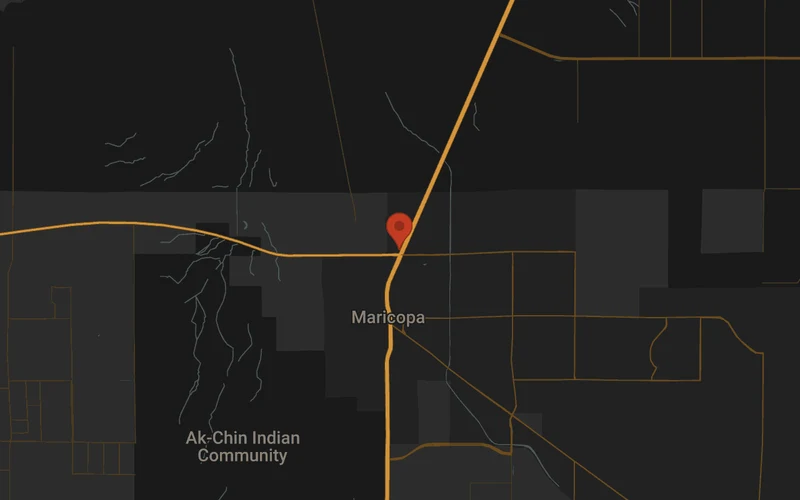
SR-347 carries more than 31,000 vehicles a day into the I-10 interchange, and it does it on a two-lane road with no median barrier. Commercial trucks make up a growing share of that traffic as distribution and logistics operations expand across Maricopa and Casa Grande. When a loaded semi meets a passenger car head-on with only a painted center line between them, the outcome almost never favors the smaller vehicle.
A truck hit you, or someone in your family, on SR-347, at the I-10 interchange, or anywhere in Maricopa. This page explains what makes these cases different, which records we pull, and why it matters where the carrier is actually based.
Call us at (520) 217-8821. The consultation is free. We don't charge unless we recover.
A Two-Lane Road Wasn't Built for This Truck Traffic
The SR-347 crash corridor investigation documents 967 crashes on this road between Maricopa City and I-10 over five years, including 15 fatal crashes. Commercial vehicles are a meaningful part of that traffic mix, consistent with the distribution and logistics growth across the Maricopa and Casa Grande areas. On a two-lane highway with no median separating opposing traffic, every oncoming truck carries head-on risk that a divided highway doesn't.
That risk isn't theoretical. On January 15, 2026, a crash involving a semi truck and a motorcyclist near Cement Plant Road shut down northbound SR-347 for hours and killed the motorcyclist. Local outlets covered it because it's the only route out of town: when SR-347 closes, Maricopa doesn't have a quick detour. The dispatch on that crash covers what that morning looked like for the thousands of commuters stuck behind it.
The I-10 Interchange: Where the Truck Problem Concentrates
The SR-347 and I-10 interchange investigation found that speed differential drives most serious crashes here. Drivers approach the merge at the posted 65 mph, then queue backup drops that to a crawl within a few hundred feet. Heavy trucks need more distance to stop and more room to change lanes than the interchange geometry gives them during peak volumes, and a rear-end at a 40-mph speed differential with a truck in the chain becomes a multi-vehicle event fast.
SR-347 also feeds directly into one of the Southwest's primary freight corridors. I-10 through this stretch moves containers and freight between Southern California and points east, and the Maricopa County truck crash data shows regional warehouse and distribution growth, including Union Pacific's expanded Casa Grande rail yard, feeding more of that freight onto the highway. A real share of the trucks reaching Maricopa run interstate routes under out-of-state motor carrier authority, which is why the carrier's registration and insurance filings matter as much as the crash report itself.
South of town, SR 84 meets I-8 near Stanfield. Our I-8 truck crash investigation found the 29 miles from that exit to I-10 at Casa Grande carried 7 of I-8's 21 truck crash deaths from 2015 to 2024, and trucks were in 44% of the injury crashes there.
Chameleon Carriers and Why the Carrier's Record Matters
Not every trucking company with a clean-looking safety record earned it honestly. Our chameleon carriers investigation found that some carriers dissolve after piling up violations, then reincorporate under a new name and DOT number to erase the history. If the truck that hit you is running under a carrier that restructured recently, its clean FMCSA record on paper may be hiding a worse one under a previous name. We pull that history regardless of where the carrier is registered.
Ron DeBrigida, J.D. reviews the legal framework below. Under respondeat superior, the carrier is generally liable for its driver's actions within the scope of employment. Negligent hiring, inadequate maintenance, and FMCSA violations create separate carrier liability that doesn't depend on where the truck came from.
What We Pull on Every Maricopa Truck Crash Case
The FMCSA carrier safety record shows out-of-service rates, crash history, and inspection violations from the SAFER database. The driver qualification file documents CDL status, medical certification, and drug test results. Federal law requires electronic logging devices on most commercial trucks, and that data establishes whether the driver was within legal hours at the time of the crash. We also pull the truck's event data recorder, similar to a car's black box, for pre-crash speed and braking, and the ADOT crash report for the specific SR-347 or I-10 segment.
Carriers deploy rapid-response teams to serious crashes within hours, and those teams aren't there to help you. We send spoliation letters the same day we take a case, putting the carrier, its ELD provider, and its insurer on notice that the electronic evidence has to be preserved. Without that letter, dispatch records and ELD data can be overwritten before you've left the hospital.
Arizona Law and Pinal County Jurisdiction
The statute of limitations is two years from the crash date under ARS 12-542, and two years from the date of death under ARS 12-542(2) for wrongful death. Arizona's pure comparative fault rule under ARS 12-2505 reduces your recovery by your fault percentage but never eliminates it, which matters because trucking defense teams are trained to push that percentage as high as possible.
The City of Maricopa sits in Pinal County, not Maricopa County. A lawsuit for a crash inside city limits goes to Pinal County Superior Court in Florence. Crashes on SR-347 north of the city or on I-10 itself may fall under Maricopa County jurisdiction depending on the exact milepost, and our team files in both courts. If ADOT's design or maintenance of SR-347 contributed to the crash, a notice of claim under ARS 12-821.01 has to go in within 180 days, a shorter and separate deadline from the two-year lawsuit window.
What It Costs
Nothing upfront. We handle every Maricopa truck crash case on contingency. You don't pay unless we recover. Truck cases involve real upfront cost, FMCSA record pulls, carrier tracing, and sometimes crash reconstruction, and we front all of it.
Call (520) 217-8821 or use the intake form. Hablamos espanol.
All Injury Cases in Maricopa
Truck crashes are one part of what we handle in Maricopa. See the Maricopa injury law overview for car crashes, motorcycle cases, premises liability, and other case types at our office at 21300 N. John Wayne Parkway. For truck accident cases across Arizona, the Arizona truck accident overview covers statewide law and carrier liability patterns.
Frequently asked questions
How long do I have to file a truck accident lawsuit in Maricopa?
Can I sue the trucking company and not just the driver?
Does it matter if the truck that hit me was from out of state?
What records do you pull on a Maricopa truck crash case?
Can I recover if I was partly at fault for the crash?
Does the crash location matter for which court handles my Maricopa case?
What does it cost to hire AZ Law Now for a truck crash case in Maricopa?
Attorney advertising. Past results do not guarantee a similar outcome. Every case is different and is decided on its own facts.
WHAT CLIENTS SAY
In their words
I cannot say enough good things about AZ Law Now Injury Attorneys. When we felt like no one was listening and didn’t know where else to turn, their team stepped in and truly made a difference for our family. Not only were they compassionate, responsive, and professional throughout the entire process, but they also took on our case pro bono when law enforcement failed to prosecute. That level of integrity and commitment speaks volumes about who they are and what they stand for. They treated us with respect, kept us informed, and made sure we felt heard every step of the way. During the most stressful time in our lives, they gave us clarity, support, and hope. We are incredibly grateful for their dedication and highly recommend AZ Law Now Injury Attorneys to anyone in need of an injury attorney who genuinely cares about their clients.
Thanks to Brendan and his team for helping me in a hard time. Dealing with your own insurance who refuses to help you out can get mentally exhausting. Stephanie was always so kind, helpful and gentle with the whole process. Even better it took way less time than I was expecting and got way more than I would have got from Kemper insurance on my own. Highly recommend! Thanks again
Last year my car got totaled i was so stressed and because im young i had no idea what to do. Im so lucky to have run into Brendan Franks. He quite literally took over everything for me not only helped with my injury and how to go about it but also helped when i expressed my stress about my rental car and about the information getting to my insurance provider. He kept constant communication with me keeping me updated on any movement in the process In the end it was so quick and stressless i feel very blessed to have been represented by Brendan Franks and i would 100% recommend him for anyone in any type of situation:)
Past results do not guarantee future outcomes.
You get answers.
Review My CaseFree, no obligation. Available 24/7. No fees unless you recover. Case costs are separate, and we'll walk you through them before you sign.
Millions recovered · 5.0 rating across 200+ Google reviews