Car Accident Lawyer in Phoenix, AZ
38,210 crashes in Phoenix in 2024. We know the corridors, the ADOT data, and the city's own road-safety records, and we use them to build car accident cases. Contingency fee. No charge unless we recover.
Free, no obligation. Available 24/7.
- Millions Recovered for Arizona families
- 5.0 ★ 176 verified Google reviews
- No Fees Unless you recover
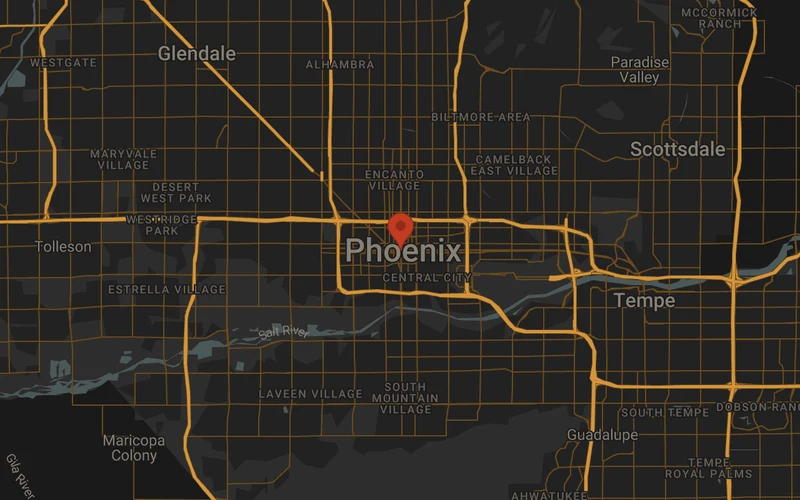
Phoenix recorded 38,210 crashes in 2024. Two hundred ninety-nine were fatal. Three hundred seventy-nine people died. That's more than one person killed on Phoenix roads every day for a year, and Maricopa County accounts for 73 percent of every crash in Arizona.
If you were in a car crash in Phoenix, on I-10, I-17, Loop 101, Loop 202, or one of the wide arterials that carry the city's daily traffic, this page explains what makes Phoenix cases different, which Arizona statutes apply, and what we investigate when we take one.
Call us at (602) 960-6600 or use the intake form. The consultation is free. We don't charge unless we recover for you.
The Crash Reality on Phoenix Roads
Behind every Phoenix crash case is a statewide pattern, and the numbers are not abstract. In 2024, 1,228 people died on Arizona roads. That's 3.36 deaths a day, one life lost every 7 hours and 9 minutes. Across the year there were 121,107 crashes, and 54,426 people were injured. Those are the Arizona Department of Transportation's official 2024 Crash Facts, and they're the baseline we work from on every case.
Maricopa County carries the heaviest share of that toll, and Phoenix sits at the center of it. The arithmetic is why crash investigation matters. When the records show a hazard was already known, that changes what a case is worth pursuing.
Phoenix's Most Dangerous Intersections
The Maricopa Association of Governments studied where crashes concentrate across metro Phoenix using 2018 to 2022 data, reported through KJZZ. The finding is blunt: about 6 in 10 injury crashes and roughly 4 in 10 traffic deaths in the region happen at intersections. Not on the freeways. At the cross streets people drive through every day.
The same analysis ranks the highest-risk intersections in the metro area. The top of the list, in order, looks like this:
- 67th Avenue and McDowell Road (Phoenix)
- 51st Avenue and Camelback Road (Glendale)
- 19th Avenue and Peoria Avenue (Phoenix)
- 67th Avenue and Thomas Road (Phoenix)
- 67th Avenue and Indian School Road (Phoenix)
- 83rd Avenue and Indian School Road (Phoenix)
- Cave Creek Road and Sweetwater Avenue (Phoenix)
- 51st Avenue and Thomas Road (Phoenix)
Nine of the ten highest-risk intersections sit on the west side of the valley, on the wide arterials that move the region's traffic. We mapped the full picture in the cornerstone Phoenix deadliest intersections data report, with the verified rankings and the public records behind them.
Red-Light Running
Disregarding a traffic signal is one of the deadliest things a driver can do at an intersection. ADOT recorded 5,891 crashes statewide in 2024 where a driver ran a red light or otherwise disregarded the signal. Sixty-four of those crashes were fatal. When a driver blows a red and T-bones a car with the right of way, the person who was following the law is the one who pays for it, and the crash report usually shows exactly that.
The City Knew, and the Fix Is Years Away
Phoenix doesn't lack the data. It has it, and it has acted on the worst corridor. In December 2023, the U.S. Department of Transportation committed a $24.96 million federal grant to rebuild the Indian School Road corridor through its Safe Streets and Roads for All program. The City's own project page says construction isn't anticipated to begin until 2028.
That gap matters for anyone hurt on that road in the meantime. We documented the full timeline in the investigation into Phoenix's deadliest intersections, including the city's own ranking and the year the work is scheduled to start. When a crash happens at a location a public agency already flagged as dangerous, that record is evidence the hazard was known.
Phoenix Roads Were Built for Throughput, Not Safety
The city's deadliest car crashes don't cluster on the freeways. They cluster on the arterials, seven lanes wide, with continuous turn lanes and half-mile gaps between signals. Roads designed to move cars fast, not to keep the people in them alive. That's the same west-side arterial network the regional intersection ranking is built on, and it's why so many serious Phoenix crashes start at a signal that should have protected the people going through it.
The Freeway Network
I-10, I-17, Loop 101, Loop 202, SR-51, and US-60 give Phoenix more freeway miles per capita than most metro areas, and each corridor has its own crash profile. Speeds are higher, truck volume is heavier, and the injuries are more severe. I-10 through the West Valley runs heavy commercial truck traffic. When a passenger car at freeway speed gets struck by a truck, the physics are brutal.
Wrong-way and impaired driving make the freeways worse after dark. Maricopa County recorded 3,544 alcohol-related crashes in 2024, 64 percent of the state total. When an impaired driver causes a crash, Arizona's dram shop law may also hold the bar or restaurant that over-served them liable.
Arizona Car Accident Law That Applies in Phoenix
Ron DeBrigida, J.D. reviews this section. These are the statutes that come up in every Phoenix car crash case.
Statute of limitations (ARS 12-542). Two years from the date of the crash to file a personal injury lawsuit. For wrongful death, two years from the date of death under ARS 12-611. If a government road or signal defect contributed, ARS 12-821.01 requires a notice of claim within 180 days of the injury. That 180-day clock is the one people miss.
Pure comparative fault (ARS 12-2505). Arizona doesn't bar recovery if you share some fault. Your compensation gets reduced by your fault percentage. Even at 49 percent fault, you recover 51 percent of your damages. Insurance adjusters are trained to inflate that number. We counter it with crash reconstruction and the ADOT crash report.
Minimum insurance limits (ARS 28-4009). Arizona requires $25,000 per person, $50,000 per accident in bodily injury liability, and $15,000 in property damage. Many Phoenix drivers carry the minimum. We check for underinsured motorist coverage on every case and look at all potentially liable parties, including any government entity responsible for road design.
At-fault state. Arizona doesn't use no-fault auto insurance. The at-fault driver's liability policy pays your damages. You don't file with your own carrier first unless the other driver is uninsured or you're seeking collision coverage.
What We Investigate on Phoenix Car Crash Cases
Every case starts with evidence. Here's what we pull on a typical Phoenix car crash.
ADOT crash report and signal data. The Arizona Crash Information System records intersection-level data, including officer-coded contributing factors and crash diagrams. For crashes at signalized arterials or freeway interchanges, we pull the full report and, where available, the city traffic signal timing logs.
Surveillance and traffic camera footage. Businesses along the major arterials and freeway frontage roads run exterior cameras. Gas stations, retail centers, and distribution facilities all have coverage. We send spoliation letters within 24 to 48 hours of intake. Footage overwrites on 30-day cycles.
Commercial vehicle records. If a truck was involved, we pull the carrier's FMCSA safety rating, the driver's qualification file, electronic logging device data, and hours-of-service records. Trucking companies send rapid-response teams to crash scenes within hours. We match that speed.
Road condition and prior-notice documentation. If intersection geometry, signal timing, drainage, or surface defects contributed, we document the condition and check for prior complaints, safety studies, or repair orders on that segment, the kind of record that turns a known hazard into a claim.
Damages in Phoenix Car Crash Cases
Arizona has no cap on compensatory damages in personal injury cases. Economic damages (medical bills, lost wages, future care costs) and non-economic damages (pain and suffering, loss of enjoyment of life, emotional distress) are evaluated without an arbitrary limit.
What you can recover depends on the severity of your injuries, how the crash affects your ability to work, and the at-fault party's coverage. If the driver was underinsured, we look at your own policy, any employer liability if a commercial vehicle was involved, and any third-party liability from road conditions.
Punitive damages can apply in cases involving reckless or intentional conduct, a drunk driver, or a carrier who knowingly put an unqualified driver on the road. Arizona doesn't cap those either.
What It Costs to Hire Us
Nothing upfront. We handle every Phoenix car crash case on contingency.
You don't pay us unless we recover money for you. No hourly rate. No retainer. Case costs may apply in some circumstances, and we discuss those in the intake call before we start. If we take your case and don't win, you owe us nothing for attorney fees.
Call (602) 960-6600 or use the intake form below. Hablamos espanol.
All Injury Cases in Phoenix
Car crashes are one part of what we handle in Phoenix. See the Phoenix injury law overview for pedestrian, truck, motorcycle, wrongful death, and other case types across Maricopa County. For car accident law statewide, the Arizona car accident overview covers the statutes and crash patterns that apply across the state.
Frequently asked questions
How long do I have to file a car accident claim in Phoenix?
What are the most dangerous intersections for car crashes in Phoenix?
Does Arizona require me to file with my own insurance first?
What if I was partly at fault for the Phoenix crash?
What is the minimum car insurance required in Arizona?
What does it cost to hire AZ Law Now for a Phoenix car crash case?
What should I do after a car accident in Phoenix?
How dangerous are Phoenix intersections compared to the rest of the road?
Sources & references
- 2024 Motor Vehicle Crash Facts for the State of Arizona. Arizona Department of Transportation (2025) https://azdot.gov/sites/default/files/2025-07/2024-Crash-Facts.pdf
- Traffic fatalities in Arizona dip for second year in a row. Arizona Department of Transportation (2025) https://azdot.gov/news/traffic-fatalities-arizona-dip-second-year-row
- These are the most dangerous intersections in metro Phoenix. KJZZ, reporting Maricopa Association of Governments intersection risk analysis, 2018 to 2022 data (2024) https://kjzz.org/content/1864266/these-are-most-dangerous-intersections-metro-phoenix
- Indian School Road Safety Corridor (ReVISIONing Indian School Road). City of Phoenix Street Transportation Department https://www.phoenix.gov/streets/isr91-39ave
- Safe Streets and Roads for All (SS4A) Grant Program, FY2023 awards. U.S. Department of Transportation (2023) https://www.transportation.gov/grants/SS4A
Attorney advertising. Past results do not guarantee a similar outcome. Every case is different and is decided on its own facts.
WHAT CLIENTS SAY
In their words
After my car accident, I was overwhelmed and unsure of what to expect, but working with this law firm was the best decision I could have made. They were compassionate, attentive, and incredibly thorough. Every question I had was answered, and I never felt like “just another case.”
Last year my car got totaled i was so stressed and because im young i had no idea what to do. Im so lucky to have run into Brendan Franks. He quite literally took over everything for me not only helped with my injury and how to go about it but also helped when i expressed my stress about my rental car and about the information getting to my insurance provider. He kept constant communication with me keeping me updated on any movement in the process In the end it was so quick and stressless i feel very blessed to have been represented by Brendan Franks and i would 100% recommend him for anyone in any type of situation:)
AZ Law Now was incredible after my accident. They handled everything, from the insurance companies to my medical bills, and made sure I got the compensation I deserved. They were always available, explained things clearly, and fought hard for my case. Highly recommend!
Past results do not guarantee future outcomes.
You get answers.
Review My CaseFree, no obligation. Available 24/7. No fees unless you recover. Case costs are separate, and we'll walk you through them before you sign.
Millions recovered · 5.0 stars across 176 Google reviews